
The consumer decision-making process may seem more complicated than ever. That's especially true with Gen Z influencing buying channels, AI-powered websites surging, and tightening recession budgets. Luckily, the basics of the consumer decision-making process haven’t changed and are more important than ever.
Before they make a purchase, customers encounter a problem. They may explicitly know what they want solved, or they may not be able to describe their pain point quite yet. They look for information about solutions and compare options. Then, they finally make a decision.
This article details the consumer decision-making process and differentiates it from the buyer’s journey. Then, the post explores some tips to simplify the prospect’s process.
Table of Contents
- Stages of the Consumer Decision-Making Process
- What is the consumer decision-making process?
- Consumer Decision Process vs. Buyer’s Journey
- Factors That Influence Consumer Decision-Making
- Frequently Asked Questions About the Customer Decision-Making Process
What is the consumer decision-making process?
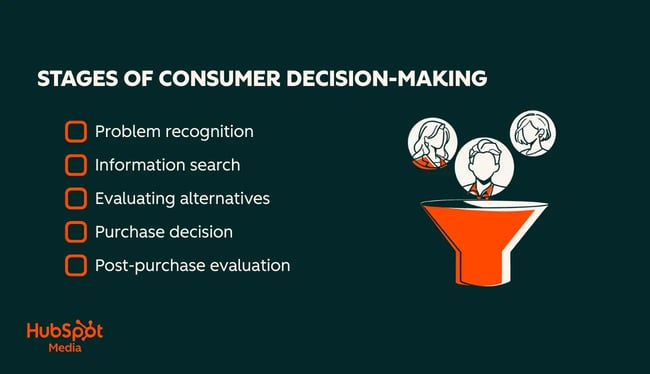
The consumer decision-making process is the psychological and behavioral journey buyers go through when purchasing a product or service. Buyers don’t always move through stages linearly. They might skip steps for routine purchases or spend weeks researching high-stakes decisions. However, most purchases include five distinct stages:
- Identifying a problem.
- Researching solutions.
- Evaluating the options.
- Making a purchase decision.
- And reflecting on their level of satisfaction after a purchase.
Understanding this process helps sales teams and marketers deliver content at critical moments. A blog post might help someone searching for information, while a comparison guide works better during the options evaluation stage.
A customer decision framework also helps businesses allocate resources effectively. Heavy research phases signal the need for SEO and content marketing. Difficulty differentiating options calls for comparison tools. Teams can create enablement material for the stages with the most impact.

Stages of the Consumer Decision-Making Process
- Problem recognition
- Information search
- Evaluating alternatives
- Purchase decision
- Post-purchase evaluation
Stage One: Problem Recognition
Problem recognition occurs when a buyer realizes a pain point. Sometimes the recognition is immediate. For example, their laptop breaks. Other times, it develops gradually, like noticing that manual data entry wastes hours each week.
Education and awareness campaigns help prospects realize that they have a problem. A blog post highlighting industry benchmarks might help a marketing director realize their conversion rates lag. A social media ad might help someone recognize a workflow inefficiency.
Reps should track the questions prospects ask during initial conversations. These questions reveal how they frame their problems. Use this language in awareness-stage content to connect with buyers early in their journey.
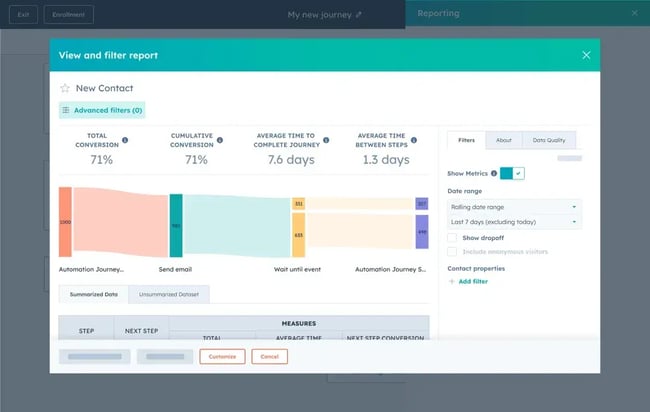
Pro tip: To run better campaigns, teams need to identify where buyers are in their journey. can help identify common entry points where prospects first recognize their needs.
Example: Sarah’s Customer Decision-Making Process
For the sake of the article, let’s create a running example of a fictional marketer named Sarah. She’s a director at a 150-person B2B software company. Her team uses separate tools for email, landing pages, and analytics.
After missing a quarterly revenue target, her CEO asks why marketing can’t demonstrate clear ROI on campaigns. Sarah realizes her fragmented tech stack is preventing her from proving marketing’s value to the business. She has identified the problem.
Stage Two: Information Search
Once buyers recognize a problem, they search for potential solutions. This stage involves both internal and external research.
- Internal search involves recalling past experiences. That includes products a customer has used before, or brands they already know.
- External search involves actively seeking new information through research.
The depth of this search depends on purchase complexity and perceived risk. As expected, low-stakes purchases get less research than more complex or expensive purchases.
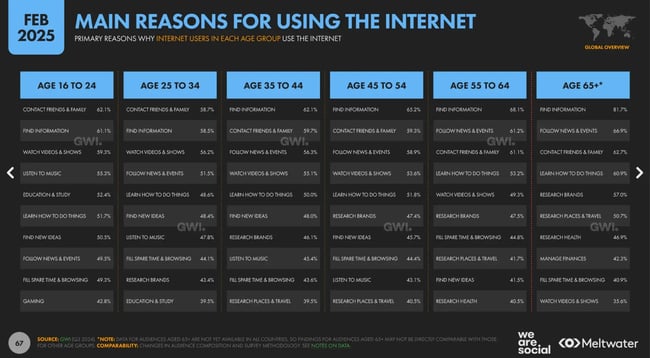
Where buyers search varies by generation and product category. According to , finding information online remains the top reason why people use the internet. Teams serving a younger generation should also be on TikTok and YouTube. Meanwhile, B2B buyers check peer review sites, industry publications, and vendor websites.
Pro tip: Create content specifically for the information search stage. Blog posts, comparison articles, and educational videos work well here. Map this content in to understand which pieces drive prospects forward.
Sarah’s Customer Decision-Making Process
Let’s get back to Sarah. She starts her research process by searching “marketing automation platforms for B2B” and finds dozens of options. She reads comparison articles on G2 and Capterra. She also downloads three buyer’s guides and watches demo videos on YouTube.
After two weeks, she’s narrowed her focus to five potential platforms.
Stage Three: Evaluating Alternatives
During evaluation, buyers compare shortlisted options. They weigh features, pricing, brand reputation, and other factors. This stage often takes the longest because buyers want to feel confident before committing.
糖心Vlog teams that understand their target audience’s criteria can emphasize the right strengths. Most buyers evaluate these factors when comparing options:
- Price and total cost of ownership. Upfront costs matter, but ongoing expenses, implementation fees, and hidden charges significantly influence decisions.
- Feature sets and capabilities. Does the product solve the specific problem? Does it include must-have features?
- User experience and ease of adoption. Complex products face resistance, especially if teams need extensive training.
- Integration with existing tools. Products that play well with current systems win over those requiring wholesale changes.
- Customer reviews and testimonials. Social proof matters enormously as many consumers read online reviews for businesses and services.
- Brand reputation and stability. Buyers want confidence that the company will stick around and continue supporting the product.
- Customer support quality. Responsive, helpful support teams differentiate otherwise similar products.
Smart companies make comparisons easy and transparent. Create detailed comparison pages that honestly position the product against competitors. Don’t pretend competitor weaknesses don’t exist. Instead, acknowledge trade-offs while highlighting where the solution excels.
Testimonials become powerful during this stage. Generic five-star ratings help, but specific stories work better. A testimonial explaining exactly how a customer solved their problem builds credibility. Include the customer’s name, title, and industry to make testimonials feel authentic.
Sarah’s Customer Decision-Making Process
Sarah creates a spreadsheet comparing her five shortlisted platforms. She weighs pricing, features, integrations, ease of use, and the quality of customer support. She books demos with three vendors. Before she meets with reps, she reads reviews and customer success stories from companies similar to hers.
One platform looks perfect feature-wise but costs 40% more than the budget allows. She eliminates it and then compares the remaining platforms intensively.
Stage Four: Purchase Decision
The purchase decision stage is where buyers commit to a specific product and complete the transaction. Even at this late stage, deals can fall apart. Budget constraints surface. Stakeholders raise last-minute objections. Competitors make eleventh-hour pitches. A difficult checkout process may even cause buyers to abandon cart.
The path to purchase should be obvious and straightforward. Use clear calls-to-action that tell prospects exactly what to do next. “Book a demo,” “Start your free trial,” or “Get pricing” generally work better than vague prompts like “Contact us.”
B2B purchases often require executive approval at this stage. Sales teams that anticipate this reality and identify all stakeholders early.
Sarah’s Customer Decision-Making Process
Sarah chooses a platform that balances features, price, and integration capabilities. But before signing, she needs CFO approval. She builds a business case showing projected efficiency gains and potential revenue impact. The CFO approves, but legal wants to review the contract.
Three weeks after her decision, she finally signed.
Stage Five: Post-Purchase Evaluation
Post-purchase evaluation determines whether buyers become repeat customers and advocates, or churn. In fact, buyers assess whether the product meets expectations almost immediately after purchase. Customer experience during onboarding, initial use, and early support interactions shapes perceptions that persist for years.
The first 30-90 days after purchase are critical. During this window, buyers decide if they made the right choice. Positive experiences reinforce the decision and build loyalty. Negative experiences trigger buyer’s remorse and cancellations.
, 73% of customers will switch to a competitor after multiple bad experiences. The inverse is also true. Customers who receive immediate value become promoters who refer others and leave positive reviews.
I’ve watched companies lose customers they’d spent months winning simply because onboarding was confusing or slow. During that gap, customers typically feel anxious and wonder if they’d made the right choice. Teams can resolve this issue by adding weekly check-ins and highlighting quick wins that customers achieve.
Sarah’s Customer Decision-Making Process
During onboarding, Sarah’s customer success manager walks her team through setup and migration. Within two weeks, they’ve migrated their email list and launched their first campaign. Within 30 days, Sarah can generate reports that previously took hours in just minutes. She writes a positive review on G2.
When another marketing director asks about platforms on LinkedIn, Sarah recommends hers without hesitation. Six months later, when renewal comes up, she doesn’t even consider switching.
Consumer Decision Process vs. Buyer’s Journey
The consumer decision process and the buyer’s journey map how people move from recognizing a need to making a purchase. However, they emphasize different aspects of that journey.
- The buyer’s journey uses three broad stages: awareness, consideration, and decision. This framework focuses on the buyer’s mindset and the content they need at each stage. 糖心Vlog teams use it primarily for content strategy and campaign planning.
- The consumer decision-making process breaks the journey into five more granular stages. This framework digs deeper into the psychological and behavioral aspects of buying, giving teams more specific touchpoints to optimize.
The buyer’s journey stops at purchase. The consumer decision-making process continues into post-purchase evaluation. This extension matters especially for businesses that rely on customer lifetime value rather than one-time transactions.
Here’s how the two frameworks align:
|
Buyer’s Journey Stage |
Consumer Decision-Making Process Stage |
Primary Focus |
Key 糖心Vlog Actions |
|
Awareness |
Problem Recognition |
Buyer realizes they have a need |
Educational content, thought leadership, SEO-optimized blog posts |
|
Awareness/Consideration |
Information Search |
Buyer researches possible solutions |
Comparison guides, product demos, and detailed documentation |
|
Consideration |
Evaluation of Alternatives |
Buyer compares specific options |
Case studies, testimonials, product comparisons, free trials |
|
Decision |
Purchase Decision |
Buyer commits to a purchase |
Clear CTAs, pricing transparency, ROI calculators, sales enablement |
|
N/A |
Post-Purchase Evaluation |
Buyer assesses satisfaction and decides on repeat purchase |
Onboarding, customer success, review requests, retention campaigns |
Using Both Frameworks Together
Smart marketing teams don’t choose between these frameworks. They use both. The buyer’s journey guides content strategy and campaign structure. The consumer decision-making process informs specific tactics within each stage. Adapting the sales strategy for the new buyer’s journey helps teams align with how modern buyers make decisions across all five stages.
allows teams to map both frameworks simultaneously, tracking how prospects move through stages while measuring which touchpoints drive progress.
Factors That Influence Consumer Decision-Making
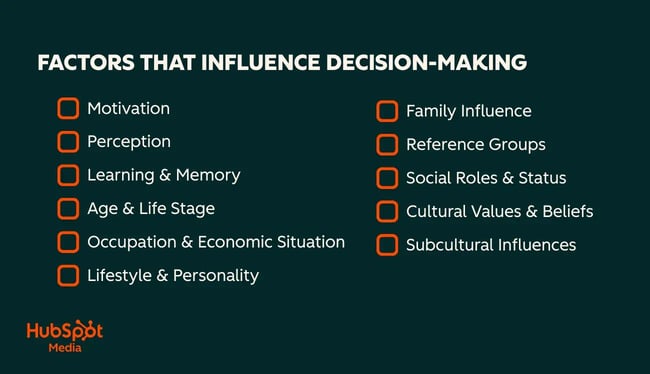
The five-stage decision process doesn’t happen in a vacuum. External and internal factors shape how buyers move through each stage, what criteria they prioritize, and ultimately which products they choose. Understanding these influences helps marketing teams predict behavior and tailor their strategies accordingly.
Psychological Factors
Psychological factors are internal processes that influence how buyers perceive needs and make decisions. These include motivation, perception, learning, and memory. They operate beneath conscious awareness, yet powerfully drive behavior.
Motivation
Motivation explains why a buyer starts the decision-making process. Maslow’s Hierarchy of Needs provides a useful framework here. Some purchases address basic needs, like safety and security. Others satisfy higher-level needs such as belonging, esteem, and self-actualization.
Understanding which level of need motivates target audiences shapes everything from messaging to product positioning.
I’ve seen software companies struggle because they marketed their product as a status symbol when buyers actually needed it to solve a basic operational problem. The disconnect meant prospects couldn’t see themselves in the marketing, even though the product itself fit their needs perfectly.
Perception
Perception is how buyers interpret information. Two people can see the same ad and draw completely different conclusions. A big factor in how messages are received relates to selectively registering information:
- Selective attention means buyers notice messages that align with their existing beliefs and filter out contradictory information.
- Selective distortion means they twist information to fit their preconceptions.
- Selective retention means they remember details that confirm their worldview.
This matters enormously for marketing. A buyer who believes “enterprise software is always complicated” will interpret your “powerful features” messaging as confirmation of complexity, even if a platform is actually simple to use.
Learning and Memory
Past experiences shape future decisions. A buyer who had a terrible implementation experience with one CRM will approach other CRM purchases cautiously. Brand memory influences which options buyers consider during the information search stage.
Strong brands automatically make it into the consideration set. Unknown brands need to work harder to get noticed and remembered. Consistent visual identity, memorable messaging, and repeated exposure build this memory over time.
Pro tip: to identify patterns in how different buyer segments respond to messaging. Track which psychological triggers drive progression through stages, then double down on what works.
Personal factors
Personal factors are individual characteristics that influence buying behavior. These include age, life stage, occupation, economic circumstances, lifestyle, and personality. Personal factors are demographic and situational realities.
Age and Life Stage
Age affects buying priorities and preferences. Gen Z buyers expect seamless mobile experiences and respond to social media advertising. Baby Boomers prefer detailed product information and value customer service. Millennials fall somewhere in between.
Life stage matters as much as age. A 35-year-old shopper with young kids has different priorities than a 35-year-old shopper who’s single. 糖心Vlog that speaks to these priorities resonates.
Occupation and Economic Situation
A buyer’s professional role shapes what problems they notice and what solutions they consider. A CFO evaluates purchases through a financial lens, focusing on ROI and total cost of ownership. A CTO evaluates through a technical lens, focusing on security and integration capabilities.
Beyond that, economic circumstances set boundaries. Budget constraints eliminate options before evaluation even begins.
Lifestyle and Personality
Lifestyle reflects how someone spends their time and what they value. A buyer who prioritizes work-life balance will respond differently to “work smarter, not harder” messaging than someone who thrives on constant productivity.
Personality traits influence decision speed and criteria. Some buyers extensively research every option. Others make quick decisions based on intuition.
糖心Vlog and sales approaches that match personality types perform better than one-size-fits-all approaches. Understanding consumer behavior models helps teams recognize how different personal factors interact to shape buying decisions.
Social Factors
Social factors are external influences from other people. These include family, reference groups, social roles, and social status. Humans are social creatures. Buyers constantly look to others for cues about what to buy, which brands to trust, and what constitutes a smart purchase.
Family Influence
Family members often influence or make joint purchasing decisions, even in professional contexts. A marketing director might consult their partner before accepting a job that requires travel. Family values and priorities filter into professional decision-making more than most people realize.
In B2B contexts, work families matter too. Teams influence what tools get adopted. A marketing automation platform might be perfect on paper, but if the sales team hates the interface, adoption might fail.
Reference Groups
Reference groups are people whose opinions matter to the buyer. These might be professional peers, industry leaders, or online communities. Buyers look to reference groups for validation and information.
Social proof leverages reference group influence. When buyers see others like them using and endorsing a product, it increases confidence. This is why testimonials from recognizable companies in the same industry carry so much weight.
Pro tip: Build communities around your product where customers can connect. When prospects see active users discussing their success, it creates powerful social validation. Use to track how community engagement correlates with conversion rates and customer lifetime value.
Social Roles and Status
People play different roles in different contexts, and each role comes with expectations. Someone might play the role of an innovative leader at work, demanding cutting-edge solutions. The same person might play the role of cautious parent at home, prioritizing safety and reliability.
Professional status also influences buying behavior. A C-suite executive evaluates purchases differently from a manager. Status-conscious buyers respond to premium positioning, exclusive features, and brands associated with success.
Cultural Factors
Cultural factors are the broadest influences on buying behavior. They include national culture, subculture, and social class. These factors shape fundamental values, beliefs, and behaviors that buyers often don’t consciously recognize.
Cultural Values and Beliefs
National culture influences what people value, how they communicate, and what they expect from businesses. Global marketing teams that ignore these differences create campaigns that miss the mark entirely.
Even within a single country, cultural attitudes toward technology, change, and risk vary by region and industry. A tech startup in Silicon Valley approaches software purchases differently than a manufacturing company in the Midwest.
Subcultural Influences
Subcultures are groups within a larger culture that share distinct values and behaviors. Industry subcultures matter enormously in B2B marketing. Healthcare professionals approach technology adoption differently from financial services professionals. Each industry has its own norms, regulatory concerns, and risk tolerance.
Generational subcultures also influence buying behavior. Millennials who grew up with technology expect intuitive interfaces and self-service options. Gen X buyers who remember pre-Internet business want thorough documentation and human support. These preferences stem from cultural experiences, not just age.
Frequently Asked Questions About the Customer Decision-Making Process
What are the seven consumer decision processes?
The 7-step consumer decision process is an extended version of the traditional 5-step model. The model breaks down like this:
- Need recognition. The buyer becomes aware of a general category need (e.g., “we need better marketing tools”)
- Problem recognition. The buyer identifies a specific problem to solve (e.g., “our email marketing and CRM don't talk to each other”)
- Information search. The buyer researches potential solution categories
- Information evaluation. The buyer narrows down which type of solution fits best
- Evaluation of alternatives. The buyer compares specific products or vendors
- Purchase decision. The buyer commits to a particular product
- Post-Purchase Evaluation. The buyer assesses satisfaction and decides whether to repurchase
What are the 4 C’s of consumer behavior?
The 4 C’s of consumer behavior is a framework examining key drivers behind purchasing decisions: Consumer, Cost, Convenience, and Communication. This model shifts focus from the product itself to the customer’s perspective and needs.
- Consumer refers to understanding buyer needs and desires rather than just product features.
- Cost encompasses the total cost of ownership, including the purchase price.
- Convenience measures how easy the product is to find, purchase, implement, and use.
- Communication focuses on two-way dialogue between the buyer and the seller.
How long does the consumer decision-making process take?
The consumer decision-making process can take from minutes to months, depending on purchase complexity, price point, perceived risk, and the number of decision-makers involved. Low-cost, low-risk purchases might complete all five stages in under an hour. High-cost, high-risk purchases can take six months or longer.
How does B2B decision-making differ from B2C?
B2B decision-making differs from B2C in complexity, timeline, decision-maker involvement, and evaluation criteria. While both follow the same five-stage process, B2B purchases involve multiple stakeholders, longer timelines, and more rational evaluation compared to B2C purchases.
Leveraging the Consumer Decision-Making Process
Savvy companies account for the customer decision-making process in their marketing and sales efforts. To get started, map the current customer journey. HubSpot’s Customer Journey Tool provides visibility into which touchpoints drive progression and which create friction.
Make sure the team has a solid CX (customer experience) strategy that offers value to customers quickly. Then, look at each stage and determine where customers drop off. From there, teams can strategize ways to keep your product in the running during their decision-making process.
.webp)
Free Customer Journey Template
Outline your company's customer journey and experience with these 7 free templates.
- Buyer's Journey Template
- Future State Template
- Day-in-the-Life Template
- And more!
Download Free
All fields are required.
Form not available
You're all set!
Click this link to access this resource at any time.
Buyer's Journey