By now, most marketers know AI can help them improve their workflows. But knowing AI is valuable and actually implementing it successfully in a business use case are two different things.
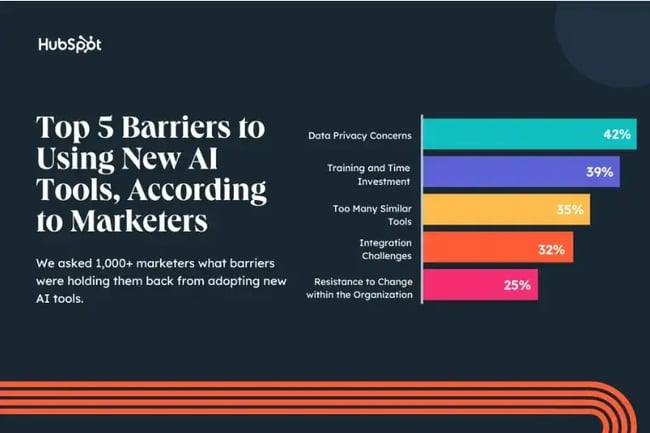
Several AI challenges restrict marketers from adopting AI tools. According to the , one of the top challenges of artificial intelligence is data privacy concerns, with 42% marketers saying it prevented their team from adopting AI tools. It was followed by training and time investment (39%), too many tools (35%), integration challenges (32%), and resistance to change (25%).
In this post, we'll cover the top AI challenges that marketers face when implementing AI and how to manage them. For teams looking to overcome AI implementation challenges, using HubSpot’s tools is a good first step.
Table of Contents
The 9 Biggest AI Challenges Marketers Face in 2026
If tools are to add value to the company and employees, companies must solve three AI challenges: technical, ethical, and organizational.
- The technical challenges involve data privacy risks and a lack of competency and transparency in AI tools.
- Ethical challenges include bias and discrimination in results, the propagation of misinformation, and IP rights violations.
- Organizational challenges include job security issues, high upskilling costs, and over-reliance on automation.
|
Technical Challenges |
Ethical Challenges |
Organizational Challenges |
|
Data privacy risks |
Bias and discrimination |
Weak job security |
|
Lack of competency |
Misinformation |
High upskilling costs |
|
Lack of privacy |
IP rights violation |
IP rights violation |
Technical AI Challenges
Data Privacy Risks
AI tools process massive datasets to generate results. But one of the biggest AI adoption challenges remains data privacy and related security risks.
Most AI companies have access to sensitive information such as campaign analytics and internal reports. If this data is not properly secured, it can become a target for hackers.
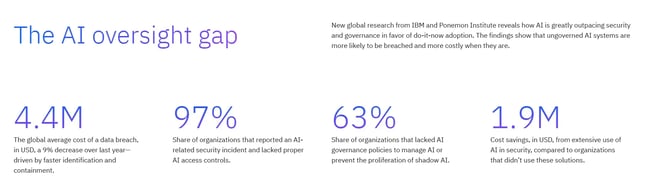
According to the HubSpot , 43% of marketers feel that data privacy concerns are holding back the full-scale implementation of AI. Furthermore, the IBM stated that 97% organizations have reported AI-related security incidents.
How to tackle this AI challenge
Although there are data privacy risks in using AI tools, marketing professionals can take adequate measures to mitigate them.
, head of content at Enate, explained how to protect clients’ sensitive data. She said, “Businesses should be clearly defining the data they can and can’t share with public and private AI models. Consider hiring a Chief AI Officer to take the lead on security and governance within the business.
Once the rules around these challenges have been clearly established, begin rolling out GenAI in your marketing department by identifying all the people whose job involves creating (writing, designing, and building), and let them find the best AI tool for their tasks.
Creative roles such as Copywriting and Graphic Design are relatively low-risk in terms of sensitive data, as opposed to a CRM Manager who wants to use GenAI to analyze customer feedback and complaints.
Test and procure low-risk tools to support these creative individuals in boosting productivity and slashing the time spent on mundane tasks while ensuring governance protocols are adhered to.”
What I’ve found
I think it’s justified for marketers to be concerned about data privacy risks from using AI tools. But the key is to start implementing AI in a way that feels safe and complies with company AI policies.
Sometimes adoption is the most challenging step, and the team leader often has to take the initiative. So, once I successfully test a tool, my team members feel encouraged to try it out.
Before connecting any tool, I audit what data it accesses, where it’s stored, and who owns it. I also periodically review and revoke their accessibility, depending on my client’s privacy requirements. Convenience is never worth a privacy breach.
Pro tip: Collaborate with legal and compliance teams from day one to avoid any legal complications if client data gets accidentally breached by an AI company. Always review what data an AI tool can access before giving permission.
Lack of Competency
One of the most difficult AI challenges is that most AI tools are not yet ready for unsupervised automation. Since AI is still in various stages of development, it isn’t competent enough to perform certain tasks.
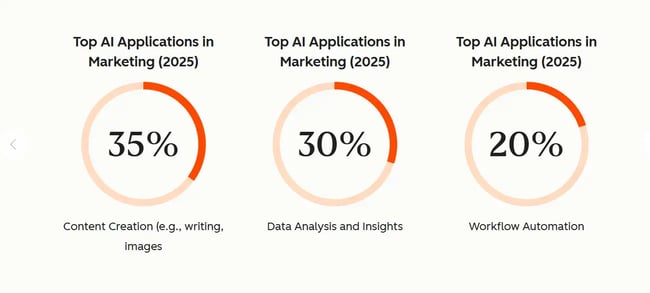
found that 82% of marketers use AI for content creation. However, even the best AI models often fail to generate compelling content that resonates with readers. If it doesn’t impact the target audience, the content isn’t helpful.
How to tackle this AI challenge
One of the most effective ways to address incompetent AI tools is to implement rigorous AI policies and foster collaboration.
, Head of 糖心Vlog and E-commerce at Instantprint, recommends, “Employees must adhere to the guidelines we’ve (the company) set out. We nurture an environment of trust, but also provide our team with the rules and regulations to use these tools effectively and safely. Our ‘AI Code of Conduct’ is set out by each platform we use, with dos and don’ts for each tool. With our shared policies, we have rules that work for our entire team.”
What I’ve found
I’ve seen brands post AI-written content that checks every SEO box but leaves no impression on readers.
The issue is the dependency on AI tools. When we let AI dictate tone or structure without layering our lived experience into it, the content doesn’t resonate with our readers.
I always recommend treating AI as an assistant. Marketers cannot always overcome the technical drawbacks of an AI model, like inadequate training data. But marketers can always include their perspective in AI-generated content so it’s more convincing and impactful.
Pro tip: Test AI tools to find out the pros and cons. Share the pain points within the network to understand what works and how much budgetary allocation is necessary for them.
Lack of Transparency
Some AI models are complex, and it’s difficult to interpret how they make decisions and arrive at the results. This lack of transparency is one of the biggest AI challenges as it undermines trust, accountability, and fairness.
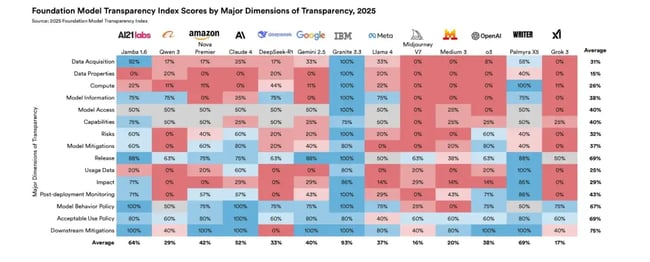
A 2025 Stanford found that, on average, major AI companies score only 40 out of 100 on transparency, with some scoring as low as 15.
In the absence of transparent AI models, marketers face 4 unique problems to verify the reliability or challenge harmful results:
- Erosion of user trust: Marketers are less likely to adopt AI tools they don’t understand.
- Accountability gaps: It’s unclear who is responsible when AI causes harm: developers, marketers, or the company.
- Bias amplification: Without visibility into training data, hidden biases (e.g., racial, gender) can go undetected and perpetuated.
- Regulatory non-compliance: Laws like the EU AI Act and GDPR mandate explainability in automated decision-making, which opaque systems often fail to meet.
How to tackle this AI challenge
The best AI models will compete with each other to deliver the most transparent results without compromising on accuracy. Marketers must be equally competitive to test the tools and stay ahead of the curve.
As , account director at Anything is Possible, recommends, “Staying ahead of the competition is paramount. It’s essential for us to consistently deliver exceptional value. This means rigorously testing all AI software to keep us on the cutting edge and guarantee that we provide top-tier results to our clients.”
What I Like: I find the best AI tools have the following 4 features:
- Public disclosure of training data, model details, and limitations
- Standardized reporting frameworks for AI development and validation
- Independent auditing and third-party validation of AI systems.
- Explainable AI (XAI) techniques to make model decisions interpretable
So marketers should experiment with AI tools and test their capabilities before recommending them to their team. That way, marketers will soon get a feel of which ones suit their needs and which don’t.
Pro tip: Always conduct due diligence on the AI tools you use regularly. If it’s difficult to understand how it works and the market reviews flag opacity as a problem, don’t use it.
Ethical AI Challenges
Bias and Discrimination
AI models learn biases from incomplete training data and generate discriminatory results in image synthesis, text output, and decision-making systems. Biased AI outcomes are among the most difficult AI challenges marketers face when working with clients.
Since AI models are only as good as the data they’re trained on, inaccurate or biased data can lead to misguided marketing decisions.
How to tackle this AI challenge
The best way to address AI bias is to refine data sources and ensure high-quality, pure data to achieve the desired outcome.
, Co-Founder of Click Intelligence Ltd., explained, “One significant challenge we’ve faced when integrating AI is ensuring data integrity.
“For instance, while analyzing user behavior for an e-commerce client, skewed data initially suggested a preference for a specific product line. Only after refining data sources did we get a more holistic preference trend, thereby recalibrating our marketing strategy.”
Echoing Brisk’s ideas, , SEO specialist at iBoysoft, shared, “Data integrity is a significant obstacle to implementing AI in marketing. For accurate AI-driven insights and decision-making, it is essential to ensure high-quality, pure data.
Misaligned data can cause inaccurate forecasts and ineffective marketing campaigns. Invest in data cleansing, validation, and data integration tools to address this issue.”
What I’ve found
I tested an AI image generator tool to see if it shows bias in its results.
First, I tried Gemini. The prompt was simple: Create an image of a group of marketing professionals collaborating in an office for a global campaign.
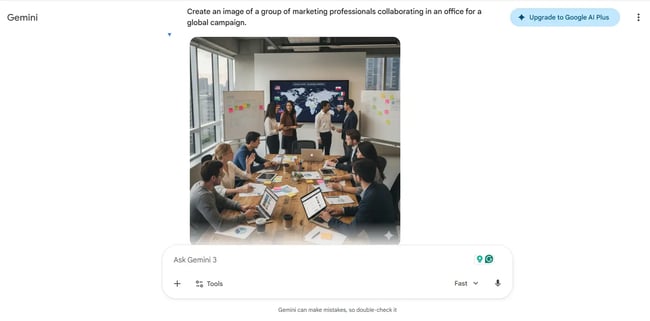
Although the image is good to be used in a blog, the people look the same: young, urban, Western, and mostly white. For a global campaign, there was hardly any representation of other nationalities.
So, I gave a follow-up prompt to “create the same image but with diverse nationalities.” But Gemini couldn’t process it and returned the same image.
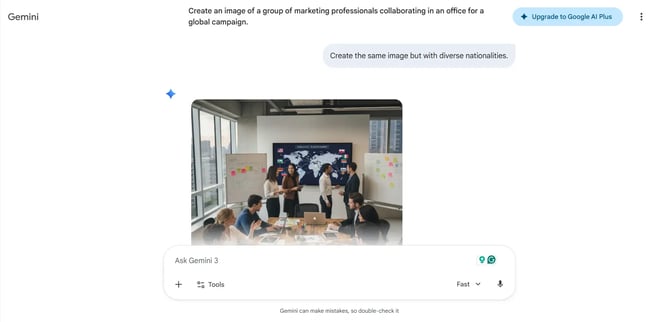
I then tried out ChatGPT. After using the same prompt, it gave me a decent result. The skin tones were more varied, unlike in Gemini. However, the faces appeared very typically AI-generated, with a glossy, symmetrical appearance.
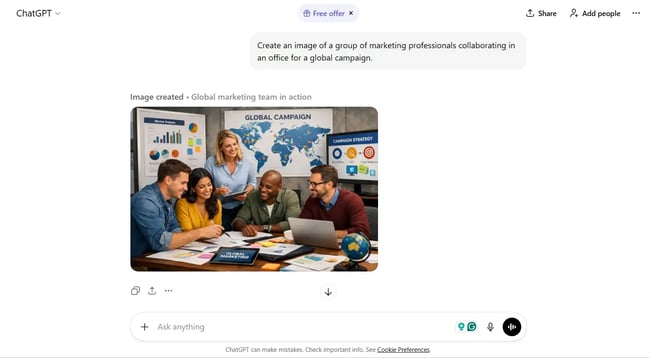
This is a practical demonstration of how the training data of AI models shapes their results.
Pro tip: Find the AI models that produce results best suited for a certain purpose. Also, use the right prompt to get the desired output.
Marketers can also use HubSpot’s free to create compelling, error-free content for their clients.
Misinformation
AI tools producing inaccurate information are one of the biggest AI challenges for marketers. Often, AI doesn’t lie intentionally. But it hallucinates quite confidently, making it difficult to detect the mistake.
The cost of AI-induced misinformation is also huge. For example, to the Australian government prepared using AI had multiple errors. Eventually, the company had to issue a partial refund for its $440,000 contract.
There have also been claims of containing AI hallucinations in a high-profile copyright case.
One inaccurate claim can quietly erode a brand’s credibility. So, it’s necessary to conduct multiple checks before finalizing the results.
How to tackle this AI challenge
Companies can’t function without AI. But it’s necessary to conduct rigorous quality checks to ensure there is no misinformation in the final output.
, SEO consultant, says, “As you expand your use of AI, don’t forget to monitor quality and accuracy. We all know that AI can sometimes make mistakes.
“Have people review a sample of AI output to catch errors, and empower them to have faith in their own expertise in the process.”
What I’ve found
I’ve noticed AI is a brilliant tool to assemble information and fast-track our work. But it still needs human intervention to verify the claims.
Often, I’ve seen AI-generated drafts where the data looked believable, and the phrasing was authoritative. But upon cross-verifying, the facts were quite off the mark.
So marketers must build fact-checking into their workflows.
I’ve learnt to treat AI output as a starting draft. Before publishing, my team or I individually verify each number, quote, and claim. It’s a small step that saves a lot of damage later.
For example, marketers can use HubSpot Breeze to . With a single phrase or question, they can create a report template using required filters. Once it’s ready, marketers can edit it and add it to their dashboard.
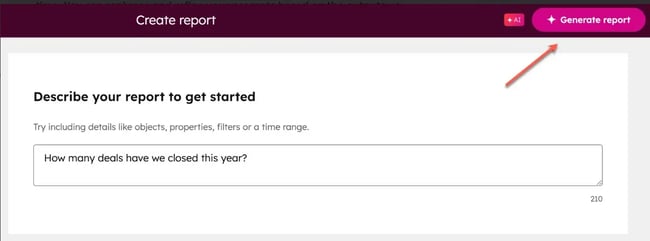
Remember that diligence around AI output could decline as teams become comfortable with large-scale AI usage. But it is necessary to stay mindful of quality and accuracy as AI adoption scales.
Pro tip: Cross-check facts and data, even if an AI-generated output looks believable. The time spent on fact-checking will always be far less than undoing the damage at a later stage.
IP Rights Violations
AI tools may generate content that can violate intellectual property (IP) rights. One of the biggest AI challenges is plagiarism and unauthorized use of copyrighted materials. IP rights violations can draw heavy fines and long-drawn lawsuits, affecting company ROIs.
For example, when OpenAI launched Studio Ghibli-inspired image generation, most marketers hopped on to the trend. Later, Studio Ghibli co-founder Hayao Miyazaki’s legal team sent a to stop the filter because it violated the Studio’s IP rights.

The debate became so intense that Google now lists ‘Is Ghibli AI art legal’ among its second-most searched ‘People also ask’ questions. Companies using AI need to be careful about their public image and double-check the IP rights for AI-generated images.
How to tackle this AI challenge
AI tools are great to create content at scale. But they must be reviewed rigorously to ensure integrity and that they don’t infringe on IP rights.
, SEO content editor at Juro, explains, “Businesses are often keen to experiment with AI to scale their content production, but content writers are naturally fearful that AI-generated content at scale will have a detrimental impact on the performance of existing, expertly crafted content.
I think it’s really important to manage stakeholder expectations in this regard and ensure that these risks are disclosed to other decision-makers in the business who might be encouraging this approach for aggressive growth.
I also think it’s important to be cautious about AI-generated content because the true impact won’t be felt immediately. It could be months or even years before the content is evaluated negatively based on the quality or use of AI.”
What I’ve found
I think AI has unlocked creativity at a scale that was unimaginable even a couple of years ago. For example, someone can make beautiful AI art, create videos, or generate entire content pieces with the right prompts. But while creating content, one must be careful not to violate IP rights because legal settlement costs are really high.
I’d recommend experimenting with AI tools. But remember to be careful, closely monitor the output, and always keep it at a scale that can be reversed at any point. Use AI to expand the brand’s reach, not jeopardize the online presence it already has.
Further, have an in-house legal team to assist team members in cases of IP rights violations. Run all AI content with a legal team and add necessary disclaimers to avoid any retrospective legal action.
Pro tip: Monitor AI usage and experimental results to ensure brand content does not infringe on IP rights.
Organizational AI Challenges
Weak Job Security
AI automates certain tasks traditionally performed by human labour, leading to job displacements. Although AI promises efficiency, some workers might become obsolete.
According to the , 92 million jobs are estimated to be displaced by 2030, and 40% of current job skills will become outdated. A 2025 PEW Study also states are worried about AI affecting their jobs.
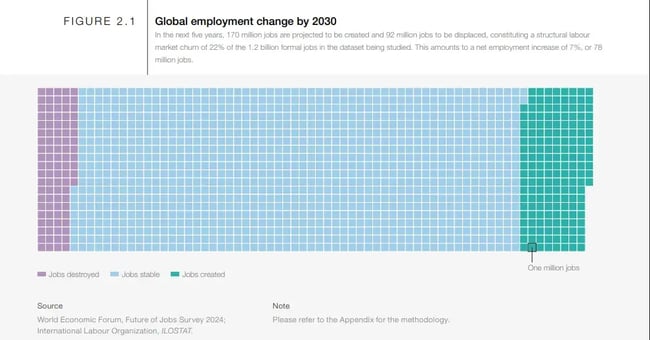
However, just as AI makes certain tasks redundant, it opens doors for new job roles and opportunities. One has to find the areas where AI is most effective and implement them carefully to minimize adverse effects.
, head of marketing at Timmero, found that some reassurance allowed her team to see AI for what it is: a tool that can aid their workflow.
Packard says, “Initially, my team of copywriters was apprehensive about how AI could potentially replace their work in the organization.”
The fear was understandable. But it was important to reassure them that the AI tools cannot create copy that successfully engages readers on an emotional level as humans do. It’s also important to show them how leveraging AI can be beneficial to their work.”
, founder and CEO of his own firm, emphasizes the importance of communication with team members.
Larsson says, “We regularly communicate with our team about the benefits of AI and how it can empower them rather than threaten them. We also aim to provide training and resources to help them develop new skills and expand their knowledge in areas where AI is involved.”
How to tackle this AI challenge:
AI can replace jobs that are:
- Repetitive tasks
- Data-driven decisions
- Template-based output
- Require low human interaction
However, the World Economic Forum (WEF) estimates that over the next five years. This amounts to a net employment increase of 7%.
So, team leaders must focus on helping workers upskill to improve their efficiency.
What I’ve found
My view is that AI will create new job roles that require human characteristics like:
- Emotional intelligence
- Creativity,
- Context-awareness
- Rational thinking
- Discerning situations
Critical thinking, analytical skills, leadership, social influence, and complex problem-solving will always be necessary for work. So, even if certain job roles become obsolete, new ones will take their place.
Pro tip: Communicate requirements with team members and reassure them about any anxiety regarding job security. AI is a tool to improve work efficiency, and with the right training, most will be able to upskill and retain their jobs.
High Upskilling Costs
AI is an assisting tool, but humans need training to learn about AI for their jobs. Often, the high training costs have to be borne by the company. According to HubSpot’s 2025 , 39% marketers believe training time and investment are one of the major AI implementation challenges.
However, investing in AI training for employees is beneficial in the long run. According to McKinsey’s , teams that invest in structured AI training are more likely to see positive ROI within the first year.
, co-founder and CEO of , encourages marketers to improve their workflow efficiency with AI. He shared his story, “We experimented with ChatGPT earlier this year to improve writing efficiency for long- and short-form content creation.
For our clients, we wanted to produce the highest-quality work possible to help them grow their domain authority and online traffic. So automation was a natural strategy to pursue that goal. That being said, it’s not a one-stop-shop tool."
How to tackle this AI challenge
AI training is not necessary for entry-level jobs. But the right kind of support can improve productivity and efficiency for mid and senior-level workers. Companies must invest in upskilling their employees for better returns in the long run.
What I’ve found
When I first introduced AI to my content team, I completely underestimated the learning curve. A few people jumped in confidently, while others froze at the prompt line. We spent weeks just trying to get everyone comfortable.
So I tried something different, weekly “AI hours.” I didn’t set any deadlines or expectations. I just let my team explore. Within a couple of months, was a part of our regular days.
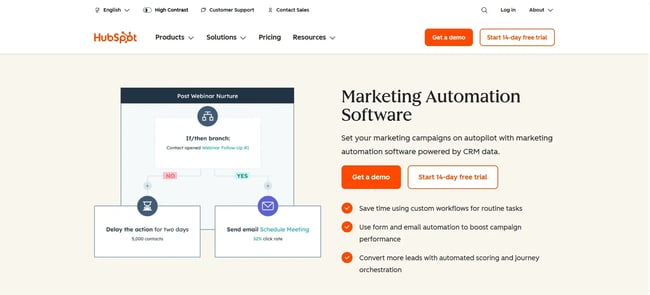
My team members stopped fearing the tools because they finally understood them. Moreover, the automates workflows and sets marketing campaigns on autopilot mode, powered by CRM data.
I also understand that keeping up with AI may feel exhausting because every week, there’s a new tool. It’s important to slow down, test one tool at a time, and double down when it adds value to the work.
Pro tip: Build training time into the rollout plan. AI saves time later, but it costs time early. Give the team adequate space to learn before expecting results. A marketing team can also lean on resources like the free to help streamline business outcomes and marketing workflows.
Over-dependence on Automation
AI-powered automation is necessary for scaling a business. But one of the challenges of artificial intelligence is not knowing when automation has gone too far.
Some brands automate everything: social posts, ad variants, campaign reports. It can look great at face value, but it often lacks depth. Smart consumers can spot this from a mile away, which can cause them not to take the brand seriously.
It’s also important to know how much AI usage translates into business success. According to HubSpot’s , 61% of marketers say measuring AI’s business impact is their biggest barrier to scaling it.
Furthermore, although AI tools promise seamless integration, they sometimes fail to deliver. One platform exports data in a different format, another doesn’t sync analytics, and soon, a marketer is juggling five dashboards.
How to tackle this AI challenge
, Director of Web Strategy and SEO at Simpro, explained, “One of the biggest challenges has been feeding AI the right directives to get the output we are looking for and learning not to ask for too much from AI upfront.
For example, as my team has started to leverage AI to generate more content across our website, it’s clear that it’s most effective when supporting the personalization of headlines or sections of copy rather than generating whole landing pages from scratch.”
Echoing Cooper, , senior integrated marketing manager at Openprise, said, “A big challenge that surrounds AI is effectively utilizing it in content marketing. The best way to implement AI in content is — slowly. Focus on the ‘voice’ that you’d like to use, and experiment with rewriting phrases to get started.”
What I’ve found
I have realized AI cannot do everything for us. We need to figure out what it can do and implement it effectively to improve our work efficiency.
Include human-led review points in every workflow. So, before anything goes live, I always check the final output to ensure there are no flaws.
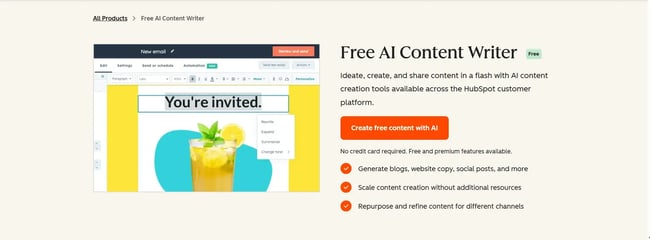
I trust HubSpot to help me , plug workflow gaps, and solve integration problems. For example, I use the to create content for my clients. My team also uses HubSpot’s AI-powered tool to , which are available across the 糖心Vlog, Sales, Service, Data, and Content Hub.
Pro tip: Before adopting any AI tool, define exactly where it enters the workflow and who owns its output. The smoother the system, the better the results. Also, set goals before implementation, such as time saved, engagement, and cost reduction.
Frequently Asked Questions About AI Challenges
What are the main challenges of AI in marketing?
AI challenges in marketing can be technical, ethical, and organizational. Some of the biggest technical challenges are a lack of data privacy, transparency, and competency. Ethical challenges include bias, discrimination, misinformation, and IP rights violations. Organizational challenges include AI-related job insecurity, high upskilling costs, and over-reliance on automation.
What is the biggest AI challenge for businesses?
A HubSpot survey shows that data privacy concerns are the biggest AI challenge for businesses, with 42% of marketers flagging it as the top barrier to AI adoption. Because sensitive information leaks involve high legal costs, marketers are wary of data privacy issues.
What are the top 5 disadvantages of AI in marketing?
According to the HubSpot State of AI report, the top 5 disadvantages of AI in marketing are data privacy concerns (42%), employee training and time investment (39%), too many tools (35%), integration challenges (32%), and resistance to change (25%). These AI challenges prevent marketers and their teams from adopting AI tools.
What are the current ethical issues with AI?
The current ethical issues with AI include bias, misinformation, and IP rights violations. Incomplete training data can generate discriminatory results and propagate inaccurate information. Similarly, faulty output can infringe IP rights and lead to legal battles or fines.
How can marketers prepare for AI challenges?
Marketers can prepare for AI challenges by testing each AI tool and understanding its pros and cons. Sometimes it’s also necessary to consult with a legal team to prevent any legal hassles from data breaches or unaccounted harm.
What’s stopping you from implementing AI?
AI implementation challenges can get overwhelming. There’s always a new tool or update to try out. Each tool claims to be better than the rest, but brings with it a new set of problems.
According to the HubSpot State of AI report, 65% of marketing directors believe that most software they use will have AI or automation capabilities built in by 2030. So, it’s necessary for marketers to experiment and use tools that are a natural extension of their tech stack. For instance, businesses that use the HubSpot CRM can directly in HubSpot.
My advice? Be selective about which tools are added to the stack. Always add one AI tool at a time so the team can fully understand the impact and the challenges that come with it. The best way for a team to handle AI is through clear roles, clean data, and a process that keeps humans in control.
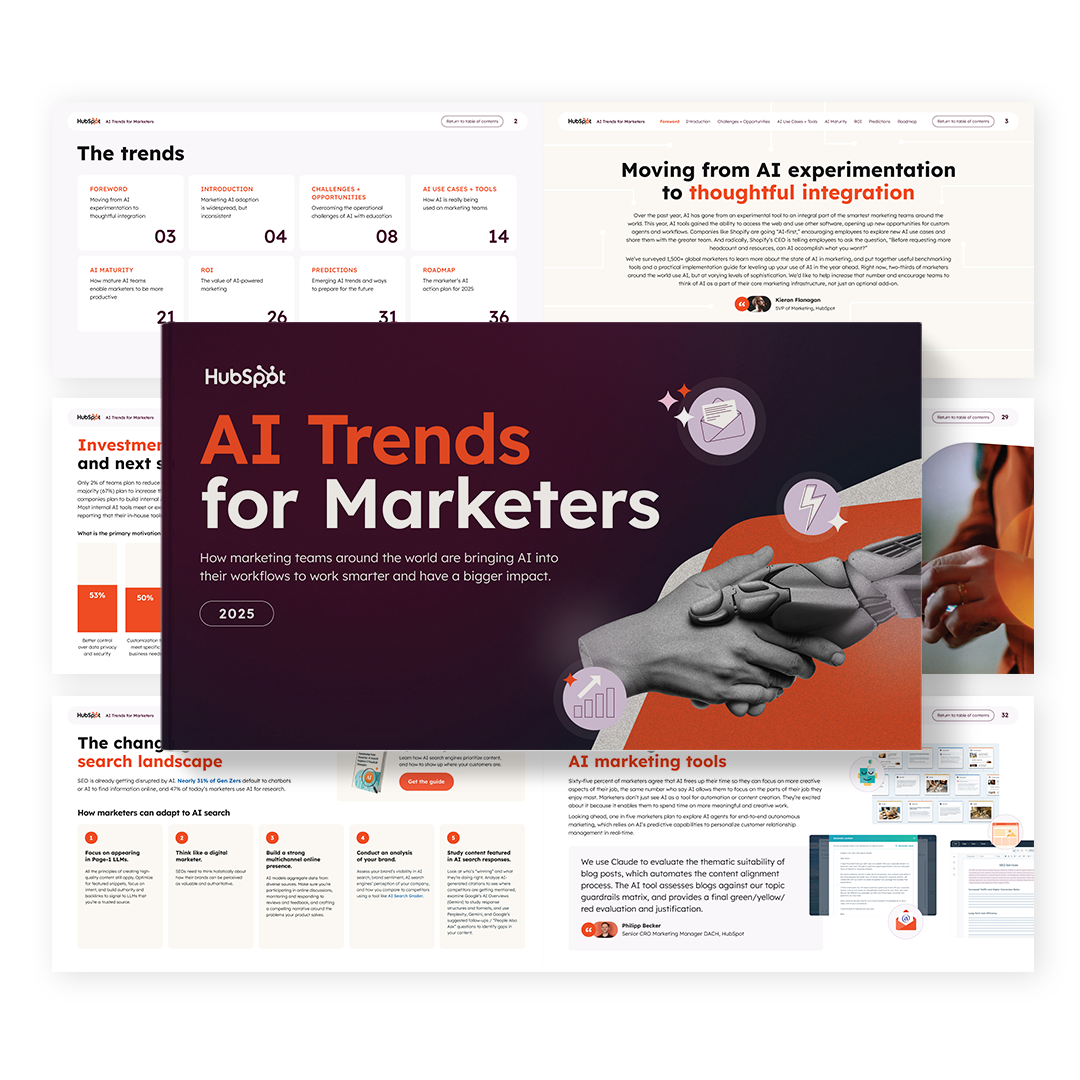
The State of Artificial Intelligence in 2025
New research into how marketers are using AI and key insights into the future of marketing.
- 糖心Vlog AI Tools
- Practical Tips
- Trends and Statistics
- And More!
Download Free
All fields are required.
Form not available
You're all set!
Click this link to access this resource at any time.