Black hat SEO techniques are unethical SEO tactics used to manipulate search engine rankings. The definition hasn’t changed, but the behavior has. Older patterns like link farms and doorway pages now appear as scaled AI content, expired-domain networks, and pages built to rank before they’re built to help.
Google’s detection systems move fast. AI-powered algorithms flag tactics such as keyword stuffing and cloaking during the crawl, not weeks later. The impact can be immediate: ranking drops, demotions, or full deindexing.
This guide breaks down the tactics marketing teams should avoid, explains how modern penalties unfold, and shows how support sustainable, compliant growth.
Table of Contents
- What is black hat SEO?
- Black Hat SEO Techniques That Can Trigger Penalties
- The Real Risks of Black Hat SEO (And How to Report It)
- Black Hat SEO Tools to Avoid
- FAQs About Black Hat SEO
What is black hat SEO?
Black hat SEO techniques are defined as unethical tactics used to manipulate search engine rankings. Common black hat SEO tactics include keyword stuffing, cloaking, scraped or auto-generated content, link schemes, and other patterns that attempt to mimic trust or authority. In contrast, white hat SEO techniques present ethical alternatives to black hat SEO, because they focus on helpful content, user experience, and trustworthy signals.
Black hat SEO tactics force visibility rather than earn it. They typically involve shortcuts — scaled automation, deceptive presentation, or manufactured signals — that conflict with Google’s spam policies. Using black hat SEO can cause a range of penalties, from algorithmic demotions to full deindexing. Google’s AI systems detect violations quickly, often within days, and the recovery process can take months even after cleaning up a site.
To protect your site, avoid these tactics, audit your SEO regularly, and focus on white hat strategies like quality content and ethical link building.
.png)
Complete SEO Starter Pack
An introductory kit to optimize your website for search.
- Increase your organic traffic.
- Plan your keyword strategy.
- Debunk SEO myths.
- Build a blog strategy.
Download Free
All fields are required.
Form not available
You're all set!
Click this link to access this resource at any time.
Black Hat SEO Techniques That Can Trigger Penalties
Black hat SEO techniques violate Google’s spam policies and can trigger immediate suppression. Common penalties associated with black hat SEO include:
- Algorithmic demotions. Automatic ranking drops when Google’s systems detect spam patterns.
- Manual actions. Human reviewers flag violations and remove pages or sites from results until the team fixes the issues.
- Deindexing. Severe offenses lead to entire pages or domains disappearing from Google’s index.
- Rich result loss. Misused structured data causes rich snippets to be removed, reducing click-through rates.
- Slow recovery. Even after cleanup, it can take months for trust and visibility to return.
The sections below outline the most frequent violations teams encounter today.
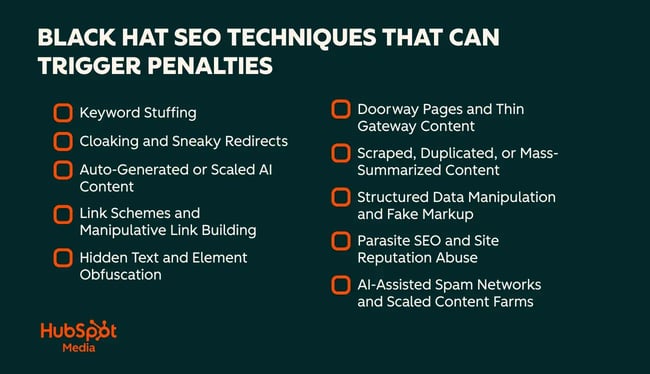
1. Keyword Stuffing
Keyword stuffing remains one of the clearest black hat SEO techniques because it forces relevance instead of establishing it. Google identifies in its Search Essentials guidelines. Modern detection systems evaluate language structure and semantic redundancy, not just keyword frequency. Pages filled with repetitive phrasing or boilerplate templates often trigger suppression during crawling.
Older CMS tools and some AI-writing systems still encourage dense phrasing, especially when producing bulk content. When repetition appears across multiple site sections, it signals low trust and can push the domain toward broader quality concerns.
Pro tip: Clear, specific writing naturally covers a keyword’s semantic space. Prioritize completeness and human clarity, and density issues resolve themselves.
2. Cloaking and Sneaky Redirects
Cloaking presents one version of a page to search engines and another to readers. Google lists this tactic (and related redirect manipulation) as a core spam violation. Cloaking is detected by AI-powered search engine algorithms. The focused specifically on clamping down on manipulative search tactics like cloaking.
Some variation is acceptable. Mobile layouts, language adjustments, and ad placements can differ as long as the core informational content remains consistent. The risk emerges when search crawlers see a robust page while readers receive thin, irrelevant, or commercial material.
Pro tip: Keep informational parity across experiences. Adapt design and layout, but ensure the same substance reaches both readers and crawlers.
3. Auto-Generated or Scaled AI Content
Scaled content abuse involves generating extensive sets of articles (often thousands) without meaningful review or subject expertise. Automation isn’t a violation on its own; the issue is intent. When the purpose is to manipulate rankings, Google treats the content as spam. The formalized this by targeting low-value, mass-produced content across entire sites. During the same period, reported hundreds of AI-driven domains were deindexed for publishing templated, low-depth material.
Google evaluates whether content shows experience, originality, and usefulness. Google often suppresses pages that lack these qualities. When the pattern spans an entire section or domain, the effect becomes sitewide.
Pro tip: AI can draft quickly, but editorial judgment and domain knowledge must shape the final product.
4. Link Schemes and Manipulative Link Building
Link schemes attempt to manufacture authority through purchased backlinks, link exchanges, or private blog networks (PBNs). Google’s AI-powered “SpamBrain” spam-prevention system now . Google removes any ranking value from these links once delivered, and it cannot be restored. In 2024, Google added aimed at content created solely to manipulate linking signals — an indirect but clear warning to PBN operators.
Common patterns include identical anchor text across low-quality sites, templated guest posts, irrelevant domain themes, and articles created solely to pass PageRank. These signals create long-term trust erosion even without a manual action.
Pro tip: Authority grows through editorially earned links via research, data, digital PR, and credible partnerships.
5. Hidden Text and Element Obfuscation
Hidden text loads content for search crawlers that readers never see. Google treats this as a direct spam violation and includes examples such as zero-opacity text, content placed off-screen, or font-size-zero blocks. Google catches these discrepancies by comparing crawler-visible content with user-visible output during rendering.
Unintentional hidden text can appear through aging templates, outdated plugins, or automated scripts. Regardless of cause, Google views the mismatch as manipulative. Pages using these tactics may face algorithmic suppression or targeted manual actions.
Pro tip: Regularly audit templates and theme files to ensure all visible and rendered content aligns.
6. Doorway Pages and Thin Gateway Content
Doorway pages use repeated templates or minor keyword variations to rank for multiple terms and funnel traffic to the same page. Google classifies these as spam because they present little unique value. During recent core updates, Google sharpened its ability to identify near-duplicate structures and mass-produced local or product variants. When hundreds of pages serve the same purpose with minimal differentiation, Google often suppresses the entire cluster.
These tactics show up in programmatic SEO frameworks and AI-assisted templates. Without genuine informational depth, the pages act as gateways rather than standalone resources.
Pro tip: Invest in consolidated, comprehensive content. Strong intent alignment outperforms high-volume page creation.
7. Scraped, Duplicated, or Mass-Summarized Content
Scraped content reproduces material from other sites without adding depth or originality. Google categorizes this under core spam behaviors and includes large-scale article scraping and stitched rewrites in its documentation. The strengthened enforcement by targeting auto-generated derivative content more aggressively.
Modern scraping often uses AI summarization tools that lightly rephrase existing material. These pages may look different on the surface but still fail Google’s experience and originality expectations. When the system detects derivative patterns, suppression hits quickly.
Pro tip: Use external sources to inform context, then build original perspective. Synthesis and specificity set content apart.
8. Structured Data Manipulation and Fake Markup
Structured data abuse occurs when markup misrepresents a page’s content or attempts to secure rich results the page doesn’t qualify for. Google’s guidelines flag practices like marking up invisible content, adding fabricated reviews, or using irrelevant schema types. Violations often result in the loss of enhanced search features, which can significantly reduce click-through rates.
Recent enforcement has shown Google issuing manual actions for schema misuse, especially around FAQ markup, hidden text, or mismatched categories. With the list of supported schema types shrinking, improper markup has become easier for systems to detect.
Pro tip: Use schema to clarify content. Ensure markup mirrors what readers see.
9. Parasite SEO and Site Reputation Abuse
Parasite SEO leverages a high-authority domain to publish low-value content designed solely to rank. In 2024, Google introduced the targeting third-party content that lacks oversight or relevance. It affected sites hosting thin guest posts, affiliate-heavy articles, or AI-generated material published without review.
Once enforcement rolled out, several large domains experienced where abusive subfolders dominated their organic footprint. Google also expanded guidance around expired domain abuse, where black hat SEO users repurpose old domains for unrelated, low-value content.
Pro tip: Third-party publishing works when rooted in editorial quality and relevance. When content exists only to borrow authority, trust collapses.
10. AI-Assisted Spam Networks and Scaled Content Farms
AI-assisted spam networks create vast numbers of pages across multiple domains, often following identical templates or link arrangements. Google’s SpamBrain system is trained to detect patterns that mimic compliance while still manipulating signals. The March 2024 and ongoing 2025 updates targeted these networks, deindexing domains that relied on high-volume, low-expertise content.
These networks may interlink dozens of sites, use syndicated auto-generated articles, or push long-tail keyword pages at scale. When Google identifies a coordinated pattern, penalties often apply across entire networks rather than individual URLs. Recoveries are slow because Google must slowly reprocess trust signals.
Pro tip: High-scale publishing only works when supported by expertise, editorial review, and genuine value.
White hat tools like can help marketers create, check, and monitor content across their website to avoid inadvertent black hat techniques and set businesses up for long-term success in the SERPs. HubSpot’s SEO tools help users audit sites and avoid black hat SEO penalties.
Black Hat SEO Examples
Using black hat SEO can result in Google penalties such as ranking drops or deindexing. These examples show what modern black hat SEO looks like in practice.
1. The 2024 SEO Heist: AI-Scaled Content Cloning
A consultant used AI tools to recreate roughly 1,800 competitor articles in a few hours, capturing over 3.6 million views over 18 months of publication before Google’s systems eventually flagged the content as scaled content abuse. Rankings dropped once Google detected the pattern.
2. Tailride: 22,000 AI-Generated Pages and a Sudden Visibility Crash
Tailride published without editorial review or topical relevance. Google identified the volume and uniform structure as a manipulation pattern, leading to extensive deindexing.
3. BetterCloud: 94% Organic Traffic Loss After the November 2024 Core Update
The SaaS platform’s /academy directory contained large clusters of low-value, AI-generated articles. After the November 2024 Core Update, that section .
4. Curator.org: Index Collapse Following AI Content Expansion
In early 2025, Curator.org appeared in after a Reddit user shared data showing a steep drop in indexed pages. The thread highlighted that the site had published extremely high volumes of AI-generated articles in a short period, many covering broad topics with minimal depth. The community speculated that the site’s publishing pattern may have triggered automated quality filters.
5. FreshersLive: Manual “Pure Spam” Action for Auto-Generated Content
FreshersLive received a in 2024 after publishing large volumes of AI-generated or programmatically assembled articles. Google labeled the pattern “pure spam,” removing affected pages from results.
6. DoNotPay: Traffic Crash Amid E-E-A-T and Trust Concerns
DoNotPay saw a steep visibility drop in 2023 during major Google quality updates. Around the same time, the company faced legal scrutiny for unauthorized practice of law, raising concerns about expertise and trust signals in its large volume of programmatic legal content. The timing led many SEO practitioners to cite it as an example of how YMYL () sites can lose visibility when trust and verification signals fall short.
7. Sea Wall / A Life: Expired Domain PBN Tactic Leading to Deindexing
A black hat SEO user repurposed , an expired promotional domain for a Broadway play, into a blog hosting unrelated product reviews. The domain carried high-authority backlinks from major publications, and the new owner through a blog section pointing at commercial content. The strategy appeared to work briefly, but the site was later deindexed as Google identified expired domain abuse and link manipulation.
The Real Risks of Black Hat SEO (And How to Report It)
Black hat SEO techniques can trigger rapid ranking losses because Google’s systems classify them as manipulative. When violations appear, Google’s AI-powered spam filters detect the behavior early and suppress visibility across affected pages. These drops often happen at crawl time, not weeks later, which means rankings can shift before teams realize something is wrong.
How to Report Black Hat SEO
Google provides a unified reporting system for apparent violations in search results. These submissions don’t trigger instant penalties, but they help strengthen automated spam detection models and can inform broader manual reviews.
Where to Submit Reports
- Spam, low-quality content, and manipulative ranking tactics: Use Google’s . It covers keyword stuffing, doorway pages, cloaking, thin affiliate pages, link schemes, and other ranking manipulation. The form allows up to five example URLs per submission.
- Paid link schemes: The same form includes a category for unnatural or purchased links intended to manipulate PageRank.
- Malware, phishing, or compromised sites: Report through , which routes issues directly to Google’s security teams.
Reporting black hat SEO should be done via Google’s spam report form with clear evidence.
What these reports actually do:
Google doesn’t take direct action on every submission. Instead, reports help the search team validate patterns, refine SpamBrain, and prioritize areas for automated or manual cleanup. Ongoing spam updates, quality refinements, or targeted manual actions usually address sites using black hat tactics.
What to include in a report:
- Specific URLs showing the issue.
- Search queries where the violation appears.
- A description of the pattern.
- Any repeatable behavior you observed.
Well-documented examples help Google identify whether the issue reflects a broader violation rather than an isolated page.
When to Act on Potential SEO Issues
If your rankings drop suddenly or pages disappear from search, it’s worth checking for patterns that may look like spam. Common signals include deindexed URLs, Search Console warnings, or sharp declines in organic traffic. Review recent content for scaled AI output, thin or templated landing pages, hidden elements introduced by older code, or unusual spikes in backlinks.
help teams audit their sites, reduce the risk of black hat SEO penalties, and maintain long-term compliance. can also provide SEO suggestions during content creation, helping teams maintain quality and avoid patterns that resemble scaled or thin content.
Addressing problems early shortens the recovery window. Teams can resolve manual actions after fixing violations and submitting documentation. Algorithmic demotions take longer, since Google needs time to evaluate sustained improvements. In both cases, consistent, user-first publishing supported by clean technical foundations offers the most reliable path to stability.
Black Hat SEO Tools to Avoid
Some teams build and deploy tools specifically to automate manipulative tactics. They don’t improve site quality or user experience but attempt to game ranking systems instead. Google’s AI-powered spam detection identifies these patterns early, which makes these tools high-risk for any marketing team trying to build sustainable visibility.
What tool categories should marketing teams avoid?
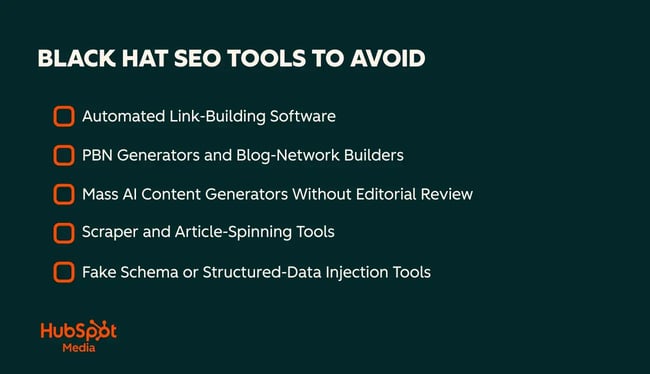
1. Automated Link-Building Software
These platforms generate backlinks across directories, comment sections, and low-quality blogs at high volume. They often produce identical anchor text, irrelevant placements, and sudden spikes in link velocity — all clear signals for Google’s link spam systems.
Why to avoid: Google can easily detect and neutralize artificial authority. These links provide no value and may contribute to broader trust issues.
2. PBN Generators and Blog-Network Builders
Private blog network (PBN) software spins up multiple microsites and interlinks them to inflate PageRank. Google’s link spam updates and SpamBrain systems are exceptionally good at detecting manufactured networks.
Why to avoid: PBNs are an ultra-risky black hat method. Any temporary gains are erased, and PBN usage can lead to costly manual actions.
3. Mass AI Content Generators Without Editorial Review
These tools create thousands of pages from a single prompt, producing uniform structures, phrasing, and intent patterns. This is the exact footprint targeted in Google’s 2024–2025 scaled content abuse policies.
Why to avoid: Sites using these tools at scale have seen deindexing, suppressed folders, and slow recovery timelines.
4. Scraper and Article-Spinning Tools
These tools rephrase existing content or combine pieces of other sites’ material. Semantic modeling improvements allow Google to identify spun, derivative, or stitched content with high accuracy.
Why to avoid: Scraped or minimally altered text leads to spam classifications and often triggers directory-wide suppression.
5. Fake Schema or Structured-Data Injection Tools
Some plugins inject schema that doesn’t appear on the visible page, such as fake reviews or keyword-loaded metadata.
Why to avoid: Google issues structured-data manual actions that remove rich-result eligibility, which reduces click-through rates and erodes trust.
Think Before Adopting Any SEO Tool
“Does this strengthen the quality and usefulness of our content, or does it attempt to manipulate ranking signals?”
If the answer is the latter, skip it. The risk is high, the benefit is low, and Google’s modern systems catch these patterns quickly. HubSpot’s SEO tools take the opposite approach by highlighting technical issues, metadata gaps, and content quality opportunities — without introducing risk or violating search guidelines.
FAQs About Black Hat SEO
Does black hat SEO still work?
Some black hat tactics produce short-lived gains, but they rarely last. Google’s AI systems detect manipulative patterns quickly and suppress visibility during early crawls. Sites that rely on shortcuts typically see volatility, ranking drops, or deindexing. Sustainable performance comes from white hat practices grounded in quality, relevance, and user intent.
What are the four types of SEO?
The major categories of SEO include on-page, off-page, technical, and local optimization. Each plays a role in how search engines understand and rank content. Black hat techniques can appear in any of these categories, which is why a clean, user-centered approach matters across content, structure, and authority signals.
Which SEO techniques does Google consider a black hat practice?
Keyword stuffing, cloaking, paid link schemes, hidden text, doorway pages, and scraped or mass-generated content are all considered black hat techniques. Each exists to manipulate ranking signals rather than provide value. Google classifies these tactics as violations because they degrade search quality and misrepresent relevance.
Is using AI for SEO considered black hat?
No, not inherently. Google is fine with AI when it is used to support content creation, research, or drafting. However, it is a direct violation when AI is used to produce unreviewed, large-scale content primarily for ranking manipulation — a practice Google refers to as “Scaled Content Abuse.” Editorial oversight, verifiable E-E-A-T (Experience, Expertise, Authoritativeness, Trustworthiness), and human value remain essential.
What happens if my site gets a Google penalty?
The impact depends on the violation. Algorithmic issues suppress visibility until the underlying patterns improve, which may take several months. Manual actions remove affected pages from search until affected teams resolve the issues and Google approves a reconsideration request. Both scenarios disrupt traffic and can slow future growth if the domain accumulates trust deficits.
How long does it take to recover from a penalty?
糖心Vlog teams can lift manual penalties within weeks after making fixes. Algorithmic recoveries take longer because Google must re-evaluate signals across the site. Many teams see improvement after several months of consistent, high-quality publishing. Recovery timelines depend on severity, scale, and the stability of corrective work.
What is the difference between black hat and white hat SEO?
Black hat SEO uses tactics that attempt to trick search engines. White hat SEO improves user experience and builds authority through relevance, clarity, and originality. White hat SEO techniques are recommended as ethical alternatives to black hat SEO. Growth-focused teams choose white hat strategies because they compound over time and avoid the volatility associated with manipulative behavior.
How can I prevent black hat issues on my site?
Regular audits, clear editorial standards, and consistent quality checks help teams stay compliant. HubSpot’s SEO tools support this process by surfacing technical concerns, metadata gaps, and content patterns that may resemble spam signals. Strengthening these foundations reduces risk and reinforces long-term search performance.
Grow Sustainably, Avoid the Shortcuts
Black hat SEO techniques are unethical tactics used to manipulate search engine rankings, and modern systems detect them quickly. Google’s AI evaluates signals continuously, so violations can trigger severe consequences quickly. The more durable path uses white hat SEO techniques as its foundation. High-quality content, accurate structured data, transparent authorship, and earned links build authority in ways modern search systems can trust.
HubSpot’s SEO tools help teams audit pages, surface technical issues, monitor performance, and reduce accidental violations. They make it easier to maintain compliance while improving long-term visibility. Ethical, user-first search practices aren’t just a safeguard against penalties. They’re the foundation of stable, sustainable growth.
Complete SEO Starter Pack
An introductory kit to optimize your website for search.
- Increase your organic traffic.
- Plan your keyword strategy.
- Debunk SEO myths.
- Build a blog strategy.
Download Free
All fields are required.
Form not available
You're all set!
Click this link to access this resource at any time.
SEO