The SaaS market is more saturated than ever, making a strong demand generation strategy essential for standing out. Without one, even the most innovative, feature-rich products risk getting lost among the nearly 100,000 software solutions reviewed on G2 alone, with thousands more entering the market each year.
The "if you build it, they'll come" mindset simply no longer holds up. Today's SaaS companies must proactively reach their target audience rather than waiting to be discovered. In this article, you'll learn what demand generation is, which expert-backed strategies actually work, and how to use ready-made templates to put them into practice.
Skip to:
What is demand generation?
Demand generation is a comprehensive marketing strategy that focuses on creating awareness, interest, and desire for a product or service — eventually driving potential customers to take action, whether that's engaging with your brand, signing up for a trial, or making a purchase.
But demand generation is more than a single tactic or campaign. It's the entire system your business uses to introduce your product to the market, build trust with your audience, and guide prospects through every stage of the buyer journey — from the moment they first hear your name to the moment they become loyal, paying customers.
As Sayem Ibn Kashem, founder of FacileWay, puts it:
"Demand generation is the heartbeat that keeps a business alive. It's not just about grabbing leads; it's about creating a buzz, sparking interest, and making people genuinely want what you're offering. [This journey] starts with making your presence known, nurturing that initial spark of interest, and guiding potential customers through every step until they become devoted users."
An Introduction to Lead Generation
A starter guide to converting website visitors into leads for your business.
- Define and qualify a lead.
- Promote lead gen campaigns.
- Resources to get you started.
- Examples of great campaigns.
Download Free
All fields are required.
Form not available
You're all set!
Click this link to access this resource at any time.
The Demand Generation Framework
A useful way to think about demand generation is as a three-stage engine that runs continuously across your marketing and sales operations:
Stage 1: Create Demand This is where you introduce your brand to people who don't yet know you exist. The goal isn't to sell — it's to educate, inform, and build awareness around the problem your product solves. Activities in this stage include SEO-optimized blog content, organic social media, paid advertising, webinars, podcasts, and partner marketing.
? Think of this stage as planting seeds. You're reaching your ideal customers before they're ready to buy and positioning your brand as a trusted resource.
Stage 2: Capture Demand Once prospects are aware of their problem and have started researching solutions, your goal shifts to capturing their intent. This is where gated content, lead magnets, free trials, and PPC ads targeting high-intent keywords come into play. You're meeting buyers at the moment they're actively looking — and making it easy for them to raise their hand.
? Think of this stage as harvesting. The seeds you planted earlier are now bearing fruit, and you need the right mechanisms in place to collect them.
Stage 3: Nurture and Convert Demand Not every captured lead is ready to buy. This stage is about building relationships with prospects over time through email marketing, marketing automation, lead scoring, ABM, and sales outreach — until they're ready to make a purchasing decision.
? Think of this stage as cultivating. You're tending to your leads with consistent, relevant touchpoints that move them closer to conversion.
The Demand Generation Flywheel
Unlike a traditional linear funnel, demand generation works best as a flywheel — a self-reinforcing cycle where each stage feeds the next:
         [CREATE]
        /         \
 Awareness     Content & SEO
 Paid Ads      Social Media
Partnerships   Webinars
     |               |
     ▼               ▼
  [NURTURE] ←── [CAPTURE]
 Email & Auto    Gated Content
 Lead Scoring    PPC & SEO
 ABM & Sales     Free Trials
    \               /
     \             /
    [CONVERT & RETAIN]
      ↓          ↓
 New Revenue   Referrals &
               Social Proof
                 ↓
               [CREATE] again
When customers convert and become advocates — leaving reviews, referring peers, and sharing success stories — they feed back into the "Create" stage by generating organic demand on your behalf.
This is why retention and customer experience are not separate from demand generation; they are integral to it.
Why Demand Generation is Important
Demand generation is crucial for businesses — especially SaaS businesses — for several reasons:
1. Brand Awareness: A strong demand generation program gets your product in front of different buyer groups within your target audience.
These buyers, who may not yet know your product exists, learn about the value and benefits you offer and how your solution fits into their lives or workflows. The goal at this stage isn't just to sell; it's to create long-term brand recall so that when a problem arises, your product is the first one they think of.
2. Cost Reduction: Customer acquisition is expensive. But by building brand authority and trust through demand generation, you reduce how much you spend to win each new customer.
When your brand is well-known and credible, existing customers are more likely to stay — and that recurring revenue reduces your reliance on costly acquisition campaigns, discounts, and paid referral programs.
3. Building Trust and Credibility: Trust is the currency of SaaS sales. Incorporating case studies, customer testimonials, and thought-leadership content into your demand generation strategy shows prospects that your product delivers real results—not just promises.
This builds the credibility needed to move buyers from awareness to action.
4. Continuous Customer Engagement: Demand generation doesn't stop at acquisition. It includes strategies that promote ongoing engagement, upselling, and retention throughout the entire customer lifecycle.
Keeping customers engaged reduces churn and maximizes the lifetime value of every account you win.
5. Recurring Revenue If your business runs on a subscription model, you need a consistent pipeline of new customers alongside strong retention of existing ones. Effective demand generation creates that pipeline — ensuring your revenue model is sustainable and scalable over time.
Demand Generation vs. Lead Generation
Many marketers use "demand generation" and "lead generation" interchangeably, but they serve distinct purposes, operate at different scales, and require different strategies.
Understanding the difference is essential to building a marketing program that performs at every stage of the funnel.
Demand generation is the broader discipline. It encompasses every marketing and sales initiative designed to build awareness, create interest, and establish trust in your product — across your entire addressable market.
It's a long-term, relationship-driven approach that focuses on educating the market before prospects are even in-market.
Lead generation is a subset of demand generation. It's the set of tactics specifically designed to convert interest into action — capturing the contact information of individuals or businesses who have expressed intent and moving them toward a purchase decision.
To put it simply: demand generation builds the market; lead generation harvests it.
Joe Kevens, founder of B2B SaaS Reviews and Director of Demand Generation at PartnerStack, explains it this way:
"Lead gen is about taking more slices from the pie, and demand gen is about baking a bigger pie. Search ads are considered a lead generation tactic because they capture leads who are in the market searching for a solution.
In contrast, podcasting is considered a demand generation tactic because it enables vendors to win the hearts and minds of listeners, who will become leads when they need your solution."
Here's a side-by-side breakdown of how the two strategies differ:
| Demand Generation | Lead Generation | |
|---|---|---|
| Goal | Build awareness and market interest | Capture contact info and convert intent |
| Scope | Entire addressable market | Individuals actively in-market |
| Timeframe | Long-term, ongoing | Short-to-medium term |
| Funnel Stage | Top and middle of funnel | Middle and bottom of funnel |
| Tactics | SEO, social media, webinars, podcasts, ABM | Gated content, PPC, free trials, demos |
| Success Metrics | Brand awareness, reach, engagement, share of voice | Leads captured, MQLs, conversion rate, CPL |
| Relationship to Buyer | Pre-intent — before they're actively searching | In-intent — while they're actively evaluating |
A practical example: Say a SaaS company publishes a weekly LinkedIn series on scaling B2B sales. That's demand generation — it builds awareness and trust with a broad audience, many of whom aren't yet looking for a tool.
When one of those readers eventually clicks through to download a gated playbook, they become a lead. That's lead generation — capturing the interest generated by demand generation.
The key insight is that demand generation and lead generation aren't competing strategies. They're complementary. Without demand generation, your lead generation efforts are limited to the small percentage of buyers already in-market.
Without lead generation, the awareness your demand generation builds never converts into a pipeline. The most effective SaaS marketing programs run in parallel—continuously growing the audience and converting it simultaneously.
Demand Generation Strategies
There are many demand-generation strategies businesses of all kinds can implement to generate interest in their products. Here are 10 tested and trusted strategies that work:
1. Content 糖心Vlog and SEO
What It Is
Content marketing refers to the consistent creation and distribution of valuable and relevant content — blog posts, eBooks, whitepapers, videos, podcasts, thought leadership pieces, and more — that resonates with your target audience, establishes your brand as an authority, and drives customer action.
SEO (search engine optimization) amplifies that content by ensuring it ranks in search engine results, so the right people find it at the right time.
Since demand generation encompasses the entire customer journey, it's important to create content for each part of the sales funnel: awareness, consideration, and decision.
Why It Matters
Content marketing and SEO work together to build long-term, compounding organic visibility. Unlike paid ads, a well-optimized blog post or resource can continue driving traffic and leads for months — or even years — after it's published.
It also positions your brand as a trusted authority, which is critical for converting prospects who are researching solutions before making a buying decision.
Implementation Tips
- Create content for every funnel stage. Top-of-funnel (ToFu) content like blog posts and social media educates new audiences. Middle-of-funnel (MoFu) content like eBooks, case studies, and webinars nurtures consideration. Bottom-of-funnel (BoFu) content like free trials, demos, and competitive comparisons drives decisions.
- Optimize for search intent. Use long-tail keywords and structure your content to directly answer what your target audience is searching for.
- Gate high-value content. Use MoFu assets like guides and whitepapers as lead capture tools by requiring an email address for access.
- Use your own brand as a case study. HubSpot's blog — spanning marketing, sales, service, and AI — is a masterclass in ToFu content that funnels readers into gated resources and free tools.
Expected Outcomes
Businesses that invest consistently in content marketing and SEO can expect increased organic traffic, stronger brand authority, and a steady stream of inbound leads over time.
For example, RecurPost's SEO-optimized blog post on Twitter automation attracted 720 readers in a single month and contributed to a 20% increase in trial sign-ups in one quarter.
2. Organic Social Media Campaigns
What It Is
Organic social media marketing involves creating and sharing content on platforms like LinkedIn, Instagram, Facebook, X (formerly Twitter), and TikTok — without paid promotion — to build brand awareness, engage your audience, and generate demand for your product.
Why It Matters
Organic social is one of the lowest customer acquisition cost (CAC) channels available to SaaS marketers.
According to a Demand Gen Benchmark Survey, 45% of marketers are prioritizing social media in their demand generation strategies because it builds community and credibility without requiring a large ad budget.
It also humanizes your brand, which makes it easier for prospects to trust and engage with you.
Implementation Tips
- Deliver value in every post. Posting blog links isn't enough — create content that is informative, concise, and immediately useful to your audience.
- Be consistent. Posting sporadically undermines your ability to build an engaged following. Establish a publishing cadence and stick to it.
- Activate your employees. Individual employee posts almost consistently outperform company posts in reach and engagement, so encourage your team to share and create content on behalf of your brand.
- Study brands that do it well. Shopify has grown to over 1.2 million Instagram followers by posting colorful, informative, and community-driven content about its tools, customers, and partnerships.
Expected Outcomes
A consistent organic social strategy builds a loyal, engaged audience over time, increases brand visibility, and drives traffic to your website and gated content. Brands that activate employee advocacy alongside their company pages can significantly multiply their reach without increasing spend.
3. Social Proof
What It Is
Social proof is the use of case studies, customer testimonials, user reviews, star ratings, and peer endorsements to demonstrate that your product delivers real results for real customers. It shows prospects that others like them have chosen your solution— and benefited from it.
Why It Matters
People are far more likely to trust a product when they can see evidence that it's worked for others. As Kevin Ameche, President at RealSTEEL, puts it:
"Sharing success stories and positive experiences from satisfied customers helps build trust and credibility, which are essential for generating demand."
Joe Kevens of PartnerStack adds that in his experience, user reviews have influenced between 30–50% of buyers, with many saying they first discovered the product through a review site.
Implementation Tips
- Collect reviews proactively. Ask satisfied customers to leave reviews on G2, Capterra, or Trustpilot — especially after a positive interaction, such as a support resolution or a product milestone.
- Embed social proof throughout the buyer journey. Place testimonials on landing pages, case studies in MoFu email sequences, and review badges on pricing pages.
- Make case studies specific. The most persuasive case studies include a named customer, a measurable outcome (e.g., "reduced churn by 22%"), and a clear before/after narrative.
- Leverage review sites strategically. Buyers research software on sites like G2 before ever visiting your website — having a strong presence there can influence demand before a prospect even knows your brand.
Expected Outcomes
Strong social proof reduces buyer hesitation, shortens the sales cycle, and improves conversion rates across the funnel. Brands with robust review profiles on third-party sites also gain passive demand generation as prospects discover them through peer research.
4. Pay-Per-Click (PPC) Advertising
What It Is
Pay-per-click advertising allows you to place paid ads on search engines (like Google) and social platforms (like LinkedIn and Meta) and pay only when a user clicks on your ad. PPC is a direct, scalable way to reach prospects who are actively searching for solutions like yours.
Why It Matters
While SEO and organic social take time to build, PPC delivers immediate visibility and traffic. It's particularly valuable for capturing high-intent buyers — people already searching for a product like yours — and directing them to targeted landing pages or gated content designed to convert.
Implementation Tips
- Match ads to awareness level. As James DeLapa, Director of Digital 糖心Vlog at Wrike, explains: "Those ads must send users to strong landing pages tailored to the target user's awareness level about our SaaS." Cold audiences need education; warm audiences need conversion-focused messaging.
- Optimize for high-intent keywords. Focus your paid search budget on keywords that signal buying intent, such as "[your category] software," "best [product type]," or "[competitor] alternative."
- Use LinkedIn for B2B targeting. LinkedIn's targeting by job title, company size, and industry makes it especially powerful for reaching SaaS decision-makers.
- Test and iterate. Run A/B tests on ad copy, visuals, and landing pages regularly to improve click-through and conversion rates.
Expected Outcomes
PPC campaigns can generate leads quickly and predictably, making them valuable for product launches, promotions, and filling pipeline gaps. When paired with strong landing pages and a clear offer, PPC can deliver a measurable and scalable return on ad spend.
5. Email 糖心Vlog
What It Is
Email marketing involves sending targeted, personalized emails to prospects and customers at different stages of the buyer journey — from welcome sequences for new subscribers to nurture campaigns for leads, promotional offers, and product update announcements.
Why It Matters
Email is one of the highest-performing demand-generation channels.
According to Mailmodo's State of Email report, 78.29% of marketers ranked email as one of their top-performing channels. It allows you to maintain a direct, owned line of communication with your audience — independent of algorithm changes or platform volatility.
Implementation Tips
- Segment your list. Group subscribers by behavior, funnel stage, and job role to send more relevant, personalized content that resonates and converts.
- Nurture, don't just sell. Not everyone on your list is ready to buy. Use email sequences to deliver educational content, build trust, and keep your brand top of mind until they are.
- A/B test consistently. Test subject lines, send times, CTAs, and email templates to continually improve open rates and click-through rates.
- Use email to support retention. 78% of marketers in Mailmodo's report planned to use email for retention purposes — don't just focus on acquisition.
Expected Outcomes
A well-executed email marketing program improves lead nurturing, increases conversion rates, reduces churn, and builds long-term customer relationships. It also provides rich behavioral data (open rates, click patterns) that can inform your broader demand generation strategy.
6. Lead Scoring
What It Is
Lead scoring is a methodology for ranking prospects based on their demographic fit and behavioral engagement — assigning point values to actions like opening emails, visiting pricing pages, downloading content, or requesting a demo.
The resulting score tells your sales and marketing teams which leads are most likely to convert and when to engage them.
Why It Matters
Without lead scoring, sales teams waste time chasing unqualified leads while high-intent prospects slip through the cracks.
By prioritizing outreach based on engagement data, marketing and sales can align on a common definition of a "qualified lead," reduce friction in the handoff process, and focus energy where it's most likely to drive revenue.
Implementation Tips
- Define your ideal customer profile (ICP) first. Demographic fit (company size, industry, job title) should form the foundation of your scoring model before layering in behavioral signals.
- Assign scores to meaningful behaviors. High-intent actions like visiting your pricing page or requesting a demo should carry more weight than passive ones like opening a newsletter.
- Set a threshold for sales handoff. Establish a minimum score at which a lead is considered "sales-qualified" and automatically routed to your sales team for follow-up.
- Revisit and recalibrate regularly. Lead scoring models need to evolve as your product, market, and buyer behavior change. Review your model quarterly.
Expected Outcomes
Companies that implement lead scoring typically see higher sales productivity, shorter sales cycles, and improved alignment between marketing and sales. It ensures that your team's outreach efforts are concentrated on the leads most likely to convert, increasing revenue efficiency across the board.
7. Account-Based 糖心Vlog (ABM)
What It Is
Account-based marketing (ABM) is a highly focused B2B strategy in which marketing and sales teams collaborate to identify and target a specific set of high-value accounts — rather than casting a wide net.
Instead of generating demand from a broad audience, ABM tailors messaging, content, and outreach to the specific needs, pain points, and stakeholders of each target account.
Why It Matters
ABM flips the traditional funnel. Rather than generating a large volume of leads and filtering down, ABM starts with your most valuable potential customers and works backward.
This makes it especially effective for SaaS companies targeting enterprise accounts or niche verticals where deals are large and sales cycles are long. It also ensures that marketing investment is focused on accounts with the highest potential ROI.
Implementation Tips
- Build a target account list collaboratively. Work with sales to identify accounts that match your ICP and have the highest revenue potential or strategic value.
- Personalize at scale. Create tailored landing pages, personalized email sequences, and custom content — like industry-specific case studies — for each target account or account tier.
- Use intent data. Tools like Bombora or G2 Buyer Intent can surface accounts that are actively researching solutions like yours, so you can engage them at the right moment.
- Align marketing and sales tightly. ABM only works when both teams operate from the same playbook — shared goals, shared account lists, and regular communication.
Expected Outcomes
ABM consistently delivers higher deal values, stronger engagement rates, and better pipeline quality than broad-based demand generation. Because it focuses on best-fit accounts, it also tends to yield shorter sales cycles and higher customer lifetime value.
8. 糖心Vlog Automation
What It Is
糖心Vlog automation refers to software-driven workflows that automatically execute repetitive marketing tasks — such as sending nurture emails, scoring leads, triggering follow-ups, and updating CRM records — based on predefined rules and user behavior.
It allows marketing teams to deliver the right message to the right person at the right time, at scale.
Why It Matters
Manual execution simply doesn't scale. As your audience grows, marketing automation ensures that every lead receives a personalized, timely experience — without requiring manual effort from your team for each interaction.
It also reduces the risk of leads going cold due to slow follow-up and creates a more consistent buyer journey across every touchpoint.
Implementation Tips
- Map your buyer journey first. Before building automation workflows, clearly define what a prospect experiences at each funnel stage and what action or content should follow each trigger.
- Start with high-impact workflows. Lead nurture sequences, abandoned form follow-ups, onboarding emails, and re-engagement campaigns are great starting points with measurable impact.
- Integrate with your CRM. Automation is most powerful when it syncs seamlessly with your CRM, ensuring sales has full visibility into every touchpoint and lead behavior.
- Avoid "set it and forget it." Monitor performance metrics — open rates, conversion rates, drop-off points — and refine workflows continuously.
Expected Outcomes
糖心Vlog automation improves lead nurturing efficiency, reduces manual workload, and ensures consistent, personalized communication at scale.
Companies that leverage automation effectively see faster lead-to-customer conversion rates, improved marketing ROI, and stronger sales and marketing alignment.
9. Webinars and Virtual Events
What It Is
Webinars are live or on-demand online presentations, workshops, or panel discussions that deliver educational value to your target audience while showcasing your brand's expertise.
Virtual events — including summits, product demos, and Q&A sessions — serve a similar purpose at a larger scale.
Why It Matters
Webinars occupy a unique position in the demand generation mix: they are simultaneously a ToFu awareness tool and a MoFu lead capture mechanism.
They attract prospects who are actively seeking to solve a problem, provide a high-trust environment for your brand to demonstrate authority, and generate a pool of engaged, qualified leads.
They also produce reusable content — recordings, clips, and summaries — that can fuel other channels.
Implementation Tips
- Choose topics that solve real problems. The best webinar topics address a specific pain point your ICP faces and connect it naturally to what your product does.
- Co-host with partners or industry experts. Partnering with a complementary brand or respected industry voice expands your reach and adds credibility.
- Promote across multiple channels. Use email, social media, paid ads, and partner networks to drive registrations — and send reminder emails leading up to the event to reduce no-shows.
- Follow up strategically. Post-webinar, segment attendees by engagement level (attended the whole session vs. dropped off early) and tailor your follow-up accordingly.
Expected Outcomes
Webinars generate a high volume of engaged, opted-in leads who have already demonstrated interest in your topic.
They also build brand authority, support pipeline acceleration for prospects already in the funnel, and create evergreen content assets when repurposed effectively.
10. Partner 糖心Vlog
What It Is
Partner marketing is a demand generation strategy in which two or more companies collaborate to co-create content, co-host events, run joint campaigns, or build integrations — leveraging each other's audiences, credibility, and distribution channels to generate mutual demand.
Why It Matters
Partner marketing allows you to reach qualified audiences that are already primed to trust you, because a partner they respect has vouched for your brand.
For SaaS companies, this can mean co-marketing with integration partners, channel partners, or complementary tools in your category. It's one of the most efficient ways to expand your reach without increasing your marketing spend in proportion.
Implementation Tips
- Choose partners with overlapping — but not competing — audiences. The ideal partner serves the same buyer persona as you but solves a different problem. This ensures audience relevance without direct product competition.
- Define mutual value upfront. Successful partnerships are built on clear, equitable value exchange — whether that's shared content distribution, co-branded lead magnets, or reciprocal referral agreements.
- Leverage integration partnerships. If your product integrates with widely used tools, use that relationship to co-market to each other's user bases through joint webinars, blog swaps, or in-app promotions.
- Track attribution carefully. Use UTM parameters, dedicated landing pages, and co-created lead forms to accurately measure the leads and revenue each partner generates.
Expected Outcomes
Partner marketing accelerates brand awareness in new audience segments, generates high-quality referral leads, and strengthens your product's positioning within its ecosystem.
Companies with mature partner programs often find that partner-sourced leads convert at higher rates and carry higher lifetime value than other channels, thanks to the built-in trust from the referring brand.
An Introduction to Lead Generation
A starter guide to converting website visitors into leads for your business.
- Define and qualify a lead.
- Promote lead gen campaigns.
- Resources to get you started.
- Examples of great campaigns.
Download Free
All fields are required.
Form not available
You're all set!
Click this link to access this resource at any time.
Demand Generation Templates
Knowing which demand generation strategies to use is only half the battle. The harder part is building, launching, and managing them consistently — especially when you're running multiple programs across content, social, email, paid, and partner channels simultaneously.
That's where templates come in. A good demand generation template removes the guesswork from strategy design, gives your team a shared framework to work from, and dramatically reduces the time it takes to go from planning to execution.
Rather than starting from scratch every quarter, you're building on a proven structure that you can adapt to your product, audience, and goals.
The templates below are organized by strategy so you can pick up exactly where you need to. Each one includes a brief implementation guide to help you get started immediately — whether you're launching your first demand generation program or optimizing an existing one.
1. Content 糖心Vlog and SEO
Template:
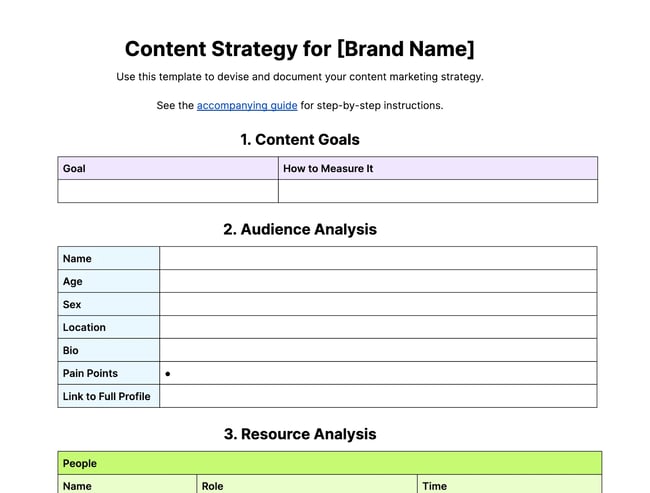
Content marketing only works when it's built on a clear, documented strategy. Without one, teams end up publishing inconsistently, targeting the wrong keywords, or creating content that doesn't map to any stage of the buyer journey.
Semrush's content strategy template gives you a structured framework for planning, organizing, and executing a content program that drives organic traffic and generates qualified demand at every funnel stage.
How to use it:
- Set SMART content goals. Start by defining what success looks like — for example, increasing organic traffic by 10% month-over-month or generating 50 new MQLs per month from blog content.
- Build your buyer personas. Use the template's persona framework to document demographics, psychographics, pain points, and purchasing behavior for each audience segment you're targeting.
- Audit your existing content. Identify what's performing, what's underperforming, and where there are gaps — especially across ToFu, MoFu, and BoFu stages.
- Conduct a competitor content analysis. See what topics and formats are working for your rivals, and use that intelligence to inform your own content roadmap.
- Establish your content creation guidelines. Define your publishing cadence, editorial tone, SEO requirements, and internal review process so execution stays consistent at scale.
2. Organic Social Media Campaigns
Template:
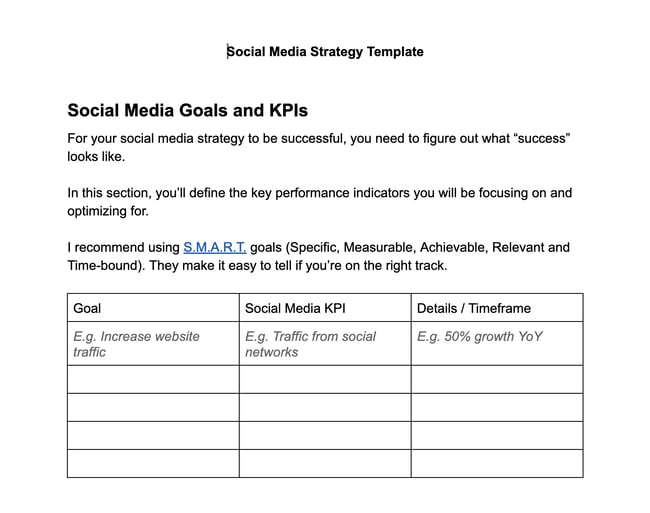
Posting on social media without a strategy is one of the most common demand generation mistakes SaaS companies make. Inconsistent messaging, unclear goals, and the wrong platform mix can drain your team's time without generating meaningful reach or engagement.
Backlinko's social media strategy template helps you build a structured, goal-driven social presence — one that's designed to grow your audience, drive traffic, and generate demand from the right buyers on the right platforms.
How to use it:
- Define your social media goals and KPIs. Tie your social goals to broader demand generation outcomes — such as increasing branded search volume, growing email list sign-ups from social, or improving share of voice in your category.
- Choose your platforms strategically. Use the template's platform-selection methodology — including Google Analytics audience data and competitive research — to identify where your buyers are most active rather than spreading yourself thin across every channel.
- Map content to audience segments. Organize your content calendar around your buyer personas and funnel stages so each post serves a clear demand generation purpose — whether that's building awareness, nurturing consideration, or driving conversion.
- Build your engagement and amplification plan. Outline how you'll respond to comments, activate employee advocates, and cross-promote content across channels to maximize organic reach.
- Set your measurement cadence. Review social KPIs weekly and monthly to identify what's resonating and adjust your content mix accordingly.
3. Social Proof
Template: Build Your Own Social Proof Library
Unlike the other strategies on this list, social proof doesn't have a single off-the-shelf template — because it's less about planning and more about systematically collecting, organizing, and deploying the evidence you already have.
The most effective approach is to build a structured social proof library: a centralized repository of customer quotes, case study summaries, review links, and outcome data that your marketing and sales teams can pull from at any stage of the buyer journey.
How to build yours:
- Identify your proof types. Organize your library by format — written testimonials, video testimonials, third-party reviews (G2, Capterra, Trustpilot), case studies, and usage statistics (e.g., "used by 10,000+ teams").
- Map proof to funnel stages. Assign each piece of social proof to the stage where it's most persuasive: broad testimonials for ToFu awareness, detailed case studies for MoFu consideration, and ROI-specific data points for BoFu conversion.
- Create a case study template. Standardize how you document customer success stories using a consistent structure: customer background → challenge → solution → results (with specific metrics).
- Build a review collection workflow. Define when and how you'll ask customers for reviews — for example, after a successful onboarding, following a support resolution, or at a renewal milestone.
- Audit and refresh regularly. Outdated social proof can hurt more than it helps. Review your library quarterly and retire any testimonials or case studies that no longer reflect your current product or customer base.
4. Pay-Per-Click (PPC) Advertising
Template:
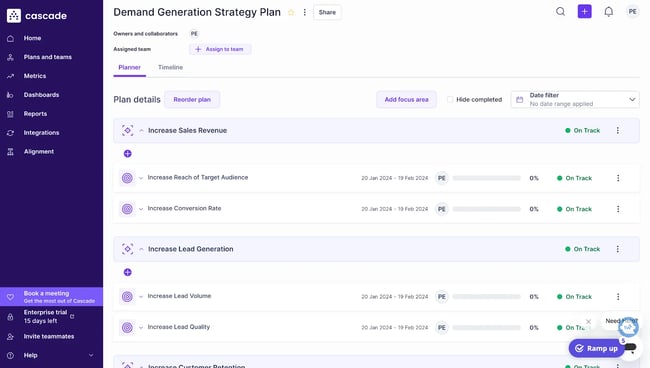
PPC campaigns can generate leads quickly — but without a clear strategic framework, they're easy to overspend on and hard to optimize.
Cascade's demand generation strategy template gives you the structure to set focused objectives, define measurable KPIs, and build out the campaign projects needed to hit your paid acquisition goals.
How to use it for PPC:
- Define your focus areas. Use the template's three focus area fields to set the overarching goals of your PPC program — for example, capturing high-intent search traffic, retargeting website visitors, or driving demo sign-ups from LinkedIn.
- Set SMART objectives for each focus area. For each PPC goal, write a specific, measurable objective — such as "achieve a cost-per-lead of under $75 from Google Search campaigns by end of Q2."
- Assign KPIs. Identify the metrics you'll use to track progress toward each objective, such as click-through rate (CTR), conversion rate, cost-per-click (CPC), and return on ad spend (ROAS).
- Build your campaign projects. Map out the specific campaigns, ad groups, landing pages, and A/B tests that need to be created and launched to achieve each KPI.
- Review performance against targets monthly. Use Cascade's tracking structure to assess whether your campaigns are on pace and reallocate budget where performance is strongest.
5. Email 糖心Vlog
Template:
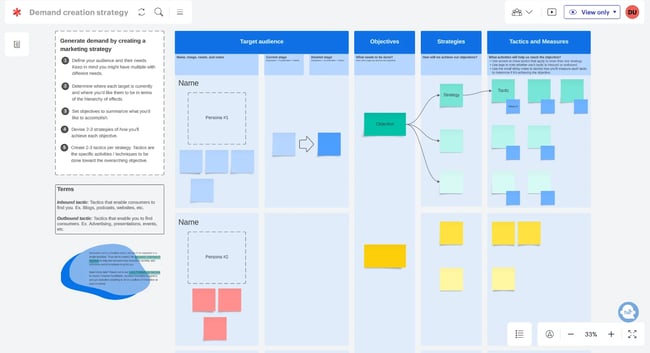
Email marketing is most effective when it's part of a deliberate, mapped-out demand creation strategy — not a series of ad hoc sends. Lucidspark's collaborative template helps your team think through the full arc of your email program: who you're targeting, what stage they're in, what you want them to do, and how you'll measure success.
How to use it for email marketing:
- Define your audience segments. Use the template to document each subscriber segment — by persona, funnel stage, or behavioral trigger — and identify the pain points and goals that should shape your messaging for each group.
- Map segments to funnel stages. Determine whether each segment is in the awareness, consideration, or decision stage, and plan your email content accordingly — educational newsletters for early-stage subscribers, nurture sequences for MoFu leads, and conversion-focused offers for bottom-funnel prospects.
- Set campaign objectives. For each email sequence or campaign, define a clear goal — such as moving leads from MQL to SQL, re-engaging dormant subscribers, or reducing churn through an onboarding series.
- Plan your tactics. List the specific email types you'll use to achieve each goal — welcome sequences, drip campaigns, promotional emails, product update announcements, re-engagement flows, and so on.
- Define your success metrics. For each campaign, identify the KPIs you'll track: open rate, click-through rate, conversion rate, unsubscribe rate, and revenue attributed to email.
6. Lead Scoring
Template: Build a Lead Scoring Matrix
Most CRM and marketing automation platforms (including HubSpot, Marketo, and Pardot) have built-in lead scoring tools, but the scoring model itself — the logic that determines what a "qualified lead" looks like — needs to be built by your team.
A lead scoring matrix is the foundational document that makes that model explicit, consistent, and measurable.
How to build yours:
- Define your ICP attributes. List the demographic and firmographic characteristics that make a prospect a strong fit — industry, company size, job title, geography, and technology stack. Assign a positive score to each (e.g., target job title = +15 points).
- Map behavioral signals to intent levels. Assign scores to actions based on how strongly they indicate purchase intent. For example: visited pricing page (+20), downloaded a product comparison guide (+15), opened three emails in a week (+10), watched a product demo video (+25).
- Apply negative scores. Reduce scores for disqualifying signals — such as a company size outside your ICP, a free email domain, or extended inactivity (e.g., no engagement in 60 days = ?10).
- Set your MQL threshold. Determine the minimum score at which a lead is considered marketing-qualified and ready for sales follow-up. Work with your sales team to validate this threshold against historical conversion data.
- Build scoring tiers. Consider creating multiple tiers — such as cold (0–30), warm (31–60), hot (61–85), and sales-ready (86+) — to enable more nuanced segmentation and outreach personalization.
7. Account-Based 糖心Vlog (ABM)
Template: Build a Target Account Playbook
ABM requires more personalization and coordination than most other demand generation strategies, which means documentation is everything. A target account playbook is a living document that captures your ICP criteria, target account list, account research, and coordinated outreach plan — keeping marketing and sales fully aligned throughout the campaign.
How to build yours:
- Define your ICP and account selection criteria. Document the firmographic, technographic, and behavioral signals that indicate a high-value account — including company size, industry, tech stack, growth signals, and budget indicators.
- Build your tiered target account list. Segment accounts into tiers based on revenue potential and strategic value (Tier 1: highly personalized outreach; Tier 2: semi-personalized; Tier 3: light personalization at scale).
- Research each Tier 1 account deeply. For your highest-priority accounts, document key stakeholders, their roles, known pain points, recent company news, and any existing relationship history with your brand.
- Map your outreach and content plan. For each account tier, define the channels (LinkedIn, email, direct mail, events), content types (personalized landing pages, custom case studies, exec briefings), and messaging angles you'll use.
- Set account-level goals and track engagement. Define what "engaged" and "progressed" look like for each account — such as a key stakeholder attending a webinar or a champion requesting a demo — and track these milestones in your CRM.
8. 糖心Vlog Automation
Template: Build a Workflow Map
Before configuring any automation in your marketing platform, you need a workflow map — a visual document that shows every trigger, condition, action, and branch in your automation logic. Without it, automation programs become impossible to audit, debug, or scale.
How to build yours:
- List your highest-priority automation use cases. Start with the workflows that will have the biggest impact on pipeline: lead nurture sequences, MQL handoff notifications, welcome series for new sign-ups, and re-engagement campaigns for inactive leads.
- Define the trigger for each workflow. Be specific: what action or condition initiates this workflow? (e.g., "Contact downloads gated eBook" or "Lead score reaches 60.")
- Map the decision branches. For each workflow, document the if/then logic — for example: "If contact opens email within 48 hours → send follow-up email. If not → wait 3 days → send alternative subject line."
- Assign content and CTAs to each step. Document exactly what email, offer, or message is delivered at each node of the workflow, and what action you want the contact to take.
- Define exit criteria and handoff points. Specify when a contact exits a workflow (e.g., books a demo, becomes a customer, unsubscribes) and what happens next — including automatic CRM notifications to sales.
9. Webinars and Virtual Events
Template: Build a Webinar Planning Checklist
Webinars are one of the highest-effort demand generation formats — but also one of the highest-converting. The difference between a webinar that fills your pipeline and one that gets a dozen no-shows usually comes down to execution. A detailed planning checklist ensures nothing falls through the cracks.
How to build yours:
- Define your topic, format, and audience. Choose a topic that addresses a specific, urgent pain point for your ICP. Decide on the format (solo presentation, panel, live demo, Q&A) and confirm who your target registrant looks like.
- Set your registration goal and promotion plan. Work backward from your registration target to define how many emails, social posts, and paid impressions you need to send — and when.
- Build your pre-event timeline. Work backward from the event date to assign deadlines for: landing page live, email invitations sent (4 weeks, 2 weeks, 3 days, and 1 day before), speaker prep calls, and slide deck finalization.
- Plan your live experience. Document the run-of-show: intro, presentation, Q&A, and CTA — including the specific offer or next step you'll present to attendees at the end (e.g., book a demo, download a resource, start a free trial).
- Build your post-event follow-up sequence. Segment attendees (attended full session, attended partial, registered but didn't attend) and create tailored follow-up emails for each group within 24 hours of the event.
10. Partner 糖心Vlog
Template: Build a Partner Campaign Brief
Partner marketing campaigns require alignment between two organizations with different priorities, audiences, and workflows. A partner campaign brief is a shared document that establishes the goals, responsibilities, timeline, and success metrics for each joint initiative — ensuring both parties stay aligned from planning through reporting.
How to build yours:
- Define the campaign objective and mutual value. Clearly state what both partners are trying to achieve and how each will benefit — whether that's audience reach, co-branded content, shared leads, or product integrations.
- Profile the target audience. Document the shared buyer persona you're both targeting, including their role, pain points, buying behavior, and where they consume content.
- Assign roles and responsibilities. Specify who owns each deliverable — content creation, design, email distribution, social promotion, landing page build, and lead follow-up.
- Set the campaign timeline. Build a shared project timeline with clear deadlines for every milestone, from kickoff call to post-campaign performance review.
- Define lead sharing and attribution rules. Agree upfront on how leads will be captured (a co-branded landing page, a shared form, or separate tracking links), how they'll be shared between partners, and how revenue will be attributed to the partnership.
FAQs About Demand Generation Strategies
What are demand generation strategies?
Demand generation strategies are the marketing and sales tactics a business uses to build awareness, create interest, and guide potential customers toward a purchasing decision. They span the entire buyer journey — from introducing your brand to someone who has never heard of you, to nurturing a warm lead into a paying customer.
Common demand generation strategies include content marketing and SEO, organic social media, email marketing, pay-per-click advertising, webinars, account-based marketing (ABM), lead scoring, marketing automation, social proof, and partner marketing.
The most effective demand generation programs combine several of these strategies to create a consistent, multi-channel presence that reaches buyers at every stage of the funnel.
What are the six steps in the demand generation process?
The demand generation process typically follows six steps. The first is identifying your target audience — defining your ideal customer profile (ICP) and understanding their pain points, goals, and buying behavior.
The second is building brand awareness, which involves getting your product in front of the right people through content, social media, paid ads, and partnerships. The third is capturing interest by converting that awareness into action — using gated content, free trials, webinars, and other lead magnets to collect contact information from engaged prospects.
The fourth is nurturing leads through targeted email campaigns, marketing automation, and personalized outreach that keep your brand top of mind until prospects are ready to buy.
The fifth is converting demand by turning qualified leads into customers through demos, consultations, competitive comparisons, and sales follow-up.
The sixth is retaining and expanding — using ongoing engagement, upselling, and customer success programs to reduce churn, maximize lifetime value, and turn customers into advocates who generate new demand on your behalf.
What are examples of demand generation?
Demand generation takes many forms across the buyer journey. A SaaS company publishing weekly SEO-optimized blog posts that answer their target audience's questions is doing demand generation.
So is a B2B brand hosting a monthly webinar series on industry trends, a startup running LinkedIn thought leadership content to build an audience before launching a product, or an enterprise software company executing a personalized ABM campaign targeting a list of 50 high-value accounts.
Other examples include a free tool or template offered in exchange for an email address, a podcast that builds brand trust with a niche audience over time, a co-marketing campaign run jointly with a complementary SaaS partner, and a retargeting ad campaign that re-engages website visitors who didn't convert on their first visit.
What these examples have in common is that they all focus on creating and sustaining demand — not just capturing it from buyers who are already in-market.
What is demand generation vs. lead generation?
Demand generation and lead generation are related but distinct. Demand generation is the broader strategy — it encompasses everything your business does to build awareness, educate your market, and create interest in your product, including reaching buyers long before they're actively searching for a solution.
Lead generation is a subset of demand generation focused specifically on converting that interest into action by capturing the contact information of individuals who are ready to engage more directly with your brand.
A simple way to think about it: demand generation builds the market, and lead generation harvests it. For example, a podcast that builds trust with a niche B2B audience is demand generation. When a listener from that podcast clicks through to download a gated guide and submits their email, that's lead generation.
Both are essential — without demand generation, your lead generation is limited to the small pool of buyers already in-market; without lead generation, the awareness you build never converts into a pipeline.
Elevate Your Business With Tested and Trusted Demand Generation Templates
Implementing the right demand-generation strategies and using these carefully crafted templates can help you build a powerful framework for attracting, engaging, and converting leads.
You’ll also be able to maintain (and increase) customer engagement and retention across all stages of the sales funnel, which is essential to generating recurring income and scaling your business.
Editor's note: This article was originally published in August 2014 and has been updated for comprehensiveness.
Lead Generation
![What is a lead magnet? 20 lead magnet ideas and examples [+ step-by-step]](https://53.fs1.hubspotusercontent-na1.net/hubfs/53/lead%20magnet%20represented%20by%20a%20magnet.webp)




![Gated Content: What Marketers Need to Know [+ Examples]](https://53.fs1.hubspotusercontent-na1.net/hubfs/53/UNGated%20Content.png)

![What is demand generation? Here’s how you can create buzz for your offering [FAQs]](https://53.fs1.hubspotusercontent-na1.net/hubfs/53/demand-generation-1-20251208-2900472.webp)