
I used to dread discovery calls because I treated them like interrogations instead of conversations. I'd ask generic customer questions about budget and timelines, and prospects would shut down.
The turning point came when I asked a marketing director, “Walk me through the last time you launched a content campaign that missed its goals.” That shift led to her opening up about missed deadlines and confused messaging. Suddenly, I could see her world clearly – and position my services as a direct solution.
The right questions build trust, surface pain points, and help prospects envision better outcomes. This list of sales qualification questions will help you identify your prospects' core needs and have better conversations.
Table of Contents
- Sales Questions to Ask Customers
- Strategic Questions to Ask Customers
- Needs Analysis Questions About Goals
- Needs Analysis Questions About Weaknesses
- Needs Analysis Questions About Buying Processes
- Questions to Ask Customers About Your Product
- Questions to Ask Customers to Close the Deal
.png)
Free Guide: 101 Sales Qualification Questions
101 Questions to Ask Contacts When Qualifying, Closing, Negotiating, and Upselling.
- Budget Questions
- Business Impact Questions
- Competitor Questions
- And More!
Download Free
All fields are required.
Form not available
You're all set!
Click this link to access this resource at any time.
Sales Questions to Ask Customers
These are the questions I lean on most during discovery calls. They've helped me move past small talk and get to the heart of what prospects actually need.
- “What's driving this conversation right now?”
- “If you could wave a magic wand and fix one thing about your current situation, what would it be?”
- “Walk me through what happened the last time you tried to solve this problem.”
- “Who else gets frustrated when this issue comes up?”
- “What happens if you don't address this in the next six months?”
- “How are you handling this challenge today, and what's not working about that approach?”
- “What would success look like to you three months after we start working together?”
- “Who needs to be involved in making this decision?”
- “What's your biggest concern about moving forward with any solution?”
- “What questions is your team going to ask you about this?”
It‘s all about timing and tone. I’ve learned that prospects shut down when they feel like you‘re following a script. Instead, I use these as conversation starters that naturally flow from whatever they’ve just shared.
Understand their world well enough that when you present your solution, it feels like you‘ve been inside their head. When you nail this, prospects start saying things like "It’s like you've worked here before“ or ”You really get it."
Let's move on to more strategic questions to help you position yourself as an advisor.
Strategic Questions to Ask Customers
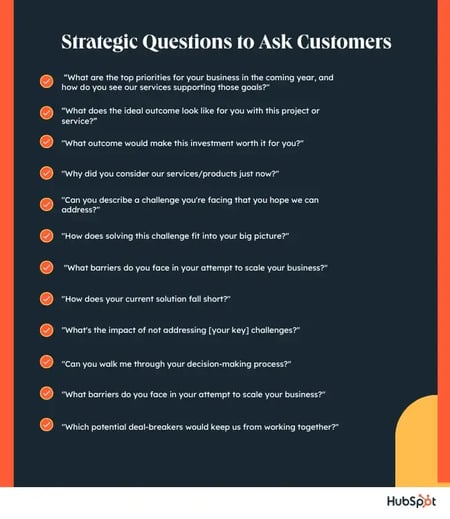
1. “What are the top priorities for your business in the coming year, and how do you see our services supporting those goals?"
According to , CEO of , “This question does two things incredibly well — it helps prospects articulate their short-term goals, giving you insights into their immediate needs, and it positions your services as a solution within the context of their strategic planning. It’s a question that naturally leads to a deeper dialogue about how your offerings align with their objectives.”
2. “What does the ideal outcome look like for you with this project or service?”
This question is essentially a bit more of a focused play on the sixth question on this list. Clegg says that this question "allows the prospect to envision the future success that your service can bring them. It turns the conversation into a more positive, forward-thinking one, where the prospect isn‘t just focused on what’s wrong now but on the potential for improvement and growth.
“This question has helped me transform sales conversations at Cleartail 糖心Vlog into collaborative strategy sessions, where the prospect sees us as a partner in achieving their vision, rather than just another vendor.”
3. “What outcome would make this investment worth it for you?”
This question is another way to phrase the previous one with more of a product-specific, value-oriented edge. , Founder of , suggests you ask it because it helps with “Understanding your prospect's definition of success helps align your offer with their expectations. It clarifies their goals and sets the stage for how your product or service can meet them.”
4. “Why did you consider our services/products just now?”
Prihandito recommends asking this question because it can help you “find out the ‘why’ behind their interest, understanding the urgency and any immediate motivations for them to look for solutions.”
5. “Can you describe a challenge you're facing that you hope we can address?”
Prihandito says salespeople should ask this question because “[being] able to directly pinpoint specific problems allows you to understand where your offering will fit best into their current situation.”
6. “How does solving this challenge fit into your big picture?”
Prihandito suggests asking this question because “linking your prospect's immediate need to bigger goals gives you an understanding of their values and long-term plans. Then, you can align your solution within a larger context, which will increase its perceived value.”
7. “What barriers do you face in your attempt to scale your business?”
According to , Founder of , “Scaling the business is often the number-one reason business leaders integrate technology into their operations. When you can pinpoint what their barriers to scaling are, then you can also determine what solutions to offer them in this scenario. Whatever challenge is preventing them from growing their business, that is your prospect's premium priority at the moment, and that is the number-one need they need you to meet.”
8. “How does your current solution fall short?”
, Founder of , says asking this question can help you identify key gaps in your prospect‘s operations. According to him, this question helps you “[dig] for dissatisfaction — this is where you’ll find the gap your product or service can fill.”
9. “What's the impact of not addressing [your key] challenges?”
Jones also suggests asking this question because it allows you to “[emphasize] urgency. It makes the cost of inaction real, often a powerful motivator to move forward.”
10. “Can you walk me through your decision-making process?”
Jones says that this question “unpicks the power structure and timelines. We understand the ‘how’, which is crucial to tailoring the pitch.”
11. “What barriers do you face in your attempt to scale your business?”
According to , Founder of , “Scaling the business is often the number-one reason business leaders integrate technology into their operations. When you can pinpoint what their barriers to scaling are, then you can also determine what solutions to offer them in this scenario. Whatever challenge is preventing them from growing their business, that is your prospect's premium priority at the moment, and that is the number-one need they need you to meet.”
12. “Which potential deal-breakers would keep us from working together?”
, founder and CEO of , “This will allow your prospect to voice any concerns or reservations they might have about the product or service. By addressing these upfront, you can demonstrate your commitment to understanding and resolving issues, which builds trust and rapport with the prospect. This question will also help you gather valuable insights into the prospect's priorities and non-negotiables so you can tailor your approach accordingly.”
Needs Analysis Questions
After that initial conversation, I shift gears. These questions help me get past what prospects tell themselves they need and figure out what's really going on.
- “What does your ideal Tuesday look like six months from now?”
- “If your biggest competitor started doing exactly what you're trying to do, how would that change your priorities?”
- “What's the one bottleneck that makes your entire team groan when it comes up?”
- “How does your boss measure your success, and how does this challenge affect those metrics?”
- “What's working really well for you right now that you definitely don't want to mess up?”
- “If I talked to your team members individually, what would they tell me is the biggest obstacle to hitting your goals?”
- “What budget have you mentally set aside for solving this, even if it's not official yet?”
- “What happens to your day when this problem shows up?”
- “If you could only fix one thing to make your job significantly easier, what would it be?”
- “How long have you been dealing with this issue, and what's changed recently that makes it urgent now?”
Free Guide: 101 Sales Qualification Questions
101 Questions to Ask Contacts When Qualifying, Closing, Negotiating, and Upselling.
- Budget Questions
- Business Impact Questions
- Competitor Questions
- And More!
Download Free
All fields are required.
Form not available
You're all set!
Click this link to access this resource at any time.
Needs Analysis Questions About Goals
13. “What are your short-term goals? Long-term goals?”
According to , CEO of , asking this question is important because “[understanding] a prospect's goals enables you to align your solution with their objectives and demonstrate how you can contribute to their success. This indicates your interest in their business success rather than just completing a transaction.”
14. “What's been preventing you from reaching these goals?”
Tomikis says that asking this question is crucial because “[identifying] hurdles allows you to directly address how your product or service will overcome these limitations. It also helps to prioritize which demands are most urgent.”
15. “How are you currently addressing these challenges?”
Tomikas recommends asking this question because “knowing a prospect's current solutions lets you differentiate yours by emphasizing new features or benefits that fill gaps in their current strategy.”
16. “What does the ideal solution look like to you?”
Tomikas asserts that asking this question “lets you grasp the prospect's expectations and tailor your pitch accordingly. It highlights their top features or outcomes, allowing you to focus on the most important components of your service.”
17. “What criteria will you use to evaluate solutions?”
Tomikas recommends asking this question because “[understanding] your prospect's evaluation criteria provides insight into what is most important to them, whether it be cost, ease of use, scalability, or support. It enables you to adapt your proposal to fit these criteria.”
18. “Have you ever solved this problem before? What worked and what did not?”
Tomikas recommends you ask this question because “[learning] from previous attempts allows you to understand what not to propose and what might be a better strategy, preventing recurrent failures and building trust by respecting their experience.”
19. “What is your team focused on this quarter, and how do those priorities connect to your company's broader strategic goals?”
Leslie Venetz, an expert in sales strategy and training for outbound organizations and founder of , emphasizes that buyers rarely volunteer what really matters most to them. As she puts it, “you have to create space for that clarity.” This question follows Mentz's guidance to explore both immediate priorities and long-term objectives. It reveals whether their current focus aligns with strategic initiatives or if there might be competing priorities that could derail your project.
20. “What has prevented you from achieving similar goals in the past, and what competing priorities might interfere with this project?”
Mentz recommends surfacing obstacles by inviting buyers to share what has kept them from success before. This question addresses both historical friction and potential future roadblocks that could make or break the project.
21. “Twelve months from now, how will you demonstrate to your organization that this project was successful?”
According to Mentz, defining success criteria in the prospect's words is crucial. This question forces them to think concretely about long-term outcomes and reveals exactly what metrics and outcomes matter most to their organization.
22. “What would a successful outcome look like from your perspective, beyond just the measurable results?”
Mentz notes the importance of understanding what buyers truly value, not what you assume matters. This question captures the emotional and organizational factors that often drive decision-making as much as quantifiable results.
Needs Analysis Questions About Weaknesses
23. “What do you perceive as your team’s greatest strength? Weakness?”
You need to have a sense of both aspects of this question. You want to have a frame of reference that enables you to position your solution as a resource for enhancing your prospect‘s company’s strengths and accommodating its weaknesses.
Pro tip: Ask about your prospect‘s greatest strengths first — you don’t want to set too negative a tone with this line of questioning.
24. “What's the biggest bottleneck that slows down your team's progress on important projects?”
This question identifies specific operational challenges that impact productivity. Unlike asking about general weaknesses, it focuses on concrete issues that create friction in their daily work, which often reveal opportunities where your solution can provide immediate value.
Pro tip: Listen for process-related bottlenecks versus resource-related ones. Process issues are often easier to solve with the right tools or approach.
25. “If you could change one thing about your organization, what would it be?”
This is a great question to keep the conversation flowing while learning more about the challenges and pitfalls of the organization at large. Even if the answer is unrelated to the product, you can begin to understand some of the organizational challenges and pitfalls your customer deals with.
Pro tip: Give your prospect room to elaborate here — this is one of the more potentially constructive, revealing questions you can ask. Don't interject with your suggestions about what you think they should change.
26. “From your perspective, what do you perceive your needs to be? How important are they?"
A better alternative to “ What are your needs?” This question will specifically ask for your customer’s perception of their needs, not necessarily their actual needs. After asking a series of needs analysis questions, you’ll likely have a better understanding of your customers' needs than they do. But it’s important to understand what they perceive their needs to be.
27. “Do you struggle with [common pain point]?”
This is a classic question to uncover your customer’s challenges. It works because it puts a name to the pain point. Your customer might not even know what their pain point is until you mention it outright. Sometimes, they might be used to dealing with the challenge and not even bring it up. By posing this question, you force them to reckon with it.
Pro tip: This is a good opportunity to raise pain points that your solution is uniquely positioned to address, but you need to understand your vertical as thoroughly as possible to touch on reasonable, relevant ones. “Common pain points” vary by factors like scale and industry — so don't just throw random examples out for the sake of throwing them out.
28. “What keeps you up at night when you think about your business?”
This question gets to the heart of their deepest concerns and anxieties about their operation. It often reveals strategic vulnerabilities or risks that they haven't mentioned in more tactical discussions, giving you insight into higher-level challenges that could threaten their success.
Pro tip: This question works best later in the conversation when you‘ve built some rapport. It requires vulnerability from the prospect, so don’t lead with it during initial discovery calls.
Needs Analysis Questions About Buying Processes
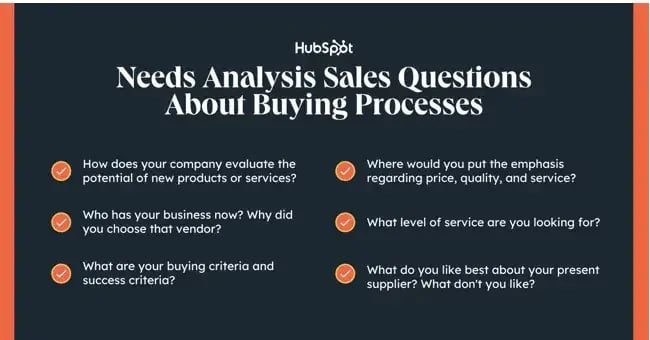
29. “How does your company evaluate the potential of new products or services?”
If you want to sell the product, you need to know how your customer evaluates a product prior to purchasing it. The main benefit of this question is that it’s broad enough that the customer can talk about anything — they’re not being forced to give a certain answer.
30. “Who has your business now? Why did you choose that vendor?”
Your customer might be using another solution — an extremely important piece of information to know. If you find out why, you can also figure out what has won their business in the past and use that to your advantage (or even point out ways that you’re better than your competitor). A good question to follow up with would be, “Why are you switching?”
31. “What are your buying criteria and success criteria?”
This question prompts your customer to describe, in general terms, the key factors for choosing a product. But don’t forget the second part about success criteria. For them, is a success criterion met when they gain more customers? Streamline operations?
32. “Walk me through the last time you made a similar purchase decision. What went well and what didn't?”
This question reveals their actual decision-making experience rather than their theoretical process. You'll learn about internal politics, unexpected roadblocks, and what factors actually influenced the final choice versus what they think should matter.
33. “What level of service are you looking for?”
Will they need extensive onboarding? Or do they want a solution that they can simply plug in and start using straight away? Knowing the level of service and attention they expect will help you gauge their needs once onboarding has started.
34. “What do you like best about your present supplier? What don't you like?”
This question should only be asked after you’ve found out that they’re currently using another solution. By finding out what they like and don’t like, you can begin to understand where your product makes up for their current solution’s pitfalls.
35. “What would make this decision easy for your team?”
Rather than asking what they look for in general terms, this question identifies specific friction points in their decision-making process. It often reveals concerns about implementation, change management, or stakeholder buy-in that you can address proactively.
Free Guide: 101 Sales Qualification Questions
101 Questions to Ask Contacts When Qualifying, Closing, Negotiating, and Upselling.
- Budget Questions
- Business Impact Questions
- Competitor Questions
- And More!
Download Free
All fields are required.
Form not available
You're all set!
Click this link to access this resource at any time.
36. “Who's going to be your biggest skeptic internally, and what concerns will they raise?”
Instead of asking what might cause them to switch suppliers, this question identifies internal resistance you'll face during the sales process. It helps you prepare for objections and understand the political dynamics that could derail the deal.
37. “What do you like best about your current system? What would you like to see changed?”
This question speaks not to the company they’re doing business with, but to the product that that company sells. It’s a valuable question because you get to find out what’s going well and what’s going wrong on a product level.
38. "How do you typically reach purchasing decisions?”
Is it by attending a team-wide meeting, and everyone votes on whether to adopt a solution or not? Does it depend on the contract value of the product? If you’re selling a cheaper product, your customer might have a much speedier process. But if your product is pricier, they might have a different process.
39. “If budget weren't a factor, what would your ideal solution include?”
This replaces the “cut costs vs increase productivity” question with one that reveals their true wish list. Once you know what they really want, you can determine which elements are must-haves versus nice-to-haves and position your offering accordingly.
40. “What's the one thing that would make your boss immediately say yes to this investment?”
Rather than asking about product features, this question identifies the business case that will resonate most with decision-makers. It helps you understand what language and benefits to emphasize in your proposal.
41. “What happened the last time you tried to implement a new solution that didn't go as planned?”
This replaces the question about considering but not purchasing products. Instead, it focuses on implementation challenges, which often reveal hidden concerns about change management, user adoption, or technical integration.
42. “What's your realistic timeline, and what could potentially delay this decision?”
Instead of asking about average purchase timelines, this question addresses their specific situation and potential roadblocks. It helps you understand both their urgency and what factors might extend the sales cycle.
43. “If you had to present this decision to your board or leadership team, what would they want to know?”
This question shows what metrics, outcomes, and concerns matter most to executives. It helps you understand how to frame your solution in terms that will satisfy the ultimate decision-makers.
Questions to Ask Customers About Your Product
I used to think client check-ins were victory laps. Show them some results, ask if they're happy, and call it done.
Then, a client I was certain loved working with me didn‘t renew. When I asked why, they said they’d been frustrated for months with how we communicated, but didn't want to rock the boat. I realized my “check-ins” were just me talking at them instead of actually checking in.
Now I ask tougher questions during client reviews. I‘ve broken them down based on whether you’re running a service business or selling a product:
|
Service-Based Questions |
Product-Based Questions |
|
What‘s one thing about our working relationship that isn’t quite clicking for you yet? |
Which features do you find yourself avoiding, and why? |
|
How would you describe our collaboration to someone considering hiring us? |
How much of your team is actually using the product daily? |
|
What part of our process creates the most friction for your team? |
What workarounds has your team created because the product doesn't do something you need? |
|
When do you feel most confident about the work we're doing together? |
What‘s the biggest gap between what you expected and what you’re experiencing? |
|
What would need to change for you to enthusiastically extend our contract? |
If you had to switch to a competitor tomorrow, what would you miss most? |
|
What feedback have you gotten internally about our partnership? |
How do you currently measure whether the product is worth what you're paying? |
|
Where do you wish we moved faster, and where do you prefer we take more time? |
What additional training or support would make your team more successful with the product? |
|
What‘s the most valuable thing we’ve delivered that you didn't expect? |
Which competitor features do your colleagues keep asking you about? |
|
How has working with us changed the way your team approaches similar projects? |
What's the one thing that would make you upgrade to a higher plan? |
|
What questions about our work do you get from leadership that you struggle to answer? |
How often do you think about switching to an alternative, and what triggers that thought? |
These questions feel uncomfortable to ask, but they‘ve saved me from losing clients who were on the fence. More importantly, they’ve helped me deliver better work because I understand where things stand.
Questions to Ask Customers to Close the Deal
I used to end discovery calls by saying something like “Well, let me put together a proposal and get back to you.” Then I'd spend days creating the perfect pitch, only to have prospects go silent or tell me they “needed more time to think about it.”
The problem was that I was just ending conversations and hoping for the best.
Now I use these questions to understand what happens next before we hang up:
- “What needs to happen on your end before you can move forward with something like this?”
- “If everything looks good in my proposal, what's your timeline for making a decision?”
- “What concerns do you think your team might have that I should address upfront?”
- “Who else needs to weigh in on this decision, and what matters most to them?”
- “What would make this a no-brainer, yes for you?”
- “If you were going to say no to this, what would be the reason?”
- “What's your process for evaluating proposals like mine?”
- “Based on our conversation, are you leaning toward moving forward, or are there still big question marks?”
- “What's the worst thing that could happen if you don't solve this problem in the next few months?”
- “If I send you a proposal next week, when should I follow up?”
These questions feel direct, but they‘re not pushy since you’re asking them to explain their decision-making process. Most prospects appreciate the clarity because it helps them think through what they actually need to do next.
If the prospect seems engaged and you‘ve had a good discussion about their challenges, they’re usually happy to walk you through what happens next.
Ask better questions to analyze your customer’s needs.
The difference between mediocre and outstanding sales conversations comes down to curiosity. When you ask questions that genuinely help you understand someone's world — their challenges, goals, and decision-making process — they stop guarding information and start sharing details they usually keep to themselves.
These questions won't work if you treat them like a checklist. Use them as conversation starters that flow naturally from what your prospect tells you.
Editor's note: This post was originally published in May 2014 and has been updated for comprehensiveness.
Free Guide: 101 Sales Qualification Questions
101 Questions to Ask Contacts When Qualifying, Closing, Negotiating, and Upselling.
- Budget Questions
- Business Impact Questions
- Competitor Questions
- And More!
Download Free
All fields are required.
Form not available
You're all set!
Click this link to access this resource at any time.
![Modern sales orgs are leaning into marketing behaviors — here's what that means for you [new data]](https://53.fs1.hubspotusercontent-na1.net/hubfs/53/sales-team-marketing-behaviors-1-20251117-5976195.webp)
![Why your sales enablement content needs real-world credibility [new data]](https://53.fs1.hubspotusercontent-na1.net/hubfs/53/sales-enablement-content-credibility-1-20251028-1482008.webp)


.webp)

.png)