
I still remember the first cold call that truly clicked. It wasn’t the perfect pitch. It wasn’t my CRM showing me a killer insight. It was the moment the prospect paused and said, “I feel like you actually get what I’m going through.”
That’s when I realized: Rapport isn’t a soft skill. It’s the whole foundation.
In sales, especially over the phone, you don’t get visual cues, fancy decks, or firm handshakes. All you have is your tone, your timing, and your ability to make a stranger feel heard fast. And if you’ve done thousands of calls like I have, you know rapport isn’t built by luck or charm. It’s built by design.
So in this post, I’m going to walk you through the techniques I’ve used to build trust, break the ice, and move deals forward. All without ever seeing the other person’s face. Let’s dive into what phone rapport really means and how to master it.
Table of Contents
What is rapport in business?
When people talk about rapport, they often think of small talk or surface-level friendliness. But in business, and especially in sales, rapport goes much deeper than that.
Rapport is the invisible bridge between two people who trust each other enough to have an honest conversation. It’s that moment when a prospect stops seeing you as a salesperson and starts seeing you as a partner who actually wants to help.
In my experience, true rapport isn’t built with tricks or rehearsed lines. It’s built through presence. It’s when you’re fully tuned in, listening to their tone, picking up on their hesitation, and mirroring their pace naturally. On the phone, you don’t have body language to lean on, so you have to build a connection through your voice. The rhythm of your tone, the pauses you take, the way you say their name. These details make all the difference.
To me, rapport is trust in motion. It’s what turns a cold call into a real conversation, and a first-time buyer into a lifelong client. And when done right, it 诲辞别蝉苍’迟 just make the sale easier. It makes the experience better for both sides.

Free Sales Plan Template
Outline your company's sales strategy in one simple, coherent sales plan.
- Target Market
- Prospecting Strategy
- Budget
- Goals
Download Free
All fields are required.
Form not available
You're all set!
Click this link to access this resource at any time.
Why is building rapport important?
If I’ve learned one thing after 11,000+ cold calls and hundreds of discovery conversations across multiple continents, it’s this: Deals don’t close because of product features. They close because of human connection.
When you’re selling over the phone, you don’t have eye contact, body language, or a polished pitch deck to fall back on. All you have is your voice: your tone, your energy, and your ability to make someone feel like they’re talking to a real human, not a script. That’s where phone rapport becomes your superpower.
In my early days selling to VPs and C-levels, I used to rush into feature talk, thinking the faster I could show value, the better. But what I noticed? The calls felt cold. People stayed guarded. The conversation never left the transactional zone. It wasn’t until I started slowing down, leading with curiosity, and actually listening (really listening!) that things changed.
Building rapport isn’t just about being liked. It’s about building trust in seconds. It’s about lowering the buyer’s defenses so they feel safe telling you what’s really going on. And when they open up, that’s when the real sales conversation begins.
When a prospect senses that you genuinely care, they start to see you as a partner, not a pitch. That’s when deals accelerate, referrals show up, and you stop being seen as a vendor and start being invited into strategy.
I’ve booked meetings off one-liners like “I noticed you’ve been hiring data scientists, how’s that scaling going?” not because the line was magic, but because the tone behind it said: I see you. I did my homework. I’m here to help, not sell.
That’s the power of rapport. It turns a cold call into a warm handshake. And in today’s sales world, where trust is the real currency, rapport isn’t a soft skill. It’s a closing skill.
How to Build Rapport Over the Phone
Over the phone, you don’t get body language or make eye contact. There’s no warm office handshake, no espresso in the lobby, no chance to read the room before you speak.
All you get is your voice and a few seconds to make it count.
Phone rapport is one of the most overlooked skills in modern sales, yet it’s the foundation for nearly every deal I’ve closed. And I’m not talking about sounding “friendly” or “excited.” That’s surface-level. What I’ve learned is that rapport over the phone isn’t about tone alone; it’s about emotional precision.
How you make someone feel in the first 60 seconds determines whether they lean in or tune out. According to , top-performing reps establish trust and credibility 22% faster than average reps — not because they speak faster, but because they ask the right questions, listen more, and sound calm, confident, and in control.
Over the years, I’ve had to win trust from strangers across the world (CEOs in London, CTOs in Dubai, VPs in Chicago) all without ever shaking hands or showing a single slide. Just my voice.
Phone rapport isn’t about following a script. It’s about building a bridge, fast and strong, with nothing more than your words, your tone, and your intention.
And the truth is, that skill compounds. Because the better you get at building rapport over the phone, the more doors you open, not just for meetings, but for meaningful conversations that actually go somewhere.
And here’s what I’ve learned works.
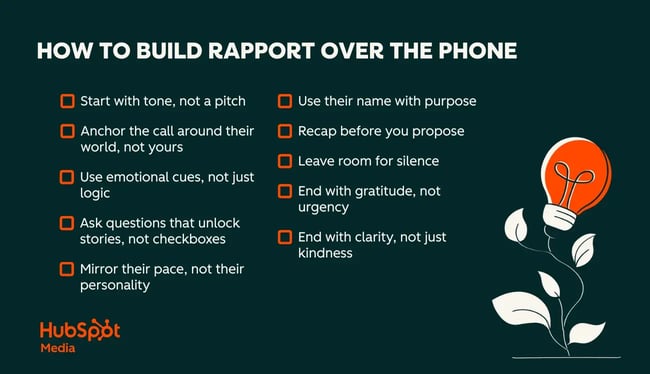
1. Start with tone, not a pitch
Your tone sets the emotional temperature of the call.
When I call someone, I always smile before I speak, not because it’s cheesy, but because it shifts my energy. People can hear that warmth. I open with their name, share exactly why I’m calling, and keep it human.
If you rush in with a value prop or talk like a robot, they’ll tune out. But if you sound like someone who respects their time and has something meaningful to say, they’ll give you a shot.
Here’s a real line I use often: “Hey John, I’ll be super brief. I noticed something about how your team’s scaling AI initiatives, and I thought it was worth a quick call.”
Clear. Calm. Human.

2. Anchor the call around their world, not yours
Too many reps sound like they’re presenting. But the best rapport starts with relevance.
Before every call, I review their LinkedIn, recent funding news, or team hires. I don’t “pitch.” I anchor the conversation in their context and let them know I did my homework.
One VP of Engineering once told me, “You’re the first vendor who mentioned the fact that we just launched in LATAM. Everyone else just spammed their pitch.”
That alone got me 30 more minutes and eventually, the deal.
3. Use emotional cues, not just logic
Building rapport isn’t just about saying “I understand.” It’s about sounding like you mean it.
When a prospect shares a frustration (budget cuts, too many tools, team burnout), I listen without interrupting. Then I reflect it back in plain human terms.
I don’t say, “That must be frustrating.” I say, “Yeah, when priorities keep shifting, it’s exhausting — I’ve seen founders get stuck in ‘pilot purgatory’ because no one wants to own the rollout.”
That kind of mirroring (emotional + situational) earns trust.
4. Ask questions that unlock stories, not checkboxes
Discovery isn’t about going through your CRM fields. It’s about unlocking why they care.
I ask open-ended questions like:
- “What’s been the hardest part about scaling this?”
- “If this problem 诲辞别蝉苍’迟 get solved by next quarter, what happens?”
- “What’s one thing your CFO 诲辞别蝉苍’迟 want to hear again?”
When people talk about problems in their own words, they feel understood. That’s rapport. And when they share something personal, like stress from a recent failed rollout, that’s gold. Because now you’re not a vendor. You’re a sounding board.
5. Mirror their pace, not their personality
One of the best ways to build subconscious trust? Match their tempo. If they speak fast and to the point, I tighten my delivery. If they pause and reflect, I slow down and give space.
I once had a prospect in Zurich who was slow and methodical in his speech. Early in my career, I thought I had to “energize” the call. It backfired. He felt rushed.
Now? I listen first, match pace second, and speak third. Because pace shows respect.
6. Use their name with purpose
Saying someone’s name isn’t a trick: it’s a signal of attention. But, you can overdo it. I’ll use their name at the start to open warmly, once mid-conversation to re-engage, and again at the end to close with intention.
For example:
- “That makes total sense, Paul.”
- “Appreciate you sharing that, Mariana.”
- “I’ll shoot over a summary, John — thanks again for the time.”
It creates a thread of presence. And people notice when you’re truly present.
7. Recap before you propose
Before I ever talk about next steps or share a deck, I always do a 30-second recap.
It sounds like this: “Just to make sure I got this right. You’re trying to reduce onboarding friction, unify three data sources, and make sure your CS team 诲辞别蝉苍’迟 drown in alerts. And this needs to happen before Q4, or the board will delay the Series C?”
When I hear “Exactly, that’s it,” I know I’ve earned their attention.
Now, I have permission to propose.
8. Leave room for silence
Most reps fear silence on a sales call. I embrace it. Silence gives your prospect space to think, vent, or reflect. It also shows you’re not in a rush to talk to them.
I once waited 7 seconds after asking, “What’s the real blocker behind this?”. And the VP finally said, “Honestly, it’s fear. No one wants to own the change.”
That moment changed the whole deal.
9. End with gratitude, not urgency
Your close isn’t a countdown. It’s a thank you.
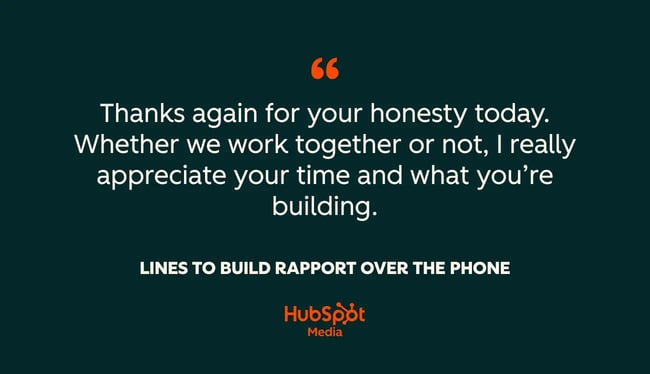
Even if there’s no clear next step, I always end with, “Thanks again for your honesty today. Whether we work together or not, I really appreciate your time and what you’re building.”
That one sentence has led to follow-ups weeks later that started with, “Hey, I remembered our chat…” Because respect lingers long after the call ends.
10. End with clarity, not just kindness
Kindness builds rapport. Clarity keeps it.
After years of cold calling, I’ve learned that rapport without next steps is like a great movie with no ending. You might’ve had a great chat, but if the prospect hangs up unclear about what happens next, the momentum dies.
So before you close the call, anchor the relationship in clarity. Confirm the next step, whether it’s a follow-up call, an intro to a colleague, or a proposal coming their way. Repeat it back in simple terms, then follow through faster than expected.
That’s how trust compounds.
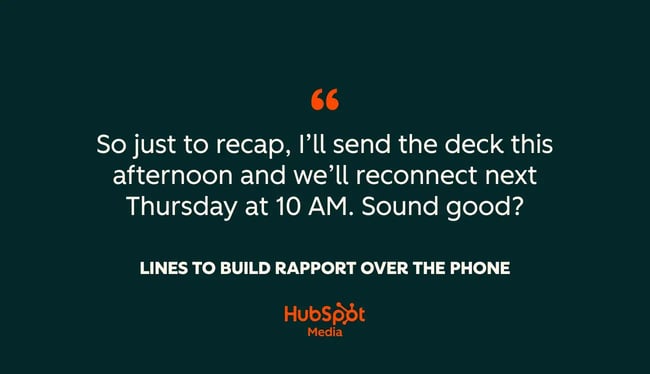
“So just to recap, I’ll send the deck this afternoon and we’ll reconnect next Thursday at 10 AM. Sound good?” That one sentence can turn a warm call into a real opportunity.
Rapport 诲辞别蝉苍’迟 end with the call: It starts with how you show up.
Over the years, I’ve learned that building rapport over the phone is less about tactics and more about presence. The words matter, yes. But how you say them, when you pause, how deeply you listen, and the energy you bring to each conversation are what actually forge a connection.
When I stopped trying to “win” calls and started focusing on creating micro-moments of trust, everything changed. Prospects opened up. Deals moved faster. And I no longer had to rely on scripts to sound like a human.
This post wasn’t just a checklist of techniques. It was a reflection of what I’ve seen work in real-life, high-stakes calls across industries and cultures. And if you’ve ever felt like you’re one sentence away from either earning trust or losing it? You’re not alone. I’ve been there too.
Phone rapport is a skill, but more than that, it’s a mindset: show up curious, stay present, and never forget there’s a real person on the other side of the line.
And that person is more likely to say “yes” when they feel heard.
Editor's note: This post was originally published in December 2022 and has been updated for comprehensiveness.
Free Sales Plan Template
Outline your company's sales strategy in one simple, coherent sales plan.
- Target Market
- Prospecting Strategy
- Budget
- Goals
Download Free
All fields are required.
Form not available
You're all set!
Click this link to access this resource at any time.
Sales Calls