An email drip campaign — also known as drip marketing — is an automated series of emails sent to contacts based on specific triggers or timelines. Drip campaigns help nurture leads, onboard customers, and drive conversions by delivering the right message at the right time.
To create an effective drip campaign, marketers must define their goal, segment their audience, choose an automation platform, write compelling emails, and measure results. Email tools like can help with every step of this process.
In this guide, explore the most common types of email drip campaigns and drip campaign examples for inspiration. Also, find step-by-step tips for creating the first email drip campaign, according to experts.
Table of Contents
- What is an email drip campaign?
- Types of Email Drip Campaigns
- How to Create Your First Email Drip Campaign
- Email Drip Campaign Best Practices
- Email Drip Campaign Templates
- Email Drip Campaign Examples
- Email Drip Campaign FAQs
What is an email drip campaign?
An email drip campaign is a type of automated email marketing strategy that sends email sequences triggered by user actions or timelines. Think of it like a steady drip from a faucet — hence the name “drip marketing” — where each message builds on the previous one to guide prospects through the sales funnel.
An email drip campaign is different from a regular email blast as drip campaigns respond to user behavior. When someone downloads a white paper, abandons their cart, or signs up for a trial, they automatically enter a tailored email sequence designed to nurture that specific action.
Effective drip campaigns increase lead engagement and conversion rates. In my experience, investing in lead-nurturing email marketing campaigns is much better than sending out abrupt, single emails. The former helps build a strong relationship with potential customers, while the latter just looks sales-y and might drive leads away. According to HubSpot research, segmented emails drive 50% more clickthroughs and 30% more open rates than unsegmented ones.
How Drip Campaigns Work
Drip campaigns operate on three core principles:
- Triggers. Every campaign starts with an action — a form submission, purchase, or even inactivity. These triggers tell the automation platform when to start the sequence.
- Timing. Emails are spaced strategically. A brand might send a welcome email immediately, a follow-up three days later, and a special offer after one week. The timing depends on the audience and goals.
- Personalization. Modern drip campaigns use subscriber data to customize content. From using their first name to recommending products based on browsing history, personalization drives engagement.
Pro tip: HubSpot enables personalized and automated email drip campaigns.
50 Free Sales Email Templates
Save time, find new ways to reach out to prospects, and send emails that actually convert.
- First-Touch Emails
- Follow-Up Emails
- Break-Up Emails
- ChatGPT Email Prompts
Download Free
All fields are required.
Form not available
You're all set!
Click this link to access this resource at any time.
Key Components of Effective Drip Campaigns
Every successful drip campaign includes:
- Clear goals. Whether it’s converting trials to paid users or re-engaging dormant customers, marketers should define the objective upfront.
- Audience segmentation. Group subscribers by behavior, preferences, or demographics for targeted messaging.
- Compelling content. Each email should provide value while moving recipients toward the goal.
- Automation rules. Set conditions for advancing, pausing, or exiting subscribers from the sequence.
- Performance tracking. Monitor open rates, clicks, and conversions to optimize the campaigns.
贬耻产厂辫辞迟’蝉 help marketers automate their sends and create a drip campaign.
Types of Email Drip Campaigns
The types of drip campaigns marketers can use for their business depend on the goals. Drip email campaigns don’t have to be about direct sales. Businesses use them to reduce cart abandonment rates, convert blog visitors into buyers, re-engage customers, or simply welcome new subscribers.
, marketing consultant at , uses drip emails for event management.
She says, “Someone registers to attend an event, and they get an email confirmation. [...] You need to give them a reason to actually attend the event they registered for. This can all be done effectively with drip campaigns.”
There are no limits to the types of drip campaigns marketers can create, but most of them fit into these categories.
1. Onboarding Email Drip Campaign
Onboarding emails are automated emails that are sent to leads right after they subscribe, register, or sign up for an account through a website. Recent research reveals that welcome emails have an .
Onboarding email campaigns typically include:
- A simple welcome email.
- An email that introduces the products or services.
- An exclusive limited-time discount for new members.
2. Retargeting Email Drip Campaign
A retargeting drip campaign targets people who’ve shown initial interest in a business but failed to convert. For example, let’s say a prospect clicked on a social media ad and visited a website, but didn’t make a purchase. Marketers can attempt to convert them using a retargeting drip email campaign.
3. Post-Demo Email Drip Campaign
A post-demo email drip campaign is an automated email that gets sent after someone has watched a product demo. This type of email can offer further educational resources, such as a one-on-one demo or tutorial. It can also help convert the lead by offering an exclusive free trial or presenting video testimonials from other clients.
4. Post-Purchase Email Drip Campaign
Post-purchase drip campaigns are sent after a customer makes a purchase. These types of drip campaigns help strengthen customer relationships and can include:
- A survey to gain insights into the customer’s experience.
- Related products they might like.
- A helpful resource related to the item purchased.
- An exclusive offer to encourage brand loyalty.
5. Cart Abandonment Email Drip Campaign
In 2025, abandoned their shopping carts. Cart abandonment emails remind customers of their abandoned carts, increasing the chances of making a sale.
Increase the success of an abandoned cart email by including:
- A notification about limited product quantity.
- A special offer, such as free shipping or a discount.
- A reminder containing a preview of the customer’s cart.
- Request for feedback on why the customer abandoned their cart.
贬耻产厂辫辞迟’蝉 allow marketers to create emails with a drag-and-drop tool, personalize emails with information from the CRM, and use to send the right campaign email at the right time.
6. Unsubscribe Email Drip Campaign
Unsubscribe drip campaigns are sent when a subscriber opts out of the email list. This type of drip email can help businesses understand the customer’s reasons for unsubscribing by including a short survey. Results help identify areas to improve their marketing strategy.
Marketers can also send unsubscribe emails to subscribers who don’t open emails as a way to keep their email list healthy.
7. Promotional Email Drip Campaign
If a company is launching a new product, running a sale, or revamping its brand, promotional drip campaigns are a great way to attract both new and existing customers. These types of emails can include sneak peeks of the product, coupon codes, and official announcements of the launch, along with a direct link to purchase.
8. Feedback Email Drip Campaign
Feedback email drip campaigns are one of the most important types of marketing emails. They tell businesses what they’re getting right and where they need to improve. Feedback emails can be sent after customers have completed one of the following actions:
- Viewed a demo.
- Abandoned their carts.
- Completed a purchase.
- Downloaded a free resource.
- Interacted with customer support.
- Attended a webinar or training program.
Pro tip: Keep your feedback surveys short. A couple of questions or just a star rating is enough to collect the right data. If your feedback email is too long, it may discourage people from completing the survey.
9. Re-engagement Email Drip Campaign
Re-engagement drip campaigns are sent to old customers who’ve become inactive. Whether it’s been a couple of years since their last purchase, or a once-regular email subscriber hasn’t opened an email for the past two months, marketers can re-engage them with an email drip campaign.
How to Create Your First Email Drip Campaign
Setting up your first email drip campaign is essential for launching an effective email marketing strategy. If you’re ready to set up your first email drip campaign, follow this step-by-step guide.
1. Identify your audience and goals.
The first step in setting up your first email drip campaign is to identify your audience and determine your goals. Email drip campaign objectives can include:
- Nurturing and qualifying leads.
- Welcoming new subscribers.
- Driving conversions.
- Building brand loyalty.
- Increasing engagement.
, marketing manager at financial firm , suggests having a strong grasp on what types of emails your audience will be most receptive to is also key.
“The right software and goals are important, but if you don’t know what’s keeping your audience up at night and what problem you’re helping them solve, your goals and email platform will be far less effective,” she says. “Understanding how they prefer to be reached, what resonates with them, and what motivates them to open your email and act will set your campaign up for success.”
, head of marketing at , emphasizes the importance of not only choosing a goal for your campaign, but honing in on the calls-to-action (CTAs) for each email.
“Define one clear goal for your series, as well as one goal for each email in that series (e.g., first purchase, booking a call, leave a review, download a new whitepaper),” he says. “It’s very tempting to try to jam three different CTAs or offers into a single email, but it only distracts and deters action.”
2. Choose an email platform.
Next, choose an email drip campaign software that aligns with your goals. If you already have an email marketing software for your business, figure out if it includes features that allow you to segment and automate emails. If your business doesn’t already have an email marketing platform, look for one that makes it easy to set up and automate drip campaigns.
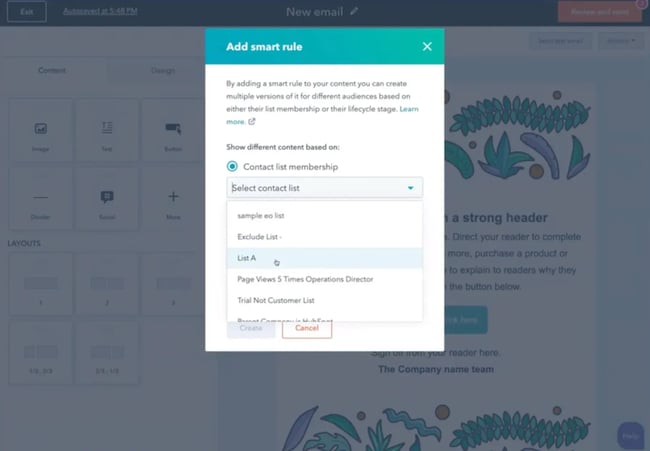
For example, makes it easy to build and automate drip campaigns without manual effort. With its email automation features, you can set up workflows that send targeted messages to subscribers at the right time — whether you’re nurturing leads, onboarding new customers, or re-engaging inactive contacts. The platform allows you to create automated email sequences that trigger based on specific actions or timelines, ensuring your audience receives relevant content throughout their journey.
For businesses that already use the software for sales or customer service, HubSpot CRM enables personalized and automated email drip campaigns within the same platform, making it a convenient solution.
3. Plan the campaign.
The next step in creating your first email drip campaign is to decide what type of drip campaign you want to run first. Welcome emails are often the best option for your first campaign, suggests , CEO of .
“Businesses new to email campaigns should start with a welcome campaign,” he says. “Welcome new contacts to your list and show them what value they can expect from you. Welcome emails also frequently have the highest open rates, so this is your chance to really wow the subscriber and get them hooked.”
4. Design the campaign.
Next, use your email marketing platform to design your campaign. The email copy and design should not only align with your company’s branding but also resonate with your audience.
If you’re new to creating email campaigns, it’s helpful to use email marketing templates to get started. Templates make it easy to set up a professional and ready-to-send campaign by simply plugging in your company information and branding.

5. Test the campaign.
One of the final steps of setting up an email drip campaign is to test the emails before officially launching the campaign. Testing ensures the automations function when triggered, the email design is effective, and all links work.
Do Couto adds, “Test deliverability by sending to yourself across email clients before launch, but don’t obsess over it. Sometimes your emails won’t look beautiful in every browser, email service, or device; test on the big services on both mobile and desktop.”
6. Review campaign performance.
After launching an email drip campaign, it’s essential to track and review its performance to measure that it’s working. Not only do you want to make sure that it’s being delivered, but you should also understand the campaign’s effectiveness.
Measuring drip campaign success requires tracking open rates, click-through rates, and conversions to identify any errors and optimize your campaign over time.
“For those new to drip campaigns, my biggest tip is to keep track of how and when contacts are enrolled in campaigns,” says Holloway. “Simultaneous campaign overlap can flood a contact’s inbox and drive them to unsubscribe. As you create multiple campaigns, map out a hierarchy of which ones contacts can or should be enrolled in at which times, and add filtering to avoid overlap.”
Email Drip Campaign Best Practices
Creating effective email drip campaigns requires clear goals, the right tools, and constant testing. Common drip campaign mistakes include sending too many emails, lack of segmentation, and poor timing. To avoid these mistakes, use these drip email marketing tips and best practices to improve every campaign with each send.
1. Choose a drip campaign software.
To automate and schedule drip emails, teams need a sales automation tool. For sales teams, is a great option as it allows them to create and send email sequences in one place.
The software easily integrates with CRMs and enterprise resource planning (ERP) tools. Businesses can import data from these tools into Sales Hub and use it to refine the email marketing strategy. There are also numerous preloaded on the software that can be customized to suit each drip campaign.
2. Know when to take someone out of the drip.
To ensure leads receive timely and relevant content, it’s crucial to monitor their activities. Once they take the desired action, it’s time to unenroll them from the drip.
Let’s say a prospect is enrolled in a drip campaign with the goal of getting them to schedule a demo. If they schedule a demo on Monday and get another email on Friday asking them to schedule a demo, they’ll probably lose faith in the brand.
This happened to me recently. I got an email asking me to provide feedback about my experience with a brand’s support team. Naturally, I should have received a thank-you email after submitting the form. Imagine my shock when I got another feedback request. It made me disappointed in the brand, and that’s not the kind of reaction you want from your prospects.
Knowing when to take someone out of the drip is a crucial part of the campaign. To ensure things flow smoothly, create a trigger that will unenroll a prospect once they complete a desired action.
3. Gather the required info early on.
Most email campaigns are triggered when a lead shows interest in the business, either by downloading a white paper, registering for an event, or creating an account. But this automation can only happen with the right info.
Create ways for prospects to submit their email addresses and other relevant details early on in the funnel. In exchange for contact info, it’s helpful to offer them an incentive such as a new member discount or an exclusive report.
For compliance and trust purposes, businesses should also include a small checkbox so customers can confirm if they want to receive marketing emails.
4. Have clear CTAs.
It’s tempting to want to schedule a demo, offer a discount, and request a purchase — all in a single email. But that’s also the best way to discourage customers from taking action.
Having too many CTAs in emails will only confuse customers, as they’ll have no clue which action to take. Stick to having a single CTA for each email.
CTAs can be built around the following goals:
- Generate revenue.
- Boost user engagement.
- Increase brand awareness.
- Gather customer feedback.
- Promote a new product or service.
- Drive registrations for an upcoming event.
5. Personalize your emails.
Customers stick with brands that genuinely care about them as individuals. A generic one-size-fits-all email might help marketers save time, but it only tells customers the brand doesn’t value their individuality.
That’s why it’s essential to personalize every email campaign based on the recipient. And it starts with the subject line. A send email marketing campaigns with personalized subject lines.
, digital marketing specialist at , shares the same sentiment: “Personalization is key. Try to customize emails to your target audience’s industry and align your emails to provide the right information at the right time. This ensures that each email feels relevant and tailored to the recipient, enhancing overall engagement and conversion rates.”
New to email personalization? It consumes a lot of time. With a mailing list of thousands of subscribers, tailoring each email to the needs of each individual is next to impossible.
The solution? Creating customer segments. Separate leads and customers into smaller groups based on their demographics and interests. Then, craft a separate email for each segment and use marketing automation to personalize the names in each email.
CRM platforms like make it simple to create audience segments and personalize emails based on customer data.
6. Run A/B tests.
Next, send these email versions to a select group of people to determine which one works best. For instance, select two or three of the best versions of an email and send it to different customer groups for A/B testing. Predetermine a metric, such as the open rate, to compare the success of each email.
These tests help marketers understand the email type, frequency, and content each customer group prefers. Then, further refine future email campaigns based on these key insights.
Pro tip: Change one element at a time. Either try out different subject lines or images while keeping everything else the same. This helps pinpoint the exact change that made the campaign more successful.
HubSpot provides native with the Professional and Enterprise plans.
7. Send emails on Tuesdays.
There has been much debate on the best time and day to send emails.
To bring an end to this debate, HubSpot surveyed 150+ marketing experts in the U.S., asking which day of the week their emails got the most engagement.
The top picks:
- 27% said Tuesday.
- 19% said Monday.
- 17% chose Thursday.
While these findings can be a nice guidepost, the best email cadence ultimately depends on when leads interact with the emails. Closely monitor performance metrics to determine what drives results for the business.
8. Measure success.
Even after testing the initial drip campaign, it’s important to continually of ongoing emails. Customer engagement serves as evergreen data to create a new email series.
Here are some email marketing metrics to track:
- Open rate. This metric measures the percentage of people who opened an email out of the total number of recipients it was delivered to.
- Click-through rate. This metric measures the percentage of people who click on a link in the email out of the total number of recipients.
- Response rate. If the email requires people to reply, compare the number of replies received with the number of emails sent.
- Conversion rate. This is the number of leads that actually converted through the email campaign.
- Value per campaign. Compare the revenue generated from the campaign with the cost to determine the ROI.
- Unsubscribe rate. Keep track of the number of people who unsubscribe after a campaign.
Since each metric indicates something different, it’s important not to rely on a single metric to measure the success of email drip campaigns. Instead, compare all of them to gain insights into email performance and see areas that need improvement.
There are some specific things to keep in mind when comparing these metrics. , senior ecommerce expert at , highlights them:
“If the unsubscribe rate for a drip campaign is significantly higher than scheduled campaigns, it is usually a good indication that something needs to be altered, such as the message timing or the content. One exception is a welcome message. Many times, a customer will sign up to receive a discount and then immediately unsubscribe.”
贬耻产厂辫辞迟’蝉 tools allow you to within the platform.
Email Drip Campaign Templates
Creating a compelling email drip campaign might be challenging. But marketers don’t have to start from scratch. Below are some customizable templates to help kick off a drip campaign.
Email Drip Template 1
Hello [Prospect],
I’m [Name], and I’m the founder of [Company Name] — a brand that simplifies online payments. We work with popular payment gateways and card companies to make credit card payments accessible for all businesses.
We’ll help you process card-based transactions with minimal fees and also handle compliance issues for you. This gives you more time to focus on your business.
If this sounds good to you, could you spare 15 minutes to explore it further by booking a free demo?
[BOOK DEMO BUTTON]
Once you’ve booked a slot of your preference, our agent will reach out to you.
Regards,
[Name]
Why This Works:
- It’s personalized to include the name of the recipient.
- The value proposition is simple, direct, and concise — using only two to three sentences.
- There’s a clear, single CTA, so the recipient knows exactly how to proceed.
- The email also indicates when an agent will follow up, showing that the company is actively engaging its leads.
Email Drip Template 2
Hi [Prospect],
Hope you found value in our demo. Our software has dedicated features to handle international transactions, so you can seamlessly collect payments from your global clients.
If you want to learn more about these features, we’d love to set up a Zoom call with our sales manager, [Name]. When would be a good time to set this up?
Regards,
[Name]
Why This Works:
- The email highlights a feature that’s of interest to the prospect, showing that the company pays attention to its customers.
- There’s a clear point of contact in the email so prospects know who they’re talking to.
- The email isn’t sales-y. Instead, it gives prospects another opportunity to understand the product better.
Email Drip Template 3
Hello [Prospect],
We are offering a 25% discount on all our annual packages. This will help you get started with our product so you can solve all your payment issues.
Use this coupon code at checkout to claim your discount:
[Insert code]
Regards,
[Name]
Why This Works:
- The email offers an exclusive coupon, which makes the customer feel valued.
- The body of the email is short and straight to the point.
- It has a clear CTA.
Send each email two to three days after the customer takes a desired action because it gives them time to absorb the value of the previous interactions.
Email Drip Campaign Examples
Ready to kickstart the first email sequence? Below are some real-life examples of effective drip campaigns to inspire your strategy.
1. Kay Unger’s Cart Abandonment Drip Campaign
is an American fashion brand and B2C company. The brand understands the importance of capturing the attention of customers who add products to their carts but leave the site without making a purchase.
Its cart abandonment drip campaign targets these customers and encourages them to complete their purchases.
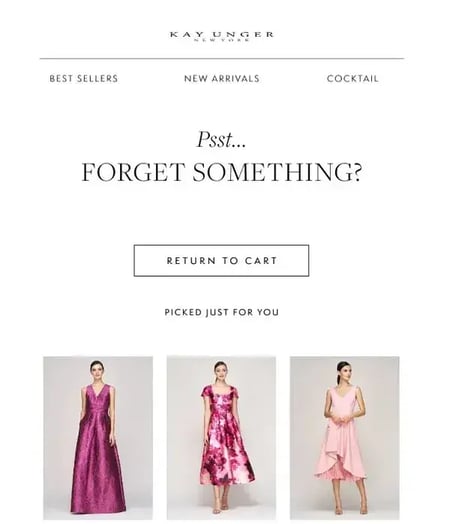
The first email is simple. It reminds the customer of products in their cart and also displays related products they might be interested in.
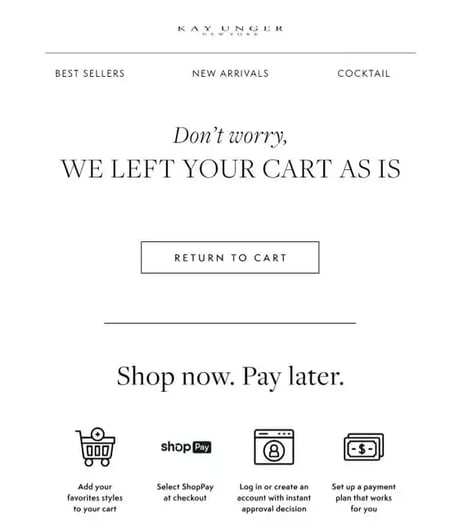
The second email goes out a couple of days later, again reminding the customer about their abandoned cart. This email also includes a “Pay Later” option, motivating the customer to complete their purchase using a flexible payment plan.
The third and final email warns the customer that their cart is expiring. If they delay further, the products may be removed from their cart or may be out of stock.
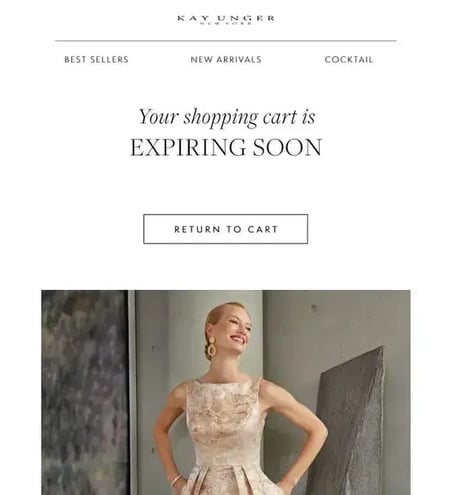
Even though Kay Unger’s campaign is simple, this email drip campaign is effective because it creates a sense of urgency and highlights solutions to possible reasons why a cart was abandoned.
2. RealSelf’s Lead-Nurturing Drip Campaign
is a global online forum for people looking for advice on cosmetic procedures. While its resources are free, it also offers an exclusive community for its members.
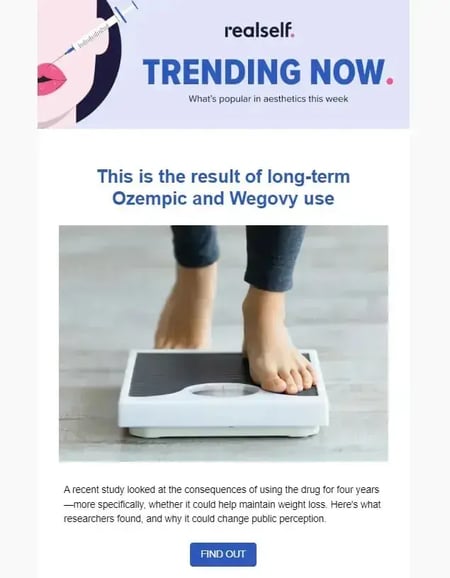
The company uses drip campaigns to nurture leads and invite them to join its community. RealSelf sends a series of educational emails on trending cosmetic topics. These emails contain links leading to the company’s blog. After a few of these informative emails, RealSelf sends out an email asking leads to join its community.
This is an effective drip campaign because it provides value before making an ask. RealSelf uses the email sequence to nurture leads who are interested in cosmetic procedure topics, and only offers an invite to the community once recipients may be ready to dive deeper into the subject.
3. Sprout Social’s Webinar Drip Campaign
is an all-in-one social media management tool that caters to all businesses, from enterprises to SMBs. It holds regular webinars, discussions, and live sessions to educate customers on how to use social media for marketing.
Here’s how Sprout Social marketed one of its webinars using an email drip campaign.
The first email explains the webinar in detail and includes a link for easy registration.
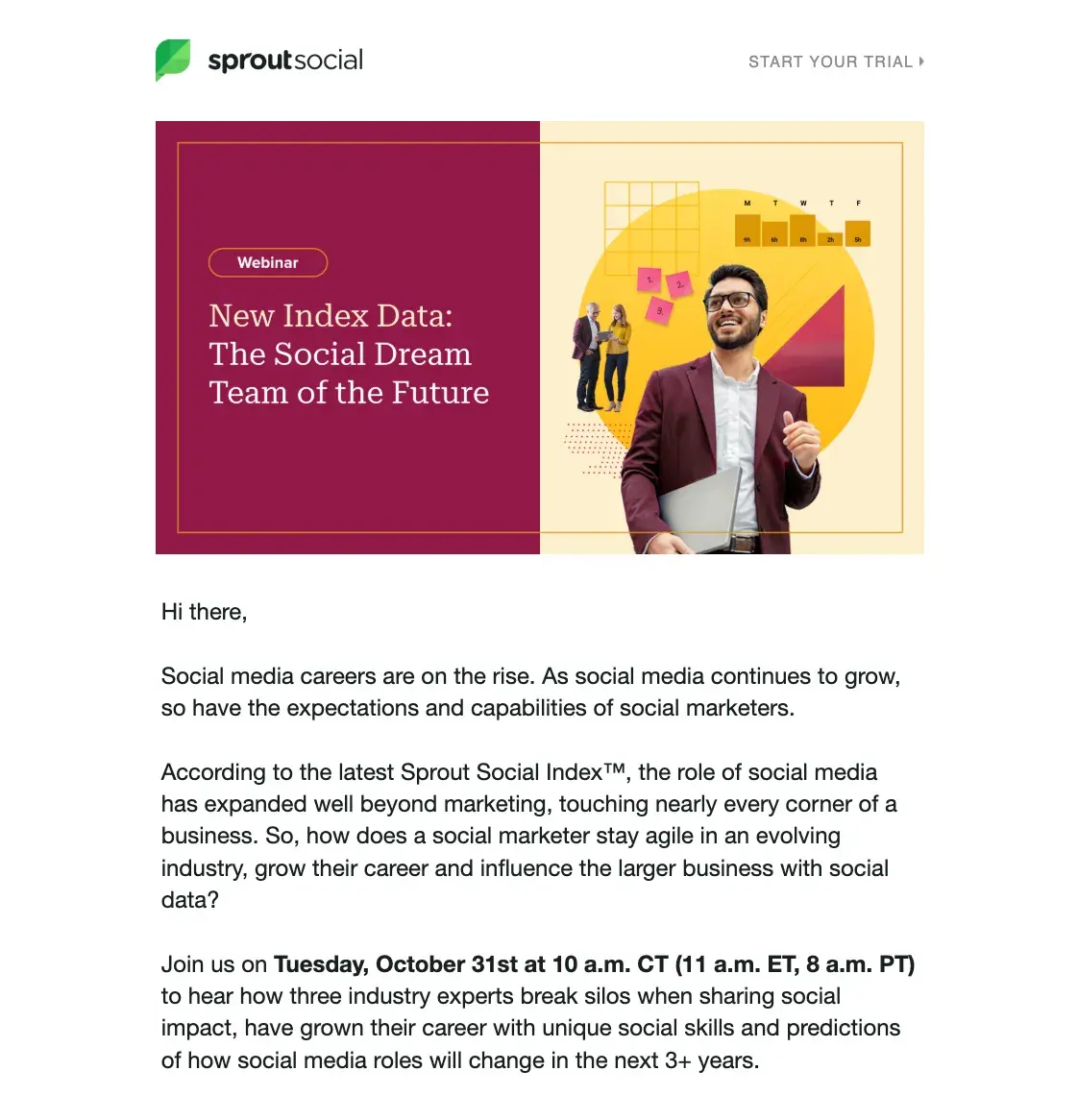
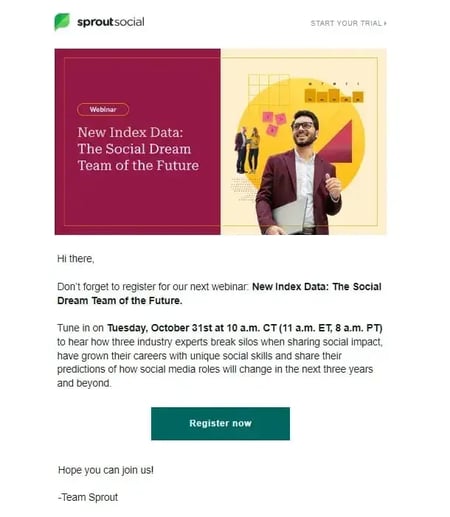
The second email is a reminder for the webinar. An example of B2B email marketing, this drip campaign is effective because some leads who are interested in the event might have missed the previous email, making this email a good reminder for registrants and non-registrants alike.
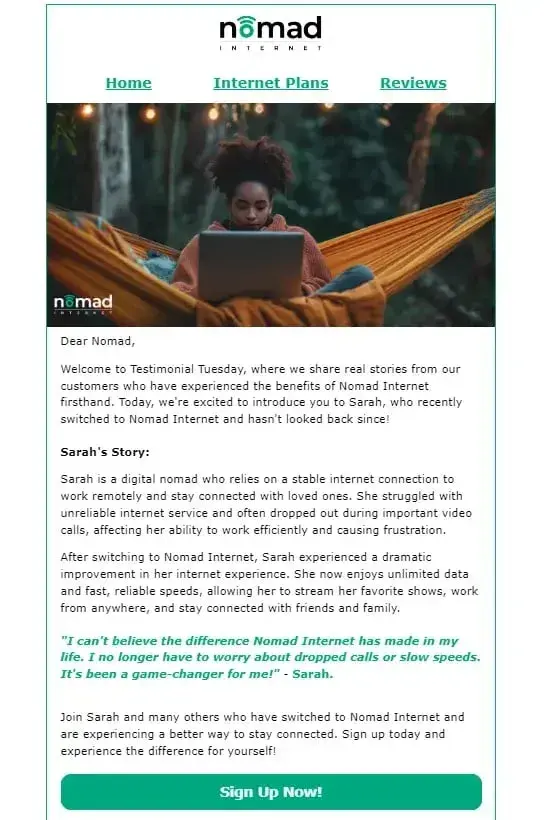
4. Nomad’s Testimonial Drip Campaign
, a high-speed Internet brand, kicked off a unique drip campaign called “Testimonial Tuesday.” The brand shares reviews and testimonials from customers every Tuesday, straight to subscribers’ inboxes.
The first email in this campaign shares a testimonial from Sarah, a customer who’s happy with the brand’s services.
This drip sequence works for two reasons:
- It’s a great way to build trust and increase customer retention.
- It’s also a good way to promote the brand, encouraging prospects to sign up.
5. Sephora’s Membership Drip Campaign
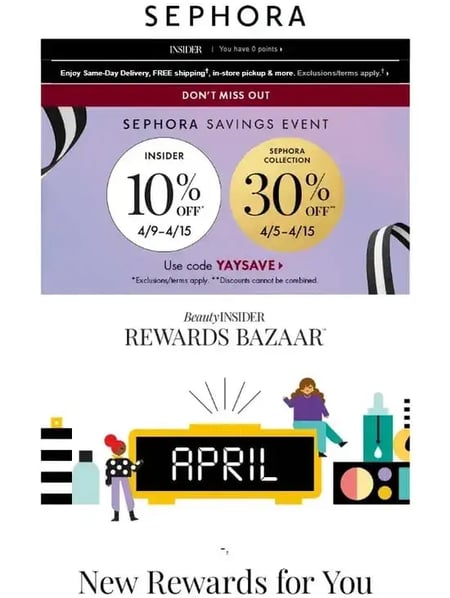
Beauty brand runs a successful loyalty program called Beauty Insider. Members enjoy perks such as extra discounts and reward points, redeemable for beauty freebies.
The brand promotes its membership program through drip email campaigns. Sephora’s strategy to promote its exclusive membership program during sales discounts encourages more people to join the community.
Email Drip Campaign FAQs
What should a drip campaign include?
A successful drip campaign should include a clear goal, targeted audience segments, and a series of automated emails that guide recipients toward a specific action. Each email should provide value and include a clear call-to-action.
It’s also important to personalize the messages based on subscriber behavior and preferences, and to establish a consistent sending schedule that keeps the brand top-of-mind without overwhelming the audience.
Do drip campaigns work?
Yes, drip campaigns are highly effective when executed properly. They typically generate higher open and click-through rates compared to one-off email blasts because they deliver timely, relevant content based on where subscribers are in their journey. Drip campaigns help nurture leads, build relationships over time, and guide prospects through the sales funnel at their own pace. The automated nature of drip campaigns also ensures consistent communication, which can significantly improve engagement and conversion rates.
make creating and automating drip campaigns effortless for sales and marketing.
How can I create a successful drip campaign?
To create a successful drip campaign, start by defining your goal and identifying your target audience. Map out the customer journey and determine what information or value you need to provide at each stage. Write compelling, personalized emails with clear CTAs, and set up triggers based on subscriber actions or time intervals. Test different subject lines, content, and sending times to optimize performance. Finally, monitor your analytics regularly and adjust your campaign based on open rates, click-through rates, and conversion data.
What is the difference between a drip campaign and an email sequence?
An email sequence typically refers to a predetermined series of emails sent in a specific order at set intervals, regardless of subscriber behavior. A drip campaign, on the other hand, is more dynamic as emails “drip” out based on specific triggers, such as user actions, behaviors, or engagement levels. In practice, drip campaigns offer more flexibility and personalization, allowing businesses to adapt messaging based on how subscribers interact with their content.
What is a CRM drip campaign?
A CRM drip campaign is an automated email campaign that’s created and managed within a Customer Relationship Management (CRM) system such as HubSpot. These campaigns leverage the customer data stored in your CRM to send highly targeted, personalized emails.
CRM drip campaigns allow you to segment your audience more effectively and trigger emails based on specific CRM events, like a new lead being added, a deal stage changing, or a customer reaching a milestone. This integration ensures your email marketing is closely aligned with your overall sales and customer relationship strategies.
Create email drip campaigns that convert leads.
An email drip campaign, or drip marketing, uses automated email sequences triggered by user actions or timelines. Drip campaigns help nurture leads, onboard customers, and drive conversions by delivering the right message at the right time.
Equipped with the best practices, examples, and step-by-step procedures laid out in this guide, sales and marketing teams will be able to create effective email drip campaigns. Whether it’s a campaign for retargeting, following up after purchase, or reminding customers of an abandoned cart, teams will reach their audience better with a well-designed drip.
Use a CRM like HubSpot to personalize and automate the sequences for better engagement. Ready to get started? .
Editor's note: This post was originally published in June 2023 and has been updated for comprehensiveness.
50 Free Sales Email Templates
Save time, find new ways to reach out to prospects, and send emails that actually convert.
- First-Touch Emails
- Follow-Up Emails
- Break-Up Emails
- ChatGPT Email Prompts
Download Free
All fields are required.
Form not available
You're all set!
Click this link to access this resource at any time.