
MEDDPICC sales is a method for qualifying prospects that includes mapping out all the steps needed to close deals. This process creates checklist for navigating modern enterprise buying. With MEDDPICC, sales teams ask hard questions early: Do reps actually know who signs the check? Have they mapped out legal review? Do reps know who else they need to talk to?
During my time in sales, I learned that handshake agreements aren’t the same as signatures. At , MEDDPICC forced our sellers to slow down where they might usually rush and validate the parts of a deal that most often fall apart. Remember, enthusiasm doesn't sign contracts — procurement departments do.
This guide will break down exactly what MEDDPICC is, how it differs from other frameworks like MEDDIC, and, most importantly, how to implement it in a sales department to stop losing deals and start forecasting with precision. Looking to research potential prospects for MEDDPICC? can help.
Table of Contents
- What Is the MEDDPICC Methodology?
- MEDDPICC Training and Certification
- What are the Benefits of MEDDPICC?
- How to Implement the MEDDPICC Methodology
- Getting Started with MEDDPICC
- MEDDPICC FAQs
What Is the MEDDPICC Methodology?
MEDDPICC is a B2B sales qualification methodology used to verify whether a prospect is viable and to map out the steps required to close the deal. It is particularly effective for enterprise sales, but it can be applied in any space with long cycles, high contract values, and multiple stakeholders.
Each letter in the acronym represents a specific criterion that must be validated to eventually close the deal:
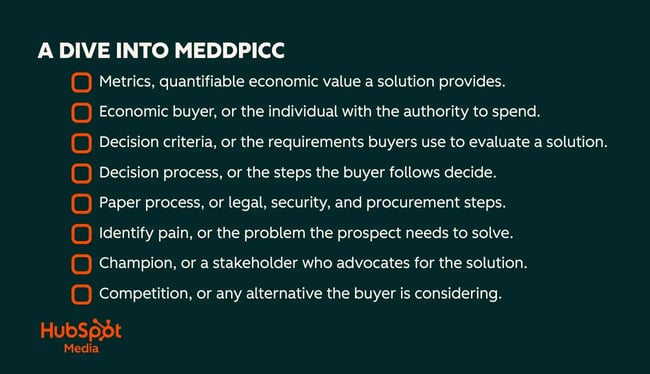
- Metrics, or the quantifiable economic value a solution provides.
- Economic buyer, or the individual with the ultimate authority to spend the budget.
- Decision criteria, or the technical, vendor, and financial requirements the buyer uses to evaluate a solution.
- Decision process, or the series of steps and approvals the buyer follows to make a decision.
- Paper process, or the legal, security, and procurement steps required to finalize the contract.
- Identify pain, or the specific problem, risk, or missed opportunity the prospect needs to solve.
- Champion, or a stakeholder at a prospect organization who advocates for the vendor’s specific solution.
- Competition, or any alternative solution the buyer is considering (including doing nothing).
Teams using the MEDDPICC method need to understand how prospects’ organizations run. The process involves deep research. can help. Breeze’s AI agent can research and monitor potential buyers so teams save time building a MEDDPICC roadmap.
Many salespeople have heard of MEDDIC, the original framework developed at Parametric Technology Corp (PTC) in the 1990s. The core difference is complexity. MEDDIC (Metrics, Economic Buyer, Decision Criteria, Decision Process, Identify Pain, Champion) is excellent for qualifying the opportunity, establishing if there is a fit and a buyer.
MEDDPICC adds two critical components for the modern era:
- Paper Process (P): Acknowledging that getting a “yes” is different from getting a contract signed. In 2025, security reviews and legal redlines can kill a deal just as easily as feature gaps.
- Competition (C): Acknowledging that buyers always have alternatives, even if that alternative is simply sticking with the status quo.
Pro tip: MEDDPICC is primarily used by enterprise B2B sales teams selling complex solutions. It’s a good fit for SaaS companies with average deal sizes above $50,000 with sales cycles lasting longer than six months. MEDDIC may suffice for simpler, shorter sales processes; however, even smaller deals may benefit from MEDDPICC's comprehensive approach.

Free Sales Plan Template
Outline your company's sales strategy in one simple, coherent sales plan.
- Target Market
- Prospecting Strategy
- Budget
- Goals
Download Free
All fields are required.
Form not available
You're all set!
Click this link to access this resource at any time.
MEDDPICC Training and Certification
While sales leaders can self-teach the basics, formal certification ensures an entire revenue team speaks the same language. Specialized training providers offer deep-dive courses that go beyond definitions into practical application.
Why Get Certified?
- Standardization: Leaders ensure every rep qualifies deals using the exact same criteria.
- Credibility: A certification signals to employers and buyers that the organization has enterprise-grade sales discipline.
Top Training Providers (2025)
- : Founded by Darius Lahoutifard, MEDDIC Academy is one of the original practitioners and the trademark owner of MEDDPICC. The organization offers comprehensive online courses and official certifications.
- (Ascender): Known for rigorous and consultant-led implementation, Force Management ties methodology to specific value messaging (“Command of the Sale”).
- : This organization a modern take on the methodology with a focus on coaching and leadership reinforcement.
Note: Training typically takes 3 to 4 weeks to launch a new program, with ongoing reinforcement required for full adoption.
What are the Benefits of MEDDPICC?
MEDDPICC fundamentally shifts how revenue teams qualify, forecast, and close. By forcing rigor into the sales process, organizations move from relying on individual performance to executing a repeatable, data-backed strategy.
Pro tip: Sales tools like can help teams qualify potential buyers. Native integration with means helpful prospect data never gets lost.
Strategic Clarity
Before a sales methodology can drive revenue, the entire organization must agree on what a “good deal” looks like. MEDDPICC forces leadership and frontline reps to align on the fundamental questions of their sales motion: What are we selling? Who is the actual buyer? Why does it matter now?
Through the implementation process, teams must define specific answers for key components:
- Metrics. Reps should determine the specific data points that prove value to the prospect.
- Economic buyer. Teams need to identify the specific titles and roles with true budget authority.
- Decision criteria. Reps should map exactly how the prospect will technically and financially judge the solution.
- Competition. Salespeople should acknowledge who else is being considered and how to position themselves against competitors.
This process eliminates ambiguity. Instead of a vague “hope” that a deal will close, the entire revenue engine works from a single source of truth regarding target accounts and winning strategies.
Improved Lead Qualification and Team Morale
One of the fastest ways to burn out high-performing sales reps is to force them to work unqualified leads. When MEDDPICC is fully integrated, it provides a ruthless framework for disqualification. This allows sales professionals to abandon low-probability opportunities early and focus their limited capacity on deals that will actually convert.
This efficiency directly impacts retention and culture. John Rankins highlights this connection in his article, :
“Picture the frustration of your sales team when they continually encounter unqualified leads. It's demotivating to see their hard work result in dead ends. This frustration can lead to burnout, high turnover rates, and a decrease in overall team morale. After all, who wants to make dozens of calls each day, only to be met with rejection or disinterest?”
When teams are empowered to disqualify bad deals, they spend more time winning. This creates a positive feedback loop where success fuels motivation, leading to better sales calls and a superior customer experience.
Pro tip: Teams can use and agent to qualify leads before outreach even begins.
Better Competitive Analysis
The “Competition” component is a critical addition that separates MEDDPICC from the original MEDDIC framework. It forces organizations to move beyond the naive but, in my experience, surprisingly common assumption that “we have no competition” and confront the reality of the market.
Unless a solution is genuinely the first of its kind in history — a rarity in B2B SaaS — there is always a competitor, even if that competitor is simply the status quo. MEDDPICC demands that sales teams rigorously map their competitors' strengths and weaknesses against their own.
Understanding competitors ensures reps are never blindsided during a negotiation. Salespeople can proactively disarm competitive threats, including inaction, before they derail a deal.
Pro tip: Battlecards can help teams prepare for objections and understand how they stack up against competitors. Check out . Just customize for the business and get started.
How to Implement the MEDDPICC Methodology
Implementing MEDDPICC transforms how sales teams qualify and advance opportunities. Teams need to rely on metrics and a deep understanding of what the buying team looks like.
Here’s a step-by-step guide for each component of the MEDDPICC process, including what each component is and how to use it to achieve sales success.
Metrics
Metrics are the data or performance indicators that a buyer most needs or values. The job of the sales team is to gather and then effectively communicate the data demonstrating how a product helps buyers achieve desired metrics.
The thing with metrics, as explained by , CEO of , is that the seller needs to turn data into concrete outcomes that actually mean something.
Popoff says, “Customers connect with concrete outcomes, not abstract data. Rather than emphasizing technical specifications, we offer scenarios like ‘This wallet blocks 99% of RFID skimming threats,’ demonstrating tangible advantages to security-conscious shoppers. This method has considerably increased our conversion rates.”
Pro tip: Case studies are helpful in proving a product’s value. to showcase winning metrics that convince prospects to buy.
Economic Buyer
The economic buyer is a key player in the MEDDPICC sales methodology. This person has control of budgets and needs to know that the service will perform for the company. Salespeople may or may not speak with them directly, but it’s vital to understand who this person is and how they can be positively influenced.
For , founder and sales manager of , MEDDPICC’s strength lies in its Metrics and Economic buyer components. Hull believes that these metrics “anchor every discussion on specific, quantifiable results and align them with the decision-maker at the top of the budget.”
Hull explains how this worked: “After introducing MEDDPICC at Modern Exterior, we estimated that our customized solutions reduced clients' project costs by 25% over two years. We’ve noticed prospects progress much further when they are confident in the numbers we provide to support our propositions.”
It makes sense. Decision-makers have skin in the game, and they need to know that their investment will pay off. Data (or outcomes, as Joel Popoff mentions above) gives them that security.
Pro tip: Use to better understand who’s buying.
Decision Criteria
Decision criteria are the elements that buyers will use to judge a product and vendor. These requirements include things like cost, implementation, collaboration, product quality, and more.
Hull provided insightful examples of decision criteria and how they helped Modern Exterior. He says, “The Decision Criteria component optimized how we sell value, helping us close 15% more deals within six months. In my experience, the framework improves transparency, making it significantly easier to track progress and identify blind spots.”
If a team isn’t sure how its offering is being judged, it’s harder to make proactive changes. One of the best ways to discover decision criteria is to ask.
Buyers want to find the right solution, so they’re likely going to be upfront about what that solution entails. At the same time, some decision criteria could be subconscious or intuitive on the part of the buyer, so go back and review both won and lost deals to determine what was important that might not have been overtly discussed.
Decision Process
The decision process is the “who, what, when” of the selection. It maps the flow from initial interest to the verbal “yes.” Unlike the Paper Process (which is about the contract), this is about the choice.
, head of growth at , relies on a MEDDPICC sales process. With MEDDPICC, the team at beehiiv discovered an unexpected influencer. White told me: “We found a back-end developer influencing integration decisions, which we’d have missed otherwise. Engaging with them boosted technical alignment and saved us 10+ hours on support post-sale.”
White’s discovery makes complete sense. A backend developer should influence integration decisions since it’s likely the developer who would deal with the integration. Any good organization would consult the in-house development resources.
However, in most cases, developers are not in charge of the budget, are absent on sales calls, and therefore might be easy to forget. If the team understands the full decision process, they can spot potential influencers who should be appeased to close a deal quickly.
Paper Process
The “Paper Process” is the second addition to MEDDPICC (from MEDDIC), and it’s often the most neglected step and biggest cause of stalled deals. The Paper Process covers everything that happens after a prospect has chosen a provider but before money changes hands.
Common bottlenecks might include lengthy security questionnaires and reviews, legal redlines over liability caps or data privacy and compliance, or vendor onboarding procedures such as getting set up in a buyer's ERP so that the seller can actually fulfill Purchase Orders.
In a discussion about MEDDPICC, , co-founder and director of sales and marketing at , was quick to mention the paper process.
“Keep detailed documentation of every step of the MEDDPICC process for each transaction. Exhaustive documentation of the ‘Paper Process’ can reveal potential bottlenecks on contract sign-offs or legal audits and allow your team to mitigate them quickly. Believe me, you’ll be reducing risk and creating predictability with this!” Soni says.
Identify Pain
A product or service should solve a pain point for the customer. If the seller knows exactly what that pain point is, they can more effectively show how their solution can alleviate it.
, growth marketer and founder of , saw a MEDDPICC implementation increase speed through a sales cycle by 60%.
Angelo says, “The most successful MEDDPICC implementation I have worked on was for a Fortune 500 technology client.” Using MEDDPICC, the client was able to understand who their economic buyer was, the Chief Revenue Officer, and resolve a $2 million revenue leak.
Angelo says, “Structuring the solution directly at their pain points resulted in closing a $400,000 deal within 45 days, or 60% faster than our typical sales cycle.”
Champion
A champion is the person who is most invested in the solution offered by the vendor. They’re already supporting the seller and their business, and they should have some influence over others within their own organization.
Once a champion is identified, the most important thing a seller can do is prepare them with information so they have more ammunition as they advocate for the solution.
Taylor Hull has a tip on getting the most out of a champion. He recommends making the Champion an endpoint, not an extra step.
“It’s essential that your Champion truly understands the value your solution provides in addressing specific pain points and feels empowered to communicate that value internally,” Hull says. “For instance, providing Champions with personalized ROI breakdowns helped us close 25% more deals, as they had the data needed to influence internal stakeholders effectively.”
Competition
Competition is the final “C” in MEDDPICC. Sales teams should always be informed about the competitive landscape, and they should have a keen understanding of the strengths and weaknesses of each member in the market. Ask prospects:
- Who else is involved in the process?
- What other providers are you in discussions with?
- Who are you working with at the moment?
- What do you like/dislike about your current solution?
Finally, don’t forget that there’s always another competitor in the room — the status quo. To reach a prospect that has ignored a problem for years, there’s significant inertia to overcome. Be prepared to articulate why inaction is no longer a viable option.
Getting Started with MEDDPICC
Implementing MEDDPICC requires more than just a spreadsheet. It’s vital to embed it into daily workflows so it becomes muscle memory for reps. To get started, teams need to audit current deals, tidy up their CRM, build qualification systems, and map the selling journey.
Here is a practical roadmap to get started.
1. Audit current deals
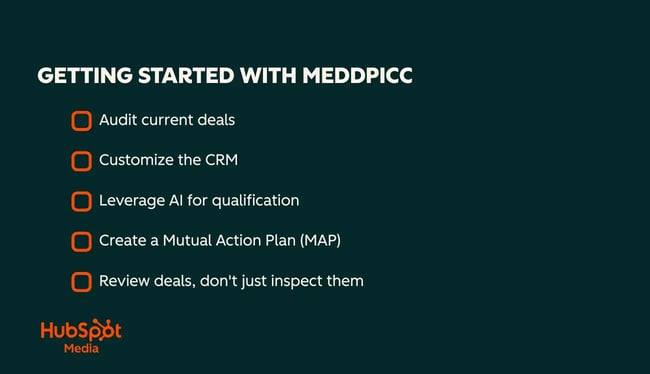
Before changing an entire process, run the top 10 active opportunities through the MEDDPICC framework. Most teams will likely spot gaps immediately — perhaps they have no idea who the Economic Buyer is, or they haven't asked about the Paper Process. This exercise creates an immediate educational moment for the team. Teams can use to help with research.
2. Customize the CRM
Don't let MEDDPICC live in notes. Build it into the system of record.
- Create Custom Properties: In , add specific properties for “Economic Buyer Name,” “Identified Pain,” and “Paper Process Status.”
- Required Fields: Make key MEDDPICC fields mandatory before a deal can move to late-stage pipeline stages (e.g., a rep can't move to “Contract Sent” without a completed “Paper Process” field).
3. Leverage AI for qualification
Modern sales tools can do the heavy lifting for reps.
- : Use HubSpot’s AI prospecting agent to research the Economic Buyer and potential Champions before a rep even gets on a call. Breeze can scrape public data to identify decision-makers and company initiatives that align with an organization's “Metrics.”
- Conversation Intelligence: Tools like can transcribe calls and automatically tag moments where “Pain” or “Competitors” were mentioned, validating the rep’s notes.
4. Create a Mutual Action Plan (MAP)
Turn the “Decision Process” and “Paper Process” findings into a shared document with the prospect. A MAP lists every step required to go live — security review, legal sign-off, implementation kickoff, etc. — and assigns owners and due dates. This turns the seller from a vendor into a project manager, guiding the buyer to the finish line.
5. Review deals, don't just inspect them
Update weekly pipeline reviews. Instead of asking “When will this close?”, ask specific MEDDPICC questions: “Have we tested the Decision Criteria?” or “Has the Economic Buyer confirmed the budget?” If a rep can‘t answer, the deal isn’t qualified.
MEDDPICC FAQs
What does MEDDPICC stand for?
MEDDPICC is an acronym for Metrics, Economic Buyer, Decision Criteria, Decision Process, Paper Process, Identify Pain, Champion, and Competition.
Is MEDDPICC worth it for my sales team?
For sellers of high-ticket B2B solutions with sales cycles longer than 3 months, absolutely. Teams using formal methodologies like MEDDPICC can standardize processes and disqualify bad deals earlier.
Who owns the MEDDPICC methodology?
The original concepts of MEDDIC were developed at PTC (Parametric Technology Corporation). While no single entity “owns” the general acronym today, organizations like MEDDIC Academy hold trademarks related to their specific training and certification programs.
When should I use MEDDPICC instead of MEDDIC?
Use MEDDPICC (with the extra P and C) in a highly competitive market or selling to large enterprises where legal/procurement (Paper Process) is a major hurdle. Use MEDDIC with a simpler sales cycle, or one where only a single vendor is usually considered.
How long does it take to implement MEDDPICC?
Full adoption typically takes 3 to 6 months. This includes initial training, configuring a CRM like to capture additional data, and coaching managers to run deal reviews using the framework.
Can MEDDPICC work for smaller deals or teams?
It can, but it may be overkill for transactional deals under $10 thousand. For smaller deals, a lighter framework like BANT (Budget, Authority, Need, Timeline) might be faster. However, the principles of identifying pain and a champion are universal.
Making the Most of MEDDPICC
In practice, MEDDPICC isn’t just a fuller version of MEDDIC — it’s a steadier operating system for complex deals. When applied consistently, it replaces gut-feel forecasting with evidence-based forecasting. And for sales teams operating in multi-stakeholder environments with real competition at the table, that shift is often the difference between deals that look good on paper and deals that actually close.
Ready to start using MEDDPICC? Let help you with your research.
Free Sales Plan Template
Outline your company's sales strategy in one simple, coherent sales plan.
- Target Market
- Prospecting Strategy
- Budget
- Goals
Download Free
All fields are required.
Form not available
You're all set!
Click this link to access this resource at any time.
Sales Methodology




![I Learned How Sales Champions Drive Deals Forward — Here’s What You Should Know [+ Recent Data]](https://53.fs1.hubspotusercontent-na1.net/hubfs/53/sales-champion-1-20250110-9355712-1.webp)
![Decoding Buying Signals in Sales [+ Examples & What I Learned]](https://53.fs1.hubspotusercontent-na1.net/hubfs/53/buying-signals-1-20250501-3647992.webp)



-3.webp)