.png?width=112&height=112&name=Image%20Hackathon%20%E2%80%93%20Horizontal%20(51).png)
Finding creative ways to say “save money” has become a necessary skill for modern sales teams. Buyers hear the phrase “we’ll save you money” constantly, and over time, it’s lost much of its persuasive power.
The words used to describe savings often matter as much as the savings themselves. The most effective sellers don’t just promise lower costs — they frame value in ways that feel credible, professional, and tailored to each buyer’s specific priorities. Using smarter words for saving money and more thoughtful cost-saving phrases can shift the tone of an entire sales conversation.
Below, I’ll walk through professional, casual, and efficiency-focused alternatives to “save money,” along with guidance on when and how to use them in real sales scenarios.
Table of Contents
- Professional Alternatives to “I Can Save You Money”
- Casual and Conversational Money-Saving Phrases
- Beyond Money: Time and Efficiency Savings
- Frequently Asked Questions About Saying “Save Money”
Professional Alternatives to “I Can Save You Money”
Professional sales conversations — especially those involving executives, finance leaders, or procurement — require language that feels deliberate and grounded in business outcomes. The phrases below are commonly used in more formal settings because they frame savings as a strategy, not discounts or cheap alternatives.
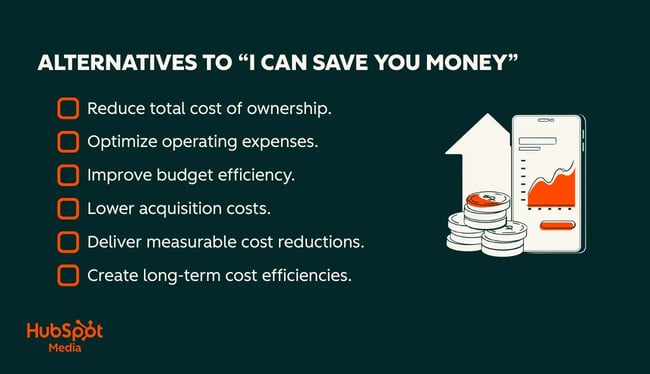
1. “Reduce total cost of ownership.”
“Reduce total cost of ownership” emphasizes long-term cost impact rather than upfront price. It accounts for implementation, maintenance, training, and operational overhead over time. Total cost of ownership (TCO) is a standard metric in procurement and finance that evaluates the full lifecycle expense of a purchase, making it particularly credible in enterprise buying decisions.
My take: I’ve found this phrase works best with CFOs and operations leaders because it reframes the discussion away from sticker price. When sellers can support it with data or benchmarks, it immediately elevates credibility.
Best for: Enterprise sales, SaaS contracts, long-term vendor relationships.
2. “Optimize operating expenses.”
“Optimize operating expenses” positions savings as part of operational efficiency rather than cost-cutting. It’s often used in financial planning and budgeting contexts where the goal is to improve margins without reducing output or headcount. Operating expense optimization suggests strategic resource allocation rather than reactive budget cuts.
My take: This phrase resonates when buyers are under pressure to improve margins without reducing headcount or output. It feels proactive, not reactive.
3. “Improve budget efficiency.”
“Improve budget efficiency” suggests better allocation of existing funds instead of reducing spend outright. Savings is framed as maximizing the value derived from current budget allocations rather than requesting additional resources. Budget efficiency appeals to department leaders who must demonstrate improved performance within fixed financial constraints.
My take: I like this phrase when working with department leaders who don’t control overall budgets but are accountable for performance within them.
4. “Lower acquisition costs.”
“Lower acquisition costs” connects savings directly to customer acquisition, making it especially relevant in sales, marketing, and growth discussions. It speaks to metrics such as Customer Acquisition Cost (CAC), which revenue leaders actively monitor and optimize. Lowering acquisition costs directly impacts unit economics and profitability without changing revenue targets.
My take: I’ve seen this land particularly well in revenue organizations where leaders already track CAC closely and want measurable improvements.
5. “Deliver measurable cost reductions.”
“Deliver measurable cost reductions” emphasizes accountability and data-backed outcomes. It signals that savings claims are quantifiable and verifiable rather than aspirational or vague. Measurable cost reductions appeal to finance-minded buyers who require proof points and documented ROI before committing to vendor changes.
My take: When I hear sellers use this phrase confidently, it signals they understand the buyer’s financial reality — not just the product. Particularly for companies accountable to shareholders, doing more with less is always worth touting.
6. “Increase return on investment.”
Rather than focusing on saving money, “increase return on investment” focuses on generating more value per dollar spent. ROI reframes the conversation from cost to value creation, emphasizing outcomes and business impact. This approach works particularly well when the solution isn't the cheapest option but delivers superior results that justify the investment.
My take: I prefer this language when the product is at a higher price point. It reframes the conversation around outcomes instead of price.
According to HubSpot’s 2025 Sales Strategy Report, poor value for money is the second-biggest killer of deals (35%), trailing just behind no product fit (37%), so suffice to say it’s critical to demonstrate a clear value proposition.
7. “Create long-term cost efficiencies.”
“Create long-term cost efficiencies” suggests sustainable savings that scale with the business. It emphasizes structural improvements that compound over time rather than one-time discounts or short-term reductions. Long-term cost efficiencies appeal to executives planning for growth who need solutions that become more valuable as the organization scales.
My take: I’ve found this especially effective with executives planning for growth, where short-term discounts feel irrelevant.
Pro tip: Sales teams that standardize this type of language using sales playbook software, like , are far more consistent in executive conversations. Playbooks ensure reps use value-driven phrasing at the right stage of the deal instead of defaulting to price talk.
.png)
Free Sales Meeting Playbook
This easy-to-follow checklist will help sales reps:
- Understand prospects' current situation and need to change
- Demonstrate the value of your products to prospects
- Agree on a plan / path forward
- And more!
Download Free
All fields are required.
Form not available
You're all set!
Click this link to access this resource at any time.
Casual and Conversational Money-Saving Phrases
Not every sales conversation needs boardroom language. In startups, small and midsized businesses (SMBs), and founder-led sales, informal phrasing can feel more authentic and build rapport faster.
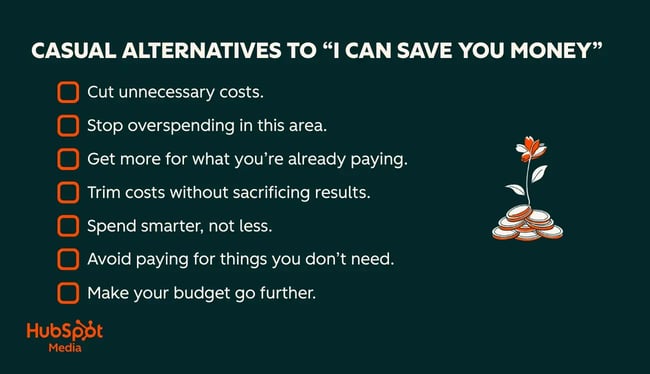
8. “Cut unnecessary costs.”
“Cut unnecessary costs” implies removing waste rather than reducing value. It targets inefficiencies or redundant spending without suggesting that the buyer needs to compromise on quality or capabilities. Cutting unnecessary costs positions the seller as helping the buyer eliminate expenses that don't contribute to business outcomes.
My take: I’ve seen this work best when sellers can quickly point to specific inefficiencies the buyer already suspects exist.
9. “Stop overspending in this area.”
“Stop overspending in this area” calls attention to a known problem without sounding accusatory. It acknowledges that the current solution may be overpriced or underperforming relative to alternatives. The phrase works when the buyer already suspects they‘re not getting good value but hasn’t prioritized finding a replacement.
My take: Used carefully, this phrase can feel refreshingly honest — especially with operators who already know something isn’t working.
10. “Get more for what you’re already paying.”
“Get more for what you’re already paying” emphasizes maximizing existing spend rather than reducing it. Instead, it suggests that the buyer can maintain their current budget while receiving superior features, service, or outcomes. This reframing helps avoid early price objections by focusing the conversation on value expansion instead of cost reduction.
My take: I like using this phrase when price objections come early. It shifts the conversation toward value before numbers get discussed.
11. “Trim costs without sacrificing results.”
“Trim costs without sacrificing results” reassures buyers that savings won’t compromise performance. It addresses the common concern that cheaper alternatives deliver inferior outcomes or create new problems. Trimming costs without sacrificing results positions the solution as both economical and effective, removing the perceived trade-off between price and quality.
My take: In my experience, this phrase reduces defensiveness, particularly when buyers worry that cheap solutions will cause problems later.
12. “Spend smarter, not less.”
“Spend smarter, not less” reframes savings as a strategic decision-making process. It implies that the buyer doesn't need to cut their budget; rather, they should redirect it toward better-performing solutions. Spending smarter appeals to buyers who have adequate resources but want to ensure every dollar drives maximum business impact.
My take: I’ve used this language often because it respects the buyer’s intelligence and priorities. The buyer already has budget allocated — they just want to allocate it better. This framing works especially well when you're displacing an incumbent solution rather than introducing a new category of spend.
13. “Avoid paying for things you don’t need.”
“Avoid paying for things you don’t need” appeals to practicality and simplicity. It highlights feature bloat or unnecessary complexity in current solutions that drive up costs without adding value. Avoiding payment for unused features resonates with buyers frustrated by all-in-one platforms where they only use a fraction of available capabilities.
My take: It works well in demos when sellers can clearly show unused features or redundant tools. Buyers often don‘t realize how much they’re paying for features that sit unused until you show them side-by-side. This moment of recognition (“we're paying for that?") creates urgency that generic savings claims never achieve.
14. “Make your budget go further.”
“Make your budget go further” emphasizes flexibility and scalability. It suggests that the same financial resources can accomplish more when allocated efficiently. Making budgets go further appeals to small teams with ambitious goals who need solutions that maximize impact without requiring significant budget increases.
My take: I’ve found this resonates with small teams managing tight budgets but ambitious goals. There's often frustration baked into these conversations — teams know what they want to accomplish but feel limited by resources. This phrase acknowledges both realities without dwelling on the constraints.
What we like: Casual phrases like these tend to perform best when reps have clear guidance on when to use them. help teams match tone to buyer maturity, deal size, and industry.
Beyond Money: Time and Efficiency Savings
Many buyers care just as much about time as money, and operational efficiency and workload reduction are top decision drivers alongside cost. The suggestions below offer more creative ways to say “save money” by emphasizing efficiency.
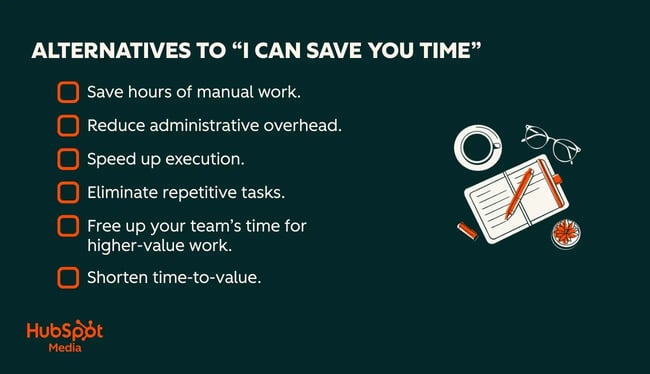
15. “Save hours of manual work.”
“Save hours of manual work” ties savings directly to time. It quantifies efficiency gains in terms that buyers immediately understand and value. Saving hours of manual work addresses both direct labor costs and the opportunity cost of teams spending time on repetitive tasks instead of strategic activities.
My take: I’ve noticed this language often lands faster than financial claims because time pain feels immediate.
16. “Reduce administrative overhead.”
“Reduce administrative overhead” connects efficiency with organizational productivity. Administrative overhead refers to the time, effort, and resources consumed by non-revenue-generating activities like data entry, reporting, and coordination. Reducing this overhead frees capacity for activities that directly impact business outcomes.
My take: I prefer this phrasing when speaking with managers responsible for process and workflow.
17. “Speed up execution.”
“Speed up execution” highlights faster outcomes rather than lower costs. It emphasizes time-to-market, project completion speed, or operational velocity as the primary value driver. Speeding up execution appeals to competitive teams where being first or moving quickly creates strategic advantages that outweigh cost considerations.
My take: Urgency-driven teams respond strongly to this framing — and in my experience, most teams today seem to fit that description.
18. “Eliminate repetitive tasks.”
“Eliminate repetitive tasks” focuses on workflow simplification. Repetitive tasks consume time, create opportunities for human error, and contribute to employee burnout. Eliminating these tasks improves both efficiency metrics and team morale by allowing workers to focus on higher-value activities.
My take: I’ve seen this resonate particularly well when paired with automation demos. When you can show a task that currently takes 40 minutes happening automatically in under 5 minutes, the value becomes visceral. Buyers immediately start calculating how many hours per week or month they're currently wasting on repetitive work.
19. “Free up your team’s time for higher-value work.”
“Free up your team’s time for higher-value work” connects efficiency to strategic impact. It positions time savings not as an end goal but as a means to redirect effort toward activities that drive revenue, innovation, or customer satisfaction. Freeing up time for higher-value work appeals to leaders managing resource constraints or scaling challenges.
My take: I often use this when speaking with leaders concerned about burnout or scaling issues.
20. “Shorten time-to-value.”
“Shorten time-to-value” emphasizes faster ROI realization. Time-to-value measures how quickly users start seeing tangible benefits from an investment, which is particularly important for solutions with complex implementations or learning curves. Shortening this timeframe reduces the period during which the buyer experiences costs without corresponding returns.
My take: I’ve found this especially effective in SaaS sales or any environment where onboarding speed matters. In my current position with , our clients are investing six or even seven figures in a new commercial real estate ERP because it’s the right decision for the long run. Ultimately, making sure they start realizing a return as quickly as possible matters much more to decision-makers than the price tag of the implementation itself.
Pro tip: allow teams to align efficiency-based messaging with each stage of the funnel, ensuring reps don’t jump to cost talk before value is established. Playbooks ensure reps know when to use professional versus conversational phrasing.
Frequently Asked Questions About Saying “Save Money”
What is a fancy word for saving money?
Professional alternatives for saving money include “cost optimization,” “expense reduction,” “financial efficiency,” and “budget optimization.” These terms are commonly used in executive and finance conversations.
How do you say “save money” in a professional way?
Formal substitutes include phrases like “reduce total cost of ownership,” “improve ROI,” and “optimize operating expenses.” These expressions frame savings as strategic outcomes rather than discounts.
What is a good slogan for saving money?
A good money-saving slogan balances aspiration with practicality, emphasizing outcomes rather than scarcity. Effective slogans avoid negative framing like “cut costs” or “spend less” and instead focus on optimization, efficiency, and value creation.
Examples include:
- “Spend smarter without sacrificing results.”
- “Efficiency that pays for itself.”
- “More value from every dollar.”
- “Smarter spending, stronger outcomes.”
What is the euphemism for saving money?
Common euphemisms include “streamlining spend,” “driving efficiency,” “budget optimization,” and “cost discipline.” These softer phrases are often used when discussing sensitive budget topics.
How to Use Creative Ways to Say “Save Money” Effectively
Using creative ways to say save money isn’t about avoiding the topic — it’s about elevating the conversation. The most effective sales teams treat savings as part of a broader value story that includes efficiency, outcomes, and long-term impact.
In my experience, sellers who rely on generic cost claims struggle to differentiate. I’ve been the cheapest option in the market, and that fact was never enough. Those who adopt more intentional cost-saving phrases sound more credible, more confident, and more aligned with how buyers actually make decisions.
Next steps: Audit your current sales scripts, identify where “save money” shows up, and replace it with language that reflects how your buyers think. Then document those phrases in your sales playbooks so every rep communicates value with clarity and confidence.
Free Sales Meeting Playbook
This easy-to-follow checklist will help sales reps:
- Understand prospects' current situation and need to change
- Demonstrate the value of your products to prospects
- Agree on a plan / path forward
- And more!
Download Free
All fields are required.
Form not available
You're all set!
Click this link to access this resource at any time.
Sales Communication

![Active Listening Techniques To Use On Your Next Sales Call [+ Examples]](https://53.fs1.hubspotusercontent-na1.net/hubfs/53/active-listening-1-20250218-4164086.webp)

![How to Reply to a Sales Rejection Email From a Client [+ Templates]](https://53.fs1.hubspotusercontent-na1.net/hubfs/53/timing-objection-responses-1.jpg)