
Sales call planning separates successful reps from those who struggle. that 82% of B2B decision-makers find sales representatives unprepared, yet 76% of top performers conduct thorough research before reaching out. The preparation gap explains why some reps consistently book meetings while others face rejection.
Pre-call planning transforms uncertain conversations into structured, confidence-building engagements. Sales professionals who invest time in preparing for a sales call can demonstrate a genuine understanding of prospects’ business challenges. AI tools, like , can help busy reps do their homework.
This guide explains how to prepare for a sales call and includes a practical pre-call planning worksheet.
Table of Contents
- What is pre-call planning?
- Benefits of Sales Call Planning
- Sales Call Planning Strategies
- Steps for Effective Pre-Call Planning
- Pre-Call Planning Worksheet Template
- Frequently Asked Questions About Sales Call Planning
What is pre-call planning?
Pre-call planning is the process of researching prospects, analyzing their business context, and developing a tailored approach before initiating a sales conversation. During their research, reps learn about the prospect's pain points and decision-making dynamics. Effective sales call planning ensures conversations focus on relevant challenges rather than generic features.
Savvy reps use technology to accelerate research without sacrificing quality. Tools like help teams learn about potential buyers. The AI also monitors buying signals so teams know when to reach out.
HubSpot can also help teams prep to meet with current customers. automates note-taking and surfaces insights, making prep for future interactions easy. Meanwhile, HubSpot analyzes past calls to identify patterns and opportunities that inform future preparation strategies.
Free Sales Software
Built for productivity, powered by relevance.
- Sales Automation
- Call Tracking
- Lead Prospecting
- And More!
Benefits of Sales Call Planning
Sales call planning delivers performance improvements. Prepared sales professionals close deals faster, handle objections more effectively, and build stronger relationships than peers who approach calls reactively. The benefits extend beyond individual call outcomes to compound over entire sales cycles.
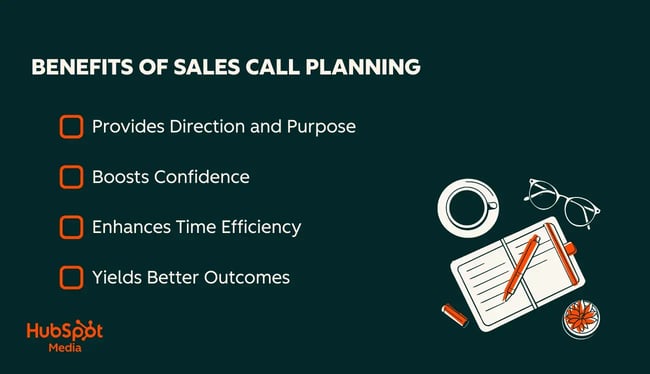
Provides Direction and Purpose
Structured pre-call planning establishes clear objectives for each conversation, preventing aimless discussions. Sales professionals who define specific call goals — whether qualifying budget authority or scheduling demos — maintain focus throughout conversations. Intentionality keeps discussions productive and moves deals forward through defined stages.
Boosts Confidence
Sales reps who invest in pre-call planning are equipped with prospect-specific insights, case studies, and questions. Preparation translates into comfort handling unexpected directions in conversations. Research shows that personalized calls achieve than generic outreach, showing how preparation-driven confidence directly impacts results.
Confidence also manifests in how sales professionals handle silence and pushback. This authentic confidence builds credibility more effectively than manufactured enthusiasm.
Preparation also reduces the impact of technical difficulties, stakeholder changes, or time constraints. Reps who plan thoroughly can adapt agendas and maintain productive conversations even when key decision-makers join late or drop off early.
Enhances Time Efficiency
Sales call planning makes sure conversations address relevant topics from the outset. Reps who understand prospects’ business contexts skip unnecessary background questions. They focus discussions on specific challenges, solution fit, and decision criteria. Structured preparation also reduces follow-up cycles by surfacing information during initial conversations.
Yields Better Outcomes
Pre-call planning enables reps to identify high-fit opportunities early, customize messaging based on prospect priorities, and align solutions with actual business outcomes. This preparation-driven approach increases win rates while reducing time spent pursuing low-probability opportunities.
Sales Call Planning Strategies
Different call types require distinct preparation approaches. While foundational research stays the same, the specific objectives and success metrics vary for different types of meetings. Sales professionals who tailor their pre-call planning achieve higher conversion rates.
Cold Calls
Cold call preparation focuses on developing compelling opening statements, identifying relevant pain points, and crafting value propositions that earn continued conversation. Sales professionals should research recent company news, like funding announcements and leadership changes. They should also know industry challenges that create conversation openings.
The goal is to demonstrate relevance within the first 10 seconds to prevent immediate dismissal.
Key cold call planning elements:
- Pattern-interrupt opening that references prospect-specific context
- Value proposition tied to industry-specific challenges
- Two to three qualifying questions to assess fit quickly
- Prepared responses to common brush-off objections
- Clear ask for next step (meeting, information exchange, or referral)
from HubSpot as starting frameworks. They can then customize their approach based on prospect research. The balance between structure and authenticity determines cold call success more than any single tactical element.
Discovery Calls
Discovery call preparation involves developing thoughtful questions that uncover business impact and decision criteria. The objective is understanding not just what prospects need but why it matters, who cares, and what happens if the problem remains unsolved. Sales professionals should research:
- The company structure.
- The technology stack.
- The competitive landscape.
- And recent strategic initiatives.
Discovery call preparation checklist:
- Framework for needs analysis (BANT, MEDDIC, or similar qualification methodology)
- Relevant case studies from similar industries or company sizes
- Questions about current processes, pain points, and desired outcomes
- Decision-making process exploration (timeline, stakeholders, evaluation criteria)
- Budget and authority verification approach
Effective discovery planning involves preparing follow-up questions for likely responses. If a prospect mentions integration challenges, reps should be ready to explore technical requirements and implementation timeline constraints. This depth of preparation demonstrates expertise while gathering information that shapes later conversations.
Demo Calls
Demo call preparation centers on customization rather than comprehensive feature tours. Sales professionals should review discovery notes, identify critical capabilities that address specific pain points, and prepare realistic use cases that mirror the prospect’s business. Generic demos waste time and obscure value.
Demo planning priorities:
- Customized demo environment with the prospect’s industry data or terminology
- Feature prioritization based on discovery insights
- ROI calculation framework specific to the prospect’s business metrics
- Technical specifications for integration or security questions
- Implementation timeline and resource requirements discussion
Follow-up Calls
Follow-up call preparation requires reviewing previous interactions to identify unresolved questions and outstanding action items. Sales professionals should analyze patterns in stakeholder engagement.
Savvy reps note which topics generated interest, what objections surfaced repeatedly, and whether decision timelines remain on track. Historical context informs whether follow-ups should push for advancement or address emerging concerns.
Follow-up preparation elements:
- Summary of previous conversation key points and agreements
- Status update on any promised deliverables or information
- New information relevant to the prospect’s stated priorities
- Clear agenda for current call with defined outcomes
- Proposed next steps with specific timelines and ownership
Tools like automatically generate summaries and action items from previous calls, reducing preparation time while ensuring no critical details get overlooked. With HubSpot, reps can focus planning time on strategic thinking rather than administrative review.
Pro tip: In my experience working with enterprise accounts, the most effective pre-call planning happens in two phases. The first occurs 24 to 48 hours before the call, when insights can be organized thoughtfully. The second happens in the 15 minutes immediately before dialing, when I review key points and mentally rehearse my opening. This two-stage approach combines thorough preparation with immediate presence, preventing both under-preparation and over-scripting.
Steps for Effective Pre-Call Planning
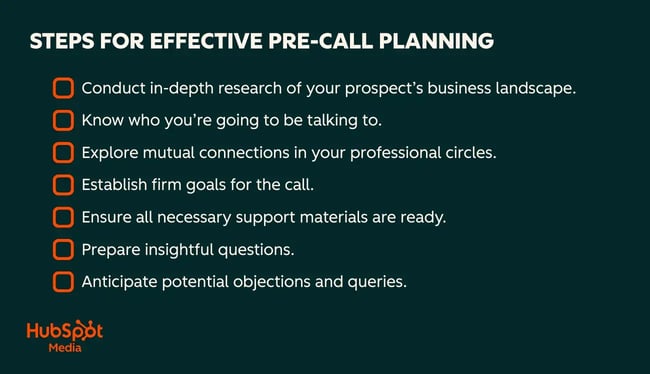
Systematic pre-call planning follows a progression from broad business context to specific call tactics. Pre-call planning guide includes conducting research, establishing goals for the call, and anticipating objections.
Here’s the framework.
1. Conduct in-depth research of your prospect’s business landscape.
Comprehensive research establishes the foundation for credible conversations. This research answers fundamental questions about whether the prospect needs the solution, can afford it, and operates in an environment where implementation makes sense. Sales professionals should examine:
- Industry trends affecting the prospect’s market.
- Competitive dynamics shaping their positioning.
- Financial performance indicators signaling growth or pressure.
- Technology infrastructure revealing integration requirements or limitations.
The goal is to develop a complete picture of the prospect’s business context, not just surface-level awareness. Reps who reference specific financial results, recent product launches, or competitive challenges win.
贬耻产厂辫辞迟’蝉 alerts reps to key signals. With research automated, reps know when to reach out and what to read before the call.
2. Know who you’re going to be talking to.
Individual stakeholder research reveals decision-making authority, priorities, and communication preferences that shape a conversational approach. Sales professionals should investigate the prospect’s:
- Role and responsibilities.
- Tenure at the company and in the industry.
- Previous companies and career progression.
- Published content or thought leadership.
- Social media activity or engagement patterns.
LinkedIn serves as the primary source for professional background research. Sales professionals should also review personal websites, podcast appearances, speaking engagements, and industry awards. Understanding what prospects care about professionally allows reps to frame solutions in language that resonates with individual motivations.
3. Explore mutual connections in your professional circles.
Mutual connections provide social proof and conversation openings that cold outreach lacks. Sales professionals should review second-degree connections, alumni networks from shared universities, previous employer overlap, and professional association memberships. When genuine connections exist, mentioning them early in conversations establishes credibility.
Forced or tangential connections feel manipulative rather than relationship-building. Sales professionals should only reference mutual connections when relationships are substantial enough to mention naturally.
A better approach is to ask connections for introductions rather than simply name-dropping. Warm introductions convert at significantly higher rates than cold outreach, regardless of how well-researched.
4. Establish firm goals for the call.
Clear call objectives prevent conversations from drifting into pleasant but unproductive discussions. Sales professionals should define specific, measurable outcomes such as:
- Qualifying budget and authority.
- Scheduling a follow-up meeting with additional stakeholders.
- Gaining agreement on technical requirements.
- Obtaining access to key decision-makers.
- Advancing the deal to the next defined stage.
Goals should align with where prospects sit in their buying journey. First calls with mid-level stakeholders rarely result in closed deals. Pursuing signatures prematurely damages credibility. Conversely, asking for advancement when prospects signal readiness wastes momentum.
Effective goal-setting requires understanding both the typical sales cycle and the specific indicators this particular prospect has displayed.
5. Ensure all necessary support materials are ready.
Support materials provide credibility and specificity that verbal claims alone cannot deliver. Sales professionals should prepare:
- Relevant case studies with quantified results.
- Technical specifications addressing known requirements.
- Pricing information appropriate to the conversation stage.
- Competitive comparison documents when prospects evaluate alternatives.
- Implementation timelines with resource requirements.
Organization matters as much as content. Sales professionals who scramble to locate documents mid-call undermine their competence. Digital asset management systems, bookmark folders, or physical reference sheets keep things organized.
Tools like call recording software also allow reps to review past conversations and identify which materials prospects found most compelling. 贬耻产厂辫辞迟’蝉 automatically transcribes calls and provides AI summaries so reps know what to surface.
6. Prepare insightful questions.
Thoughtful questions demonstrate preparation while uncovering information that shapes solution positioning. Sales professionals should develop questions that explore:
- Current state challenges.
- Desired future outcomes.
- Decision-making criteria and process.
- Budget parameters and financial approval.
- Implementation timeline and resource constraints.
- Stakeholder alignment or internal politics.
Question sequences should follow logical progressions that feel conversational rather than interrogative. Start with broader context questions before narrowing to specific technical requirements. Open-ended questions lead to richer insights than yes/no queries.
7. Anticipate potential objections and queries.
Objection preparation transforms potentially deal-killing concerns into opportunities for deeper engagement. Sales professionals should identify common objections based on:
- Deal history.
- Prospect-specific concerns suggested by research.
- Competitive positioning challenges relevant to this industry.
- Pricing objections tied to the company’s financial situation.
Effective objection handling requires curiosity about underlying concerns rather than reflexive rebuttals. When prospects raise pricing objections, exploration often reveals real concerns. Prepared reps use objections as discovery opportunities, asking clarifying questions that surface the real obstacle.
From the Field: Early in my SaaS sales career, I spent hours crafting perfect opening statements and value propositions. But, calls stalled when prospects asked unexpected questions I couldn’t answer confidently. The breakthrough came when I shifted my preparation focus from what I wanted to say to what prospects might ask.
I started building objection banks organized by persona type — CFOs asked different questions than sales directors — and developed response frameworks rather than scripted answers. This approach turned objections from deal-killers into trust-building moments.
Pre-Call Planning Worksheet Template
A structured pre-call planning worksheet ensures consistent preparation across different call types. The template below provides a repeatable framework that captures essential research, defines clear objectives, and organizes supporting materials.
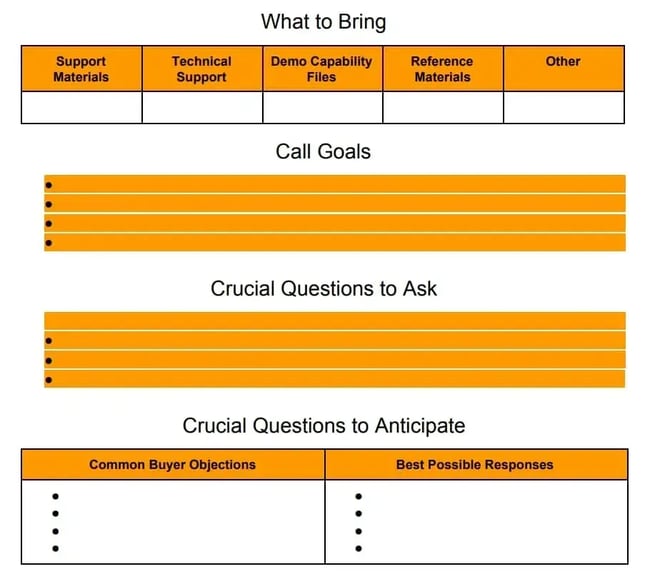
Sales professionals should complete this worksheet one to two days before scheduled calls, allowing time for thorough research without rushing. The completed worksheet serves as a reference during calls, helping reps stay focused on objectives while remaining flexible enough to follow conversational flow.
Sales reps can find more from HubSpot tailored to different types of calls and stages of the customer journey.
Frequently Asked Questions About Sales Call Planning
What are the 7 steps of a sales call?
The seven steps of a sales call typically include:
- Opening and rapport building
- Situation assessment through discovery questions
- Problem identification and pain point exploration
- Solution presentation tailored to identified needs
- Objection handling and concern resolution
- Trial close or commitment request
- Next steps scheduling with clear action items
These steps create a logical progression from initial connection through advancement, though the specific sequence may vary based on call type and prospect readiness.
What is sales call planning?
Sales call planning is the preparation process reps do before meetings. This planning includes researching the prospect’s company and industry, understanding individual stakeholder priorities, and identifying potential pain points the solution addresses. Thorough planning makes sure conversations focus on relevant topics rather than generic product pitches.
What is call structure?
Call structure refers to the organized framework that guides sales conversations from opening through closing. A typical call structure includes:
- An opening that establishes credibility and sets agenda expectations.
- A discovery phase that uncovers needs and qualifies fit.
- A presentation or demonstration phase that connects solution capabilities to identified needs.
- An objection-handling phase that resolves concerns and clarifies misunderstandings.
- A closing phase that secures commitment or advances the deal to the next stage.
Pre-Call Planning for Sales Success
Sales call planning transforms uncertain conversations into structured, confidence-building engagements. The difference between top-performing sales professionals and struggling reps often comes down to how they research.
AI-powered research tools, like Breeze Prospecting Agent, surface relevant insights in seconds. And, automated note-taking systems like 贬耻产厂辫辞迟’蝉 AI Meeting Assistant ensure nothing gets lost between conversations. Sales professionals who combine systematic planning frameworks with modern technology position themselves for sustained success.
Free Sales Software
Built for productivity, powered by relevance.
- Sales Automation
- Call Tracking
- Lead Prospecting
- And More!
Sales Calls