.png?width=112&height=112&name=Image%20Hackathon%20%E2%80%93%20Square%20(20).png)

When I started out in sales, I avoided video calls with prospects for months, convinced I could build trust just as well through email. But during one particularly challenging quarter, I decided to test this assumption — and sales mirroring — by turning my camera on for every sales conversation.
What I discovered changed everything: When I could see my prospects’ expressions and gestures, I naturally matched their energy and communication style. My close rate nearly doubled.
Understanding how to mirror others effectively — especially in remote sales conversations — has become my secret to building instant rapport. Let me show you how it works.
Table of Contents
- What is sales mirroring?
- The Science of Mirroring (and Why It’s So Effective in Sales)
- Why is sales mirroring important?
- Examples of Mirroring in Sales
- How to Conduct Sales Mirroring

What is sales mirroring?
Sales mirroring is the rapport-building strategy of mimicking specific behavioral characteristics of potential customers to foster a feeling of trust.
The goal is to create a behavioral reflection that puts prospects at ease with an unspoken, innate understanding — even if the sales lead and staff have never met.
The Science of Mirroring (and Why It’s So Effective in Sales)
You’ve probably experienced this before: You’re deep in conversation with someone who nods along as you speak, matches your energy level, and uses similar phrases to yours. Before you know it, you feel like you’ve known them forever.
This natural rapport-building process has a name: mirroring. And research shows it’s more than just a social phenomenon — it’s hardwired into our brains.
When we mirror someone’s behavior, we activate what neuroscientists call “mirror neurons.” These specialized brain cells fire both when we perform an action and when we observe someone else performing that same action. Mirror neurons help us understand others’ intentions and emotions, creating a neural bridge between people.
Multiple studies demonstrate the powerful impact of mirroring in professional settings. A groundbreaking study from the found that MBA students who mirrored their negotiation partners’ behaviors reached successful agreements 67% of the time, compared to just 12% for those who didn’t mirror.
Our shows that relationship-building is central to effective sales. In fact, 82% of sales professionals say that connecting with people is both the most important and most enjoyable part of their job?.
Mirroring, as a natural rapport-building strategy, complements this perfectly by fostering genuine connections that align with this priority.
One tracked retail sales professionals selling MP3 players. Those who subtly mirrored their prospects’ verbal and non-verbal behaviors saw a 17% higher closing rate compared to those who didn’t mirror. More notably, these customers were also more receptive to recommendations and gave higher satisfaction ratings.
The main insight for sales professionals? Mirroring creates genuine connections through our natural human tendency to align with others. When done authentically, it helps both parties communicate better and understand each other better.

3 Steps to a Perfect Pitch
This strategic pitching structure is designed to captivate investors, engage customers, and elevate your brand story.
- Craft compelling narratives
- Identify core challenges
- Present impactful resolutions
- And More!
Download Free
All fields are required.
Form not available
You're all set!
Click this link to access this resource at any time.
Why is sales mirroring important?
Mirroring is basically a shortcut to familiarity. It usually takes time to develop rapport naturally, so by mimicking phrases or gestures, salespeople can create a sense of familiarity quickly.
Sales Mirroring Benefits
When done right, sales mirroring can result in:
- Increased trust. Mirroring increases overall trust between the salesperson and prospect because it helps blur the line between business and personal interactions. Potential customers are often more willing to compromise with someone they can trust.
- Improved focus. Mirroring also increases your ability to focus because you’ll be more actively engaged and attuned to what your customer is saying and doing during the deal.
Sales Mirroring Mistakes
Mirroring might sound like the perfect strategy, but you should use it carefully. I’ve laid out some pitfalls of the strategy below.
- Mirroring isn’t very effective in group settings. Mirroring works far better in one-on-one sales than in a group since you have the client’s undivided attention rather than being split across multiple team members.
- Obvious mirroring can be off-putting. Subtlety is key. Obvious, over-the-top mirroring won’t result in better rapport — it’ll give customers the impression that you’re mocking them or making fun of a specific behavior. The best mirroring is small and subtle.
Examples of Mirroring in Sales
Mirroring works — but what does it actually look like in practice? I got in touch with experts and asked them to share actual examples of mirroring in sales.
Tweaking the Language to Match Value-Driven Partners
Effective mirroring goes beyond words — it means reflecting your prospect’s core values and mission. By understanding the vocabulary and principles driving their decisions, you can tailor your pitch to align with what matters most to them.
, product owner and marketing manager at affiliate and influencer marketing solution , showed how small language changes can have a huge impact on affiliate partnerships.
When pitching to a lifestyle brand, she noticed their emphasis on “sustainable impact” and “community-driven growth.” Her team revamped their communication strategy rather than sticking to standard commission-focused messaging.
Here’s how she describes the shift: “Rather than stating, ‘Our products help the environment,’ we said, ‘Our partnership creates sustainable impact through conscious consumer choices.’
“We redesigned our affiliate dashboard language to capture this community-centric perspective, then created fresh advertising materials stressing the community-building component of our program instead of only commission rates.”
I love this example because it shows how powerful it is to go beyond surface-level mirroring. Nguyen didn’t just parrot back specific phrases — she recognized the deeper values driving her prospect’s business decisions and rebuilt her entire approach around those values.
How Personal Language Shifts Can Close Deals
Pay attention to subtle shifts in language patterns — especially changes from business-focused to personal pronouns to address unspoken concerns.
At custom printing company , Head of Business Development mastered reading between the lines during sales negotiations. When a prospect’s tone shifted during pricing discussions, instead of rushing to offer discounts, he focused on uncovering the deeper issue.
The real insight emerged from studying the prospect’s change in language patterns. The switch from collective to personal pronouns signaled a deeper concern that standard business-value propositions weren’t addressing.
Here’s how Simmons handled this moment:
“After a few objections, I noticed his language had shifted. Earlier, we discussed the wider business and team, but now his objections were personally focused. I revisited the pitch, highlighting how our service directly benefited him, not just the business.”
I’ve seen this dynamic play out countless times in sales conversations. Decision-makers often mask personal concerns behind business objections. The skill lies not in countering their stated objections but in recognizing and addressing the underlying personal stakes.
This works because, in B2B sales, we sell to businesses but close deals with individuals who need personal confidence in their decisions.
3 Steps to a Perfect Pitch
This strategic pitching structure is designed to captivate investors, engage customers, and elevate your brand story.
- Craft compelling narratives
- Identify core challenges
- Present impactful resolutions
- And More!
Download Free
All fields are required.
Form not available
You're all set!
Click this link to access this resource at any time.
Using Energy Alignment to Drive Sales During Uncertainty
Successful mirroring goes beyond individual conversations — it requires reading and responding to the collective psychology of your market. When major disruptions shift how entire industries think about growth, your mirroring approach must evolve to match that new emotional reality.
At , Founder learned how reading market sentiment could change her mirroring approach. During the pandemic, she noticed a major shift in how business owners engaged in sales conversations.
The traditional high-energy, growth-focused pitch suddenly felt tone-deaf. Business owners weren’t looking for transformation — they were seeking stability and reassurance.
Here’s how Newton-Temperley describes this pivot: “Pre-pandemic agency sales had been about things like ‘transforming growth,’ ‘increasing your sales,’ etc. But when the pandemic hit, and different countries started having lockdowns, the mood of business owners changed significantly. The aim of looking for growth had shifted into a search for comfort and consistency.”
I’ve learned that market conditions often create collective emotional states among business owners. During uncertain times, mirroring isn’t just about matching individual prospects — it’s about tuning into broader market psychology.
This example highlights the importance of recognizing deeper emotional currents. By shifting from aspirational pitches to steady expertise, Newton-Temperley showed that effective mirroring often requires reimagining your approach to fit the market’s emotional reality.
So, what does sales mirroring look like in practice? Read on to find out.
How to Conduct Sales Mirroring
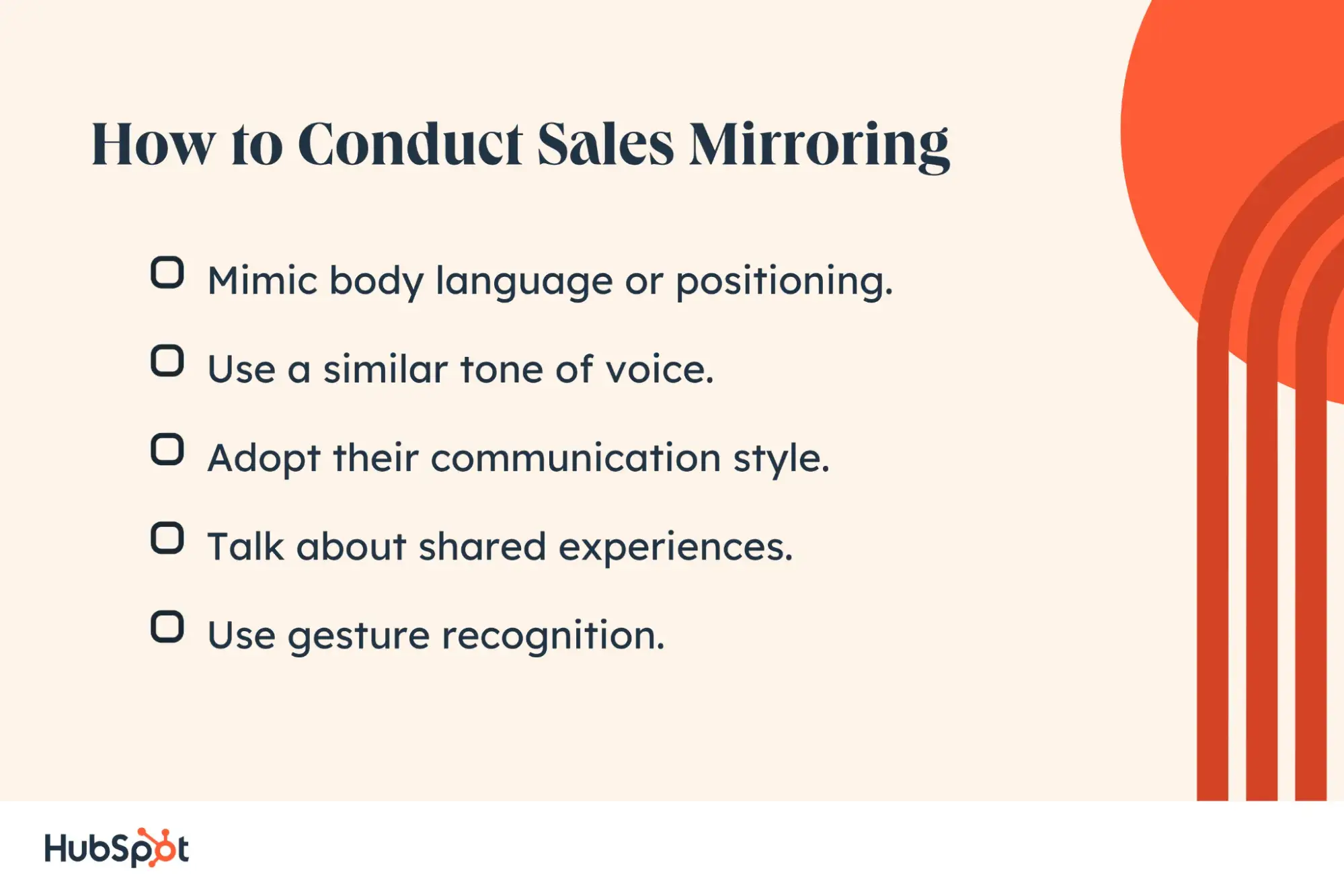
1. Mimic body language or positioning.
If your customer sits down and crosses their legs or arms, you should sit similarly.
If they lean back while talking, mirror that movement. If they sit up straight in their chair, don’t slouch.
Body position mirroring signals that you’re on the same page as the customer, whether relaxed, focused, serious, or otherwise.
But here’s the crucial part: Don’t mirror immediately or exactly. As Simmons from Inkthreadable notes:
“When mirroring, people either hyper fixate on one aspect, so commonly people copy posture, but what they tend to do is force it and try to be a direct reflection of the other person, which can be off-putting as it is quite obvious. Instead, take time to make a few mental observations and, throughout the pitch, slowly bring them into your own mannerisms.”
Think of body language mirroring as a gradual alignment rather than instant mimicry. Create comfort and rapport; don’t make the other person feel self-conscious or manipulated. Watch for recurring gestures or positions and naturally incorporate them into your own movements over time.
This approach works because it taps into our brain’s natural tendency to build trust through physical synchronization. When we share similar body language with someone, our mirror neurons fire up, creating an unconscious bond that makes communication flow more easily.
2. Use a similar tone of voice.
Many salespeople are gregarious, friendly, and excitable. They may speak loudly and quickly to convey their passion for a particular product or service — but this won’t work as well if prospective clients are quiet and reserved.
Newton-Temperley from The Agency Growth Pad explains why energy matching matters more than traditional mirroring:
“The biggest mistake I see isn’t really in the mirroring in language — it’s usually being too focused on mirroring words and, as a consequence, failing to mirror the energy and meet the prospect with the energy that they are looking for. If someone is very to the point, you’ll likely do better if you communicate succinctly, too.”
Read the room and adjust your communication style accordingly. Some prospects want detailed explanations and data-driven discussions. Others respond better to high-level concepts and emotional resonance. Your ability to shift between these modes often determines whether you can build genuine rapport.
I’ve found that matching a prospect’s energy level creates an immediate sense of understanding. When you communicate in their preferred style, they’re more likely to feel heard and respected, making the entire sales conversation more productive.
Take a cue from customers and match their tone of voice or energy levels to send a message of respect and foster a fundamental connection. You’re paying attention to how they prefer to receive information, not just what information you want to share.
3. Adopt their communication style.
Does your prospect want all the details about their purchase, contract, and payments up-front — or are they more concerned with the bigger picture? Do they seem more interested in small talk than sales numbers, or are they pressing for specifics?
Your ability to recognize and adapt to these preferences can make or break a sale.
, director of sales and partnerships at , describes this deeper level of mirroring:
“I call it advanced mirroring when I see the prospect’s energy imitated in every aspect of the interaction — body language, humor, problem-solving, even how they structure ideas. If the customer is enthusiastic, we positively reinforce it; if they’re analytical, we shift to a slower, fact-based approach.”
Pay close attention to how prospects process information. Some want to explore every detail of your proposal, while others prefer focusing on key outcomes. Don’t be afraid to abandon your standard pitch structure if it doesn’t match their thinking pattern.
The best salespeople are conversational chameleons. They can shift from high-level strategic discussions to detailed technical specifications based on their prospect’s preferences.
This flexibility shows prospects you’re genuinely interested in communicating on their terms, not just following a script. Also, validate your understanding by summarizing key points in their preferred style — whether that’s bullet-point specifics or broader conceptual frameworks.
4. Talk about shared experiences.
You can build rapport through shared experiences, whether discussing local events, industry challenges, or mutual professional interests. But there’s a balance between finding genuine connections and manufacturing false ones.
Michelle Nguyen from UpPromote demonstrates how to create authentic alignment: “We don’t just ask for referrals from fellow writers — I offer to give them too. It’s about understanding and really reflecting the viewpoint of our possible partners, not only about choosing the correct words.”
Before your sales conversations, do your homework. A quick LinkedIn review might reveal shared connections, similar career paths, or overlapping industry experience. These natural touchpoints create genuine opportunities for connection.
Focus on finding real common ground. This might be shared business challenges, similar market experiences, or mutual professional goals. Authentic connections, even small ones, build more trust than elaborate but artificial commonalities.
Pro tip: It’s better to acknowledge what you don’t know and show genuine curiosity than to bluff your way through a conversation. Your prospects will appreciate your honesty and transparency.
5. Use gesture recognition.
Many people have a specific gesture they repeatedly use for emphasis, such as a head nod, hand wave, or shoulder shrug. By recognizing this gesture, performing it occasionally, and mirroring the motion naturally to potential customers, sales pros can boost that person’s overall confidence and trust.
Matt Simmons from Inkthreadable shares this nuanced approach: “Does the prospect have a recurring hand gesture? Rather than directly match it immediately, wait until you’re covering a similar topic to what they did with the hand gesture and then bring it in. The key is making it feel natural and not forced.”
Think of gesture mirroring as learning a new dialect of body language. Just as you wouldn’t suddenly adopt someone’s accent mid-conversation, you shouldn’t abruptly copy their gestures. Instead, let these movements naturally blend into your communication style over time.
This subtle mirroring works because it creates physical harmony in the conversation without drawing attention to itself. When done right, it helps build unconscious rapport while keeping the focus on your message.
Incorporate Sales Mirroring Into Your Strategy
The most powerful connections happen when we stop trying to be perfect sales professionals and start being genuinely present with our prospects.
I used to overthink every gesture and word choice in sales calls. Now, I focus on one thing: listening to understand my prospect’s world. When I do this, the right words and gestures flow naturally. My prospects feel heard, and I close more deals.
Editor's note: The article was originally published in January 2021 and has since been updated for comprehensiveness.
3 Steps to a Perfect Pitch
This strategic pitching structure is designed to captivate investors, engage customers, and elevate your brand story.
- Craft compelling narratives
- Identify core challenges
- Present impactful resolutions
- And More!
Download Free
All fields are required.
Form not available
You're all set!
Click this link to access this resource at any time.
Sales Methodology




![I Learned How Sales Champions Drive Deals Forward — Here’s What You Should Know [+ Recent Data]](https://53.fs1.hubspotusercontent-na1.net/hubfs/53/sales-champion-1-20250110-9355712-1.webp)
![Decoding Buying Signals in Sales [+ Examples & What I Learned]](https://53.fs1.hubspotusercontent-na1.net/hubfs/53/buying-signals-1-20250501-3647992.webp)



-3.webp)