.png?width=112&height=112&name=Image%20Hackathon%20%E2%80%93%20Square%20(14).png)
Consistent monitoring of sales performance metrics is vital for organizational growth. Clearly defined metrics give teams the visibility needed to understand results, identify gaps, and optimize revenue-driving activities.
While most sales leaders want to track sales performance, choosing the right metrics is where many teams struggle.
Don‘t know where to start? Don’t worry. HubSpot surveyed over 1,000 sales professionals to give you some perspective. This piece explores all things sales metrics, including the seven metrics respondents cited as being important to track. Let's dive in.
Table of Contents
- What are sales performance metrics?
- Sales Performance Metrics Every Team Should Track
- How to Track Sales Performance Metrics Effectively
- Best Practices for Making the Most of Sales Performance Metrics
- Frequently Asked Questions About Sales Performance Metrics
What are sales performance metrics?
Businesses generate constant sales activity, but without measurement, leaders can’t identify what’s driving or limiting results. This lack of visibility makes it difficult to diagnose performance issues, optimize processes, or protect revenue when outcomes decline.
Sales performance metrics are measurable data points for evaluating the performance of a business, team, or sales reps. They help organizations analyze results, understand trends, and make informed decisions. For example, a month-over-month revenue drop can be traced back to specific activities or stages in the sales process using performance metrics.
While often confused, sales performance metrics and KPIs are not the same. Performance metrics track operational inputs and outcomes, such as conversion rates. KPIs are a prioritized set of metrics tied directly to strategic goals like revenue growth.
By linking daily activities to outcomes, performance metrics improve coaching, forecasting, and team accountability. When metrics fall outside target ranges, they signal underperformance that can directly impact revenue and overall sales effectiveness.
The Challenge of Measuring Sales Success
Modern sales teams have access to enormous data, from activity-level metrics to pipeline and revenue reports. This volume of data creates opportunity, but also causes data overload. When teams track many metrics, it becomes difficult to distinguish meaningful from irrelevant signals, thus slowing decision-making and diluting focus.
Focused measurement fixes this challenge by prioritizing the core metrics aligned with revenue goals and sales strategy. This also lets organizations direct attention to what truly drives performance. Also, this approach enables clearer insights, more effective coaching, and faster corrective action. Data then supports outcomes rather than overwhelming the team.
Sales Metrics vs. KPIs: What’s the Difference?
Sales metrics and KPIs are closely related but serve distinct functions.
Sales metrics track specific activities or performance indicators, such as win rate and conversion rate. They provide granular insight into how the sales process is functioning and where improvements can be made.
Key performance indicators (KPIs) are a select group of metrics that reflect progress toward core business objectives. For example, revenue growth is a KPI because it directly measures success against strategic goals.
This distinction matters because while metrics inform day-to-day optimization, KPIs keep teams aligned on outcomes that impact overall business performance.
Why are Performance Metrics Important?
Tracking and analyzing performance metrics help businesses evaluate the soundness of their operations and make better-informed decisions. What the “right” metrics are depends on factors like your sales organization's structure and priorities, the nature of your industry, and your broader company objectives.
Pro Tip: For users, many of these metrics are available with , while others can easily be created in the custom report builder.
Sales Performance Metrics Every Team Should Track
Sales performance metrics generally fall into three categories: activity metrics, performance metrics, and efficiency metrics.
Activity metrics measure the inputs that drive sales motion, performance metrics evaluate outcomes and results, and efficiency metrics assess how effectively resources are converted into revenue. Organizing metrics this way helps teams focus on what to track, why it matters, and how often to review it — without creating unnecessary data overload.
Here are the seven most important sales performance metrics your sales team should be measuring, according to over 1,000 sales professionals.
- Average Profit Margin - Efficiency Metric
- Year-over-Year (YoY) Growth - Performance Metric
- Conversion Rate - Performance Metric
- Sales Productivity Metrics - Activity Metric
- Quota Attainment - Performance Metric
- Win Rate - Performance Metric
- Customer Acquisition Cost (CAC) - Efficiency Metric
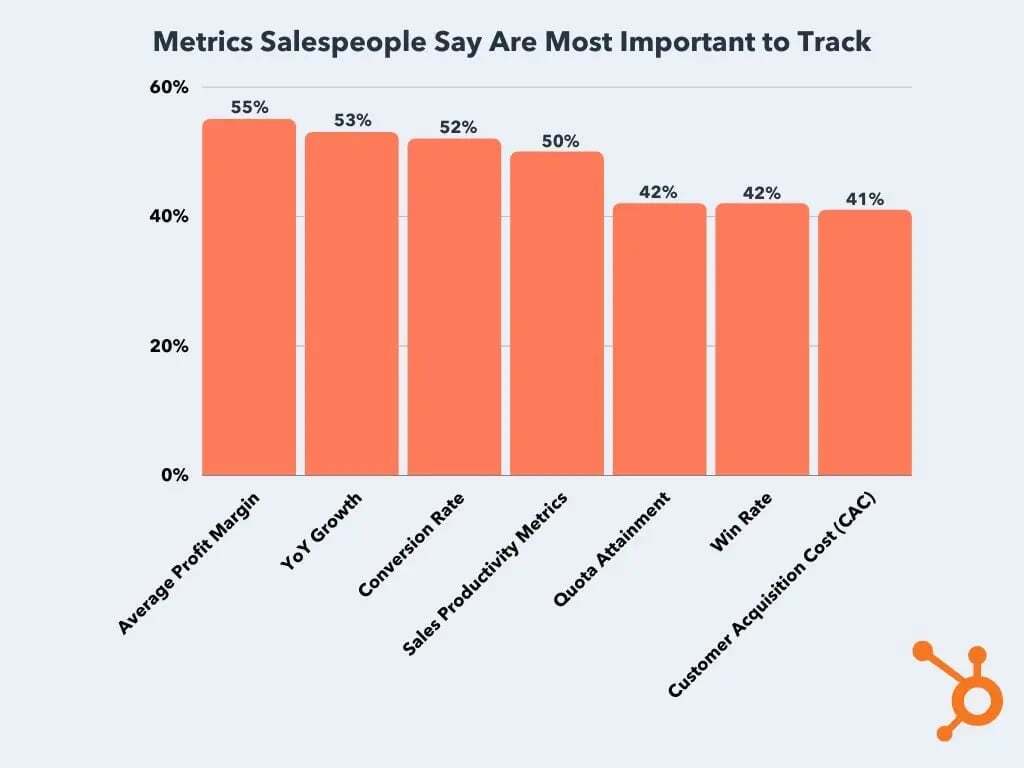
Average Profit Margin: 55% of Respondents
What is it?
Average profit margin, typically expressed as a percentage, measures the proportion of a company's net margin from sales over an extended period, usually multiple years. It also factors in business expenses, making it an effective measure of how a company can manage costs relative to sales.
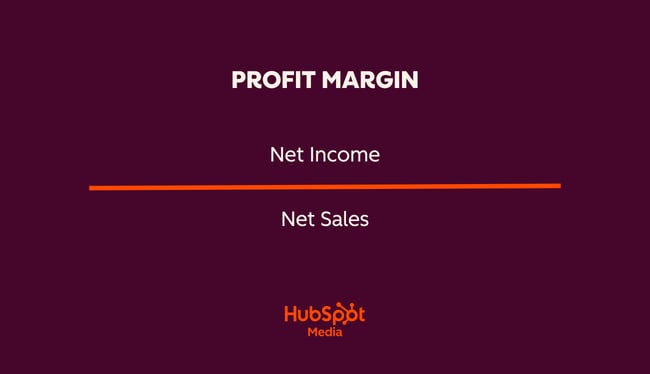
How to Calculate It
To calculate average profit margin, you divide net income from a given period by the net sales over that same timeframe.
Why is it important?
Tracking average profit margin is one of the best ways to understand the efficiency of a sales organization. It gauges how much of the generated revenue is making it to the bottom line.
This metric tells organizations how well the team‘s input is translating to productive output. While tracking revenue is important, it doesn’t give a full picture of how effectively a sales org is leveraging the resources at its disposal.
Companies can generate impressive revenue figures in a quarter. But if they‘re investing more into supporting those efforts than they’re reaping, those figures might paint a misleading picture of the company’s performance.
When to focus on it
Review regularly during pricing changes, expansion into new markets, or when revenue grows but profitability declines.
Year-over-Year (YoY) Growth: 53% of Respondents
What is it?
Year over year (YoY) growth is a metric that shows how an organization‘s sales figures have improved from one year to another. It’s typically expressed as a percentage.
How to Calculate It
To calculate YoY growth, take the revenue figure for an initial 12-month period, subtract that number from the previous 12 months' revenue, divide the difference by the latter, and multiply the result by 100.
Current Period Revenue?Prior Year Revenue÷Prior Year Revenue*100
So if you saw $100,000 in revenue in 2025 and $90,000 in 2024, you would divide the difference of $10,000 by $90,000 and multiply that figure by 100, resulting in a YoY growth figure of 11.11%.
Why is it important?
YoY growth gives sales leaders a picture of how their sales orgs are performing from a wider lens. Monthly and quarterly figures are relatively limited and more vulnerable to shifts that might not reflect the company's real health.
Annual growth figures help sales orgs gauge elements like the effectiveness of their sales processes and efficacy of their sales efforts, beyond the influence of factors like seasonality or monthly volatility.
Usage context
Best used in quarterly and annual reviews to evaluate sustainable growth and sales strategy effectiveness.
Conversion Rate: 52% of Respondents
What is it?
Conversion rate measures the percentage of prospects that move from one stage to the next, often from lead to customer.
How to Calculate It
To calculate conversion rate from leads to customers, divide the number of leads who become customers by the number of leads generated in a given period.
Number of Leads Who Become Customers?/Total Number of Leads Generated*100
So if you get approximately 500 leads per month, and on average 50 buy your product, the conversion rate is 10%.
Why is it important?
Conversion rate reveals funnel health and identifies where prospects drop off in the sales process.
With this metric, companies can calculate the required number of leads needed to meet revenue targets. Historical conversion rates also show whether reps are becoming more effective. If the average conversion rate is climbing — and the business is closing the same or greater quantity of deals — then sales performance is improving.
If conversion rate is dropping, something is probably wrong with the sales process, team, and/or lead generation efforts.
Review frequency
Monthly or per pipeline stage, with deeper analysis during periods of declining revenue.
Sales Productivity Metrics: 50% of Respondents
What are they?
Sales productivity metrics are a catch-all term that covers how actively, consistently, and productively sales reps engage in the activities relevant to their roles. It can cover metrics like CRM usage, calls made, emails sent, conversations, or use of sales tools.
How to Calculate Them
Sales productivity metrics cover a range of figures. Calculating them entails tracking reps' individual activity through in CRMs such as HubSpot or call tracking software.
Why are they important?
Ultimately, an entire sales org can only be as productive as the reps who support it. As a sales leader, it’s vital to know that everyone in the org is staying engaged and pulling their weight. Tracking sales productivity metrics offers a way to hold reps accountable and ensure they're staying active and motivated.
The value of these metrics is twofold. For one, they give leaders a picture of how the broader org performs. Secondly, they offer managers insight into how individual reps are contributing — showing whether they might need extra attention, coaching, or support.
Tracking cadence
Weekly for managers and reps to support coaching, workload balancing, and early performance signals.
Quota Attainment: 42% of Respondents
What is it?
Quota attainment is a relatively straightforward metric. It shows whether a rep has hit their quota for a given period — more specifically, the metric represents the proportion of a rep's actual sales to their quota.
How to Calculate It
To calculate quota attainment, divide a rep's actual sales in a given period by their quota for that same timeframe and multiply that figure by 100.
(Revenue Closed÷Assigned Quota)*100
Why is it important?
Like sales productivity metrics, quota attainment offers sales leaders a more thorough picture of how individual salespeople are performing. It might be the purest measure of the results reps are delivering.
Tracking quota attainment lets managers know which of their salespeople need extra attention, coaching, or support.
But the value of quota attainment isn‘t just specific to how individual reps are performing. Tracking quota attainment on an org-wide scale shows the soundness of the org’s sales process, messaging, leadership, and goal-setting.
When to analyze
Monthly and quarterly, especially during compensation planning and forecasting cycles.
Win Rate: 42% of Respondents
What is it?
Win rate refers to the percentage of final-stage prospects who closed and became customers divided by the total number of deals in your sales pipeline.
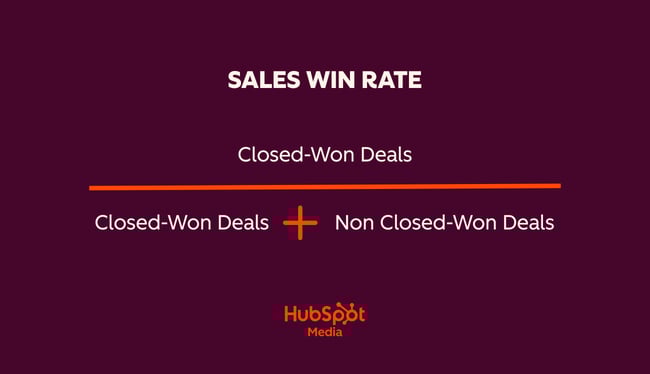
How to Calculate It
To calculate win rate, you divide your number of closed-won deals by the sum of your closed-won deals and non-closed-won deals.
Why is it important?
Win rate gives sales leaders a picture of the timeframes, specific reps, or other factors that maximize their orgs‘ potential to turn prospects into customers. That kind of perspective can inform better-structured sales strategies, lead to more tactful personnel decisions, and help expose flaws in sales processes — among several other elements that dictate a sales org’s performance.
When to review
Analyze monthly and by segment, rep, or deal size for actionable insights.
Customer Acquisition Cost (CAC): 41% of Respondents
What is it?
Customer acquisition cost (CAC) refers to the average sum of sales and marketing spend an organization exhausts to convert a lead to a new customer.
How to Calculate It
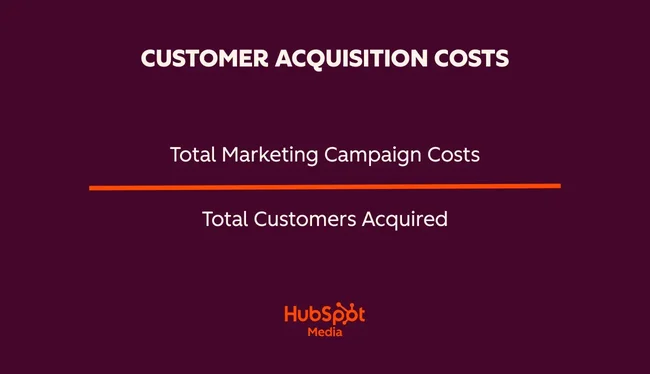
To calculate customer acquisition cost, start by determining a timeframe for the calculation — typically a month, quarter, or year. After getting a designated frame of reference, add your total marketing and sales expenses from that stretch and divide that figure by the total number of customers acquired over the period.
Why is it important?
Like so many other metrics listed here, customer acquisition cost is a measure of your organization‘s efficiency. It’s a reflection of the soundness of your sales and marketing strategies as well as how effectively both departments are leveraging the resources at their disposal.
A less-than-ideal customer acquisition cost can indicate lapses in your sales process, reveal misalignment between sales and marketing, show that reps might not be putting in enough effort, or shed light on other elements of your efforts that prospects aren't receptive to.
One way or another, a poor CAC is one of the better indicators that your organization needs to work on. Tracking it provides a starting point for determining what is working well and where improvement will help.
Analysis frequency
Quarterly, with deeper review during growth initiatives or budget adjustments.
How to Track Sales Performance Metrics Effectively
Tracking sales performance metrics effectively requires structure, consistency, and alignment with business goals. A clear implementation approach ensures data is reliable, actionable, and used to improve revenue outcomes rather than simply reported.
Define Clear Sales Objectives
Sales performance measurement starts with clearly defined business and revenue objectives. Metrics should be selected only after goals such as growth targets, market expansion, or efficiency improvements are established, ensuring relevance and alignment. Clear goals and objectives also make it easier to select the appropriate metrics to track.
Select Metrics by Category
Metrics should be grouped into activity, performance, and efficiency categories to balance leading and lagging indicators. This structure prevents overreliance on revenue-only metrics and improves diagnostic insight.
Standardize Data Collection
Consistent definitions and calculation methods are required to ensure accuracy. Standardization reduces reporting discrepancies and improves trust in performance data across teams.
Use Sales Performance Measurement Tools
Technology enables consistent tracking, reporting, and analysis at scale. The following tools are commonly used to support sales performance measurement:
-
CRM Platforms (e.g., HubSpot, Salesforce)
Centralize customer data, pipeline activity, and revenue reporting to support end-to-end performance tracking.
-
Sales Engagement Tools (e.g., Outreach, Salesloft)
Track activity metrics such as calls, emails, and follow-ups to connect rep behavior to outcomes.
-
Revenue Intelligence Tools (e.g., Gong, Clari)
Analyze conversations, forecasts, and deal health to improve win rates and predictability.
Establish Review Cadence and Ownership
Metrics are most effective when reviewed regularly and owned by specific roles. Clear accountability ensures insights translate into action.
Best Practices for Making the Most of Sales Performance Metrics
Maximizing the value of sales performance metrics depends on disciplined usage, strategic focus, and company-wide adoption. High-performing sales teams apply metrics consistently and use them to drive constructive decisions.
Focus on Fewer, High-Impact Metrics
Limiting tracked metrics increases clarity. Teams that prioritize a small set of high-impact indicators act faster and more effectively.
Pair Leading and Lagging Indicators
Combining activity-based metrics with outcome-based metrics creates early warning signals and improves coaching effectiveness. Leading indicators such as calls made, meetings booked, demos completed, or follow-up response time show future revenue potential.
Lagging indicators, such as closed-won deals and quota attainment, confirm results after they occur.
Tracking these metrics together allows teams to identify performance issues early — for example, a drop in meetings booked may signal an upcoming quota attainment shortfall, letting the business help reps to adjust behavior before outcomes are impacted.
Use Metrics as Coaching Inputs, Not Just Evaluations
Metrics should guide development conversations rather than function solely as performance scorecards. This approach improves adoption and rep engagement.
Frequently Asked Questions About Sales Performance Metrics
What Are Sales Performance Metrics?
Sales performance metrics are measurable data points used to evaluate how effectively sales teams, individuals, and processes contribute to revenue and business goals. They provide visibility into activity levels, outcomes, and efficiency across the sales funnel.
What Are the 5 Key Performance Indicators in Sales?
Commonly tracked sales KPIs include:
- Revenue Growth – Measures overall sales success by tracking increases or decreases in revenue over time.
- Customer Referrals – Indicates customer satisfaction and advocacy by tracking how often existing customers generate new business.
- Rep Retention Rate – Measures sales team stability and effectiveness by tracking how many reps remain over a given period.
- Annual Contract Value (ACV) – Evaluates revenue efficiency by measuring the average annual value of customer contracts.
- Sales Cycle Length – Assesses speed to close by measuring the time it takes to move a deal from first contact to close.
How Do You Choose the Right Metrics for Your Sales Team?
Metric selection should be based on alignment with revenue goals, role relevance, data reliability, and actionability. Metrics should clearly inform decisions, coaching, or strategic adjustments.
How Often Should You Review Sales Performance Metrics?
Review frequency depends on metric type:
- Activity metrics: Weekly
- Performance metrics: Monthly
- Efficiency and strategic metrics: Quarterly
Regular review ensures timely insights while avoiding unnecessary reporting overhead.
It's worth noting that our list of sales performance metrics is far from exhaustive. The performance metrics you choose to track will rest on the needs, interests, and structure of your sales org.
Still, the metrics listed here represent a solid starting point to give you some valuable perspective on what you're doing well and where you might have room for improvement.
Sales Metrics




![Sales metrics: What to track, how to track, & why [expert tips]](https://53.fs1.hubspotusercontent-na1.net/hubfs/53/Sales-metrics-1-20251030-6874232.webp)