.png?width=112&height=112&name=Image%20Hackathon%20%E2%80%93%20Square%20(14).png)
Even when sales volume targets are met, businesses can still fall short of revenue goals due to sales price variance — a gap that often goes unnoticed until performance reviews highlight the shortfall.
Hitting a unit sales target does not guarantee revenue performance. Pricing pressure, discounting, and shifts in customer demand can quietly erode revenue when sales variance is not tracked. As a result, revenue forecasts become less reliable, and pricing decisions are made without the data needed to adjust course.

Unreliable forecasting occurs across growing and mature organizations alike. While tools like can improve visibility, teams should still know how to calculate and understand sales variance. Keep reading to see why sales variance matters, the formula to use, and how to use the data to make informed business decisions.
Table of Contents
- What is sales variance?
- How to Calculate Sales Variance
- How to Calculate Sales Volume Variance
- Other Essential Variance Types
- Frequently Asked Questions about Sales Price Variance
What is sales variance?
Sales variance is the overarching term that explains the difference between actual and budgeted sales. Sales variance allows companies to understand how their sales are performing against market conditions.
When sales variance is favorable, the company receives more money from the sale of a product than expected. An unfavorable sales variance means the company receives less revenue from product sales than expected.
.png)
Free Sales Metrics Calculator
A free, interactive template to calculate your sales KPIs.
- Average Deal Size
- Customer Acquisition Cost (CAC)
- Customer Lifetime Value (CLV)
- And more!
Download Free
All fields are required.
Form not available
You're all set!
Click this link to access this resource at any time.
Types of Sales Variance
1. Selling Price Variance
Selling price variance is a type of sales variance that accounts for the difference between the actual selling price and the expected selling price. Selling price variance can impact the company‘s revenue goals either positively or negatively if it isn’t calculated and anticipated.
2. Sales Volume Variance
Sales volume variance measures the difference between expected units sold and actual units sold. Volume variance can also be positive or negative.
A business can have both sales price variance and sales volume variance together, or one of each, at a time. In fact, sales teams may strive for one type of variance if a business is changing the positioning of a product, entering a new market, or working on a high-impact goal.
Sales Variance Outcomes
Favorable sales variance occurs when a company can sell its product at a higher price than what was budgeted. Positive variance occurs more often in less competitive markets where companies charge a premium for goods and services.
On the other hand, unfavorable sales variance occurs when a company charges less for its product compared to what was budgeted. This scenario is more common in competitive markets where companies lower their prices in an effort to appeal to customers.
Now that we understand the causes and potential outcomes of sales variance, let’s walk through how to calculate it.
How to Calculate Sales Variance
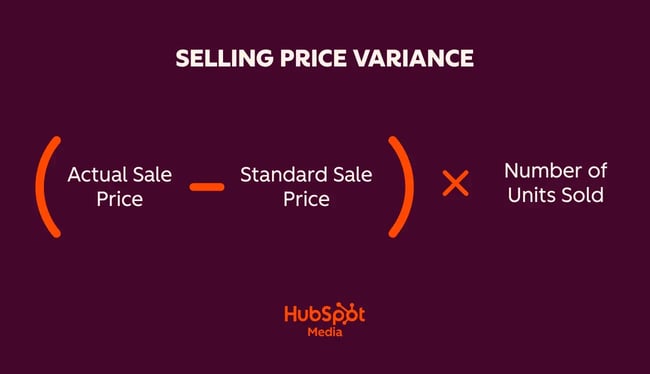
To calculate selling price variance, a business needs the following values:
- The actual selling price of the product (per unit).
- The standard selling price of the product (how much was budgeted to sell the product for a unit).
- The number of units sold.
With this information handy, a business can plug the values into the sales variance formula:
Sales Variance = (Actual Sale Price — Standard Sale Price) x Number of Units Sold
Sales Variance Example
Say a business sells potted plants online and expects to sell 100 pothos plants in decorative pots for $30 each. After one month, the plants are selling above projections due to a viral TikTok review, and the product demand is sky-high. To allow time for the manufacturing team to restock, the company raises prices to $35.
During this sales period, the company sells all 100 potted pothos plants for $35. Using the formula, we can calculate the sales variance for the potted pothos plants.
Sales Variance = ($35 — $30) x 100 = $500.
This calculation shows a favorable variance of $500 from the sale of the potted pothos plants. This means the company brought in $500 more than anticipated from the plants sale.
In this situation, the company raised the price of its product to temporarily reduce demand, and it still brought in more sales revenue than originally planned.
How to Calculate Sales Volume Variance
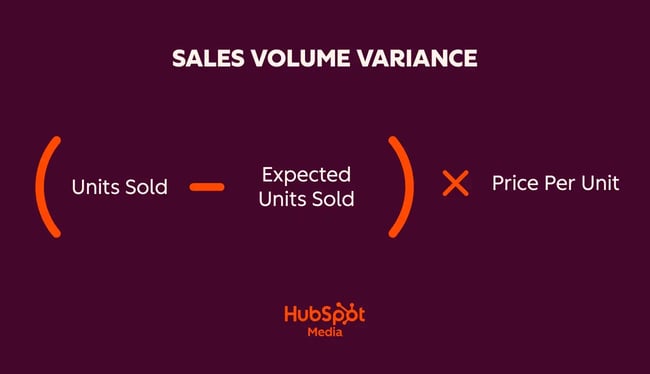
Sales Volume Variance = (Units Sold — Expected Units Sold) x Price Per Unit
To calculate sales volume variance, a business needs:
- The number of units sold
- The number of expected units sold
- The price per unit
This formula isolates the revenue impact of pricing decisions from volume changes and helps understand how price adjustments affect the bottom line.
Sales Volume Variance Example
A company sells subscriptions to an online music streaming service. The company’s founder has a background in entertainment law and was able to secure the widest selection of music available, featuring numerous artists and albums that are unavailable on any other streaming platform.
Initially, the company budgeted to sell 1,000 subscriptions for $9 per month. An existing streaming service added new features without raising the price of its product. This resulted in the competitor gaining additional market share right before the launch of your company's new music catalog.
After a month of promoting the new catalog and charging $9 per subscription, your company sold 900 new subscriptions. Using the formula, we can calculate sales volume variance for the music service subscription.
Sales Volume Variance = (900 —1,000) x $9 = -$900
This calculation shows a negative variance of $900 from the sale of new subscriptions to your service. This means the company brought in $900 less than originally anticipated during this sales period.
This company realized a negative variance because the competitor gained market share just as they were differentiating their product.
When to Use Sales Price Variance
Use sales price variance analysis when the business needs to:
- Evaluate the revenue impact of pricing decisions.
- Separate pricing effects from volume changes.
- Compare actual pricing performance against strategic goals.
- Identify which products or markets allow premium pricing.
For a comprehensive analysis, combine sales price variance with sales volume variance to see the full revenue picture.
Other Essential Variance Types
While sales price and volume variances are crucial for revenue analysis, other variance types provide deeper insights into business performance.
Purchase Price Variance (PPV)
Purchase price variance measures the difference between what a company expected to pay for materials or goods and what it actually paid. This metric is essential for businesses that resell products or use raw materials in production.
PPV Formula: (Standard Price - Actual Price) × Quantity Purchased
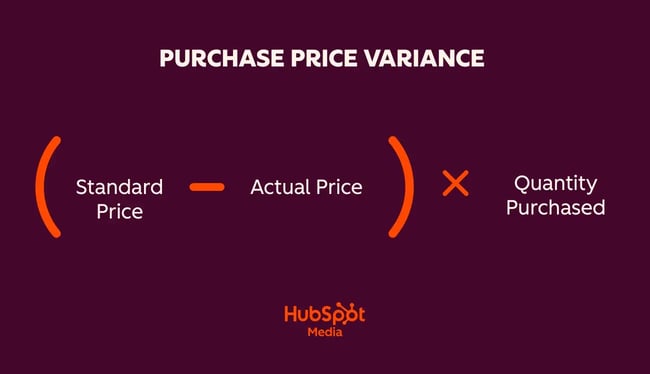
PPV helps teams monitor supplier pricing changes and identify cost-saving opportunities. That helps procurement teams and finance offices budget more accurately for future purchases.
For example, if a company budgeted $5 per unit for 1,000 units but paid $4.50, its PPV is $500 favorable. This could result from better negotiation, bulk discounts, or market price drops.
Sales Mix Variance
Sales mix variance occurs when the proportion of products sold differs from the budgeted mix. Remember, different products typically have different profit margins. Teams analyze sales mix variance when they sell multiple products with varying margins. The data helps sales orgs understand customer preferences between product lines.
For instance, if a company sells more high-margin premium products than budgeted, it’ll see a favorable mix variance even if total unit sales match expectations.
Choosing the Right Variance Analysis
Different situations call for different variance types:
- Use sales price variance when evaluating pricing strategy effectiveness.
- Use sales volume variance when measuring market demand and sales execution.
- Use purchase price variance when managing supplier costs and procurement.
- Use sales mix variance when optimizing product portfolio profitability.
The most effective businesses use multiple variance analyses together for a complete performance picture.
Frequently Asked Questions about Sales Price Variance
How do you calculate sales price variance?
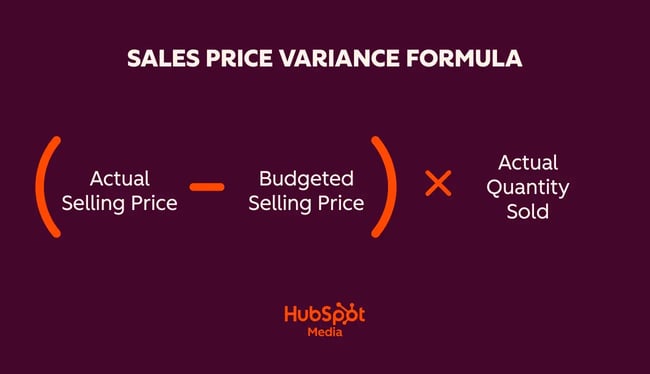
Sales price variance is calculated by subtracting the budgeted from actual price and multiplying the units sold.
- Sales Price Variance Formula = (Actual Selling Price ? Budgeted Selling Price) × Actual Quantity Sold
What causes a favorable or unfavorable sales price variance?
A favorable sales price variance occurs when the actual selling price is higher than the budgeted price. Favorable variance happens due to strong demand, reduced discounting, premium positioning, or successful upselling. An unfavorable sales price variance occurs when products are sold below the planned price. Common causes include:
- Competitive price pressure.
- Aggressive discounting.
- Weaker demand.
- Contractual price reductions.
- Outdated products.
When should you use sales price variance analysis?
Sales price variance analysis is most useful during budget reviews, monthly performance reporting, and pricing strategy evaluations. An analysis helps isolate whether revenue changes are driven by pricing decisions rather than customer demand or sales volume.
How is sales price variance different from sales volume variance?
Sales price variance measures the financial impact of price differences, while sales volume variance measures the impact of quantity differences.
- Sales price variance: Did the business sell at a higher or lower price than planned?
- Sales volume variance: Did the business sell more or fewer units than planned?
What’s a good sales price variance percentage?
There is no universal benchmark for a good sales price variance percentage. It depends on industry norms, pricing strategy, and market conditions. Generally, a small favorable variance is viewed positively, as it suggests pricing discipline without harming demand. Large variances — positive or negative — should be reviewed closely.
Stay on Track with Sales Variance
Calculating sales variance for a company’s products is a worthwhile activity for each sales period that ensures the business is on track with its revenue goals.
If, for some reason, a company has an unfavorable sales variance and can’t raise prices, it may want to consider revising its sales strategy to get more units out the door to account for the difference.
Editor's note: This post was originally published in April 2020 and has been updated for comprehensiveness.
Free Sales Metrics Calculator
A free, interactive template to calculate your sales KPIs.
- Average Deal Size
- Customer Acquisition Cost (CAC)
- Customer Lifetime Value (CLV)
- And more!
Download Free
All fields are required.
Form not available
You're all set!
Click this link to access this resource at any time.
Sales Metrics





![Sales metrics: What to track, how to track, & why [expert tips]](https://53.fs1.hubspotusercontent-na1.net/hubfs/53/Sales-metrics-1-20251030-6874232.webp)