
Sales development representatives need the right product knowledge and selling techniques to drive results. Unstructured SDR training can lead to missed opportunities. That’s why effective teams have training sessions that cover what the brand offers, prospecting techniques, objection handling, and pipeline management.
A strong SDR training program accelerates ramp time and leads to higher quota attainment. All of these lead to a more reliable pipeline.
I’ve spent nearly 18 years advising sales organizations on rep development. I’ve seen teams that invest in structured training in the first 90 days outperform those that don’t. Below, I’ll share how effective managers get SDR training right.
Table of Contents
- How to Train Your SDR Team
- How to Build Your SDR Training Program
- Frequently Asked Questions About SDR Training
What does a modern SDR actually do?
A modern sales development representative (SDR) is responsible for generating qualified pipeline. SDRs find and engage prospective buyers who match the brand’s ideal customer persona. Remember: SDRs are not closers. Their role is to start conversations, qualify interest, and hand opportunities to account executives (AEs), who manage the rest of the sales cycle.
Pro tip: The best SDRs today operate more like mini-researchers than script-followers. When an SDR references a specific event in their outreach, reply rates climb significantly. Training programs that invest in research skills and signal literacy produce SDRs who outperform their volume-focused counterparts.
Modern SDRs typically:
- Prospect across phone, email, and social channels using coordinated outreach.
- Make cold calls, send personalized emails, and conduct LinkedIn outreach before requesting meetings.
- Qualify leads using frameworks such as BANT, MEDDIC, or CHAMP.
- Confirm budget, authority, interest, and next steps before handing leads to AEs.
- Use research and personalization at scale to improve response rates.
- Leverage buying signals like funding events, leadership changes, job postings, and intent data to tailor outreach.
.png)
Free Sales Training Template
Use this template to set up a 30/60/90 day sales training and onboarding plan.
- 30/60/90 Day Goals
- People to Meet
- Feedback/Review Process
- And More!
Download Free
All fields are required.
Form not available
You're all set!
Click this link to access this resource at any time.
How has the SDR role changed?
The biggest shift in the SDR role over the past five years has been the move from high-volume cold calling to personalized, signal-driven prospecting. Top-performing SDRs today look for buying triggers to time and tailor their outreach.
AI has also reshaped how SDRs spend their time by accelerating many administrative and repetitive tasks. SDRs may use AI to help with account research, first-draft email writing, CRM data entry, and meeting documentation. For example, HubSpot Prospecting Agent can help SDRs research potential buyers so their outreach is personalized.
SDRs who can combine strong sales fundamentals with systematic AI usage consistently outperform those who rely on manual workflows alone. SDRs need to understand how to use AI tools effectively and how to prompt for the right outputs. Beyond that, SDRs need human-centered skills to craft messages that land. SDRs must be able to:
- Personalize outreach in a meaningful way.
- Handle objections with emotional intelligence.
- Build trust and relationships that create pipeline opportunities.
Want to learn more about how to thrive as an SDR? Check out the skills SDRs need to master.
How to Build Your SDR Training Program
SDR training programs can be structured as a 30/60/90-day plan. Training should start with foundational knowledge. From there, training can become more specific, focusing on active skill development and independent performance. Each phase needs defined outcomes and measurement criteria.
Here’s what a 90-day training program might look like.
Pro tip: Build a 30/60/90 plan backward from quota. If an SDR is expected to book 15 qualified meetings per month, goals should be defined at each stage. By day 30, “good” might look like booking a first meeting. By day 60, ten meetings should be booked. And at day 90, the SDR should have 15 meetings consistently.
Foundation & Onboarding (Days 1-30)
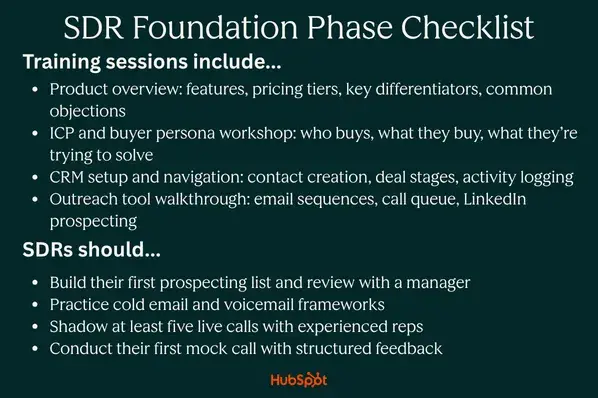
SDR onboarding covers the foundational knowledge reps need before they make their first call. Product training should include buyer personas, not just product features. SDRs who understand the buyer’s problem along with the product write more relevant outreach.
ICP workshops help SDRs build their first prospect lists with real criteria, so targeting isn’t random. Outreach basics include cold email structure, voicemail scripts, and LinkedIn message frameworks.
Within the first month, SDR outcomes focus on foundational knowledge and tool setup. The SDR should be able to:
- Articulate the company’s product clearly.
- Navigate the CRM without assistance.
- Build a prospect list that matches the ideal customer profile (ICP).
- Book at least one qualified meeting.
SDRs who cannot meet these benchmarks by day 30 need structured intervention before advancing.
Pro tip: Teams using Sales Hub can review rep performance. HubSpot’s give managers real-time visibility into every new rep’s ramp progress.
Skills Development & Practice (Days 31-60)
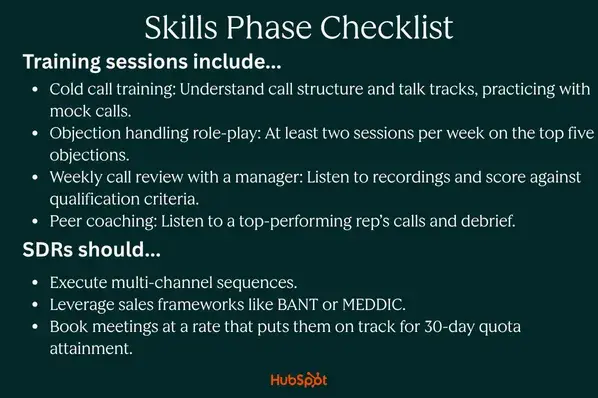
In the second month, the SDR should be more autonomous. The rep transitions away from just learning and starts to practice skills across channels. SDRs at this stage also receive cold call and objection handling training. The SDR should be able to:
- Runs multi-channel sequences independently.
- Applies a consistent qualification framework on every call.
- Books meetings at a rate that puts them on track for 30-day quota attainment.
Cold calling training should cover call structure, talk tracks, and mock calls. A has five components:
- A sharp opener that earns attention in the first five seconds.
- A brief section explaining why the offering is relevant to the prospect.
- A qualifying question that opens dialogue.
- An objection response.
- A meeting request with a proposed time.
Objection handling training helps SDRs move past common roadblocks to buying. In these sessions, managers discuss common objections the SDR may encounter and give tips on how to respond. These sessions often include role-playing so SDRs can practice.
Pro tip: Managers can use HubSpot to review calls with new reps. SDR managers can directly in Sales Hub, then talk through key coaching moments.
Performance Management (Days 61–90)
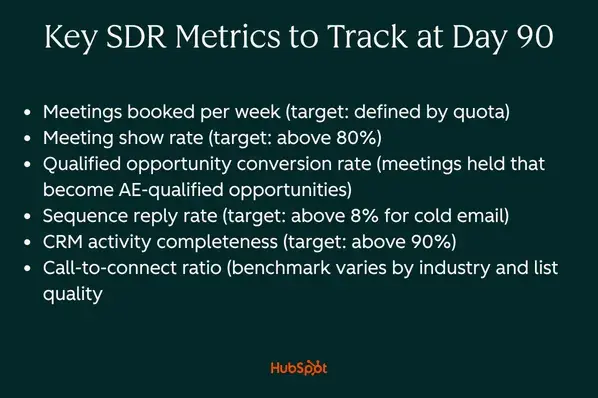
During month three, SDR outcomes focus on repeatable performance and coaching-driven improvement. Remember that day 90 is not the end of training. It is the transition from structured ramp to ongoing coaching. At this point, SDRs should be:
- Hitting or trending toward quota.
- Passing qualified pipeline to AEs.
- Operating independently.
Performance management for SDRs should be metric driven. Managers should monitor the following to evaluate performance:
- Leading indicators, like dials made per day, emails sent per day, LinkedIn messages sent per week, and meetings booked per week.
- Lagging metrics, like meetings held, qualified opportunities created, and pipeline dollars generated.
Note: Distributed SDR teams may require additional structure. Be sure check-ins are regularly scheduled and goals are clearly communicated. and other digital tools can be used during review sessions, even when managers and SDRs are in different locations.

How to Train Your SDR Team
- Implement a standardized SDR training program.
- Start with goals, then work backward.
- Structure SDR training into modular courses.
- Incorporate hands-on training exercises.
- Pair new SDRs with experienced reps.
- Practice objection handling.
- Set clear expectations and give honest feedback.
- Let SDRs own their metrics.
- Encourage communication and collaboration.
1. Implement a standardized SDR training program.
A standardized SDR training program ensures every new rep receives the same foundational knowledge regardless of which manager they report to. An SDR training program should cover:
- Product knowledge and demos.
- How to use the CRM and outreach tools.
- Prospecting and research basics.
- Cold calling and email outreach fundamentals.
- Buyer personas and ICP definition.
- Outreach and follow-up sequence structures.
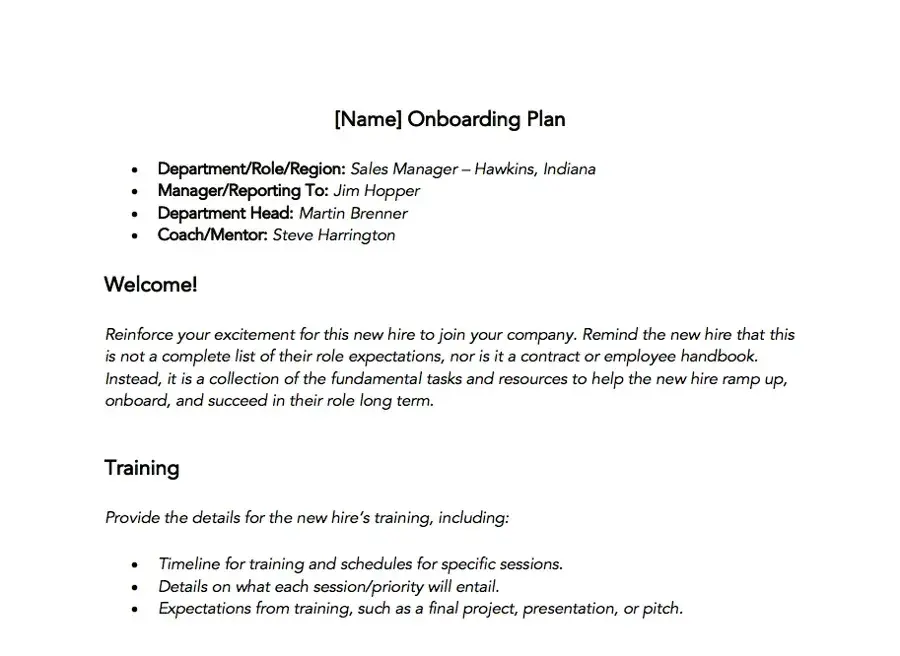
Pro tip: Teams can use sales training templates to standardize their curriculum. HubSpot’s provides a starting framework that teams can customize. From there, managers can create an orientation library for enablement materials.
2. Start with goals, then work backward.
Managers often have quotas for fully ramped reps. Use those numbers to set realistic benchmarks and goals throughout the SDR training process. Working backward keeps expectations realistic, while providing helpful checkpoints along the way.
, a former sales manager at HubSpot, says, “Plan where you want to go and what you want to achieve, and then work backward. Get your team to do the same. By working backward, you end up breaking your target down into smaller bite-size pieces.”
Pro tip: Build a training template around outcomes, not activities. “Complete product overview module” is an activity. “Can articulate top three differentiators and handle the most common product objection” is an outcome. Outcome-based templates make it clear whether training is actually working.
3. Structure SDR training into modular courses.
Break the SDR training program into modular courses. One topic per module makes training more digestible. For example, prospecting research should be a separate module from cold email writing. Each module should conclude with a review activity or a short assessment to confirm retention before the SDR moves forward.
Modular structure also makes it easier to update individual components when product, ICP, or messaging changes, rather than overhauling an entire training document.
What we like: Modular training programs make it easy to identify exactly where knowledge gaps are. For example, a low score in a qualification module may mean the rep needs more training.
Free Sales Training Template
Use this template to set up a 30/60/90 day sales training and onboarding plan.
- 30/60/90 Day Goals
- People to Meet
- Feedback/Review Process
- And More!
Download Free
All fields are required.
Form not available
You're all set!
Click this link to access this resource at any time.
4. Incorporate hands-on training exercises.
Training exercises convert passive knowledge into active skill. Role-playing shows managers how SDRs work and offers room for coaching. The most effective exercises are:
- Prospecting challenges. Ask the SDR to build a 50-account list matching the ICP with sourcing criteria.
- Product-matching scenarios, like assigning a sample prospect to the correct product and tier based on their described problem.
- Outreach drafting sessions. Ask the SDR to write a cold email for a given persona with manager review.
Exercises work best when they use real company data rather than hypothetical examples. The closer an exercise mirrors the real world, the faster the skill transfers from training to execution.
5. Pair new SDRs with experienced reps.
Pairing new SDRs with experienced reps is one of the best training investments a manager can make. An experienced rep serves as a mentor and a real-time source of answers that no training document can fully replicate. New SDRs can see how experienced reps handle difficult objections, time their follow-up, navigate conversations, or recover from a stumbled opener.
Informal buddy programs often dissolve when reps are busy trying to hit quota. So, pairings should be formalized, not optional.
6. Practice objection handling.
Objection handling training helps reps practice responding to the objections they will hear dozens of times per week. When an objection arises on a live call, the SDR can respond naturally and avoid freezing up.
Most teams hold scenario-based role-play with structured feedback. The manager plays the prospect and introduces an objection mid-conversation. The SDR responds. The manager can then provide notes on what worked, what the alternative phrasing could have been, and why. Repeat with the same objection until the response is consistent, then move to the next.
HubSpot’s Former Head of Direct Sales runs these exercises with his team. He emphasizes the importance of learning from mistakes.
“I try to emphasize the fact that [new SDRs] will fail. I expect them to fail, and I expect them to embrace it. Failure is a necessary part of growth,” Cardenas says. “One failure doesn’t define you. It’s what you do with what you learn from it that will determine the outcome.”
7. Practice with mock calls.
A mock call is a structured simulation of a real conversation where the SDR can fail, recover, and be coached without consequence. Mock calls can be tailored to any stage of the buyer journey. Mock call scenarios should cover:
- Cold calls with immediate pushback.
- Calls with an angry or impatient prospect.
- Calls that reach a high-level executive unexpectedly.
- Calls with a prospect who is not a good fit.
- Inquisitive prospects who ask detailed product questions the SDR hasn’t encountered before.
Record every mock call. Review what went well and what to change before moving to the next scenario.
Pro tip: Use HubSpot to review real calls from experienced reps alongside mock calls. New SDRs can then compare their mock calls to actual talk-time ratios, question cadences, and pacing.
8. Set clear expectations and give honest feedback.
Setting clear expectations means communicating not just quota targets but the daily and weekly behaviors that allow SDR to hit those goals. SDRs who understand the full picture of what success requires are better equipped to self-manage than those who know only their end-of-month number.
Cardenas recommends that managers be open with their expectations. She says, “Give them clear goals for every day. How many accounts should you source, how many dials should you make, what proportion of your daily activity should be emails vs. dials.”
From there, managers can give feedback. Notes should be specific, timely, and actionable. Reps should have a roadmap of what they should do to grow.
Bennett adds, “Be honest. No one wins on a sales team if you’re dishonest. Feedback must be actionable, but make it honest. Work with each person to understand how they like their feedback, but make sure the feedback is honest and where possible positive.”
9. Let SDRs own their metrics.
SDRs who understand and track their own metrics develop faster than those who receive performance data only during manager reviews. Teach SDRs how to read their own dashboards and how to identify the leading indicators that predict whether they are on track for their monthly quota.
, a senior sales manager at HubSpot, says, “Make sure your team understands the value of each of the metrics of their process. Once they get the relevance of their metrics, they’ll become more self-aware and autonomous with their own process.”
What we like: give individual SDRs a real-time view of their own activity metrics and quota progress alongside team benchmarks. When SDRs can see how their dial volume compares to the team average, they self-correct faster.
10. Encourage communication and collaboration.
A psychologically safe training environment produces faster learning than a competitive one. When SDRs are free to ask questions without being judged and to make mistakes without being singled out, more insights surface.
Cardenas says, “Chances are, if someone has a question, they’re not the only one who has it. No matter how silly they feel, I would rather have them ask and gain clarity than not ask and make a mistake based on a wrong assumption.
In my experience, collaboration is also a pipeline strategy. When SDRs share what’s working, the whole team benefits. Cardenas also focuses on building a culture where teams share their wins.
“When I address my entire team or speak with people 1:1, I ask them to share their wins and how they got there. Whether it’s a new question-asking strategy, or a lead view, or a time-management hack that worked for them, whatever it is, if they are finding success, my ask is that they share it with the team,” Cardenas says.”
To improve collaboration, create a dedicated Slack channel or a standing weekly sync specifically for SDR wins, not just quota numbers. When sharing success is a norm rather than an exception, knowledge transfer happens naturally.
Frequently Asked Questions About SDR Training
What is SDR training?
SDR training includes structured onboarding and ongoing coaching program for sales development representatives. Sessions cover product knowledge, prospecting methods, qualification frameworks, objection handling, outreach execution, and CRM usage.
Is SDR the hardest sales job?
The SDR role is widely considered a mentally demanding entry-level sales position. It requires high outbound activity volume, frequent rejection, and the patience to develop pipeline that other people close.
Is SDR better than BDR?
Sales Development Representative (SDR) and Business Development Representative (BDR) are used interchangeably at many companies. For teams that differentiate, SDRs typically focus on inbound lead qualification while BDRs focus on outbound prospecting and new account development.
What do I need to become an SDR?
Most SDR roles are designed as entry-level positions with formal training programs that teach the required skills. What candidates need is strong written and verbal communication ability, resilience when facing rejection, organizational discipline to manage high-volume outreach activity, and genuine curiosity about the buyers they will work with.
Familiarity with CRM tools, like , and experience with any form of customer-facing communication is a differentiator in competitive hiring processes.
Build the SDR program you wish you’d had.
SDR training works when it is structured, measurement-driven, and treated as an ongoing investment rather than a one-time onboarding event. Teams just starting to formalize their training programs can use HubSpot Academy as a guide. Sales Hub Conversation Intelligence and regular dashboard reviews can also help identify training gaps.
After nearly 18 years advising sales organizations, I’ve seen that the teams with the best SDR programs set clear outcomes, measure consistently, and coach with honesty. They treat their SDRs like the pipeline investment they actually are and work toward their success.
Editor's Note: This article was originally published in October, 2020 and has been updated for comprehensiveness.
Free Sales Training Template
Use this template to set up a 30/60/90 day sales training and onboarding plan.
- 30/60/90 Day Goals
- People to Meet
- Feedback/Review Process
- And More!
Download Free
All fields are required.
Form not available
You're all set!
Click this link to access this resource at any time.
Sales Training
-Sep-24-2025-08-06-04-5244-PM.webp)
![Want to be a sales rep? Here’s everything you need to get started [+ tips]](https://53.fs1.hubspotusercontent-na1.net/hubfs/53/Operation-everest-getting-started-as-a-sales-rep-1-20250915-1709284.webp)





![Virtual vs. In-Person Training: Pros & Cons of Each [New Data]](https://53.fs1.hubspotusercontent-na1.net/hubfs/53/inperson-vs-online.webp)