.png?width=112&height=112&name=Image%20Hackathon%20%E2%80%93%20Vertical%20(67).png)
Customer success teams are facing increased pressure to do more with less, and artificial intelligence is quickly becoming a powerful tool to help organizations scale without sacrificing the customer experience. From predicting churn to identifying expansion opportunities, using AI for customer success helps organizations automate repetitive tasks, identify risks earlier, and make more informed decisions.
This post will discuss how B2B customer success leaders can adopt AI, including suggested workflows, tools, and implementation best practices.
Table of Contents
- What is AI for customer success?
- The Benefits of Using AI for Customer Success
- How to Use AI for Customer Success
- AI Tools for Customer Success
- AI Customer Success Best Practices
- Frequently Asked Questions About AI for Customer Success
What is AI for customer success?
AI is being used in customer success to scale personalized support without sacrificing the customer experience. AI can automate many manual parts of customer success, like gathering account data, summarizing meetings, updating CRM notes, or identifying at-risk customers. Many CS teams are also using AI to analyze customer data and behavior and proactively intervene when necessary, reducing escalations and preventing churn.
By adopting AI, customer success organizations can deliver scalable, personalized programs while eliminating repetitive work, uncovering actionable insights, and creating more proactive, data-driven customer experiences. Adopting AI allows customer success managers (CSMs) to focus their time on delivering more white-glove support, like having strategic conversations, relationship building, and driving customer outcomes.
.webp?)
Free Help Desk & Ticketing Software
Keep track of customer requests in one unified help desk that connects to your CRM database.
- Provide personalized, AI-powered support to your customers
- Save time, reduce errors, and streamline service processes
- Improve rep efficiency & time to resolution
- And more!
The Benefits of Using AI for Customer Success
As customer success organizations evolve, AI is becoming less about replacing human interaction and more about complementing it. The most effective CS teams are using AI to reduce repetitive and time-consuming work, proactively address customer risk to reduce churn, and prioritize retention and expansion. In turn, these teams empower their CSMs to focus on the areas where human expertise and relationships matter the most.
Here are three major benefits that B2B customer success leaders can expect when pairing AI and customer success.
Reduce churn before it happens.
AI helps CS teams detect early risk signals by continuously monitoring customer behavior patterns that are often time-consuming to keep track of manually. AI can analyze thousands of data points and customer interactions, uncovering subtle changes that may indicate potential risk. This type of large-scale analysis offers timely, actionable data for customer success teams to act on.
AI can detect changes both inside and outside the product, helping customer success teams obtain a holistic view of customer risk. AI can flag risk in product usage behavior by analyzing data such as user logins, active user count, session times, or declining feature use, all of which may signal a decrease in value for a customer.
Outside of the product, AI can analyze data such as:
- Delayed customer responses
- Lower engagement with various teams
- Increases in support tickets
- Negative sentiment across various interactions
- Changes or absence of executive sponsors
By analyzing customer behavior patterns at scale, AI helps customer success teams spot risk early and intervene before it turns into a churn risk.
Increase retention and expansion.
Customer success teams are benefiting from AI’s predictive analytics capabilities to identify which customer accounts are most likely to renew, expand, or churn. AI analyzes historical customer data, product usage, customer interactions, renewal outcomes, and more to surface the factors that most strongly predict retention and growth. This allows CS teams to make more informed decisions and to implement sales plays accordingly.
A key component of this strategy is customer health scoring. AI-driven health scores combine CRM data, product usage data, support history, and engagement signals. When companies leverage tools like to monitor customer health, CSMs can automatically be alerted to changes in product adoption, feature usage, support sentiment, and more.
Leveraging AI-driven health scores with predictive analytics means that CSMs have the real-time data they need to prioritize their retention and expansion efforts. This allows them to work more strategically on what really matters to the business — revenue.
Give CSMs more time for strategic work.
While AI is great at many things, it doesn’t replace the benefits that customers receive from having a human-to-human relationship with their CSM.
CSMs can have more high-level, strategic conversations with their customers, positioning them as a true partner when teams use AI to automate repetitive admin work and data analysis. When AI surfaces key account insights, CSMs can turn those insights into strategic recommendations and help guide their customers towards even more value realization.
AI helps customer success teams maintain a high-touch experience as the organization scales and the customer base grows. When AI handles tasks such as meeting note capture or account summaries, CSMs can spend more time conducting strategic business reviews, focusing on renewal conversations, planning adoption initiatives, and strengthening relationships with key stakeholders.
How to Use AI for Customer Success
B2B customer success leaders trying to decide where to implement AI should consider AI’s key strengths and then identify workflows or tasks that would benefit from those strengths. For example, AI is great at summarization, data analysis and classification, predictive modeling, personalization, content generation, and workflow automation.
Below are six AI use cases that customer success leaders can implement, along with example workflows for each.
Score customer health automatically.
Today’s dynamic, AI-driven health scoring turns the old ways of monitoring customer health upside down. Since can evaluate wide ranges of data and continuously analyze that data as it changes, customer success teams benefit from real-time, actionable insights.
Example Workflow: Build an AI-Powered Health Score
Build a health score that reviews key data across customer usage, behavior, engagement, and sentiment. For example:
- Usage data. Active users, login frequency, feature adoption, usage trends, and whether key “sticky” workflows are being completed.
- Engagement data. Customer engagement (meetings, email interaction, training), stakeholder engagement, engagement from an executive sponsor
- Support data and customer sentiment. Support ticket volume, customer sentiment, recurring issue patterns, product feedback submissions, CSAT, NPS.
Why this works: Since this AI-powered model can surface deeper insights, it can detect that usage of high-value features is declining or that power users are logging in less over time.
Additionally, the model can surface that a customer hasn’t responded to emails or interacted with a CSM over a period of time, allowing customer success teams to prioritize outreach and avoid letting a customer become disengaged.
Predict and prevent churn.
With a robust customer health score, customer success teams can identify churn risk before it becomes a renewal issue. When a dynamic health score is paired with , CSMs benefit from immediate alerts, and customers can receive timely intervention.
Customer success automation triggers playbooks based on health, sentiment, lifecycle stage, and usage changes. AI continuously analyzes customer behavior and engagement patterns to detect early warning signs, then triggers automated workflows designed to address risk as soon as it’s identified.
Example Workflow: Automated Risk-based Triggers
Example 1: Internal workflow
- Create an internal alert that is sent to the CSM when there are critical changes to the health score or when negative sentiment is detected. Include a playbook in the alert or CTA so that CSMs know exactly what to do next.
Example 2: Customer workflow
- Create a trigger that enrolls customers with certain risk behaviors into intervention campaigns designed to re-engage them. Ex: Customers who haven’t used a sticky feature 30 to 60 days after onboarding begin receiving email or in-app messages driving them towards that feature.
Why this works: AI can detect account risks and trigger automatic alerts and engagements to help minimize them. This means that CSMs are alerted to the risk as it’s happening, empowering them to act quickly while also leveraging automation to help get the customer back on track towards success with the product.
Spot expansion opportunities.
AI is great at predictive modeling, both for potential risk and for potential expansion. While churn prediction models identify accounts with elevated renewal risk, expansion propensity scoring surfaces accounts with upsell or cross-sell potential. This means that customer success teams can use AI workflows to scale the expansion and upsell process, from opportunity identification to initial outreach.
Example Workflow: Expansion Identification and Outreach
Step 1: Build a workflow that surfaces expansion opportunity, ideally into the CRM
The CRM or the Customer Success Workspace will likely be the best place to surface this information to account teams. Consider pulling a combination of the following data points into the predictive model, as just one factor is likely not enough to warrant expansion.
- Growing adoption: Adding more users, using additional features, increased product usage, adopting advanced functionality
- High engagement: Engaging with content related to specific modules or features, attendance at webinars or trainings for advanced functionality
- Positive experience: Positive CSAT or NPS combined, executive sponsorship
Step 2: Build triggers, either internal or external, that drive action on the opportunity.
Example: Once an account is identified as a potential expansion opportunity, decide what should happen next and automate that action. This could look like the opportunity being automatically generated in the CRM, or triggering a personalized email to the customer from the AE inviting them to discuss a new feature.
Why this works: This is an area where AI can do the heavy lifting. Since the model is ingesting a variety of customer behaviors, it often can spot opportunities that CSMs or AEs might accidentally miss. Having AI identify expansion opportunities and automate the outreach process means the account team can focus on preparing for the conversation with the customer.
Free Help Desk & Ticketing Software
Keep track of customer requests in one unified help desk that connects to your CRM database.
- Provide personalized, AI-powered support to your customers
- Save time, reduce errors, and streamline service processes
- Improve rep efficiency & time to resolution
- And more!
Draft personalized outreach faster.
When AI is embedded in tools like the CRM or Customer Service software, customer success managers can quickly draft personalized emails at scale. They can tell AI which customer details to compile and reference in the email draft as well as specify the goal of the email, tone, and any CTAs to include.
Here’s an example prompt that customer success leaders can use to draft personalized outreach for upcoming renewals. For best results, CSMs can include a short account summary, recent meeting notes, or even a recent QBR deck alongside the request. The more customer-specific context that is provided, the better the output will be.
Draft prompt example.
“Draft a professional but conversational renewal email to the below customer, in the tone of their Customer Success Manager. I’m attaching their recent QBR so you can see what their goals and key outcomes achieved are.
Customer Details to include in the email:
Company: [Company Name]
Renewal Date: [Date]
Products Used: [Products]
Key Outcomes Achieved: [Results/ROI]
Recent Product Usage: [Summary]
Stakeholders: [Names/Roles]
Current Health Score: [Healthy/At Risk]
Potential Expansion Opportunity: [Yes/No]
Instructions for the email:
-
Thank the customer for their partnership.
-
Highlight the value they’ve achieved over the past year.
-
Reference specific usage trends or business outcomes.
-
Introduce the upcoming renewal discussion.
-
If appropriate, mention opportunities to further support their goals.
-
Keep the tone consultative and customer-focused, not sales-heavy.
-
Limit the email to 200 words.
-
End with a CTA to book time on my calendar.”
Why this works: AI eliminates the manual process of pulling customer data and compiling it into an email. CS teams can take this to the next level by setting up automations that draft these emails automatically within a certain window of renewal (i.e., 90 to 120 days out). A human should always review this type of email for accuracy, though.
Customer success teams should never put sensitive customer data in public AI models, and they should only do this in accordance with their company’s AI guidelines. The best-case scenario is having an AI-powered CRM like or that already has access to customer data.
Automate QBR prep and meeting summaries.
Customer success teams are reclaiming hours of administrative work by using AI to handle much of the heavy lifting associated with meeting follow-up and QBR preparation. AI can transcribe conversations, generate summaries, identify key discussion points and action items, and even draft follow-up emails on a CSM’s behalf.
AI also consolidates information from across the customer journey. Rather than manually gathering data from multiple systems, AI can generate account summaries that highlight key metrics, customer sentiment, risks, and opportunities.
Many AI tools can even create presentation-ready slides based on these insights. As a result, CSMs spend more time translating AI-powered insights into meaningful, strategic conversations that drive customer value.
Example Workflow: Automated QBR Preparation
CS operations leaders will want to create an automation for the steps below to kick off and send the outputs to the appropriate CSM.
- Step 1: Thirty days before the QBR, AI automatically pulls information from the CRM, product analytics platform, help desk/support platform, customer surveys, and customer meeting summaries.
- Step 2: AI reviews and analyzes the data and identifies trends, successes, risks, and opportunities.
- Step 3: AI generates an executive summary from the collected data and includes key data such as business goals and objectives, adoption and usage trends, key outcomes, open risks, expansion opportunities, customer sentiment, and recommendations for the conversation.
- Step 4: AI automatically drafts a slide deck, populating charts, metrics, customer milestones, and recommendations. The CSM reviews the slide deck and adds details or customizations where necessary.
- Step 5: AI recommends talking points, questions to ask, things to avoid, and potential risk or expansion opportunities to be aware of.
Why this works: Prepping for QBRs and customer meetings is incredibly time-consuming for leaders and companies who operate a . AI-assisted QBR preparation reduces manual prep time for CSMs so they can spend their QBR doing what they do best — guiding their customer towards deeper value realization with the product.
Analyze customer sentiment at scale.
Analyzing customer sentiment at scale is quickly becoming one of AI’s biggest strengths in customer success. AI can evaluate feedback for a customer by scanning , support tickets, emails, chat conversations, meeting transcripts or recordings, and more.
AI-powered sentiment analysis detects patterns in customer language, surfaces themes, and spots emerging issues so they can be mitigated before they become a problem. For example, AI can recognize if customers are consistently frustrated with certain features, if there’s friction at some point in the customer journey, or how they’re feeling about the value they are receiving. This type of sentiment analysis provides a holistic view of customer health and would be nearly impossible to achieve manually.
Example Workflow: Analyzing & Surfacing Customer Sentiment
- Step 1: Collect feedback across channels such as surveys, support tickets, chat, meetings, customer reviews, and emails.
- Step 2: AI analyzes the language that customers use and identifies trends, themes, and emotional indicators.
- Step 3: AI enriches the sentiment insights with key data points like product usage, adoption, and support metrics. From here, AI determines whether customer feedback aligns with the overall health score or if there is hidden risk or opportunity.
- Step 4: Automations are put in place to address both negative and positive sentiment. For example, when negative sentiment is detected, an email could be triggered that offers to set up a call with the customer, while also alerting the account team to the negative sentiment. For positive feedback, an email could be triggered to the customer inviting them to participate in a reference program while also alerting the CSM about the positive sentiment.
Why this works: Layering sentiment analysis on top of key metrics and adoption data gives customer success teams a more complete view of customer health. When data is fragmented, CSMs don’t always know if a customer has a poor support experience or is frustrated with something. AI-powered sentiment analysis flags risk early on, enabling early churn prevention.
AI Tools for Customer Success
Having the right tools in place is key to implementing seamless AI workflows. With an AI-powered tech stack, customer success leaders can quickly analyze customer data, surface actionable insights, and automate time-consuming tasks across the customer journey. What once took hours of manual effort can now be accomplished in minutes.
Here are eight AI tools that can help customer success teams work more efficiently.
1.
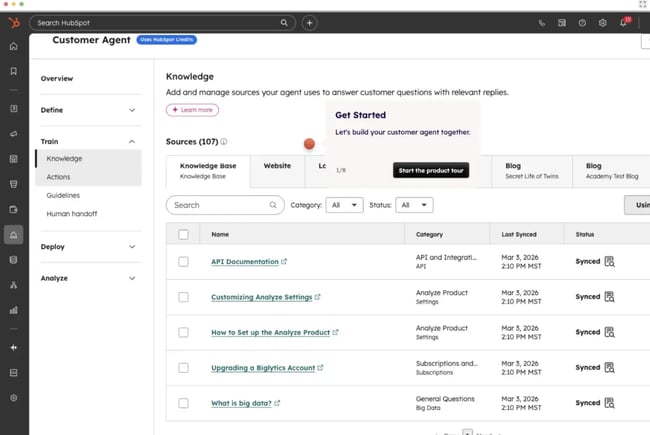
Inside is an AI Agent called , a 24/7 concierge that works across the entire customer journey. It handles support conversations from start to finish and can even qualify prospects and book meetings with leads.
When Customer Agent recognizes a complex or nuanced customer need, it can automatically route to a human agent and includes the conversation and key context in the handoff. This means the agent receives the handoff with the customer details, current issue they’re facing, customer sentiment, and more. That customer context then gets passed to the CRM so that CSMs, AEs, and other internal team members can see the context in places like the customer health score and customer record.
What lands Customer Agent on this list, though, is its ability to give internal teams access to unified customer data and automate repetitive work for customer-facing teams. Customer Agent can pull and pass information to key CS infrastructure like the customer health score and the customer account, offering a personalized customer experience and giving account teams key insights as they happen.
Customer Agent is also easy to customize and train, and can learn from , internal documents, websites, CRM data, and more.
Key Features
- Connects to CRM, Customer Support software, and more to provide a unified view of customer data across the customer journey.
- This means that everyone who touches a customer account gets a full picture of the customer’s experience.
- Analyzes data across the ecosystem to summarize account activity, identify engagement trends, surface important customer sentiment, and provide context for agents or reps before a meeting.
- Enables personalization at scale by generating tailored recommendations, outreach, and customer communication based on account-level data.
- Using customer history and CRM data, Customer Agent can create personalized emails, follow-ups or recurring customer outreach at scale.
- Automates repetitive work by triggering actions based on customer behavior, summarizing key interactions, and updating CRM records with key takeaways and next steps.
- Helps monitor engagement signals, account activity, trends, and lifecycle data to identify which customers require attention.
- Supports multiple channels, including chat, email, voice, and social.
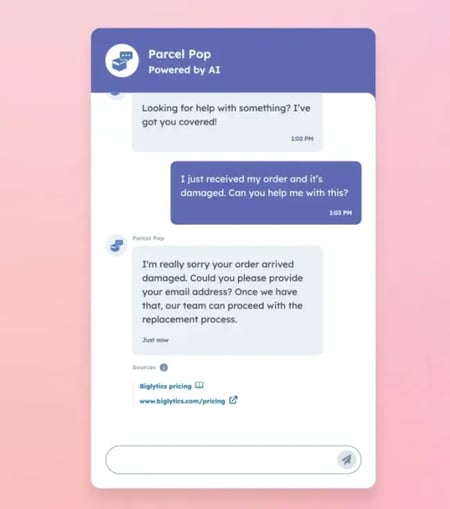
Customer Agent is included in Professional and Enterprise subscriptions and runs on HubSpot Credits. Additional credits can be purchased as needed — visit the for full details.
Best for: Teams of all sizes, customer organizations who operate across multiple channels, customer success teams looking to unify their customer data.
2.
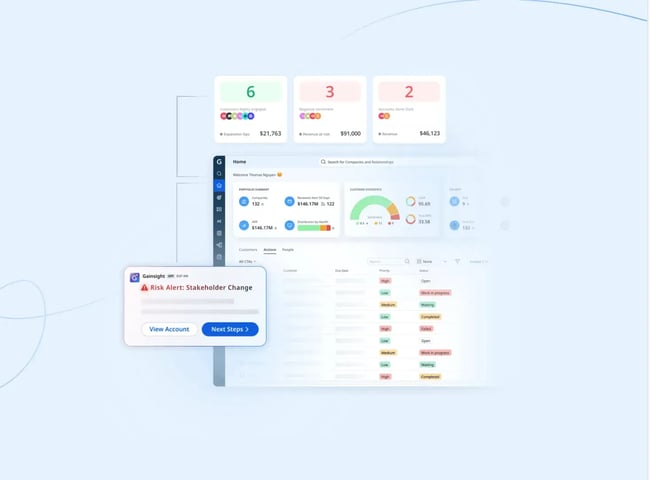
Gainsight is an enterprise customer success platform that combines customer data, predictive analytics, automation, and AI-driven insights. Known for its customer health scoring and customer communications, Gainsight enables customer success teams to track customer health and automate risk intervention programming.
Key Features
- Customer health scoring that combines data from product usage, CRM, support ticket systems, customer communication, and engagement activities.
- Predictive analytics that identify accounts that may be at risk of churn or primed for expansion.
- Automated workflows that trigger based on customer behavior, changes in the health score, lifecycle milestones, or risk indicators.
- AI-powered insights that analyze customer interactions, usage trends, and account activity to surface recommendations, summarize customer information, and highlight opportunities and risks.
- Customer communication and journey orchestration that allows CS teams to create personalized customer journeys, and AI can help determine the right engagement based on behavior.
Best for: Enterprise-level organizations looking to use one tool for customer communications, account-level data, and customer health scoring.
3.
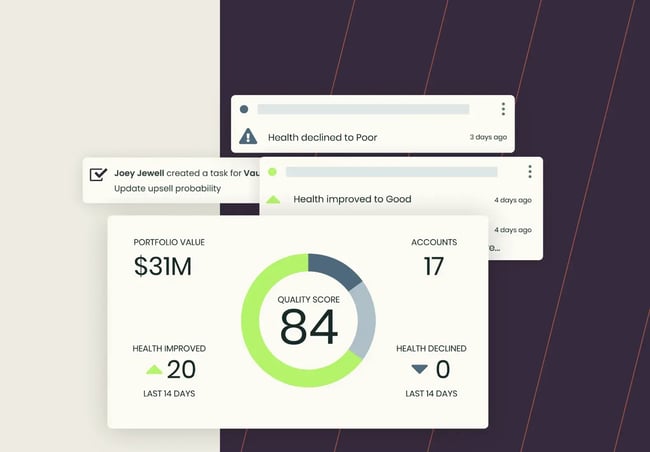
Totango is a customer success platform that helps teams manage customer health, automate engagement, and drive adoption. Its AI capabilities are centered around identifying risk and opportunity as well as reducing manual effort in managing a large book of customers.
Key Features
- AI-driven customer health monitoring that pulls data from product usage, CRM, support platforms, customer interactions, and more to analyze customer behavior and surface risk.
- AI-recommended interventions, including automated customer journeys and playbooks that leverage pre-defined workflows and automatically launch when certain conditions are met.
- Segmentation and prioritization capabilities that use AI insights to help determine where CSM attention is needed the most.
- Scalable customer engagement through automated communications and customer journey orchestration.
- Task automation and workflow management that can do things like use the AI insights to automate execution. For example, CSMs can trigger an automatic task assignment, alert generation, campaign launch, and customer success playbook implementation based on customer activity.
Best for: Companies facing rapid customer growth, scaled or pooled CS teams managing large volumes of customers, and teams looking to implement digital customer success workflows.
4.
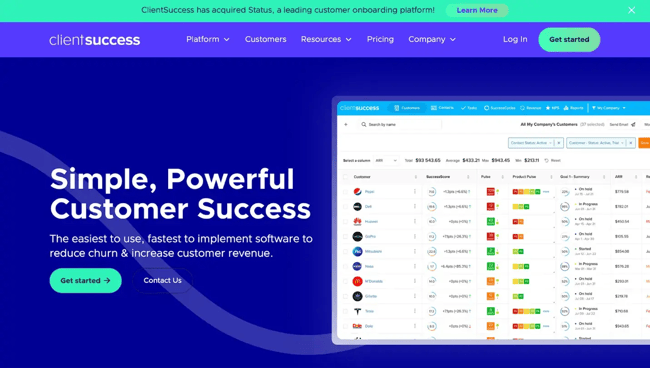
ClientSuccess’s software helps customer success teams scale while still delivering a great customer experience. With AI-powered customer analytics and automated customer success workflows, CSMs can leverage ClientSuccess to streamline repetitive tasks and customer communications.
Key Features
- AI-powered customer health insights that analyze customer data and summarize account health, surfacing key strengths, areas of concern, and health trends so CSMs can quickly identify what their accounts need.
- Predictive churn detection that analyzes key customer metrics to identify potential churn risk before it becomes an issue.
- AI-powered email generation that empowers CSMs to create personalized customer emails using prompts, customer context, and key account information.
- Automated playbooks and customer journeys that combine AI insights and automation to automatically launch tasks, emails, and workflows based on certain changes in customer data.
Best for: Teams of all sizes, but especially beneficial for small teams looking for a big lift and teams with digital or scaled customer success motions.
5.
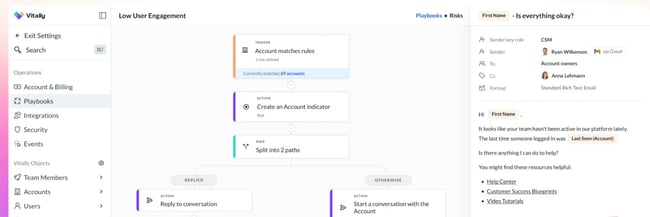
Vitally positions itself as the AI-powered workplace for CSMs, and layers AI into the daily workflows of CSMs within its platform. Vitally focuses on helping CS teams quickly understand customer context, automate time-consuming follow-up work, identify risk, and scale proactive engagement.
Key Features
- AI Copilot for CSMs: An embedded assistant that helps CSMs analyze customer data, summarize account activity, and uncover insights via natural language queries.
- AI-powered account summaries created based on AI analysis of unstructured customer data, including patterns identified around churn risk, customer sentiment, and expansion potential.
- AI Meeting Recording that automatically records, transcribes, summarizes, and analyzes customer conversations, reducing the administrative burden on CSMs.
- Automation and AI-generated follow-up, where AI can automatically draft personalized follow-up emails, recommend next steps, generate tasks and actions, and even create documentation and customer-facing content.
Best for: Companies of all sizes, but the tool is especially great for CS teams managing multiple stages of the customer lifecycle (like onboarding, post-onboarding, and renewals, for example).
Free Help Desk & Ticketing Software
Keep track of customer requests in one unified help desk that connects to your CRM database.
- Provide personalized, AI-powered support to your customers
- Save time, reduce errors, and streamline service processes
- Improve rep efficiency & time to resolution
- And more!
6.
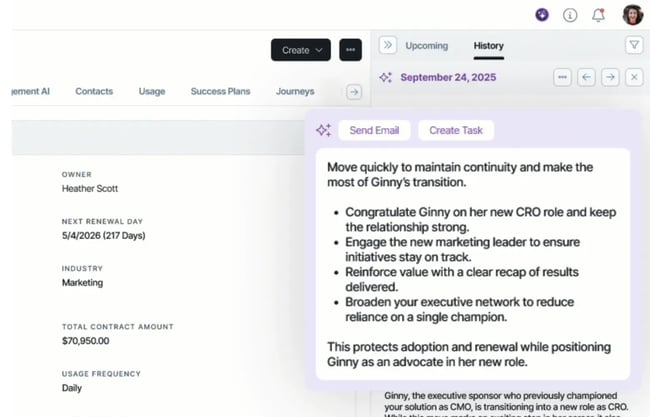
ChurnZero’s customer success software platform focuses on AI agents that not only identify risks and opportunities, but can also recommend and automate key next steps on behalf of CSMs. ChurnZero leverages AI to summarize key customer account information, draft customer communications, and create content.
Key Features
- Engagement AI capabilities that analyze customer interactions to uncover sentiment, relationship health, and trending topics, offering a holistic view into the customer’s experience.
- AI-generated account summaries that consolidate customer health, outcomes, risks, and more to help CSMs quickly prepare for customer calls and QBRs.
- AI-powered content creation that drafts customer emails, creates success plans, and generates renewal communications, reducing the administrative burden on CSMs.
- AI and Automation capabilities that can trigger appropriate actions based on AI-surfaced insights, requiring minimal CSM effort.
Best for: Large CS organizations, companies looking to build or scale digital cs programs, or companies looking to improve the onboarding and post-implementation lifecycle.
7.
Custify positions its customer success software as an AI tool built around your company’s knowledge. Custify’s platform can learn company processes, goals, and rules, and then automatically configure the CS platform based on those learnings. From there, Custify’s AI agents can build and launch playbooks that automate key interactions for both CSMs and customers.
Key Features
- Tailored CS workflows powered by AI. Once the platform learns the rules, processes, and goals for a company’s CS org, it can automatically run relevant workflows.
- AI-powered playbooks that can automate tasks, communication, notifications, and customer journeys based on designated triggers.
- Task management capabilities that surface key customer information and automatically send tasks that require action to CSMs.
- Customizable customer dashboards that let CS orgs tailor the view to include the custom metrics and KPI’s they care about most.
Best for: Companies looking to stand up a CS tool quickly, CS orgs with complex workflows or processes, or companies with niche or custom KPIs and metrics.
8.
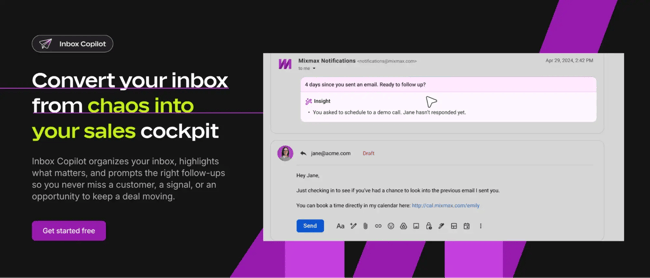
MixMax is an inbox organization tool that helps CSMs prioritize account outreach, streamline follow-up, and simplify the meeting scheduling process. MixMax works inside the email client and syncs activity to Salesforce, keeping customer history accurate and up to date.
Key Features
- Account prioritization: MixMax helps CSMs prioritize important customer conversations, identify overdue follow-ups, and surface accounts that require attention.
- AI writing assistant that generates personalized emails, renewal reminders, follow-up messages, meeting recaps, and more — all from the CSM’s inbox.
- Meeting Copilot automatically prepares users for customer meetings by surfacing key account context and previous interactions, capturing notes during the meeting, and generating meeting summaries and action items.
- Automated follow-up workflows such as email sequences and workflows that trigger based on customer actions, engagement levels, or lifecycle milestones.
Best for: Companies looking to automate onboarding, scaled or digital CSM teams and organizations looking to streamline meeting scheduling and management
AI Customer Success Best Practices
Below are a few best practices to keep in mind while implementing AI for customer success.
1. Remember the 10-20-70 rule.
The 10-20-70 rule suggests that the success of AI depends far more on people and processes than on the technology itself. In order of importance, implementing AI initiatives should prioritize 10% technology, 20% data, and 70% people and processes. When implementing a new AI initiative, customer success leaders should spend more time preparing data and outlining the process and internal plans than they spend on finding the “right” tool.
The real challenge lies in determining which workflows require automation, what areas of the business could benefit from AI, how to train employees to trust and adopt AI, and what the change management process will look like. Without those key internal process changes, even the best AI platform could go to waste.
Don’t overindex on finding or building the “perfect” AI technology. Instead, start by defining how and where you’ll implement AI, make a plan for internal change management, get your data in order, then go shopping for AI tooling.
2. Start with clean data.
Because AI relies on customer data to identify churn risk, expansion opportunities, and customer health trends, having accurate and up-to-date data is essential. Incomplete or outdated information can lead to inaccurate insights, reducing trust in AI recommendations and creating challenges for both customer success teams and customers.
Accurate data also enables more effective automation. When AI-driven workflows and campaigns are based on reliable information, teams can confidently deliver the right intervention at the right time while protecting the customer experience.
Before implementing AI, customer success operations teams should establish a single source of truth by aligning data across CRM, product analytics, , communication channels, and customer success platforms. This unified view allows AI to analyze the full customer journey and generate more meaningful insights.
3. Use AI to support judgement, not replace it.
Customer success teams should treat AI as a decision-supporting tool, not a decision maker. While AI can analyze large swaths of data faster than a human can, it still lacks the context and judgement that an experienced CSM brings to the table. CS teams should use AI to surface insights, but a human still needs to validate those insights and make the final decision.
It’s best practice to keep humans front and center for important or high-impact customer moments such as renewals, escalations, and executive conversations. AI can help a CSM prepare for those interactions, but a human should be the one to lead them. Even digital or scale segments should have a workflow that loops in a human for escalations and commercial conversations.
4. Review every output before acting on it.
AI is constantly learning and evolving, so it’s going to . CS teams should always review an AI output before accepting or acting on it.
While it’s tempting to take that AI-generated report and send it off to a customer, CSMs need to review it for accuracy. Without reviewing an output before acting on it, CSMs risk creating a negative customer experience (imagine sending an inaccurate report to an executive stakeholder — yikes!).
There’s a variety of reasons that an AI output might be slightly off, including bad (or outdated) data, missing context, or forced certainty. Customer success teams should always review AI outcomes before acting on them, and CS Ops leaders should continually test and refine the model. One of the most important rules of using AI for business is to always rely on human oversight — no exceptions!
Frequently Asked Questions About AI for Customer Success
What is the 10-20-70 rule for AI?
The 10-20-70 rule for AI is a framework that suggests the success of AI initiatives depends more on people and processes than on the technology itself. The breakdown is typically:
- 10% technology (the AI models and tools)
- 20% data (the quality and accessibility of the data feeding the AI)
- 70% people and processes (change management, business processes, workflow redesign, adoption and training, etc)
This framework helps organizations focus their investments where they drive the greatest ROI, emphasizing people and processes rather than over-indexing on technology alone. To successfully implement this rule, organizations should focus on mapping out where AI augments or replaces workflows, upskilling their teams, and aligning tech and data.
Will AI replace customer success managers?
No, and it’s not designed to. Customers still want human support for complex, nuanced issues, which means that customer success managers are here to stay.
AI is most effective when it complements customer success managers rather than replacing them. By automating repetitive, time-consuming tasks such as data analysis, insight generation, meeting summaries, and follow-up, AI frees up CSMs to focus on helping customers achieve their goals. When AI is used this way, it’s actually helping customer success managers be more strategic, transforming the role to be more about relationship building and consultative problem solving.
— AI is a multiplier for CSMs, not a replacement, and gold-star CS relies on relationships, which requires human-to-human interaction. As AI continues to evolve, the organizations that will see the greatest success are those that view it as a partner to human expertise, not a replacement for it.
What are the main use cases for AI in customer success?
The main use cases for AI in customer success include dynamic customer health scoring and churn prediction, identifying expansion and retention opportunities, email and content generation, account summaries and customer intelligence, workflow and lifecycle/playbook automation, meeting prep and follow-up, and delivering personalization at scale.
AI can be implemented seamlessly into areas of CS that could benefit from the following:
- Summarization
- Data analysis and classification
- Predictive modeling
- Personalization
- Content generation
- Workflow automation
What data does AI need to be effective in customer success?
For AI to be effective in customer success, it needs to access key data points that provide a complete picture of customer behavior, engagement, and business outcomes. This includes data for:
- Product usage
- Customer engagement
- CRM and account-level information
- Support and customer service
- Customer communications
- Customer feedback
- Commercial and contract information
- Any specific customer success activity data like success plans
To be effective, AI needs to understand what customers are doing, what customers are saying, and who customers are. Customer success leaders should aim to create a unified view of customer data, combining CRM insights, product analytics, support ticket interactions, customer feedback, and customer interactions.
A Powerful Duo: AI and Customer Success
AI can be a powerful accelerator in customer success, removing manual work and surfacing key insights to help drive product adoption and revenue. The most successful organizations use AI to handle repetitive tasks, analyze large volumes of data, and identify patterns that would be difficult to uncover manually. This allows CSMs to focus on what they do best — building relationships, understanding customer goals, driving adoption, and delivering business outcomes.
For B2B customer success leaders, AI provides greater visibility into customer health, more accurate forecasting, and the ability to scale operations efficiently as customer portfolios grow. By following the 10-20-70 rule and using the right AI customer success tools, B2B customer success leaders can create stronger customer relationships and deliver measurable business impact at scale. Tools like HubSpot’s Customer Success Workspace and Customer Agent are built exactly for this — combining proactive health scoring, AI-powered insights, and always-on customer support in one connected platform.
Editor's note: This post was originally published in May 2024 and has been updated for comprehensiveness.
Free Help Desk & Ticketing Software
Keep track of customer requests in one unified help desk that connects to your CRM database.
- Provide personalized, AI-powered support to your customers
- Save time, reduce errors, and streamline service processes
- Improve rep efficiency & time to resolution
- And more!







![How AI Can Unlock Customer Insights [+Expert Tips]](https://53.fs1.hubspotusercontent-na1.net/hubfs/53/customer-insights-ai-1-20241101-2082956.webp)