.png?width=112&height=112&name=Image%20Hackathon%20%E2%80%93%20Vertical%20(67).png)
Customer advocacy in 2026 is more than just soliciting reviews and hoping for referrals. It’s a structured business strategy in which companies systematically engage their most loyal customers and encourage them to promote the brand online and to their peers. Increasingly, they’re using customer advocacy software to do it.
Word of mouth is a highly trusted marketing channel because of the power of . The (73%) rank word-of-mouth and peer recommendations as the most influential factor for prospects deciding which vendors to consider. But historically, it’s been nearly impossible to operationalize at scale.
Unlike an email campaign, marketers can’t simply draft up some customer advocacy and hit send. Customer advocacy software is changing this, though. It provides marketing, customer success, and revenue teams with the tools to identify enthusiastic customers, activate them at the right moment, monitor their impact, and reward them for their efforts.
The best customer advocacy tools give marketers the power to turn word of mouth and high-value brand activities into a predictable, trackable marketing channel. This guide features a curated round-up of the best customer advocacy platforms in 2026, a framework for evaluating features, and guidelines for teams looking to integrate these tools into their tech stacks.
Table of Contents
- What are customer advocacy platforms?
- Customer Advocacy Software Features to Prioritize
- Best Customer Advocacy Platforms
- How to Integrate Customer Advocacy Tools With Your Existing Tech Stack
- Frequently Asked Questions About Customer Advocacy Platforms
What are customer advocacy platforms?
Customer advocacy platforms are software tools that help businesses recognize, activate, and manage customers willing to promote the brand. Advocacy includes referrals, case studies, reference calls, reviews, speaking at events, and more.
These platforms assist businesses in systematically deputizing their most loyal customers as an unofficial sales force with the following core functions: targeting, activation, recognition, and measurement.
Targeting
Customer advocacy platforms process CRM data, NPS scores, product usage signals, and behavioral triggers to identify which customers are most likely to be enthusiastic advocates. Rather than relying on gut instinct or random outreach from customer success managers (CSMs), these tools surface advocates systematically at scale.
Activation
Once the customer advocacy platform identifies potential advocates, it helps manage the “ask.” The software provides a portal or interface where advocates can complete specified advocacy tasks, such as scheduling a reference call, writing a review, or recording a testimonial video. Customer advocacy platforms can leverage automation to route the right asks to the right customers based on their preferences and history, reducing team workload and ensuring no customers are overburdened with advocacy requests.
Recognition
Customer advocacy platforms manage the rewards and recognition that brands award customers in exchange for their advocacy. For B2C companies, that might include discounts or cash incentives, while B2B companies are more likely to offer points-based gamified incentives, VIP status, early access to new features, and other non-monetary incentives. Recognition rewards advocates for their efforts and keeps them engaged over time.
Measurement
The best platforms let companies track advocacy activity and its impact on revenue. In combination with a CRM, companies can track which deals involved a reference call or a peer testimonial, and overall what percentage of incoming revenue was influenced by an advocacy program. can record advocacy activity on the contact timeline, enabling teams to attribute revenue to specific advocacy campaigns.
.webp?)
Free Help Desk & Ticketing Software
Keep track of customer requests in one unified help desk that connects to your CRM database.
- Provide personalized, AI-powered support to your customers
- Save time, reduce errors, and streamline service processes
- Improve rep efficiency & time to resolution
- And more!
Customer Advocacy Software Features to Prioritize
Customer advocacy platforms should offer, at a minimum, advocate segmentation, CRM integration, rewards management, multi-channel communication, and campaign management. Not every customer advocacy platform is created equal, though. Some platforms better serve large enterprises with advanced segmentation and targeting needs, while others are more suited to small and mid-market companies. Platform choice depends on a team’s size, goals, budget, and existing stack.
Advocate Segmentation and Targeting
The foundational capability of a customer advocacy platform is the ability to surface potential customer advocates at scale. Advocacy platforms should allow teams to segment their customer base based on data points such as product usage, NPS score, customer health score, and CRM data. Segmentation should be dynamic, meaning the advocate lists update in real-time as customer data changes.
CRM Integration and Bi-Directional Sync
Customer advocacy platforms must integrate with a business’s CRM. It should pull data from a CRM for segmentation and targeting within the platform, and then push data back to the CRM to update records when customers perform an “act of advocacy.”
HubSpot does not offer a standalone customer advocacy platform, but its and serve as the single source of truth for customer data. HubSpot reliably integrates with the top customer advocacy platforms, ensuring that an advocate’s activity is visible to sales, success, and support teams in real-time.
Pro tip: , , and lifecycle stage data can feed directly into advocacy tools that offer CRM integrations, giving teams a more complete advocate profile from day one.
Rewards and Recognition
A customer advocacy platform should handle fulfillment of rewards and recognition natively or through integrations with gifting tools. It should include multiple reward types, including branded swag, gift cards, or a points-based loyalty system. Recognition requires a gamification engine with leaderboards, milestone emails, badges, and loyalty tiers to keep advocates engaged and build a community centered on brand advocacy.
Multi-Channel Communication
Customer advocacy platforms should engage customers wherever they are. That includes email, social media, Slack, WhatsApp, or in-app widgets. Advocates are far less likely to complete an ask if they are forced to leave the online spaces they already occupy.
Advocacy Campaign Management
Campaign management enables marketers to define and develop strategies for specific asks. Review requests, referral invitations, and case study interviews are distinct advocacy tasks for different customers at different levels of loyalty. A customer advocacy platform should automatically route advocates to the appropriate campaigns. The best platforms support multi-step campaign sequences with personalized messaging, response tracking, and activity scoring.
Best for: Teams running multiple concurrent advocacy programs. For example, if a brand runs a review campaign alongside a reference program, they will require a platform that can manage multiple advocacy campaigns.
Reference Management
Platforms should streamline and automate the process of identifying, managing, and activating customers willing to serve as references. According to research from UserEvidence, have lost or delayed deals because they couldn’t quickly surface customer references to reassure risk-averse buyers.
Reference management features ensure companies maintain a real-time pool of customers willing to serve as references and can match them to open deals based on industry, similar company sizes, and similar use cases. In addition, the platform should track how many times a specific customer has been tapped as a reference to prevent advocate fatigue.
Best Customer Advocacy Platforms
Below are the best customer advocacy platforms for companies of different sizes and use cases. Pricing reflects publicly available information as of early 2026. Enterprise plans typically require a custom quote.
: Best for Enterprise
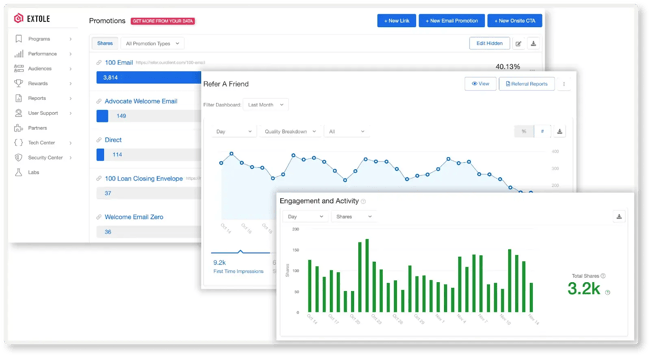
Extole is a customer advocacy platform geared toward large enterprises running referral programs with advocate touchpoints in the millions. It features advanced audience segmentation, A/B testing, fraud prevention, and an open, well-documented API that helps enterprise teams integrate Extole seamlessly into their custom tech stacks.
Extole’s fraud prevention capabilities are a differentiator for large brands where referral abuse is a real risk. At the enterprise scale, individuals sometimes exploit referral marketing programs to obtain illegitimate rewards. Referral abuse can skew metrics and have serious effects on revenue, but marketers can rest easy thanks to Extole’s built-in fraud prevention.
What I like: Extole’s Flow Builder is an intuitive, no-code visual interface that helps marketers design how prospects move through a referral flow. In combination with a full developer API, Extole can help marketing teams move quickly and still achieve technical depth when necessary.
Integrations: and , Salesforce, Shopify, and more.
Pricing: Custom pricing reportedly starting from $999 to $2,500 per month
: Best for Mid-Market
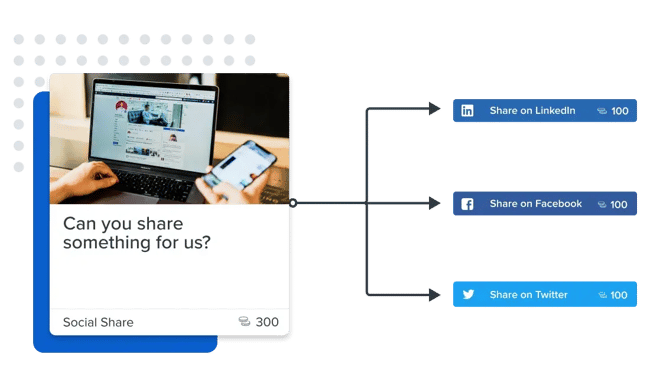
Influitive is a customer advocacy program that excels in gamification. It helps businesses invite and incentivize advocates to complete challenges, write referrals, share social media posts, and participate in branded forums. As advocates complete challenges and referrals, they earn points, badges, and levels that can be redeemed for perks and privileges. G2 user reviews state that Influitive makes advocacy fun for customers, resulting in reliable pools of “super users” who are happy to step up for advocacy activities.
What I like: Influitive integrates seamlessly with popular CRMs, including HubSpot. Customer advocacy activities, such as referrals and other actions, are automatically synchronized and recorded within the CRM.
Pricing: Custom pricing reportedly starting at $1,499 per month
Integrations: HubSpot and Hubs, Salesforce, Marketo, and more.
: Best for Community-Led Advocacy
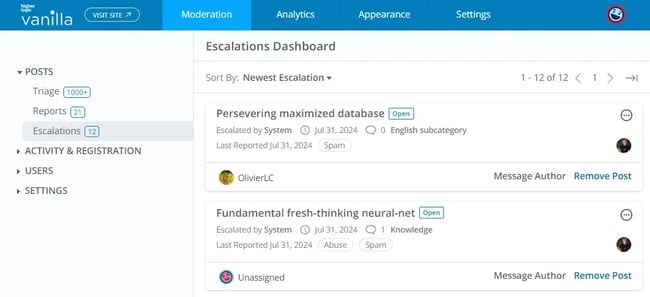
Higher Logic Vanilla is an all-in-one customer community software solution. For companies whose advocacy strategy is rooted in community engagement, Vanilla is an obvious choice. Vanilla allows brands to create customer-branded online forums where customers can seek peer-to-peer support and collaboration. Using gamification, sentiment analysis, and reputation systems, brands can identify customer champions who engage deeply with community forums, recognize them, and award them for their contributions.
What I like: When I was a support rep at HubSpot, part of my job was moderating our community forum where HubSpot users gathered to support each other and discuss the product. I remember certain power users who reliably popped up in discussion threads to flex their expertise. Advocates like that have strong voices and deep credibility with peers. Vanilla makes it easy to identify these valuable power users and reward/encourage their advocacy.
Pricing: Custom
Integrations: HubSpot and Hubs, Salesforce, Zendesk, and more.
: Best for Review-Heavy Advocacy
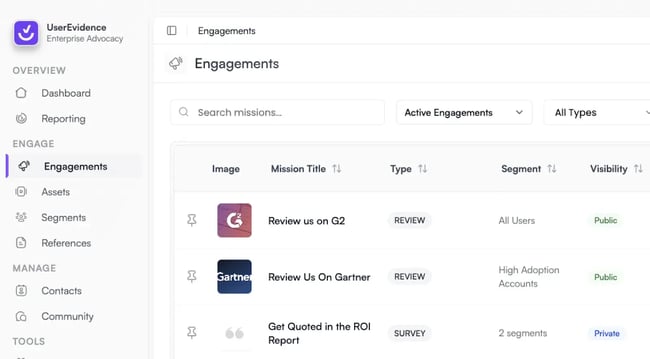
UserEvidence is a fully-featured customer advocacy and customer evidence platform focused on collecting verified user reviews, testimonials, ROI data, and case studies. For SaaS businesses that rely on testimonials, UserEvidence is a strong choice because of its verification layer. Every customer stat and testimonial gathered through UserEvidence is third-party verified and carries a trust mark confirming it came from an independent survey, not vendor-written copy.
UserEvidence made a significant move in 2025 with the , adding proactive advocate activation, 1:1 reference management, and AI-powered deal matching to its already strong evidence-collection capabilities.
What I like: In the SaaS space, G2 reviews are the gold standard. UserEvidence’s G2 integration automatically turns inbound G2 reviews into reusable review assets, which can seal the deal for prospects seeking social proof.
Pricing: Available upon request
Integrations: HubSpot and , Salesforce, G2, Slack, and more.
: Best for B2B
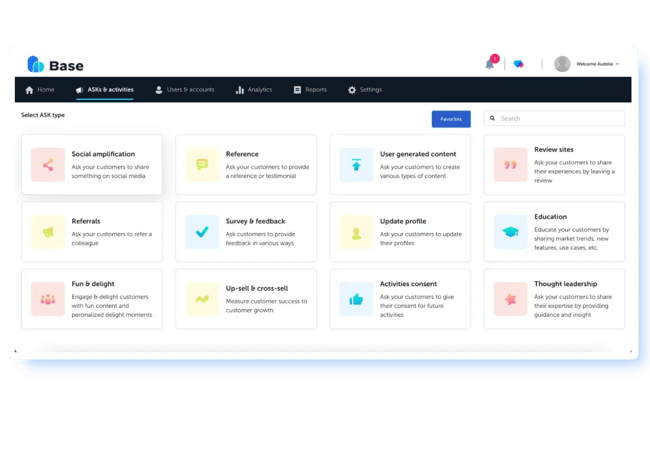
Base is an AI-driven platform built for customer advocacy, references, and building mutually rewarding relationships with happy customers. B2B customers have praised its intuitive interface, streamlined workflow for managing advocacy activities and customer rewards, coupled with straightforward, insightful analytics. Using AI and automation, Base helps B2B businesses scale advocate targeting while maintaining personalization.
What separates Base from other advocacy tools is its scope. Many platforms are built around a single feature, such as gamified challenges, reference requests, or review campaigns. Base covers the full post-sale customer relationship from product adoption, retention, upsell, cross-sell, and churn reduction in a single platform.
What I like: Revenue attribution in reporting. Base connects advocacy program activity to live CRM pipeline data, so every reference, review, referral, and upsell can be attributed to the appropriate advocacy campaign.
Pricing: Available upon request
Integrations: 400+ connectors via their integration hub
: Best for Small Teams
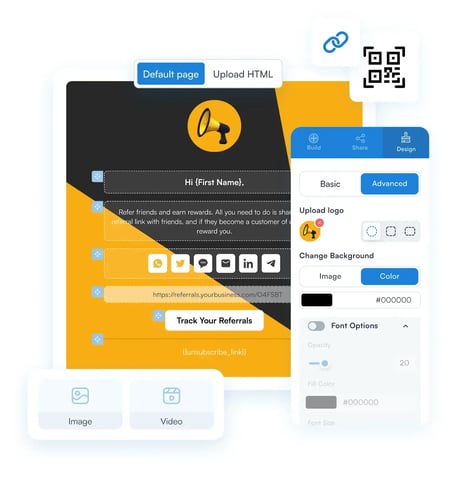
Referral Factory is an excellent choice for small teams at the beginning of their customer advocacy journey. Referral Factory is not a fully fledged advocacy platform like the other options on this list that offer references, reviews, and community management. However, referrals remain a core component of customer advocacy, and Referral Factory helps customers quickly build custom referral programs from scratch. No coding, no headaches.
What I like: Referral Factory offers an affordable entry point for companies looking to begin leveraging customer advocacy. Most other advocacy platforms cater to enterprise clients, with pricing to match. In addition, Referral Factory offers a native HubSpot integration that automatically adds incoming referrals as contact or deal records in the CRM. For small scrappy teams building a scalable advocacy tech stack, it’s a hard combo to beat.
Pricing:
- Starter - $76/mo
- Basic - $160/mo
- Pro - $320/mo
- Enterprise - custom pricing
Integrations: , Salesforce, Stripe, Intercom, and more (+3,000 apps).
How to Integrate Customer Advocacy Tools With Your Existing Tech Stack
Customer advocacy platforms integrate with CRMs, product analytics tools, community platforms, review sites, gifting tools, and data warehouses. If a customer advocacy platform can’t talk to other key platforms in a company’s tech stack, it’s nothing more than a glorified contact list.
CRM Integration
CRM integration is the foundation of success with a customer advocacy platform. Advocate data should bi-directionally sync between a company’s CRM and advocacy software to ensure key data points, such as activity history, last engagement date, and burnout risk, are available on the customer record. When customer advocacy platforms connect to CRMs like HubSpot, sales teams can see which accounts are active advocates before sending a reference request, and success teams can nominate high-health customers to the advocacy program without having to work out of a separate system.
integrates with major customer advocacy platforms like UserEvidence, Influitive, Extole, Referral Factory, and Higher Logic, allowing contact records to reflect advocacy activity and enabling HubSpot workflows to trigger based on advocate milestones. That means a customer who completes advocacy challenges in Influitive can be automatically enrolled in a HubSpot workflow that thanks them and then pings their CSM, for example. Most customer advocacy platforms offer integrations with major CRMs, but if that’s not available, companies will have to rely on custom API integrations to ensure data integrity in both systems.
Product Analytics Integration
Connecting advocacy platforms to product analytics tools like Amplitude, Mixpanel, or Pendo lets teams identify advocates based on usage behavior instead of just survey responses or CSM nominations. A customer who logs in daily, uses three or more core features, and has been active for over six months is a likely advocacy candidate, even if they haven’t responded to a survey.
When product analytics data drives advocate segmentation, targeting becomes more precise, and conversions improve. In addition, teams can avoid the mistake of asking disengaged or at-risk accounts for advocacy, which can damage the customer relationship rather than strengthen it.
贬耻产厂辫辞迟’蝉 tracks product adoption milestones through custom properties, which can drive advocacy platform segmentation alongside dedicated product analytics tools.
Community Platforms
Connecting a customer community to advocacy software creates a direct pipeline from organic engagement to advocate activation. Customer participation should feed into the advocacy platform. Integration with community platforms powers even more accurate advocate targeting than demographic and activity data alone.
Community platforms such as Higher Logic Vanilla offer native integrations with HubSpot, enabling community participation to trigger workflows, such as milestone emails, CSM alerts, or invitations to reference programs, without anyone needing to leave their preferred workflow.
Review Sites
For B2B SaaS companies where reviews are a key part of the buying process, integrations with popular review sites are highly valuable. These integrations allow advocacy platforms to automatically enroll satisfied customers into review request campaigns for popular sites like G2 and Capterra based on industry, persona, or any other cohort information. Using , marketers can route promoters to the right review campaign at the right time, based on NPS survey responses and customer health data.
Review site integrations can automatically pull review content back into the advocacy platform, making it available as reusable sales material. More advanced integrations use AI to surface specific proof statements buried within reviews, so marketing and sales teams can quickly find relevant customer quotes without manually combing through review sites.
Gifting
Most customer advocacy platforms include native reward engines that handle the basics, such as gift cards, points, and badges. But for companies that want to go beyond digital incentives, integrations with dedicated gifting platforms unlock physical gifts, branded swag, direct mail, and global fulfillment. These integrations allow advocacy platforms to automatically trigger a gift when an advocate completes a high-value activity, such as a reference call or case study interview, without anyone on the team needing to manually coordinate procurement and shipping.
For large advocacy programs, tracking what was sent, to whom, and at what cost becomes increasingly difficult to manage manually. When gifting syncs with an advocacy platform and a CRM, teams can gain visibility into gifting costs, prevent overgifting, and ensure the gifting program delivers ROI.
Data Warehouses
Integrating a customer advocacy platform with a data warehouse enables teams to combine advocacy data with revenue, product usage, support, and marketing data in a single place. For large enterprises with large customer bases, proprietary tools, and vast data sets, integration with a data warehouse is essential for maintaining advocacy data and measuring the long-term revenue impact of advocacy programs at scale.
Data warehouse integration enables analysts to fold customer advocacy data into existing BI tools and executive reporting. For companies already piping CRM data into a warehouse, adding advocacy data to the same pipeline ensures a complete picture of the customer lifecycle from acquisition through advocacy.
Frequently Asked Questions About Customer Advocacy Platforms
What is the difference between customer advocacy platforms and referral software?
Customer advocacy platforms manage a full range of advocacy activities, including referrals, reviews, case studies, reference calls, speaking engagements, social sharing, and more. These platforms also offer segmentation and targeting features to help businesses identify which existing customers are most likely to complete advocacy activities.
Referral software is designed specifically for referral programs. It helps track and reward customer-to-customer referrals, generate links, attribute sign-ups, and manage payouts.
How long does it take to implement a customer advocacy program?
A fully-featured customer advocacy platform typically takes two to three months to implement. Timelines vary depending on the platform’s complexity and the state of a company’s existing data.
Do I need a community platform if I have advocacy software?
A community platform is not necessary for companies using advocacy software. A community forum is a specific investment for certain businesses, like those with large user bases, technical products, or strong peer-to-peer support dynamics. Not every company needs one, but almost any company with happy customers can benefit from an advocacy program.
However, companies that already operate a community platform should absolutely consider connecting it to an advocacy platform. Community engagement is one of the strongest signals that a customer is ready to advocate. Integrating these platforms ensures that high-engagement community members are automatically surfaced as advocacy candidates.
How do I avoid reference fatigue and still hit revenue goals?
Teams can avoid reference fatigue by growing their advocate pool, setting activity caps, and strategically matching reference requests. Reference fatigue occurs when the same small group of customers is repeatedly tapped for sales calls, case studies, and other high-effort requests. It’s one of the fastest ways to burn out advocates and damage relationships. Avoiding it requires delivering the right request to the right customers at the right time, and not doing it too often.
- Grow the reference pool. The more advocates available, the less any individual gets asked. Teams can use CRM health scores, product usage data, and advocacy platform insights to identify new candidates continuously.
- Set advocacy activity caps. Program managers should track how often each advocate is referenced and set limits. For example, no more than one reference call per advocate per quarter.
- Match strategically. Advocacy platforms can match reference requests based on industry, company size, and use case, so the ask is relevant to the advocate.
- Mix high- and low-effort asks. Balancing reference calls (high effort) with lighter activities like reviews or social shares keeps advocates engaged without overloading them.
How should we handle gifting and tax compliance for rewards?
Companies should consult a tax advisor and track cumulative reward value per advocate to stay compliant with gifting and tax obligations. In the U.S., the IRS requires businesses to report non-cash prizes and awards exceeding $600 in value per recipient per year, and international programs add additional complexity.
From a practical standpoint, here are some best practices to help keep things manageable:
- Track the cumulative reward value per advocate. Program managers should maintain a running total to flag when recipients approach tax-reporting thresholds.
- Offer non-monetary incentives where possible. Early access to features, VIP event invitations, and public recognition carry no tax implications and are often more meaningful to B2B advocates than cash equivalents.
- Use a gifting platform with compliance features. Some dedicated gifting tools include built-in tracking and reporting to help companies stay on top of tax obligations.
Turning Customer Loyalty Into Scalable Growth
Loyal customers are the most valuable assets a business has. They buy more, stay longer, and have the power to bring in new customers through their advocacy in a way no traditional marketing campaign can replicate. In the past, companies had to hope for good word of mouth and fish for referrals during check-in calls. Now, customer advocacy tools allow them to systematically turn organic goodwill into a structured, measurable channel that drives referrals, reviews, references, and ultimately, revenue.
贬耻产厂辫辞迟’蝉 Smart CRM syncs advocacy data bi-directionally with customer advocacy platforms, so sales teams can source references without leaving their pipeline, CSMs can nominate high-health customers without switching tools, and marketers can tie every review, referral, and case study back to ROI.
During my time as a support rep at HubSpot, I saw how consistently great service turned customers into vocal advocates. Customers often told me they stayed loyal not just because of the product, but because they knew we’d take care of them if something went wrong. That kind of trust is what advocacy platforms are designed to capture and scale.
Free Help Desk & Ticketing Software
Keep track of customer requests in one unified help desk that connects to your CRM database.
- Provide personalized, AI-powered support to your customers
- Save time, reduce errors, and streamline service processes
- Improve rep efficiency & time to resolution
- And more!
Customer Service