.png?width=112&height=112&name=Image%20Hackathon%20%E2%80%93%20Vertical%20(30).png)
Customer care focuses on how people are treated across every interaction with a brand. Focusing on customer touchpoints has a huge impact. found that 52% of consumers abandoned brands after poor product or service experiences, while 29% left due to subpar interactions.
Customer care acts as a unifying framework that connects service managers, success leaders, and experience professionals. Organizations that adopt this unified framework consistently achieve stronger retention metrics. The end result is higher customer lifetime value and improved net revenue retention.
This article will explain what customer care is, how it differs from customer service and customer success, and how to build a customer care program that drives results.
Table of Contents
- What is customer care?
- How Customer Care Differs From Other Customer Service Concepts
- Why Customer Care Programs Matter
- How to Start a Customer Care Program
- 4 Classic Customer Care Examples
- Frequently Asked Questions About Customer Care
What is customer care?
Customer care focuses on how people are treated throughout their entire brand relationship — from first contact through purchase and beyond. The care team anticipates what customers need next and builds emotional bonds that drive lasting loyalty.
Customer care focuses on different metrics than service operations, prioritizing customer lifetime value and retention rather than and ticket closure rates. Beyond that, customer care is proactive, which leads to wins. Customers receiving proactive support demonstrate versus those getting only reactive assistance.
The strongest ROI emerges from unifying both customer care and service. With a hybrid approach backed by the right technology, customers feel genuinely understood and supported. natively integrates with the CRM, giving teams a complete view of the customer. Coupled with , teams can proactively serve their clients.
Key Characteristics of Customer Care
Emotional connection, proactive engagement, and relationship building guide customer care. To deliver on these principles, teams need a complete view of the customer. A CRM like logs every customer interaction, so care teams can assess customer health and needs.
1. Emotional Connection
Emotional connection is the ability to recognize and respond to how a customer feels, not just what they need. Reps can build trust by acknowledging the customer's frustration or uncertainty. Operationally, this requires training teams to listen actively, respond with empathy, and adapt their tone to customer context rather than relying on scripts.
2. Proactive Engagement
Proactive engagement anticipates problems before customers encounter them. Reps can do that by monitoring usage patterns, identifying risk signals, and reaching out with guidance or reassurance at the right moment. Proactive care reduces friction and prevents escalations.
3. Relationship Building
Relationship building extends beyond single transactions. Reps need to continuously engage throughout the customer lifecycle, ensuring customers don’t feel like each interaction starts from zero. Strong relationship-building practices rely on shared context, consistent follow-up, and cross-team alignment.
Business Impact of Customer Care
Three-quarters of U.S. consumers are more likely to be loyal if a brand understands them at a personal level, according to . Customer care delivers measurable returns that traditional customer service metrics miss. Here’s how the numbers break down across three critical business dimensions: customer lifetime value (CLV), customer advocacy, and cost reduction.
Customer Lifetime Value Growth
Companies that excel in personalization, a core element of customer care, typically generate 10% to 15% more revenue, with best-in-class execution achieving up to 25%, a confirms. These gains come from improved conversion rates, higher average order values, and increased purchase frequency. The compound effect across the customer journey makes personalization investment essential for CLV growth.
Customer Advocacy and Referrals
Effective customer care transforms buyers into vocal advocates who drive growth through word of mouth and referrals. According to , referred customers generate 30% to 57% more referrals than non-referred customers, and businesses with formalized referral programs report 71% higher net promoter scores, says.
Cost Reduction
While customer care requires investment in relationship-building, it also generates substantial cost savings through churn prevention and operational efficiency. According to , AI-powered customer experience reduces cost-to-serve by 20% to 30%, while enhancing customer satisfaction by 15% to 20% and increasing revenue by 5% to 8%.
Providing quick solutions to pain points is a part of reducing churn. improves customer satisfaction by providing fast, accurate 24/7 responses. When challenges are complex, they get escalated to an agent.
The 4 C’s of Customer Care
A customer care program encompasses four core principles known as the 4 C's: Convenience, Communication, Competency, and Connection. Unlike metrics-driven functions, customer care prioritizes building trustworthy relationships over measuring transactional outcomes.
Convenience
Customer care creates seamless experiences that respect customers' time and circumstances. This involves anticipating customer needs before they say anything and removing unnecessary roadblocks. Convenience can include flexible policies, accessible support channels, and proactive problem-solving.
Example: Amazon’s returnless refund policy refunds customers for low-cost items without requiring a return. This builds goodwill and customer loyalty by saving them time and effort. This policy is a deliberate part of Amazon’s customer care program.
Communication
Effective customer care requires transparent, timely, and personalized exchanges. Communication strategies include active listening, acknowledging emotional context, and adapting messaging to individual situations rather than relying on scripts.
Example: As a support rep at HubSpot, I practiced active listening and empathetic communication daily. I focused my communication on understanding customer needs and meeting their goals. Even in challenging situations, I practiced clear, honest communication to keep customers informed.
Competency
Customer care demands both technical expertise and emotional intelligence. Representatives must solve problems efficiently while demonstrating a genuine understanding of customer circumstances. Competency means having the knowledge, tools, and authority to resolve issues without unnecessary escalations or delays.
Example: At HubSpot Support, my team and I completed extensive technical training to support customers across all aspects of our product. Training went beyond product knowledge to include technical areas such as web design and web hosting, enabling us to exceed customer expectations.
Connection
Customer care builds emotional bonds that transcend individual transactions. Connection emerges when customers perceive your business as a trusted partner that genuinely cares about their success and well-being. Building an emotional connection with customers requires meeting them as individuals with unique stories and needs, rather than just numbers in a spreadsheet.
Example: ecommerce pet-supply giant Chewy sends flowers and a handwritten card when a customer's pet dies. They also refund unopened food and suggest grief counseling services. Gestures like this are baked into Chewy’s playbook to build emotional connections with customers through genuine empathy.
How Customer Care Differs From Other Customer Service Concepts
Customer care is an essential business concept that often gets grouped with similar CS terms. To truly optimize customer interactions and resource allocation, teams must understand the nuances that set customer care apart. The following sections dive into how customer care is distinct from (yet related to) customer service, customer experience, customer success, and customer relations.
Customer Care vs. Customer Service
Customer care is the process of building an emotional connection with customers, whereas customer service is the assistance a business provides them. Customer care is less quantifiable than customer service and focuses more on one-to-one customer interactions.
While both functions increase customer satisfaction, customer service works by answering questions and providing support. Customer care, on the other hand, focuses on active listening and understanding the customer’s emotional needs as much as the physical or business ones.
Customer Care vs. Customer Relations
Both customer care and customer relations deal with long-term relationship-building. However, customer relations aims to expand relationships with the target audience. Its goal is to create loyal customers and eventually turn them into advocates.
Customer care works toward a similar goal but is much less calculated. Its purpose is to build a great experience, even if it doesn’t result in referrals. By doing so, a company becomes a trusted resource in the eyes of its clients.
Customer Care vs. Customer Success
Customer success is also sometimes called customer support. Customer care is more about emotion; customer success is more about solving a technical problem.
Customer success departments are more commonly found at SaaS companies, where the product they sell has a learning curve. Customer success departments deal with everything that has to do with the product experience. They carry out tutorials, walk the customer through a problem on their end, and are the first point of contact when bugs appear in the product.
Customer Care vs. Customer Experience
Customer care typically refers to the relationship-building aspect of customer service, so it requires interactions with a representative. Customer experience encompasses the whole customer journey before, during, and after a purchase.
Something as simple as the user experience on the website can impact the customer experience. Customer care, on the other hand, refers to moments when a problem was promptly resolved, and the rep went above and beyond to find a solution. Make no mistake: Customer care can make for a great customer experience, so the two are closely related.
Customer care, experience, success, and support all impact customer satisfaction scores. It’s important to emphasize them all equally when creating a service strategy for a business or scaling a service team.
|
Concept |
Primary Focus |
Measurement Approach |
Interaction Style |
|
Customer Care |
Emotional connection and trust |
Qualitative, relationship-based |
One-to-one, empathy-driven |
|
Customer Service |
Issue resolution and support |
Quantitative metrics (resolution time, CSAT) |
Standardized, process-driven |
|
Customer Experience |
End-to-end journey quality |
Touchpoint satisfaction, NPS |
Omnichannel, design-focused |
|
Customer Success |
Product adoption and outcomes |
Usage metrics, retention rates |
Proactive, technical expertise |
|
Customer Relations |
Loyalty and advocacy development |
Lifetime value, referral rates |
Strategic, segmented engagement |
Why Customer Care Programs Matter
Customer care programs increase customer loyalty and retention, which has a significant positive impact on revenue. Companies with strategic customer care programs excel at satisfying customers and turning them into loyal, vocal advocates. Loyal customers are less likely to leave, more likely to generate referrals, and make frequent, high-value purchases. Additionally, customer care programs increase customer lifetime value and reduce churn.
Below are key reasons why customer care programs matter.
Creates Long-Term Customer Relationships
Customer care programs build trust-based relationships that reduce churn and . When customers see that a company is genuinely invested in their success, they reciprocate with loyalty. This dynamic creates more predictable revenue growth and transforms one-time buyers into long-term partners.
According to a recent SAP survey, cite poor customer service as a loyalty breaker. Accordingly, investing in customer care is a proven strategy to prevent churn, retain revenue, and improve the quality of customer relationships.
In my experience as a support rep at HubSpot, relationships built through customer care can withstand rough patches that would otherwise cause customers to churn. I remember dealing with a significant product outage where many customers couldn’t access their portals.
They were understandably frustrated, but because of a history of empathetic and transparent care, the majority of customers remained patient and appreciative. They trusted that the company had their best interests at heart, even when the technical issue was outside of our immediate control.
Reduces Customer Acquisition Costs
Customer care programs generate referrals and boost retention, significantly lowering acquisition costs. On average, referred customers have , and the loyal customers satisfied through care programs are more likely to bring those referrals through the door. These referred customers are up to , creating a compound growth engine where loyalty generates revenue while acquisition costs shrink.
This referral cycle is especially powerful because it’s to acquire a new customer than to retain an existing one. By building durable relationships and preventing churn, organizations can reduce their reliance on expensive marketing and paid acquisition. Instead, they can focus resources on deepening the value of their existing customer relationships and letting customer care-powered referrals bring in new customers at a reduced cost.
Differentiates Brands and Justifies Premium Pricing
Customer care creates a competitive advantage in saturated markets where most products offer similar features and meet the same customer needs. say the experience is a key factor in purchasing decisions, often making an effective customer care program the deciding factor between two otherwise comparable solutions.
This differentiation also commands premium pricing because customers value strong relationships and exceptional experiences beyond a product's basic functionality. are willing to pay more for an excellent customer experience, making customer care programs a worthwhile investment that increases margins.
Improves Employee Satisfaction and Retention
Customer care programs empower employees with autonomy and the freedom to make meaningful decisions. Research on high-retention organizations finds that companies that invest in employee autonomy, development, and engagement achieve and longer employee tenure than peers that don’t.
While many factors contribute to a positive workplace, a culture of customer care is a significant driver because it gives employees purpose and trust, naturally increasing engagement and tenure.
In customer-centric organizations like HubSpot, team members are encouraged to solve problems creatively and do whatever it takes to delight customers. I experienced this firsthand as a support rep at HubSpot.
Rather than reading from rigid scripts, I had the autonomy and trust to make judgment calls, communicate transparently, and help customers in ways that felt meaningful. That trust made the work more fulfilling and made me want to show up better for customers.
Organizations that trust employees to exercise judgment during care moments create a virtuous cycle: satisfied employees deliver superior experiences; superior experiences create satisfied customers, and satisfied customers reinforce employee purpose and pride. Over time, this loop strengthens team culture and makes talent easier to retain.
How to Start a Customer Care Program
Building an effective customer care program starts with clear intent and clear boundaries. Customer care shouldn’t operate as a standalone initiative or compete with customer service and customer success. Instead, it should connect the two, building a system where emotional support and business outcomes reinforce each other rather than exist in silos.
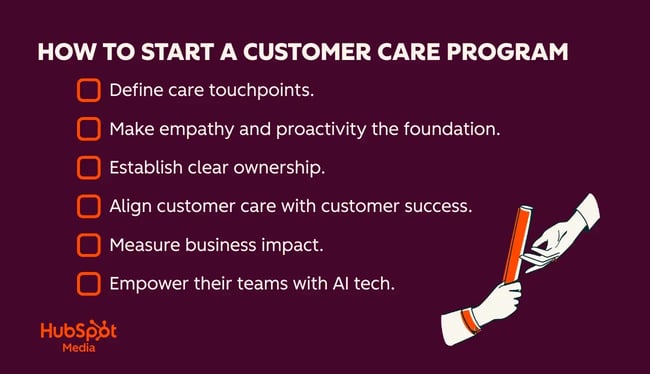
To start a customer care program, service leaders should:
- Define care touchpoints.
- Make empathy and proactivity the foundation.
- Establish clear ownership.
- Align customer care with customer success.
- Measure business impact.
- And empower their teams with AI tech.
1. Define care touchpoints and priorities.
Customer care leaders should start by mapping where emotional connection influences retention, expansion, or advocacy. Focus areas include:
- Onboarding.
- First support contact.
- Renewals.
- And service failures.
Define what empowered care looks like. Reps should know when they can deviate from scripts, how judgment calls are made, and what guardrails protect both customers and the business.
helps customer care teams by unifying omnichannel support and providing customer insights so teams can deliver fast, consistent service.
2. Build empathy and proactivity into the foundation.
Organizations must train teams to recognize emotional cues, acknowledge customer feelings, and identify patterns to inform decision-making. Teams can start by building proactive monitoring systems that identify risk signals, like declining usage, multiple support contacts, or sentiment shifts. Alerts trigger outreach before issues escalate.
3. Establish clear ownership and collaboration.
While service teams often execute customer care behaviors, they must be supported by leadership, success managers, and operations. Clear escalation paths and shared accountability prevent care from becoming inconsistent.
Teams should build workflows where support tickets trigger customer success outreach. When patterns show risk, the success team reaches out. Teams know who needs high-touch care during support interactions.
4. Align customer care with customer success through shared workflows.
When care interactions and customer signals feed directly into customer success systems, customer care teams gain clearer visibility into risk and adoption. That insight reduces handoff friction and links empathetic support to measurable outcomes, like retention and long-term customer value.
5. Measure business impact, not just activity.
Customer care programs should track specific metrics — customer effort score, Net Promoter Score, retention rate, and customer lifetime value — alongside traditional service metrics. Reps should build business cases with concrete ROI that translate into operational improvements.
6. Empower customer care teams with AI technology.
According to , 76% of customers expect agents to know who they are and what they’ve been through. However, half still repeat themselves because systems don’t share context between touchpoints. Use tools like to provide agents with instant context from the CRM, so they can personalize responses.
4 Classic Customer Care Examples
1. Delta Airlines Flight: Going Beyond the Boarding Pass
Kam and Tim Boles were already on board a Delta flight to Cape Town when they realized one of their passports was missing, putting their long-planned cruise at risk. The crew triggered a massive search.
When all seemed lost, the couple left the plane, resigned to missing out on their vacation. Only a few minutes later, they were chased down by a Delta employee, who let them know that the passport had been found. The pilots allowed them to board again before take-off, and they could continue with their trip as planned.

This example highlights the empathy and proactive problem-solving pillar of customer care. The Delta team prioritized the customer’s emotional experience and needs over strict adherence to process. By going above and beyond, the crew prevented a major disruption to the couple’s long-planned vacation but also fostered trust and loyalty. A potentially negative situation turned into a memorable, positive brand experience.
2. Burger King: Employee Who Worked a Last-Minute Shift in Graduation Clothes
Mykale Baker, an 18-year-old Burger King employee in Hoschton, Georgia, had just graduated from high school. He went to the Burger King location where he worked to celebrate. When he arrived in his cap and gown, ready to enjoy his achievement, he saw his coworkers struggling with the evening rush.
In an act of kindness, he walked behind the counter — still wearing his graduation outfit — and started helping. Baker showed that he understood both external and internal customer care culture.

Baker recognized that overwhelmed employees can’t deliver great customer experiences, and the fastest way to help customers was to help his coworkers first.
The video went viral, and a raised over $200,000. The kind-hearted teen also received $10,000 from the Burger King Foundation to put toward his future studies.
This moment illustrates that customer care culture starts internally. When organizations invest in employee well-being and model care behaviors between team members, that culture naturally extends to customer interactions.
Baker’s instinct to support colleagues during a rush demonstrates that care isn’t a policy to enforce but a culture to cultivate.
3. Beckett Simonon: Turning Mistakes Into Loyalty
The easiest response to a customer error is often a refund. But customer care sees these moments as opportunities to build something deeper.
A customer ordered loafers from Beckett Simonon, then realized they had missed the eight-to-10-week made-to-order timeline and needed the shoes in two weeks. They emailed to cancel, expecting a simple refund.
Instead, the customer care agent acknowledged the situation and offered solutions: a full refund, an exchange for in-stock sneakers, waiting with a $50 credit, or — here’s where care elevated service — personalized alternatives. The agent selected four similar styles that could ship immediately and sent photos. The customer found one they loved, received it within three days, and got the $50 credit anyway.

This example highlights the personalization and proactive problem-solving pillar of customer care. Rather than defaulting to a simple refund, the Beckett Simonon agent reframed the mistake as an opportunity to understand the customer’s urgency and offer tailored solutions. By investing a few extra minutes, the brand strengthened loyalty and transformed a potential loss into long-term advocacy.
4. Chewy: Empathy at Scale
When customers contact online pet store, Chewy, to cancel pet food subscriptions after losing their pets, representatives send condolence flowers and handwritten notes. They then refund the purchase and suggest donating extra product to animal shelters.
Chewy’s response isn’t mandated policy. It’s empowered judgment where pet-loving team members make human decisions that build long-term loyalty. The business impact shows in retention rates that exceed industry averages. Memorable interactions convert satisfied customers into vocal advocates who share their experiences on social media.
Frequently Asked Questions About Customer Care
1. What is the meaning of customer care?
Customer care refers to the quality of relationships companies build with customers through every interaction — before, during, and after purchases. It encompasses the emotional connection, proactive engagement, and relationship depth that transform satisfied customers into loyal advocates.
Unlike transactional customer service that resolves individual issues, customer care focuses on understanding customer context and creating experiences that foster long-term loyalty.
2. What are the 4 C’s of customer care?
The 4 C’s framework — Communication, Competence, Convenience, and Courtesy — provides a structured approach to delivering consistent care across all customer touchpoints.
- Communication means providing clear, timely, and honest information that sets accurate expectations and keeps customers informed throughout their journey.
- Competence refers to the knowledge and skills representatives need to solve problems effectively, answer questions accurately, and demonstrate expertise that builds customer confidence.
- Convenience involves making interactions effortless through omnichannel support, self-service options, and processes designed around customer needs rather than internal workflows.
- Courtesy encompasses the respectful, empathetic tone that makes customers feel valued as individuals rather than ticket numbers in a queue.
3. What are the key skills for customer care?
These are the key skills customer service agents need to provide customer care:
- Empathy. The ability to understand and share customer feelings, recognize frustration beneath surface-level complaints, and respond with appropriate emotional intelligence.
- Active listening. Understanding underlying needs beyond what customers explicitly state, often revealing root causes that differ from the presenting problem.
- Technology and technical proficiency. Deep understanding of technologies, products, policies, and systems to resolve issues that frustrate customers.
- Problem-solving creativity. Finding solutions when standard procedures don’t fit unusual circumstances.
- Communication skills. Ensuring clarity while maintaining appropriate tone across both written and verbal channels.
- Judgment and decision-making. Balancing policy adherence with situational flexibility that prioritizes long-term relationships over rigid rule enforcement when circumstances warrant exceptions.
4. What are the 7 qualities of good customer service?
- Responsiveness. Addressing customer inquiries promptly and efficiently has proven to increase customer retention, according to .
- Reliability. Consistent execution with accurate information and follow-through on commitments.
- Knowledge. Answering questions confidently without constant transfers or researching basic information.
- Personalization. Valuing customers as individuals by referencing purchase history and previous interactions rather than treating each contact as isolated.
- Empathy. Acknowledging feelings and responding with human concern rather than robotic script adherence.
- Professionalism. Maintaining appropriate boundaries and communication standards even during challenging interactions.
- Proactivity. Anticipating needs and offering solutions before customers ask, demonstrating investment beyond the immediate transaction.
Care for the Customer and They’ll Care For You
Customer care transforms support from a cost center into a growth driver. Companies that integrate care principles with customer success strategies see measurable improvements in retention, lifetime value, and competitive differentiation.
But strategy alone isn’t enough. Care must be operationalized. When emotional connection and relationship-building are embedded into workflows, customer care becomes scalable. Tools like HubSpot Service Hub unify customer data, automate proactive outreach, and equip teams with AI-powered context. Then, every interaction feels personal without sacrificing efficiency.
The future of customer experience isn’t choosing between empathy and performance — it’s aligning them. Organizations that treat customer care as a strategic discipline rather than a soft skill build durable customer relationships that compound in value over time.
.png)
61 Templates to Help You Put the Customer First
Email, survey, and buyer persona templates to help you engage and delight your customers
- 6 buyer persona templates
- 5 customer satisfaction survey templates
- 50 customer email templates
Download Free
All fields are required.
Form not available
You're all set!
Click this link to access this resource at any time.
Customer Service