
The best website builder for AEO is the one that exposes structured data, gives full control over indexation, and connects AI visibility to CRM revenue. Most platforms claim AI readiness. Few provide the technical controls that make LLM citation predictable.
This guide evaluates the best website platform for AEO based on technical capabilities, content modeling depth, and CRM integration — with a feature comparison chart to make the decision easier.
Table of Contents
- What features make the best website builder for AEO?
- How We Evaluated the Best Website Builder for AEO
- Best Website Builder for AEO by Use Case
- Which website builder offers the best SEO features that could be used for AEO?
- Frequently Asked Questions About the Best Website Builder for AEO
What features make the best website builder for AEO?
The best website builder for AEO exposes machine-readable structure, crawl controls, and attribution that connects AI visibility to revenue. These factors are important because LLM retrieval algorithms prioritize structured, clearly modeled content with explicit entity signals.
An AEO website builder must therefore support schema extensibility, head-level control, performance optimization, and API-level data portability.
HubSpot AI Search Grader
Learn how leading answer engines like ChatGPT, Perplexity, and Gemini interpret your brand.
- Understand your competitive landscape
- Discover your brand perception in AI results
- Maximize performance with data-driven insights
- And more!
1. JSON-LD Injection Flexibility to the Template and Page Level
JSON-LD is the structured format used to explain a webpage to large language models (LLMs) in a clear, machine-readable way. While your webpage shows text to humans, JSON-LD explains to AI systems key components of the page:
- What this page is.
- Who the author is.
- What company it belongs to.
- Whether it’s an article, product, FAQ, or tutorial.
- What questions are being answered.
Many website builder platforms offer a default schema but restrict the use of custom JSON-LD. Yet Answer Engine Optimization (AEO) requires custom JSON-LD injection for advanced entity modeling.
There are two important levels of JSON-LD control that SEO specialists and growth leads should evaluate when choosing a website builder for AEO:
Template-level injection to automatically apply structured data to every page using a template.
For example, if a blog template contains Article schema, every blog post consistently communicates author, publish date, and topic type to LLMs. This creates structural consistency across large content libraries.
Page-level injection to customize structured data for an individual page.
A pillar page may need an FAQ schema. A product page may require Product schema. A case study may need Organization or Review schema.
supports both template-level and page-level JSON-LD control, allowing structured data to scale without sacrificing specificity.
2. Schema Access and Structured Data Control
Schema access determines whether an AEO website builder can clearly tell AI algorithms what each page represents and which real-world entities it describes.
These entities can include:
- Your company.
- Your product.
- The author of an article.
- A service.
- A pricing offer.
- A frequently asked question.
- A case study of a customer.
AEO requires explicit subject–predicate–object relationships, or semantic triples. Structured data expresses them in a clear format that machines understand.
Here’s a simple illustration of semantic triples:
- HubSpot’s Content Hub (subject) allows (predicate) custom schema injection (object).
- Structured data (subject) improves (predicate) AI citation clarity (object).
If schema access is ignored, LLMs infer structure from HTML heuristics. That means they try to infer the page's meaning from layout patterns, headings, bold text, and other visual cues in the raw HTML.
The result is a drop in citation likelihood because entity relationships remain implicit.
Featured reading: How simple semantics increased our AI citations by 642% [New results]
3. Head Tag and Metadata Control
AI crawlers parse canonical tags, hreflang, robots directives, and structured meta fields during retrieval — making metadata governance a core AEO requirement.
For example, exposes full head-level controls through theme templates and advanced settings. Marketers can manage canonicals, meta robots, OG tags, and structured metadata without breaking templates.
4. Robots, Sitemap, and Crawl Governance
Robots.txt tells crawlers the pages they can and can’t access. XML sitemaps tell crawlers which pages exist and which ones matter. Sitemaps also give LLMs a clear site hierarchy, which improves topical clustering in AI-generated answers, especially in knowledge graph–style responses.
If important pages are blocked from crawling, buried deep in navigation, or excluded from sitemaps, they may never be processed or updated in LLMs.
5. Speed, Hosting Architecture, and Performance Controls
Speed and hosting architecture determine how reliably AI bots can access, render, and process a site at scale, directly affecting how efficiently AI crawlers can fetch content. In fact, web admins have to ensure the site loads to appear in LLMs.
When evaluating the best web builder for AEO, check for the presence of technical capabilities that directly affect site speed:
- Server-side rendering (SSR).
- Managed hosting with built-in CDN.
- Minimal plugin dependency.
- Core Web Vitals stability across templates.
is built to handle around 1,000 page views per second per site — roughly 3.6M per hour or 86M per day.
6. API Access and Data Portability
API access determines whether you can programmatically read, update, and audit your structured content at scale. For example, if you have 500 product pages and need to update schema properties or audit missing FAQ markup, without API access, that becomes manual page-by-page work.
provides robust CMS and CRM APIs, so SEO specialists can run bulk schema audits and programmatic updates without touching each page individually.
How We Evaluated the Best Website Builder for AEO
I evaluated each platform based on one principle: can this CMS produce consistent, machine-readable signals that LLMs can reliably extract and attribute to revenue?
I looked beyond marketing claims and surface-level SEO features and focused on platform capabilities that directly influence AI retrieval systems, including:
- Structured content modeling and flexible schema implementation.
- Robots.txt editing, XML sitemap structure, and canonical management.
- Rendering reliability.
- API access to content objects and bulk update capabilities.
- Template-level and page-level JSON-LD control.
With those criteria in mind, here's how each platform performed.
Best Website Builder for AEO by Use Case
: Best for marketers who want schema control and CRM attribution
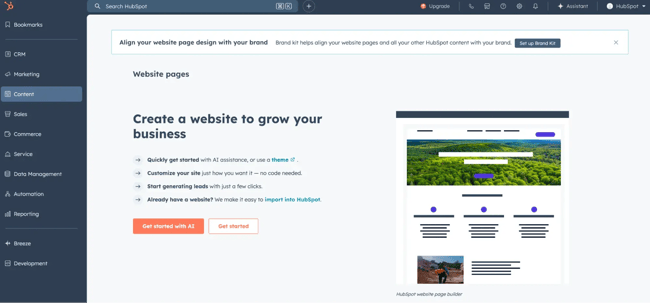
is the website builder for AEO teams that ship LLM?ready pages with structured content, schema, and SEO baked into every template. It combines CMS?level control (themes, coded templates, and full head-markup access) with native HubSpot CRM attribution and a drag-and-drop page builder.
Because Content Hub runs on HubSpot CRM, every visit, form fill, and chat rolls up into real contacts, companies, and deals so marketers can prove the AEO pipeline.
HubSpot also offers a with premium cloud hosting and powerful security features.
HubSpot Content Hub’s core AEO capabilities:
- Structured content and scalable templates. Content Hub supports coded templates (HTML, HubL) and theme?level control, plus structured content via HubDB and custom modules, so teams can centralize schema patterns and metadata logic instead of hand?coding each page.
- Schema/JSON-LD in the right place. HubSpot supports adding structured data (JSON-LD) via head code injection patterns.
- Crawl governance. HubSpot supports configuration of Robots controls (and related meta handling) through its knowledge base-supported workflows.
- Attribution that connects to CRM objects. Because Content Hub runs on HubSpot CRM, every form fill, chat, and session from your content is tied to contact records and their associated companies and deals, so AEO initiatives can be measured in terms of pipeline and revenue.
- Lightning speed under high traffic. HubSpot CMS is set up to handle around 1,000 page views per second per site (≈3.6M/hour, ≈86M/day).
Content Hub also provides SEO guidance to content teams in the editor, as well as operational prompts while editing for titles, headings, indexation basics, and internal linking.

Pricing
- 14-day free trial
- Starter: $15/month; 1 brand domain, 1 core seat
- Professional: $500/month; 1 brand domain and 3 core seats, plus advanced features
- Enterprise: $1,500/month; 10 brand domains, 5 core seats, custom objects, advanced features
: Best for teams that need a broad plugin ecosystem with full code access
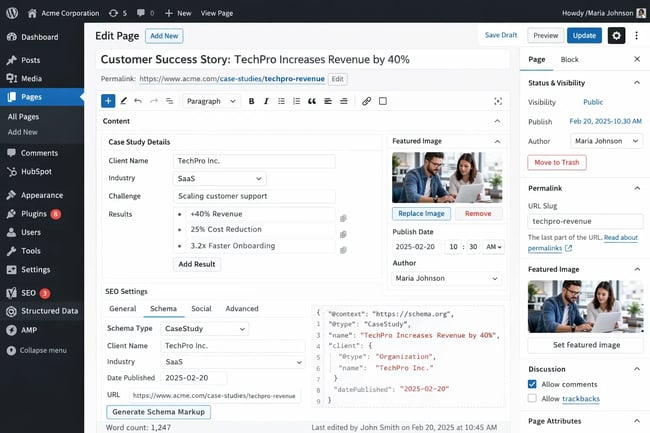
WordPress is a solid AEO website builder for teams that want maximum flexibility and are willing to own the technical stack. Self?hosted WordPress (WordPress.org) gives you deep theme control and the freedom to implement almost any schema strategy — manual JSON?LD, custom plugins, or SEO plugins.
WordPress’s core AEO capabilities:
- Full programmatic access. The WordPress REST API exposes content as JSON, which is great for audits and bulk?change scripts, but you have to design and maintain those workflows yourself.
- Many schema options, little guardrail. You can wire schema through theme code or plugins with full control over markup placement, but there’s no native guardrail to stop plugins or editors from colliding with your standards.
What I like and don’t like:
WordPress gives maximum AEO control, but there's a significant caveat — you need developers. Budget for ongoing engineering time, hosting, plugins, template maintenance, schema reviews, and QA to keep your AEO setup from quietly degrading over time.
Not sure WordPress is the right fit? Check out 22 WordPress alternatives.
Pricing:
WordPress.org software is open-source; costs come from hosting, themes, and plugins.
Featured reading:
: Best for design-led teams that want clean HTML and structured content
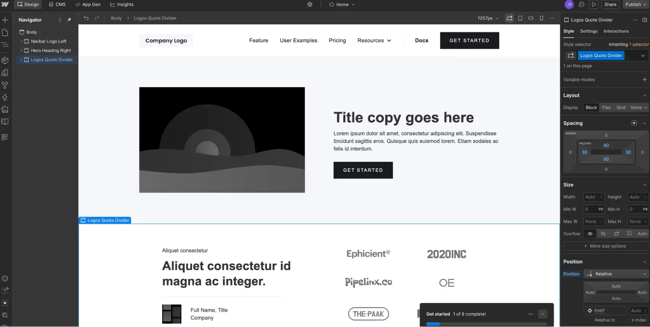
Webflow is best for design?led teams that care about clean HTML and structured content, but don’t want to live in code full?time. Its visual designer sits on top of a CMS that models content as collections and fields, which makes it much easier to keep layouts, copy, and schema patterns consistent.
Webflow’s core AEO capabilities:
- Head/body custom code. Webflow explicitly supports injecting custom code into the head and body tags.
- Structured collections. Webflow CMS uses collections and fields for pages, blogs, and custom content types, so you can define a single, structured model and reuse it across templates.
What I like and don’t like:
Webflow hits a sweet spot for AEO by bringing design, content, and basic structure into a single visual system. The big trade?off is that Webflow doesn’t come with a native CRM integration, so tying revenue back to AEO requires integrations and external reporting.
Pricing:
- Starter: Free
- Basic: $18/month
- CMS: $29/month
- Business: $49/month
- Enterprise: custom pricing
: Best for small teams needing guided SEO with limited dev time
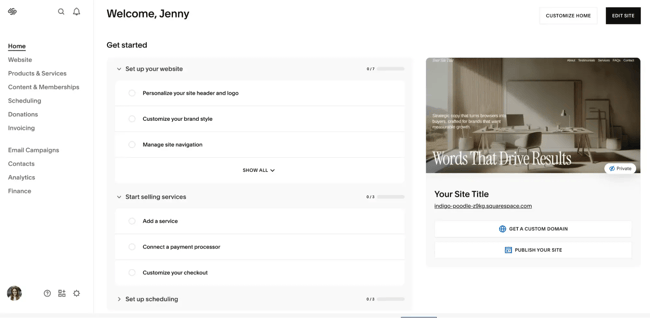
Squarespace fits small businesses, solopreneurs, and marketers who need speed to launch, guided SEO tooling, and “good enough” structured data without developers on call.
The platform will give you clean pages, metadata, and a straightforward publishing workflow.
Squarespace’s core AEO capabilities:
- Auto-generated structured data (non-editable). Squarespace automatically generates structured data for common types (Blog post, Event, Local business, Organization, Product, Website).
- Robots.txt is not user-editable. Squarespace runs a standardized robots.txt across sites, and users generally can’t directly edit it.
- Strong baseline SEO hygiene. Squarespace supports standard SEO fields like meta tags and related basics through built-in workflows.
What I like and don’t like:
Squarespace is fast to launch landing pages with consistent templates and fewer moving parts. What I don’t like is the limited technical control over robots.txt and schema, which are a large constraint for mature SEO teams.
Pricing:
- A 14-day free trial
- Basic: $16/month
- Core: $23/month
- Plus: $39/month
- Advanced: $99/month
Which website builder offers the best SEO features that could be used for AEO?
For most B2B marketing teams, offers the strongest alignment between SEO features and AEO requirements, including:
- Editor-level SEO recommendations.
- Template-level control over metadata.
- Header/footer code injection for JSON-LD.
- Indexation controls.
- Native attribution reporting tied to CRM objects.
For industries where content directly influences pipeline — like B2B SaaS, professional services, fintech, healthcare technology, and education platforms — HubSpot Content Hub performs best. It also fits teams whose job-to-be-done is to scale structured content across case studies, product pages, landing pages, and knowledge hubs.
On the other hand, WordPress becomes the stronger option for teams that need deep technical customization or unconventional architecture. Ecommerce brands with complex catalogs, publishers running custom content taxonomies, marketplaces, and organizations requiring bespoke schema logic often benefit from WordPress’s full code access and plugin ecosystem.
Frequently Asked Questions About the Best Website Builder for AEO
Is AEO different from traditional SEO?
Yes. Traditional SEO focuses on ranking web pages in search engine results. AEO focuses on structuring content so LLMs can extract, interpret, and cite it inside generated answers in platforms like ChatGPT, Claude, Perplexity, or Google’s AI Overviews.
SEO optimizes for clicks and keyword targeting. AEO optimizes for retrieval and summarization. That requires structured data, consistent entity modeling, clean heading hierarchy, and crawl governance.
Do I need a developer to implement AEO?
Not always. If your website builder supports template-level metadata control, header code injection for JSON-LD, and structured content fields, marketers can implement foundational AEO without engineering support. With HubSpot Content Hub, you don’t need a dev team.
However, advanced entity modeling, programmatic schema generation, or large-scale structured audits often require technical involvement.
Which schema types should I start with?
Start with schema types that match your core content model. For most B2B sites, that means Article, FAQPage, Organization, Product (if applicable), and Review.
Once those core entities are consistently defined, consider adding HowTo for instructional content, CaseStudy for customer proof, Event for webinars or conferences, and JobPosting if talent acquisition is strategic.
How long does it take to see AEO impact?
Initial structural improvements can influence crawl and indexing behavior within weeks. Citation impact inside LLMs typically takes longer because it depends on retraining cycles, retrieval refresh frequency, and overall entity authority. However, some pages surface in LLM results as quickly as two days after publication.
AEO is cumulative. Consistent structured publishing across multiple pages produces measurable visibility shifts over several months, especially for non-branded queries.
Can I test AEO without migrating my site?
Yes. You can begin by implementing structured data, cleaning heading hierarchy, improving internal linking, and tightening crawl governance on your existing platform.
Migration only becomes necessary if your current website builder restricts schema control, head-level metadata management, crawl rules, or structured content modeling. AEO can start small and scale as platform capabilities allow.
Choose the platform that lets your content speak clearly to machines.
AEO rewards sites that consistently signal the same entities, page structure, and crawl controls across their content. The right website builder determines whether content gets surfaced by LLMs — or gets ignored by them.
HubSpot Content Hub allows teams to standardize templates, deploy JSON-LD via header/footer injection, apply SEO recommendations during publishing, and then measure impact with attribution tied to CRM contacts and deals.
I’d always prefer HubSpot Content Hub and HubSpot Free CMS for B2B marketing teams, agencies, and classic industries. Not only does it provide flexibility in website and page building, but HubSpot Content Hub is also connected to your HubSpot AI CRM, so digital marketers can directly see the impact of a page on lead generation.
HubSpot AI Search Grader
Learn how leading answer engines like ChatGPT, Perplexity, and Gemini interpret your brand.
- Understand your competitive landscape
- Discover your brand perception in AI results
- Maximize performance with data-driven insights
- And more!