

On-page SEO determines whether visitors and search engines understand a web page. It also determines how the page is ranked on a Search Engine Results Page (SERP) and then clicked on. On-page SEO also influences your brand’s AI visibility, such as how LLMs extract, reuse, and cite your content in their answers.
Here’s the tricky part: a web page can be full of useful information, but it might not perform well if its on-page SEO elements aren’t working properly.
This guide breaks down the on-page SEO fundamentals that matter now. You’ll also get a practical on-page SEO checklist and tools for monitoring on-page SEO success and AI visibility. Unsure how to optimize your site or what to fix first? and at the Pro and Enterprise levels.
Table of Contents
- Essential On-Page SEO Elements
- What is on-page SEO?
- Why is on-page SEO important?
- On-Page SEO Checklist: From Quick Wins to Advanced Optimization
- Technical On-Page SEO Factors
- Measuring On-Page SEO Success
What is on-page SEO?
On-page SEO is the practice of optimizing the content, structure, and HTML elements on a webpage so search engines and AI systems understand what the page covers and when to surface it. It focuses on areas that live directly on the page and can be edited without relying on external websites.
In 2026, on-page SEO extends beyond keywords and title tags. It includes entity clarity, semantic structure, content completeness, internal linking logic, and machine-readable formatting. These elements help both traditional search engines and answer engines extract information and cite pages in AI-generated responses. Here’s a list of concrete elements of on-page SEO:
- The page title (title tag).
- Headings (H1, H2, H3, H4).
- The written content on the page (its depth and topical coverage).
- Internal links to other pages on your site and anchor text.
- URL structure (for example: /mobile-crm-benefits).
- Meta description.
- Image alt text.
- Core Web Vitals, page speed, and mobile performance.
- Structured data/schema markup.
- Content layout and readability.
On-Page SEO vs. Off-Page SEO
On-page SEO ensures each page clearly communicates what it is, who it’s for, and what question it answers. Off-page SEO improves how other sites and the web talk about it, using external signals such as backlinks and brand mentions. Together, these signals determine whether a page qualifies for ranking and how strongly it competes once indexed.

On-Page SEO Template
Save time with content planning and rank higher on Google with the help of this beginner-friendly SEO template.
- Organize your on-page SEO strategy
- Coordinate pages and keywords
- Implement key SEO elements
- Track changes and results all in one place
Download Free
All fields are required.
Form not available
You're all set!
Click this link to access this resource at any time.
Why is on-page SEO important?
On-page SEO directly affects rankings, click-through rate, usability, and conversions. It determines whether search engines and LLMs understand your page, whether users choose your result, and whether visitors complete an action after landing.
On-page SEO helps search engines and LLMs understand your pages
Search engines and LLM-powered answer engines rely on page-level relevance signals to interpret content. Titles, headers, body content, semantic relationships, entity clarity, internal links, and structured data define what a page covers and when it should appear. These same signals determine whether AI systems extract and cite your content. Pages with the right on-page SEO are more likely to:
- Appear in AI Overviews
- Be cited in ChatGPT, Perplexity, Gemini, Claude, and Grok responses
- Be summarized in Google search generative answers
- Rank in featured snippets
- Earn zero-click visibility
Want to know how your brand competes in ChatGPT or Gemini? Use the free to assess your AI share of voice and receive recommendations for improvement.

On-page SEO improves user experience and engagement
On-page SEO bridges the gap between intent and action. Page speed, mobile usability, readable formatting, and content clarity determine whether visitors stay, scroll, and convert. These signals also influence ranking systems and AI answer extraction.
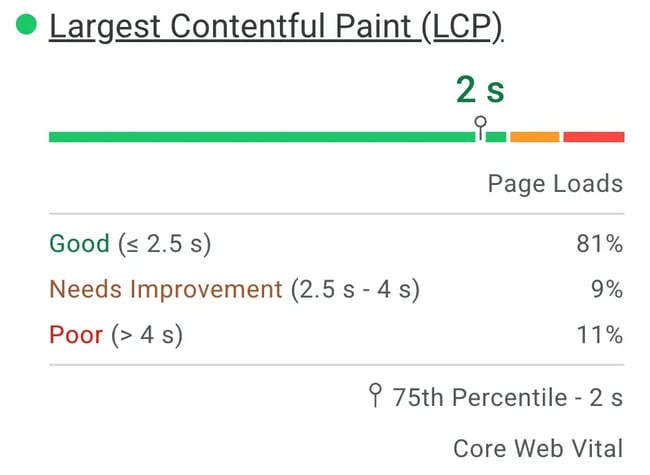
For example, your page speed should stay under 2 seconds to provide a good user experience, according to Google’s . Slower performance correlates with lower website engagement and higher abandonment. This metric directly affects both ranking eligibility and user satisfaction.
On-page SEO creates a controllable competitive advantage
On-page SEO is one of the few ranking levers teams fully control. Because on-page elements are evaluated per URL, improving a single page can change its performance without waiting for domain-wide authority from off-page SEO efforts.
Conversely, if metadata, Core Web Vitals, and intent alignment are broken, pages become only partially interpretable. Search bots struggle to match them to queries, and AI answers favor competing sources with clearer structure.
Essential On-Page SEO Elements
- Page Titles
- Meta Descriptions
- Headers
- Content Quality
- URL Structure
- Structured Markup
- Internal Linking
- Mobile Responsiveness
- Site Speed
- Readability
- Page Experience
All on-page SEO elements fall into three main categories:
- Content optimization elements
- Technical SEO elements
- User experience factors
Content Optimization Elements
Page titles
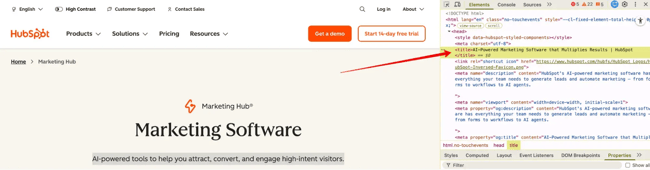
Your website page titles (also known as title tags) are one of the most important SEO elements. Title tags help search engines and visitors understand the page topic and what to expect on the corresponding pages. To ensure your site pages rank for the right intent, include the focus keyword in each page’s title. Incorporate your keyword as naturally as possible.
For example, the product page, a suite of advanced tools for analytics, personalization, and lead generation, has a distinctive title tag: “AI-Powered 糖心Vlog Software that Multiplies Results | HubSpot.”
Meta descriptions
Meta descriptions are the short page descriptions that appear under the title in search results. Although it’s not an official ranking factor for search engines, meta descriptions can improve click-through rate from search results. Therefore, it’s just as important when doing on-page SEO.

Meta descriptions can also be copied over to social media when your content is shared (by using structured markup). So, it can encourage click-throughs from there, too.
Header tags
Headers, also known as body tags, refer to the HTML elements <h1>, <h2>, <h3>, and so on. Header tags organize page content into a clear hierarchy for readers and help search engines identify which part of your content is most important and relevant, depending on search intent. Think of it as a table of contents, but for a web page.
Content quality and search intent
The first step to creating high-quality content is choosing relevant keywords and topics. Conduct keyword research by using tools like , , , and .
When doing keyword research, consider how your page content falls into the buyer’s journey and visitors’ search intent. This will impact how you will use your keywords and what types of content you will create.
Now, it’s time to write your page content for people and AI, or clean it up if you’re currently auditing your on-page SEO.
Technical SEO elements
URL structure
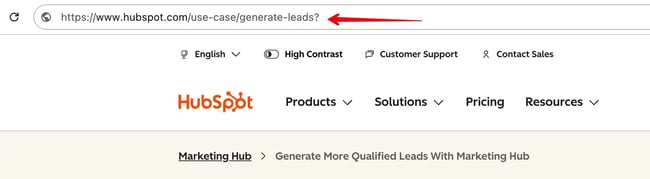
Your page URLs should be simple to digest for both readers and search engines. They are also important for keeping your site hierarchy consistent as you create subpages, blog posts, and other types of internal pages.
Internal linking
Internal linking is the process of hyperlinking to other helpful pages on your website. Internal linking is important for on-page SEO because it sends readers to other pages on your website, keeping them around longer and signaling to Google that your site is valuable and helpful. Internal links also distribute authority across important pages and thus help Google recognize them first and rank higher, though it’s not always the case.
Another benefit of internal links is the increased time visitors spend on your site. This is a signal Google recognizes as positive for rewarding your pages with higher rankings.
And finally, the more time Google has to crawl and index your site pages, navigating from link to link, the more Google absorbs information about your website and potentially ranks it higher on the search engine results pages.
Schema markup
Structured markup, or structured data, is the process of “marking up” your website source code to make it easier for Google to find and understand different elements of your content.
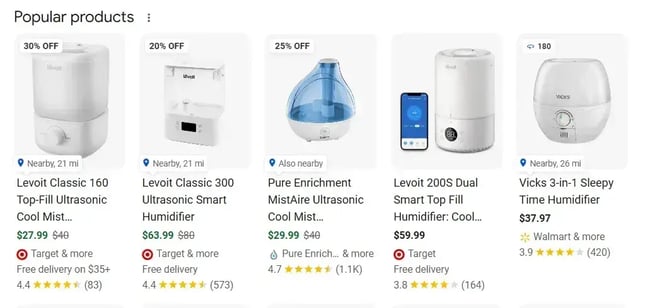
Structured markup is the key behind those featured snippets, knowledge panels, and other content features you see when you search for something on Google. It’s also how your specific page information shows up so neatly when someone shares your content on social media.
For example, with schema markup, you can nudge Google to show reviews and the delivery icon on your product offerings. Use an official to find microdata codes for any use cases.

Page speed and crawl efficiency
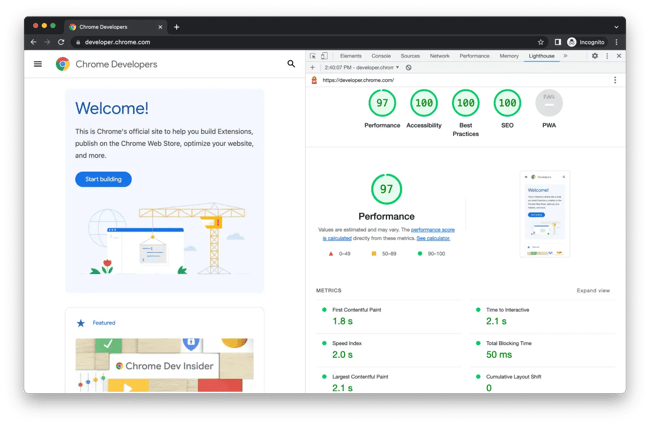
Whether viewed on a mobile device or desktop, your site must be able to load quickly. When it comes to on-page SEO, page speed counts big-time — under 2 seconds is the best loading time, remember?
Google cares about user experience first and foremost. If your site loads slowly or haphazardly, it’s likely your visitors aren’t going to stick around — and Google knows that. Moreover, site speed can impact conversions and ROI.
Site architecture elements are the elements that make up your website and site pages. How you structure your website can help Google and other search engines easily crawl the pages and page content.
User experience factors
Mobile optimization
Mobile responsiveness matters because search engine bots visit the mobile version of a page as the primary version for crawling, indexing, and ranking.
It’s critical to choose a website hosting service, site design, theme, and content layout that’s readable and navigable on mobile devices. If you’re not sure about your own site’s mobile readiness, use .
Readability and formatting
Readability affects how quickly users, LLMs, and search systems interpret a page without relying on surrounding context. Plus, great readability translates into a positive user experience, which is an indirect search ranking factor.
Readable pages break content into short sections, descriptive headers, and consistent formatting patterns. Paragraphs should stay concise, headers should communicate meaning, and lists should group related ideas. This structure helps readers scan and helps search engines understand topical relationships.
Visual elements — charts, diagrams, screenshots, and comparison tables — support readability when they clarify meaning. They reduce cognitive load and make complex ideas easier to interpret. They also create anchor points that separate sections and reinforce hierarchy.
Page experience
Search engines evaluate page experience signals at the page level, where page experience refers to how stable, responsive, and usable a page feels during interaction. Key page experience factors include:
- Stable layout during loading
- Fast interaction response
- Predictable rendering
- Accessible navigation
- Minimal intrusive elements
- Consistent mobile behavior
On-Page SEO Checklist: From Quick Wins to Advanced Optimization
This checklist prioritizes on-page seo techniques based on effort and impact. Start with changes that improve how pages appear in search. Then refine structure and intent alignment. Finish with advanced optimizations that improve extractability for AI systems and competitive visibility.
Quick wins
This scope of work is best for pages that already rank or get impressions but underperform on clicks or clarity.
1. Rewrite title tags to match search intent
Craft a descriptive title that includes your target keyword and accurately describes the page’s content and search intent. Aligning titles with intent often improves CTR without changing rankings. Here are some best practices for when developing a page title:
- Keep it under 60 characters to ensure that your titles display correctly. Although Google doesn’t have an exact character limit, its display titles max out at 600 pixels. Keeping your titles to 60 characters ensures the title won’t be cut off in search results.
- Don’t stuff the title with keywords
- Keep the primary keyword near the front
- Don’t use all caps — use sentence case or Title Case
- Match format to intent (definition, comparison, checklist, guide)
- Avoid branding unless brand demand exists
- Remove filler like “complete guide” unless necessary
2. Rewrite meta descriptions for click-through clarity
Meta descriptions influence how users choose between similar results. Generic summaries lose clicks. Strong descriptions gain the audience and conversions. Here’s what makes for a good meta description:
- Keep it under 160 characters
- Include your entire keyword or keyword phrase
- Use a complete, compelling sentence (or two)
- Avoid alphanumeric characters like —, &, or + (retrival systems don’t understand them)
- Avoid repeating the title.
Instead, use the description to add new information. A good meta description should describe the page:
- What the reader will learn
- Who it is for
- Why this page is different
- One clear benefit
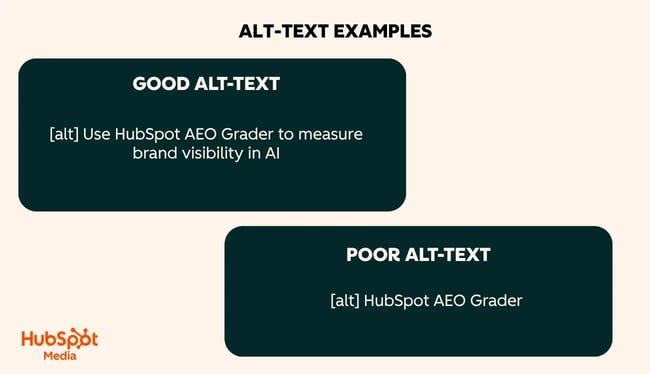
3. Add descriptive alt text to meaningful images
Search engines and AI systems cannot interpret screenshots, charts, or diagrams without text. Missing alt text removes context and your rankings.
Add alt text for product screenshots, comparison tables, process diagrams, charts, and unique visuals. Be sure to include your keyword in your image alt text. It’ll help with the page’s SEO and offer the potential to rank in image search (e.g., on a SERP, AI Overviews, or image carousel). Here’s what to keep in mind when adding image alt-text:
- Make it descriptive and specific
- Make it contextually relevant to the broader page content
- Keep it shorter than 125 characters
- Use keywords sparingly (one per image), and don’t keyword stuff
4. Fix broken internal links and weak anchors
Help search engines discover and understand the relationships between different pages on your website by adding or fixing internal links to your content. Broken links waste crawl budget and break context. Weak anchors like “read more” reduce semantic clarity. Replace with anchors that describe the destination:
- “CRM implementation checklist”
- “customer onboarding workflow”
- “B2B lead scoring model”
Fixing internal links helps both navigation and topic relationships. To add new internal links to your content, you’ll need to:
- Identify relevant anchor text. Determine the anchor text (the clickable blue text) that you want to use for your internal link. The anchor text should be descriptive and related to the content of the page you’re linking to.
- Identify the target page. Determine the specific page on your website that you want to link to. Choose a page that is contextually relevant and provides additional value or information related to the current content.
- Place links strategically throughout the page. Aim for a reasonable number of links per page — usually one link per 100 words — ensuring they are contextually relevant and add value to the user experience. Avoid excessive linking, as it may be seen as spammy.
5. Compress large images and remove unnecessary weight
Heavy pages slow crawling and reduce rendering reliability. This affects both rankings and AI retrieval. Using these practices ensures quick AI parsing, better LLM ingestion, and fast website crawling. Here are quick fixes to balance crawling, page speed, and image quality:
- Resize images to the actual display size
- Convert PNGs to WebP or AVIF
- Use lazy-load below-the-fold media to force images/videos to load only when the user scrolls near them
- Remove autoplay video embeds
6. Clean up duplicate or unclear H1s
Multiple H1s or vague H1s confuse topic detection. Every page should state its purpose immediately and use only one H1 per page. A good H1 is specific, descriptive, aligned with the title tag, and not keyword-stuffed.
Core optimizations
Apply these tactics to pages that need stronger structure, better intent alignment, or clearer machine readability.
7. Clean up the header hierarchy for machine readability
Organize content with header tags to make it more scannable and search-engine friendly. Incorporate important keywords naturally in your headers, but choose different ones from what’s in your page title. Put your most important keywords in your <h1> and <h2> headers. Headers should create a logical outline and have a concrete header hierarchy structure:
- H1 = page topic
- H2 = main sections
- H3 = subtopics
- No skipped levels
8. Refine URL slugs for clarity and stability
URLs reinforce topic meaning and site structure. Add your target keyword to your URL so users and search engines know what kind of content they will find on the page.
Imagine you own a hot yoga studio called ADYoga. You have a web page that includes videos of your classes. The keyword for this page is “hot yoga online classes” — so, you’d want to include that keyword in your URL. The URL for this web page may look like this:
adyoga.com/hot-yoga-online-classes
Here are a few tips on how to write SEO-friendly URLs:
- Remove the extra, unnecessary words
- Use only one or two keywords
- No dates unless required
- Avoid stop words
- Adhere to consistent naming
A good URL slugs: /crm-for-startups
A bad URL slug: /the-best-crm-for-small-startups-in-2024-guide
Use HTTPS if possible, as Google uses that as a positive ranking factor.
9. Expand content for search intent and AI extractability
Many pages rank but fail to answer the query directly. AI systems prioritize pages that present answers clearly. To align your content with machines, improve content formatting:
- Place the definition paragraph directly after H2
- Use short paragraphs of two to four lines
- Use descriptive headers
- Add comparison tables
- Add numbered steps for processes
- Use bullets for grouped attributes
Begin each section with a short, explicit answer or summary. LLMs favor content that surfaces conclusions upfront, making it easier to quote without inferring intent from long paragraphs. In turn, poor formatting often looks like:
- Long, unbroken paragraphs that are hard to read and skim
- Vague headers
- Inconsistent list usage
- Walls of text without a clear hierarchy
- Visuals placed without context
10. Add schema markup for page meaning
Schema helps large language models and search engines understand what the page represents and which real-world entities it describes. Use schema to clarify meaning, not to manipulate results. Entities can include:
- Your company.
- Your product.
- The author of an article.
- A service.
- A pricing offer.
- A frequently asked question.
- A case study of a customer.
Advanced techniques
Optimize high-value pages in competitive SERPs or pages you want cited in AI answers with these steps.
11. Format sections for featured snippet eligibility
Rich snippets are visually appealing Google search results that display extra data — such as ratings, prices, images, and widgets — beyond the standard title and description. Webmasters generate snippets using Schema.org markup and add them as structured code to a website’s HTML to help search engines understand the context.
Start by adding schema to key pages. Remember, featured snippet optimization uses concise answers and structured formatting. Follow the for more instructions, then test in to ensure AI can read and surface them correctly.
12. Build topic clusters around the page
Topic clusters strengthen topical authority and help search engines and AI algorithms understand how pages relate. Instead of publishing isolated articles, connect supporting content to a core page using consistent internal linking and shared terminology. This creates a clear knowledge structure that improves crawl paths and content interpretation.
How to implement topic clusters:
1. Choose a core page targeting a broad topic. Example: On-page SEO
2. Create supporting pages covering subtopics:
- Title tag optimization
- Internal linking strategy
- Schema markup guide
- Search intent examples
- Core Web Vitals explained
- “On-page SEO best practices”
- “Technical on-page SEO”
- “On-page optimization checklist”
Featured Resource: How to create an SEO strategy [template included]
13. Optimize for conversational and voice queries
AI search increasingly surfaces answers to natural-language questions. Pages that include direct question-and-answer structures are easier for AI systems to extract and reuse. Conversational formatting also improves featured snippet eligibility and voice assistant visibility.
To implement conversational optimization, add structured questions to your page sections like “When should you update on-page SEO?” or consider adding FAQs to every page. Here are content formatting best practices for question-like sections:
- Use question-style H3s or H4s
- Provide direct answers in the first sentence
- Follow with supporting context
- Avoid long intros before answering
14. Monitor page-level performance signals
On-page SEO improvements often affect individual pages before sitewide metrics change. Tracking performance at the page level reveals early gains, such as increased impressions or CTR, before ranking improvements appear. Track these page-level metrics:
- Impressions. Shows increased visibility before ranking improves
- CTR. Indicates title and meta optimization performance
- Average position. Measures ranking movement
- Engagement rate. Reflects intent alignment and UX quality
- Conversions. Connects SEO improvements to business impact
15. Add original examples and real scenarios
AI systems and search engines favor concrete, specific explanations. Abstract advice is harder to interpret and reuse. Real scenarios make intent clear and content citable.
Don’t write “Improve page speed.” This is weak. Write strong and clear explanations: “Reduce homepage JavaScript bundle from 1.8MB to under 500KB and preload hero images to improve LCP.”
Once you implement these fixes, wait a few days, then score your brand with to see improvements in AI visibility.
Technical On-Page SEO Factors
Technical on-page SEO covers page-level signals that affect how pages are crawled and experiences. These elements live on the page or directly support how the page loads and gets interpreted. Unlike off-page signals, they are fully controllable and influence whether search engines and AI models can access and reuse the content.
Page Speed and Performance
Performance directly shapes crawl reliability. Fast-loading pages reduce fetch latency and failure rates, increasing how often content gets successfully processed and reused by AI crawlers and search bots. Follow these key technical steps for faster load times:
- Low Time to First Byte (TTFB) and stable rendering. Optimize server response times, use edge/CDN caching, and avoid render-blocking resources. Use Google Lighthouse (TTFB), WebPageTest, or server access logs. Target: sub-500 ms TTFB on primary templates.
- Minimal JavaScript dependency. Ensure core content renders without client-side execution in Chrome DevTools Coverage. Prefer static or server-rendered HTML.
- Clean CSS and DOM structure. Reduce unused CSS, avoid deeply nested DOM trees, and limit layout shifts. Check the site in WebPageTest.
- Efficient hosting and caching. Use modern hosting with HTTP/2 or HTTP/3, proper cache headers, and compression (Brotli or gzip).
Core Web Vitals
Core Web Vitals measure key aspects of page experience that affect rendering stability and interactivity. These metrics are evaluated at the page level and influence both ranking systems and usability. Current Core Web Vitals metrics are:
- Largest Contentful Paint (LCP) tracks how long it takes for the main content element to appear. Good: under 2.5 seconds, and needs improvement: 2.5–4.0 seconds.
- Interaction to Next Paint (INP) that measures how quickly a page responds to user input, like clicks or typing. Good: under 200 ms, and needs improvement: 200–500 ms.
- Cumulative Layout Shift (CLS) tracks unexpected layout movement during loading. Good: under 0.1. Needs improvement: 0.1–0.25
Mobile Optimization
Search engines now evaluate the mobile version of a page as the primary version for crawling, indexing, and ranking. If content loads differently on mobile, the mobile experience determines visibility. This makes mobile optimization a core on-page SEO factor, not just a UX improvement.
Mobile-ready pages load quickly on slower networks, render content without relying on heavy JavaScript, and maintain readable layouts across small screens. Navigation, spacing, and typography must support scanning and interaction without zooming or horizontal scrolling. From a technical perspective, mobile optimization starts with responsive rendering:
- The viewport must scale properly
- Images should resize automatically
- Content blocks must stack cleanly
- Font sizes should remain readable by default
- Interactive elements should be spaced to avoid accidental taps
- Navigation should collapse into simple menus that expose links without requiring complex scripts
When these elements break, search engines often struggle to render the page correctly. This affects both ranking eligibility and AI content extraction.
Featured Resource:
Crawlability and Indexation
Crawlability determines whether search engines can access the page. Indexation determines whether the page is stored and eligible to rank. These signals ensure pages are discoverable, renderable, and eligible for ranking and AI extraction. Key crawlability and indexation factors include:
- XML sitemap. Lists indexable pages and helps search engines discover URLs faster. Include only canonical, indexable pages. Update automatically.
- Robots.txt. Controls crawler access. Avoid blocking CSS, JS, or directories required for rendering. Use robots.txt for crawl control, not index control.
- Canonical tags. Tell search engines which version of a page is the primary one. Prevent duplicate content issues across parameters, pagination, and variants.
- Internal linking. Pages without internal links are harder to discover. Ensure each page is reachable within a few clicks from primary navigation or hub pages.
- Status codes. Pages must return correct HTTP responses:
- 200 is an indexable page
- 301 is a permanent redirect
- 302 is a temporary redirect
- 404 is a removed, broken page
- 410 is intentionally removed
Measuring On-Page SEO Success
On-page SEO changes should improve visibility, click behavior, engagement, and technical health. The fastest way to validate impact is to track page-level performance before and after updates. Rankings alone are not enough. On-page improvements often increase impressions and CTR before traffic grows.
Evaluate success at the URL level, not just domain-wide. Compare metrics over time after title updates, content restructuring, internal linking changes, or performance improvements.
Key Performance Indicators
Impressions
Impressions show how often a page appears in search results. This is usually the first signal that on-page optimization is working. When titles, headers, and content alignment improve, search engines match the page to more queries. If impressions rise but clicks don’t, the issue is usually title tags or meta descriptions. In Google Analytics, watch for :
- Steady impression growth after content updates
- Expansion into new keyword variations
- Increased visibility for long-tail queries
Average Position
Average position indicates where the page ranks across queries. On-page improvements often move pages from page two to page one before traffic increases. Large ranking swings usually follow structural or intent-level changes. Marketers check the average position in Google Search Console and SEO tools like Ahrefs and Semrush.
Organic Click-Through Rate (CTR)
CTR measures how often users click when your page appears in search results. On-page elements, like title tags, meta descriptions, and rich results, directly shape that number. A rising CTR with stable rankings usually signals stronger SERP presentation. Track shifts in Google Search Console to catch those changes early.
Organic Traffic
Organic traffic confirms whether visibility and clicks are actually driving visits. It typically rises after impressions and CTR improve. When evaluating growth, look at landing page sessions, new vs. returning users, and traffic from long-tail queries to get a complete picture.
AEO Visibility Metrics
These metrics evaluate whether pages are being surfaced, cited, and reused in AI-generated answers.
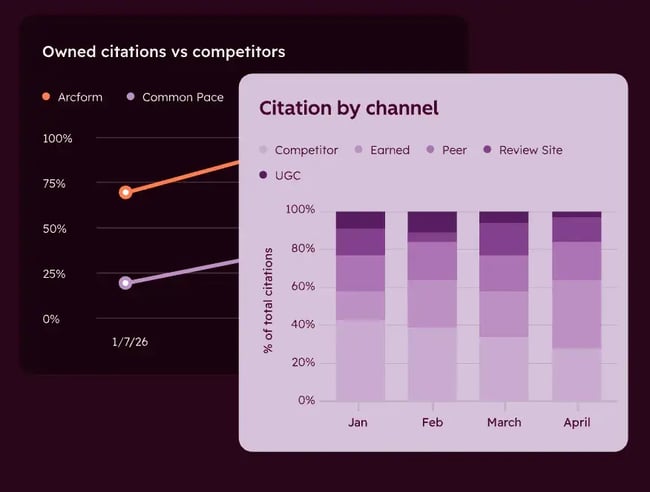
AI citation rate
AI citation rate measures how often your page or brand appears as a cited source in AI responses. A rising citation rate usually signals that content is well-structured, complete, and easy for AI systems to extract and reuse. Marketers and content teams use tools like to measure the brand’s citation rate.
Prompt coverage
Prompt coverage shows how many prompts trigger your content, which measures topical breadth. Strong on-page SEO expands prompt coverage because the page answers more variations of the same question. If coverage increases, your page is becoming more extractable. analyzes prompt coverage and points out the gaps marketers can close with on-page optimization.
AI share of voice
AI share of voice compares how often your brand appears in AI answers versus competitors. This reveals whether on-page optimization improves competitive visibility even before rankings shift. Track brand mentions in AI responses, competitor mentions, and citation position (primary vs. secondary source) using .
AI referral traffic (when available)
Some AI models pass referral traffic. This signal remains inconsistent, so it should not be the sole KPI. Many AI citations produce zero-click visibility. Referral traffic may come from:
- ChatGPT browsing
- Perplexity
- Gemini
- Copilot
- Claude
Tools for Monitoring On-Page SEO Success and AI Visibility
1.
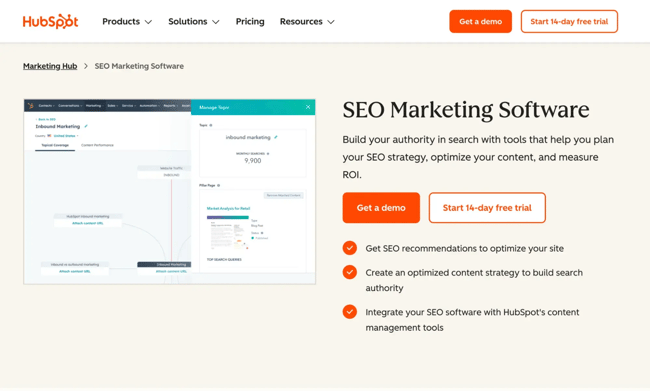
support SEO optimization, reporting, content workflows, and track on-page performance alongside content updates. With HubSpot SEO tools, marketers can monitor keyword visibility, topic cluster coverage, and get SEO and AEO optimization recommendations within the same workflow used to publish pages.
2.
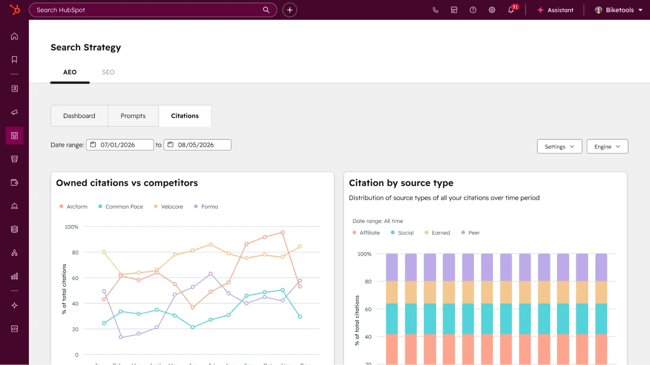
The evaluates how well your website and web pages are structured for AI ingestion. HubSpot AEO evaluates how your brand appears across answer engines — returning a visibility score, sentiment analysis, competitive positioning, and recommendations to improve your AI share of voice.
Marketers get a detailed overview of how leading answer engines represent their brand. HubSpot AEO also recommends improvements marketers can make to receive more citations.
Already on 糖心Vlog Hub Pro or Enterprise? is already included — with prompt suggestions informed by your CRM data, so recommendations are grounded in your actual business context from day one.
3.
is the primary source for measuring organic search visibility changes after on-page updates. It shows impressions, clicks, CTR, and average position at the URL level. This data helps confirm whether search engines interpret the updated content and begin surfacing it for additional queries. It also reveals indexing issues, crawl errors, and coverage gaps.
4.

measures what happens after users click. It shows landing page sessions, engagement rate, conversions, and behavior flow. This matters because on-page SEO should improve not only rankings but also usability and conversions. With Google Analytics, website owners can confirm whether structural changes reduce friction and improve interaction.
5.

tracks how often your brand or pages appear in AI-generated answers across platforms like ChatGPT, Perplexity, Claude, and Google AI Overviews. It monitors prompt-level visibility (i.e., which prompts trigger brand mentions) and citation frequency. Profound also analyzes prompts and context where competitors appear instead of you.
Put Your On-Page SEO to Work
On-page SEO is no longer just about placing keywords in the right fields. It is an ongoing work that helps search engines interpret your pages and AI platforms decide whether your content is clear enough to cite. That makes on-page SEO one of the highest-leverage growth levers on your site because it affects rankings, click-through rate, ROI, usability, and AI visibility at the same time.
Run your website through our on-page SEO checklist and make updates. Once you’re done, measure the result at the page level and check whether your brand is gaining visibility in AI-generated answers too.
HubSpot AEO is a useful next step. It shows how your brand appears across answer engines and helps you spot where clearer positioning or new supporting content can improve your AI share of voice.
On-Page SEO Template
Save time with content planning and rank higher on Google with the help of this beginner-friendly SEO template.
- Organize your on-page SEO strategy
- Coordinate pages and keywords
- Implement key SEO elements
- Track changes and results all in one place
Download Free
All fields are required.
Form not available
You're all set!
Click this link to access this resource at any time.

.webp)
![How to create a landing page with high ROI [+ expert and data-backed tips]](https://53.fs1.hubspotusercontent-na1.net/hubfs/53/%5BUse-2.webp)

![Signs it's time to redesign your website [+ 15 steps to follow]](https://53.fs1.hubspotusercontent-na1.net/hubfs/53/phaseswebsiteredesign%20copy.png)
%20(7).webp)

![How to start a blog (the right way) and write posts people actually want to read [+ free templates]](https://53.fs1.hubspotusercontent-na1.net/hubfs/53/how-to-start-a-blog-2.webp)
![What is a lead magnet? 20 lead magnet ideas and examples [+ step-by-step]](https://53.fs1.hubspotusercontent-na1.net/hubfs/53/lead%20magnet%20represented%20by%20a%20magnet.webp)