.png?width=112&height=112&name=Image%20Hackathon%20%E2%80%93%20Horizontal%20(58).png)
A while back, I signed up to “learn more” about a certification in AI from a name-brand university. I wasn’t ready to enroll, but I was curious; their landing page promised additional details if I provided my email address.
So, I opted in for more information. What I got instead? A once-a-week barrage of “Enroll now!” emails. Like clockwork. No additional info on the professors. No sneak peek at the coursework. Nothing about what kinds of students take it or what the certification might actually do for my career. Just the same call-to-action (CTA), over and over.
At first, I was mildly annoyed. By week five, I was actively deleting the emails. And by week eight? I’d ghosted them (I didn’t even care enough to unsubscribe). This, friends, is what happens when lead nurture becomes lead nagging.
In this post, I’ll show you how to do better. How to build nurture emails that inform, engage, and guide people forward without overwhelming them. Whether your audience is just starting their research or nearly ready to buy, great nurture emails meet them where they are and help them take the next step.
Let’s dig in.
Table of Contents
- What is a nurture email?
- 9 Tips for Crafting Lead Nurture Emails That Actually Nurture
- 21 Lead Nurturing Email Examples to Inspire Your Strategy
What is a nurture email?
A nurture email is a strategic message designed to build a relationship with a lead over time, not rush them into a sale. It delivers timely, relevant content that educates, inspires, or solves a problem, guiding the reader closer to conversion without pushing too hard. In truth, just about any email you send should nurture your subscribers in this way.
Think of it as the digital equivalent of a helpful nudge, not a cold call in email form.
9 Tips for Crafting Lead Nurture Emails That Actually Nurture
Let’s be honest: A lot of what passes for “lead nurture” today is more like inbox loitering. You’ve got a form fill, a follow-up series, and … well, that’s about it. The emails go out on autopilot, but the lead? Drifting away quietly like a bad first date.
Nurturing isn’t just sending emails. 滨迟’蝉 building momentum. You’re guiding, offering value, earning trust; not just keeping your name in their inbox until the SDR calls. So if your nurture emails are underperforming, or if you’re not sure what “good” looks like, here are nine practical, proven tips (with resources to learn more!) to step up your strategy.
1. Start with strategy, not a template.
Yes, I know it’s tempting to Google “lead nurture email template.” But before you even touch the keyboard, ask:
- What funnel stage are you targeting?
- What’s the bottom-line goal of this series?
- What does success look like?
Too many brands skip the planning stage and go straight to “Here’s a white paper, please download.” But if you don’t define the audience, message, and metrics, you’re just sending nice-looking noise.
Resource:
2. Write like you actually know them.
A nurture email shouldn’t feel like it was written by a committee, or a chatbot with a quota. Use what you know about the person and tailor accordingly:
- Mention their industry or job title if you have it.
- Reference what they downloaded or clicked.
- Use a tone that matches the funnel stage (friendly intro vs. confident advisor).
True personalization isn’t {FirstName}. 滨迟’蝉 relevance. And yes, that requires actual customization based on data.
Resource:
3. Add value before you ask for anything.
Let me say this clearly: The goal of lead nurture is not to schedule a demo in every email. 滨迟’蝉 to deliver so much value that they want to learn more. Give them:
- A practical checklist or template.
- A short, scannable how-to.
- A stat they can use in a meeting today.
Resource:
4. Don’t bury the lede (or the CTA).
If you want them to download the white paper or register for the webinar, say it. Early. Clearly. Once. Maybe twice. But skip the six-paragraph backstory. This isn’t a TED Talk. 滨迟’蝉 a nurture email.
Pro tip: Your CTA should be above the fold and at the end of the email. Repetition helps, especially if your reader is skimming between Zoom calls and Slack pings.
5. Space out your sends with purpose.
Cadence is a nurture series’ secret weapon. Too fast, and you’re annoying. Too slow, and you’re forgettable. Here’s a starter cadence I recommend:
- Day 0: Trigger email based on behavior.
- Day 3: Follow-up with related content.
- Day 7: Bring in a new angle or resource.
- Day 14+: Move toward a conversion (demo, trial, etc.).
Use engagement signals to speed up or pause efforts; don’t just send every 48 hours on a rigid schedule. That’s not nurture. That’s spam with better intentions.
Resource:
6. Use data to prioritize (and prune).
Not every lead is created equal. Some are hot, some are not, and some just like your free content. Lead scoring + email engagement = your best bet at figuring out where to focus.
Also, prune your list. If someone hasn’t opened a single email after six sends, stop pestering them. Or better yet, send a re-engagement email that says:
“Still interested in [solving X]? If not, we’ll step back. No hard feelings.”
Resource:
7. Stop treating “unsubscribes” like a bad thing.
If someone opts out of your nurture series, that’s not a fail; that’s focus. 滨迟’蝉 one less person your sales team has to chase. And one more signal about who’s actually a fit for what you sell.
Bonus: It improves your deliverability and keeps your metrics clean. Embrace the unsubscribe. 滨迟’蝉 spring cleaning for your CRM.
8. Make it feel human (because it should be).
If your email sounds like it was written by legal or a marketing robot, your lead will treat it accordingly: archive or delete.
Let your brand voice show. If you’re conversational on LinkedIn, don’t suddenly sound like a finance textbook in email. You can be professional and personable.
9. Measure what matters.
Opens are nice. Clicks are better. But if your nurture series isn’t ultimately driving:
- Trial signups
- Demo requests
- Pipeline and revenue
… it’s just expensive brand awareness. Make sure you’re connecting email performance to business outcomes, and optimizing based on that, not vanity metrics.
Resource:
Final Word: Nurture like you mean it.
Lead nurture done right builds trust, offers value, and moves people forward, even if that “forward” is just bookmarking your name for later. Done wrong, it’s just noise.
So let’s aim higher. Write emails people want to read. Test your timing. Track what matters. And if you’re ready to upgrade your nurture game, start with these:
Because “lead nurture” shouldn’t feel like a slow fade. It should feel like a thoughtful, strategic, well-timed conversation.
Email Newsletter Guide
In-depth research on how to create a revenue-driving newsletter.
- Newsletter ad sales.
- Paid acquisition.
- Newsletter structure.
- And More!
Download Free
All fields are required.
Form not available
You're all set!
Click this link to access this resource at any time.
21 Lead Nurturing Email Examples to Inspire Your Strategy
Here are lead nurturing examples that you can refer to and review while developing your emails. I’ve organized them as follows:
- B2B
- B2C
- 糖心Vlog
- Holidays
- Special Cases
But here’s a pro tip: Almost any email can be a nurture email.
Whether you’re following up on a document download, trying to re-engage subscribers who have ghosted you, or just sending a seasonal note, the goals are the same: build trust, offer value, and move the relationship forward. These examples span different industries and audiences, but no matter what kind of nurture email you’re planning, you’ll find lessons in all of them.
So review the ones in your category, but don’t stop there. Steal a content idea from a B2C cart-abandonment email, borrow a CTA from a B2B financial message. Let them cross-pollinate. Nurture is a mindset, not a format.
B2B Lead Nurturing Email Examples
1.
Assessment: Calculator follow-up with personalization and testimonial.
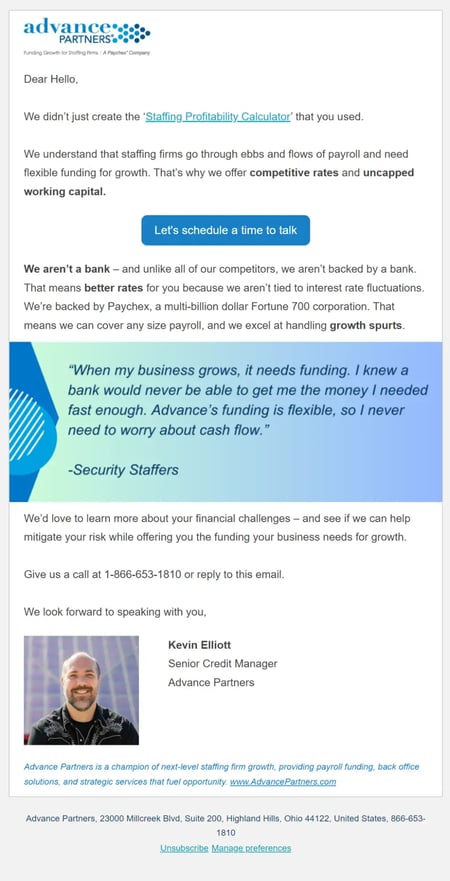
What the email does: This B2B nurture email from Advance Partners is a follow-up to a calculator tool, triggered after a lead uses the “Staffing Profitability Calculator.” It aims to convert that interest into a conversation by positioning Advance Partners as a flexible, non-bank funding source that understands the realities of staffing firms.
Why this works:
- Behavior-based trigger = smart timing. The email is clearly part of a lead nurture flow based on content interaction, a great example of using engagement as a signal to move a prospect further along the funnel. This isn’t a cold blast; it’s contextual and relevant.
- Clear, value-focused copy. The message gets to the point: Staffing firms face payroll volatility, and Advance Partners helps with funding. There’s no fluff, just a few bolded phrases that reinforce the offer (flexible capital, not a bank, no cap on working capital).
- A real photo and name humanize the CTA. Having Kevin’s face and name at the end makes the pitch feel more like a helpful outreach than a generic sales push. The testimonial in the middle reinforces this tone with a peer voice.
- The “we aren’t a bank” angle is differentiated. Especially in financial services, that’s a strong positioning statement; Advance leans into what makes them different without overexplaining.
Where it could be even better:
- Personalization feels incomplete. The greeting says “Dear Hello,” which immediately undercuts the otherwise sharp targeting. If you’re going to use a dynamic field, it needs a fallback that doesn’t call attention to itself. Even “Hi there” would be better.
- The testimonial is visually awkward. 滨迟’蝉 good to include a quote, but the design could be cleaner. The font and box feel a little disconnected from the rest of the email, and it doesn’t read as part of a well-designed user journey. A headshot or company name would also increase credibility.
- No reinforcement of the tool value. The email opens by referencing the calculator, but doesn’t connect it back to the offer. For example: “Now that you’ve seen how your profitability stacks up, let’s talk about how to improve it with flexible capital.” That would tie the CTA more directly to the user’s action.
- Dual CTAs compete. The email has both a “Schedule a time to talk” button and a “Call or reply” ask later. 滨迟’蝉 okay to have options, but right now they feel a bit scattered. One unified CTA, supported by a “prefer to call?” secondary option, would be cleaner.
Key takeaway: This is a strong example of behavior-based B2B nurture, following up with leads based on what they’ve already shown interest in. 滨迟’蝉 human, clear, and well-timed. With just a little tightening on personalization and visual design, it could go from solid to standout.
2.
Assessment: Good content, but who is it for?
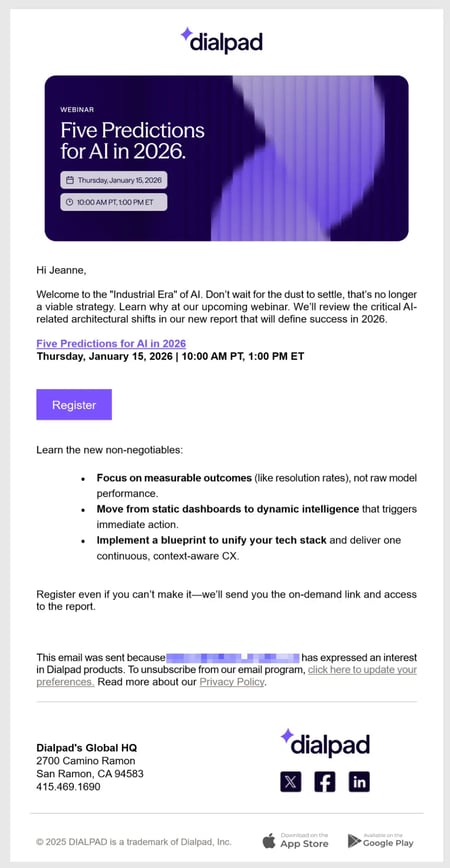
What the email does: This message invites the recipient to a webinar on “Five Predictions for AI in 2026.” The layout is clean, the copy is tight, and the focus is clear: Register for the webinar, and you’ll get insight into future-proofing your tech stack with AI. There’s even a soft fallback CTA: “Register even if you can’t make it, we’ll send you the recording.”
Why this works:
From a pure email mechanics perspective, this email checks a lot of boxes.
- The design is clean and scannable, with clear visual hierarchy.
- The event details are front and center — date, time, topic, CTA.
- The bullet points spell out concrete takeaways, which help convince the reader that the session will be worth their time.
- Bonus points for the “register anyway” reassurance, which removes a common barrier to conversion.
In isolation, it’s a solid promotional email. But as part of a nurture journey? There’s a missing layer.
Where it falls short:
Here’s one problem — I didn’t opt in. I hadn’t heard of Dialpad until I received this email. And while the content sounds timely, I had no idea what Dialpad does.
That’s the gap. The email tries to deliver value, but without context or connection, it feels more like a cold call in inbox form than a natural next step in a nurture flow.
If you’re going to promote a webinar as part of your lead nurture, you need to:
- State who the webinar is for. Is this for support leaders? IT execs? Customer experience teams? The email doesn’t say.
- Tie it to the brand’s expertise. “Dialpad helps X teams do Y with Z. This webinar shares trends we’re seeing based on that work.” Instead, you’re left to guess or, as in this case, click through only to discover you’re not the target audience after all.
- Qualify your leads before you nurture. If someone like me isn’t a fit, why am I getting this email? A webinar invite is a strong CTA; it assumes familiarity or high relevance. Without either, it falls flat.
Key takeaway: Even well-designed emails can miss the mark if the context isn’t clear and the audience isn’t qualified. Before asking for time or attention, make sure the reader knows who you are, what you do, and why they were invited. Otherwise, you’re nurturing the wrong people, or worse, annoying them.
3.
Assessment: Valuable insight, but the CTA gets lost.
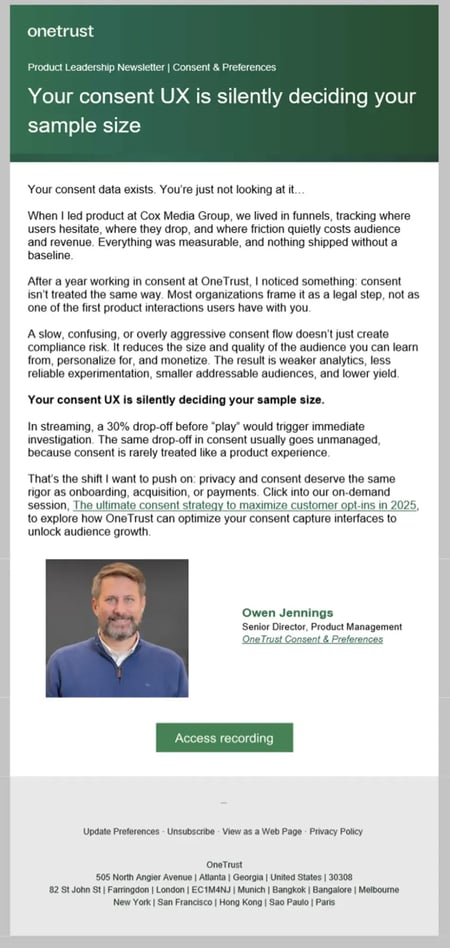
What the email does: This email from OneTrust frames a thoughtful argument: Your consent UX directly impacts your data sample size, and therefore your business outcomes. The sender uses personal experience and strong B2B logic to elevate consent from a legal obligation to a product experience. There’s also a link to an on-demand recording buried mid-paragraph and repeated as a button at the bottom.
Why this works:
There’s a lot to like in terms of message quality and subject matter expertise:
- Strong point of view. The narrative is clear: Friction in your consent flow is silently hurting performance. That’s a compelling, overlooked idea and well-suited to OneTrust’s audience of product leaders and data/privacy stakeholders.
- Author credibility. The email is signed by a senior director, complete with a photo and title, adding authority and a human touch that works well in B2B.
- Concept-led, not product-led. The content is framed around a problem the reader should care about, not just the product OneTrust wants to promote. That builds trust and thought leadership.
Where it could be even better:
The email buries its strongest CTA, and that’s where it stumbles:
- The on-demand session is the lead, but it’s buried. Right now, the “Access recording” button appears way at the bottom, and the first mention of the session is embedded in a paragraph mid-way through the email. 滨迟’蝉 too easy to miss.
- No visual cue that this is a video. A screenshot thumbnail with a play icon would immediately signal that there’s watchable content and help drive clicks. Right now, “on-demand recording” looks like fine print, not a compelling offer.
- Long intro slows the pacing. The personal anecdote is solid, but it takes 3+ paragraphs to get to the actual insight or benefit. A sharper lead that hints at the takeaway (or references the recording) could hold more attention.
- No real personalization or segmentation. There’s a missed opportunity to reference what the recipient has done before (e.g., signed up for a webinar, leads product, opted into consent guidance). Even light segmentation, by role or vertical, could make the messaging tighter.
Key takeaway: If your nurture email is built around a high-value content asset (like an on-demand webinar), don’t bury the lede. Lead with the value, show it visually, and make the CTA unmistakable. This email nails the message, but hides the action, and that can cost you clicks.
B2C Lead Nurturing Email Examples
4.
Assessment: Story-driven with empathy and authority.
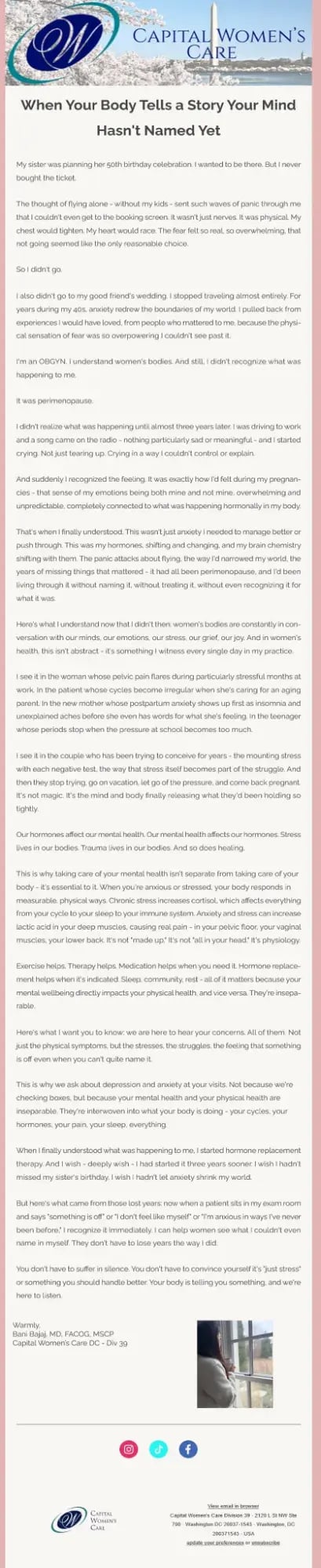
What the email does: This email opens with a deeply personal story from a physician, a moment of vulnerability and reflection around missed milestones, unexplainable panic, and the eventual realization that perimenopause was at the root of it all. The piece then transitions into education and reassurance for readers experiencing something similar, ending with a gentle reminder: You’re not alone, and we’re here to help.
Why this works:
This is empathetic storytelling at its finest, and it’s exactly the kind of message that builds long-term trust, especially in healthcare marketing, where vulnerability is often met with clinical detachment.
What this email does especially well:
- The story feels real. 滨迟’蝉 not some polished testimonial; it’s a physician sharing her own fear, confusion, and hindsight with honesty.
- It educates while validating. The email connects physical symptoms to emotional responses in a way that feels both human and medical, an important bridge for readers struggling with “invisible” issues.
- The message is generous. There’s no sales push, no overt self-promotion. Just help. Just listening. That makes it a textbook example of nurturing through support instead of sales.
Design-wise, the email is long, but white space, short paragraphs, and clear section breaks make it surprisingly easy to skim. It feels like a letter, not a wall of copy.
Where it falls short:
滨迟’蝉 powerful, but it’s long. Really long. There’s a tipping point where even the most beautifully written email starts to lose readers simply because of the scroll.
A few gentle edits could improve scannability without compromising the message:
- Pull a few key insights into subheads or callouts (e.g., “It was perimenopause,” “Our bodies hold stories,” “You’re not alone.”).
- Consider a clear CTA, not to sell anything, but to offer a follow-up: a guide, a resource, or even a page about perimenopause symptoms. Something that gives the reader a next step if they’re ready.
- The intro is powerful, but it takes a long time to get to the “why you’re receiving this email.” A stronger hook or even a brief summary up top might help orient the reader.
Key takeaway: If you want your nurture emails to feel supportive, start by being human. Storytelling like this builds trust. But to keep attention (and guide action), pair your vulnerability with clarity, brevity, and a path forward.
5.
Assessment: Short, direct, and risk-free.
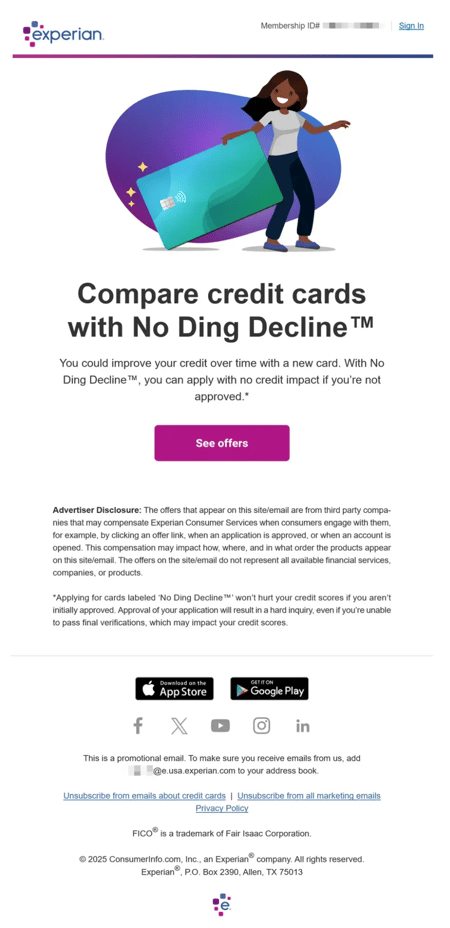
What the email does: This nurture email from Experian offers their “No Ding Decline?” feature, a way to compare credit cards without harming your credit score if you’re not approved. This is free to use; Experian’s real goal is to get you to purchase credit monitoring services. The design is simple, the message is clear, and the CTA (“See offers”) is right there, ready to click.
Why this works:
Let’s give credit where it’s due (pun intended): This is a tight, well-targeted piece of email marketing.
- 滨迟’蝉 short — no fluff, no scroll fatigue.
- 滨迟’蝉 benefit-forward. “Compare cards with no credit impact” is the kind of promise that grabs attention.
- It anticipates friction — and addresses it head-on. People worry about getting dinged when they apply for credit, and this email neutralizes that anxiety in the headline and supporting copy.
Also worth noting: The CTA is strong and unambiguous. “See offers” tells the reader exactly what’s next, and what they’re not committing to yet. That’s a smart move for a nurture-stage audience still in the research phase.
Where it falls short:
The email is crystal clear, but also a little sterile. There’s no context for why this message is showing up now. Is it tied to the user’s recent credit activity? Is there a seasonal reason to explore new cards (back to school, holidays, new year, etc.)? Without that, it feels like a one-off promo rather than a step in an intentional nurture sequence.
Also, the illustration is … fine. But, it doesn’t communicate trust or professionalism. It leans a little too generic for something as personal (and high-stakes) as credit. A photo or even a testimonial quote might have given it more credibility.
Key takeaway: A short email can still pack a punch, especially when it removes friction and offers a clear, low-risk next step. But even in short-form, don’t miss the opportunity to anchor the message in context and connect emotionally with your audience. That’s what turns a click into a conversion.
6.
Assessment: Educational, not pushy.
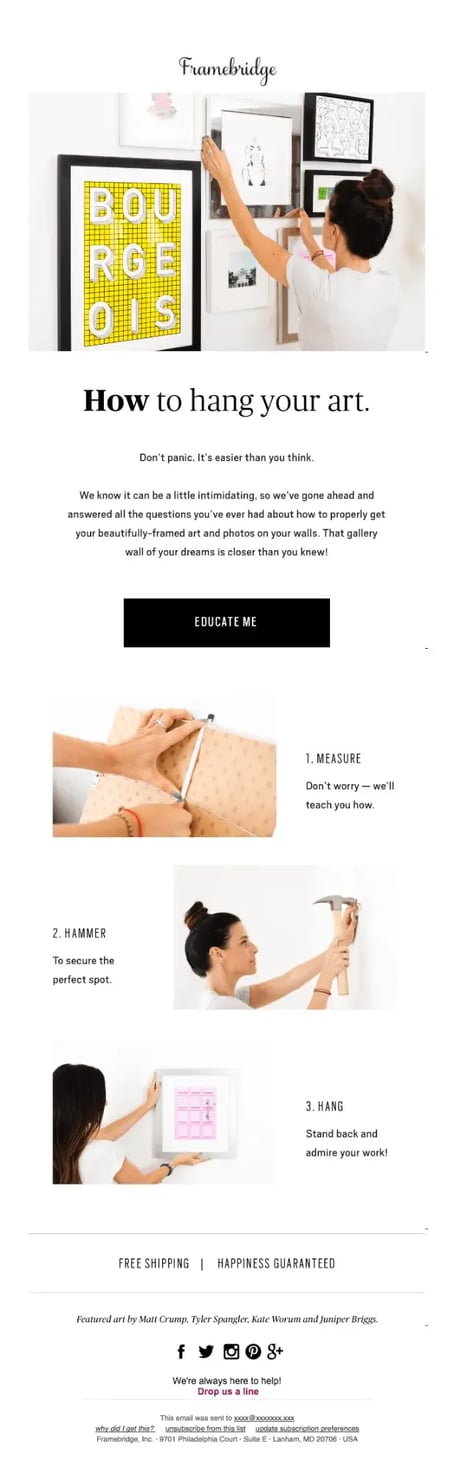
What the email does: Framebridge sends a nurturing email that doesn’t lead with a sales pitch. Instead, they teach the reader something useful, in this case, how to hang art in your home. That’s smart because it gives value first, without asking for a purchase right out of the gate.
Why this works: This email is a great example of education-based nurturing. It provides practical tips the reader can use immediately, which builds trust and positions Framebridge as an expert, not just another shop asking for your credit card. Value-first content like this keeps leads engaged longer, and often pulls them further down the funnel over time. 滨迟’蝉 exactly the kind of email that feels helpful instead of sales-y, and that means more opens and clicks in future sends.
Where it falls short: That said, there’s a missed opportunity here. While educating people on how to hang their art is a genuinely valuable topic, there’s no direct tie-back to Framebridge’s core service, which is framing. A subtle CTA such as “See how pro framing enhances your art” or “Find the perfect frame for your piece” could bridge the gap between teaching and conversion. Without that nudge, the reader gets the value but not the next step toward Framebridge’s solution.
Key takeaway: Value-first emails like these earn attention, just make sure you connect the dots back to your brand’s value proposition. Nurturing isn’t just about being nice; it’s about strategically moving people closer to a decision.
7.
Assessment: Clever, on-brand engagement that nurtures loyalty.
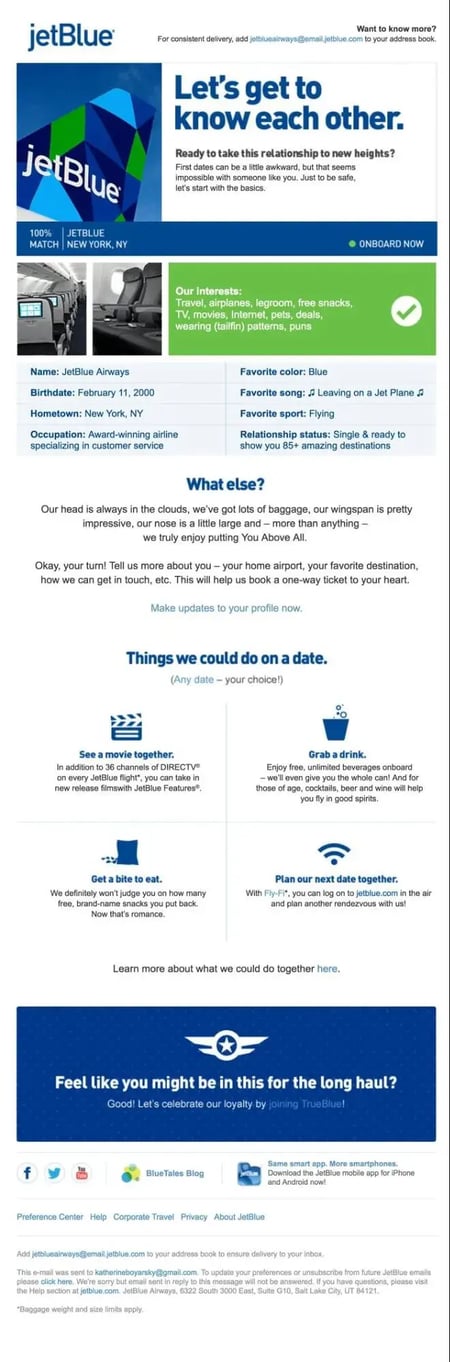
What the email does: JetBlue’s nurture email leans into playful, witty copy and a friendly tone to reinforce its brand personality, while subtly pushing readers toward joining its TrueBlue loyalty program. The message isn’t a hard sell. It feels like a conversation with a friend who happens to have some travel tips and perks to share.
Why this works:
JetBlue is excellent at using voice and tone as a nurturing tool rather than a hard sell. Instead of simply saying “join our program,” they engage and entertain with puns, useful travel info, and personality. All help keep the reader reading. The copy reflects the airline’s broader customer?obsessed brand positioning, which makes the email feel authentic and on purpose.
A few things this email gets right:
- Personality carries the message. JetBlue doesn’t just tell you about TrueBlue. They make the journey fun, which is exactly the emotion people want when they think about travel.
- Brand alignment. Humor and helpfulness fit what long?term flyers expect from JetBlue, so this email strengthens the relationship rather than feeling random.
- Nurture, not pressure. Rather than a hard CTA to buy flights immediately, the goal here is subtle: deepen loyalty and remind leads about the benefits of joining or engaging with the brand.
Where it falls short:
The email assumes familiarity with JetBlue and its loyalty program, which works great for existing customers, but as a true nurture message, it could do a better job of contextualizing why non?customers should care.
- A line or two reminding the reader what TrueBlue actually gives you (e.g., points toward free flights, perks, partner benefits) would make the value proposition clearer for new leads.
- A secondary CTA like “See how TrueBlue works” or “Compare your rewards options” could help bridge the gap between casual engagement and actual program signup.
Key takeaway: This is a great example of brand?centric nurture using voice, humor, and personality to strengthen affinity and make the brand feel like a thoughtful companion rather than a corporation. But when your audience includes true leads who haven’t yet transacted, pairing that voice with a clear value proposition helps the nurture message move beyond charm and toward conversion.
Lead Nurture 糖心Vlog
8.
Assessment: Strategic content, clear voice, smartly packaged.

What the email does: This edition of my Email Optimization Shop newsletter is a round-up of timely email marketing insights, content previews, upcoming events, and one smart promotional offer (50% off online training). 滨迟’蝉 a high-value, high-frequency touchpoint, a good example of nurture that’s useful, relevant, and unmistakably “me.”
Why this works:
There’s a lot here from both a strategy and execution standpoint:
- Clearly defined sections. My team has chunked content so readers can easily scan and pick what matters to them. No wandering paragraphs or mixed CTAs.
- Strong editorial voice. My practical, slightly wry, never-fluffy voice and tone are present throughout. I want to sound like a trusted expert, not a broadcaster.
- Cross-channel continuity. My goal is to build synergy between my blog, training, newsletter, and community sessions (e.g., “Let’s Talk Email”), which is exactly how nurture should work.
- Timeliness + urgency. The 50% training promo is well-placed and well-framed. 滨迟’蝉 not pushy, just smart (“give your 2026 team a head start” is gold).
From a nurture lens, this email does the job of deepening connection with existing subscribers and gently nudging toward deeper engagement via conversation, training, and consulting work.
Where it could be even better:
I’m never really satisfied whenever I review something I’ve done. I always see ways to refine it, so …
- 滨迟’蝉 a bit long. With this much content, we should consider adding a brief editor’s note or table of contents at the top, so the reader knows what’s inside before committing to scrolling. We’ve got 8+ different content paths here. We should guide the reader a little more.
- Visual pacing could be even stronger. We’ve done a nice job with white space, but because every section uses the same visual format (header > image > text > link), it starts to feel like a scroll marathon. I’m going to talk to the team about:
- Highlighting one story as a “feature” with a colored background.
- Turning the training offer into a mini-banner.
- Making the “Let’s Talk Email” section pop with bolder formatting.
Key takeaway: We’re doing exactly what great nurture should do: showing up regularly, offering value without requiring a purchase, and gently inviting deeper engagement. A little tightening in format and CTA structure would make this even easier to digest, especially for time-starved readers scrolling on mobile. But content-wise? Rock solid (IMHO).
9.
Assessment: Friendly relationship-building in action.
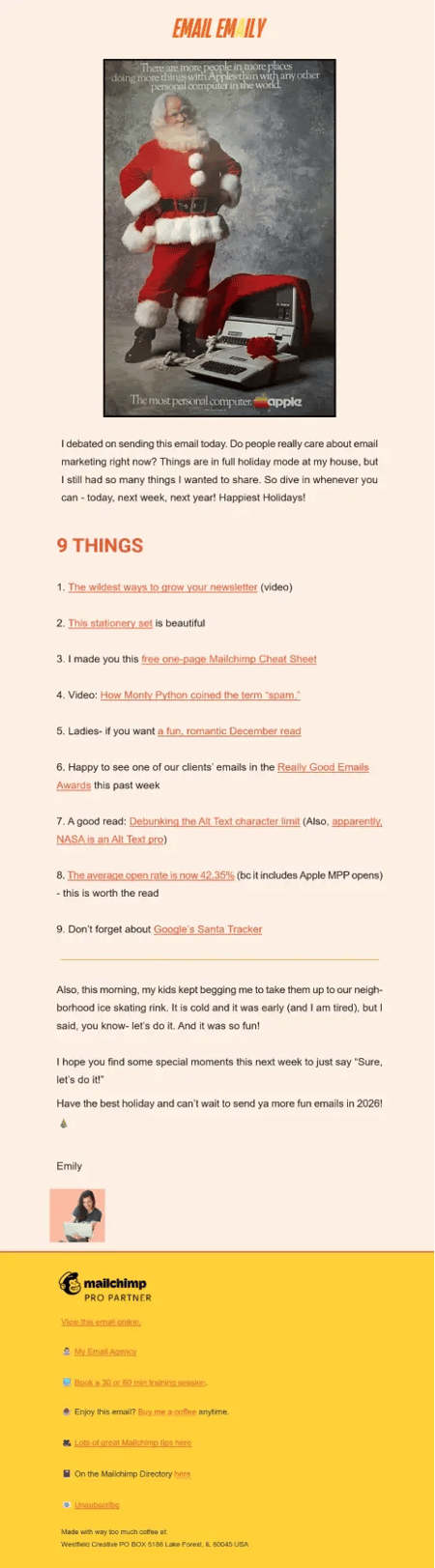
What the email does: This message from “Email Emily” leans all the way into relationship-driven nurture. It opens with a warm personal note, includes a festive throwback ad for Apple, and delivers a nine-link list of business and personal goodies, from a Mailchimp cheat sheet to a romantic December read. 滨迟’蝉 part newsletter, part digital stocking stuffer, part gentle invitation to connect further.
Why this works:
Emily nails the tone. This is relationship-based nurture at its best: friendly, human, full of value, and sent with no hard pitch. You don’t feel like she’s trying to “convert” you. Instead, you feel like she’s trying to help (or just make you smile).
A few specific things this email does really well:
- Personal touches like the story about skating with her kids build warmth and trust.
- The content mix blends business and life, a classic value-first approach.
- The design is clean and very skimmable, with white space, clear hierarchy, and no cluttered CTAs shouting over each other.
This kind of email keeps leads engaged, even if they’re not ready to buy. And it builds brand affinity in a way no sales sequence can.
Where it falls short: That said, it’s a little too easy to forget why this email showed up in your inbox. The content is solid, but the positioning is vague. There’s no preheader or intro sentence reminding you who Emily is, what her expertise is, or why you should trust her email advice.
Also, some of the content leans very far into the personal lane. A couple fun links? Great. But nine loosely connected items plus a family anecdote can leave readers unclear on the value prop. If this is supposed to be a nurture series for an email marketing consultant or agency, then the “hire me” or “learn more” links shouldn’t be buried in the footer. A pre-footer CTA like:
“Want help with your email strategy? Book a session with me here.”
… would clarify the relationship without compromising the friendly tone.
Key takeaway: A warm, relationship-driven tone is a powerful nurture tool, especially when paired with true value-add content. Just make sure your reader knows who you are and what you offer without having to scroll all the way to the footer. Otherwise, it’s a fun email, but not a functional one that nurtures.
Special Case Lead Nurturing Email Examples
10.
Assessment: Cart abandonment with the right idea, slightly misapplied.
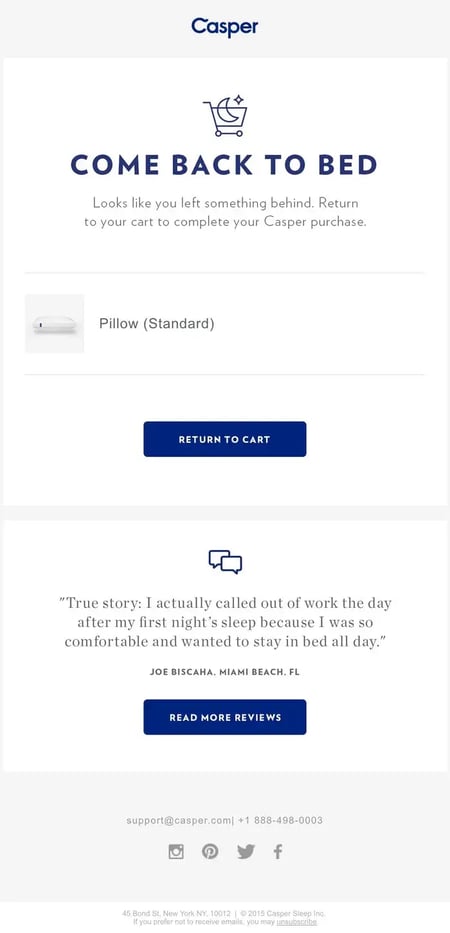
What the email does: This message lives inside a cart abandonment nurture, which is a very sticky, very specific form of nurture. The goal here is conversion right now, not long-term education. Casper leans on a testimonial to reassure the shopper: Someone else liked their product, so maybe you will, too.
Why this works: Using a testimonial in cart abandonment is smart. It gives the reader a quick “proof point” that the product they’re considering actually satisfied someone else. From a psychological standpoint, that’s exactly what hesitation needs: a nudge from a peer?voice rather than a brand voice.
Where it falls short: But, and here’s the crux, the testimonial isn’t specific to the item in the cart. If I left a pillow in my cart, showing me a generic Casper review about a mattress sleep experience doesn’t feel super relevant. Relevance matters, especially at the moment someone is about to buy.
And then there’s the CTA: a prominent button leading to more reviews. That’s a classic rabbit hole. Instead of moving the sale forward, I can easily disappear down a review scroll-fest, forgetting about my abandoned cart altogether.
A more helpful, purchase-friendly CTA would keep the reader focused on making the choice easier, for example:
- Link to the FAQ about pillow performance and sizing.
- A quick note about the return policy or trial period.
- A comparison chart showing which pillow is right for what kind of sleeper.
Any of these would feel more aligned with the immediate decision the reader is facing, and less like a detour to browse more opinions.
Key takeaway: Testimonials absolutely have a place in nurture emails, especially cart abandonment, but their impact depends on relevance and context. Don’t just throw in social proof; make sure it’s tightly connected to what the reader is considering, and pair it with a CTA that helps the reader make the decision, not distracts them from it.
11.
Assessment: Social proof to push toward purchase.
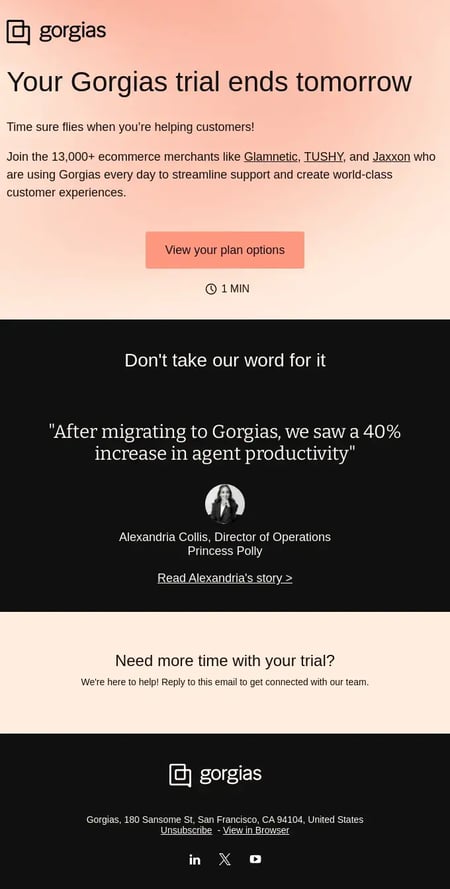
What the email does: This Gorgias email is clearly part of a free trial nurture series, and it knows exactly what job it’s there to do: reduce hesitation and drive conversion before the clock runs out. The subject line sets the urgency (“Your Gorgias trial ends tomorrow”), but the body of the email leans heavily on social proof, not panic.
Why this works:
Gorgias smartly stacks multiple layers of credibility in a single message:
- They highlight scale, “13,000+ ecommerce merchants.”
- They name recognizable brands (Glamnetic, TUSHY, Jaxxon).
- They include a testimonial with a concrete outcome, “40% increase in agent productivity.”
- They attribute that quote to a real person, with a name, title, company, and headshot.
All of this reassures the reader that people like them, and brands they likely recognize, have already made this decision and benefited from it. In a trial-ending moment, that’s exactly the right message. This isn’t about education anymore; it’s about confidence.
Where it falls short: While the social proof is strong, the email doesn’t quite connect the dots between the testimonial and the reader’s specific experience during the trial. The reader is left to infer how the “40% increase in agent productivity” might map to what they’ve already done inside the platform. A brief line reinforcing what they’ve already accomplished (“You’ve already handled X tickets faster” or “You’ve seen how Gorgias centralizes support”) could make the message feel more personal and less generic.
Key takeaway: When a nurture email is part of a free trial sequence, its role shifts. Education takes a back seat, and validation takes over. Social proof, especially quantified results and recognizable brand names, is one of the most effective ways to nudge a trial user toward a purchase. Just make sure you also reflect the user’s own experience back to them, so the proof feels personal, not just impressive.
12.
Assessment: Feature-driven re-engagement with education.
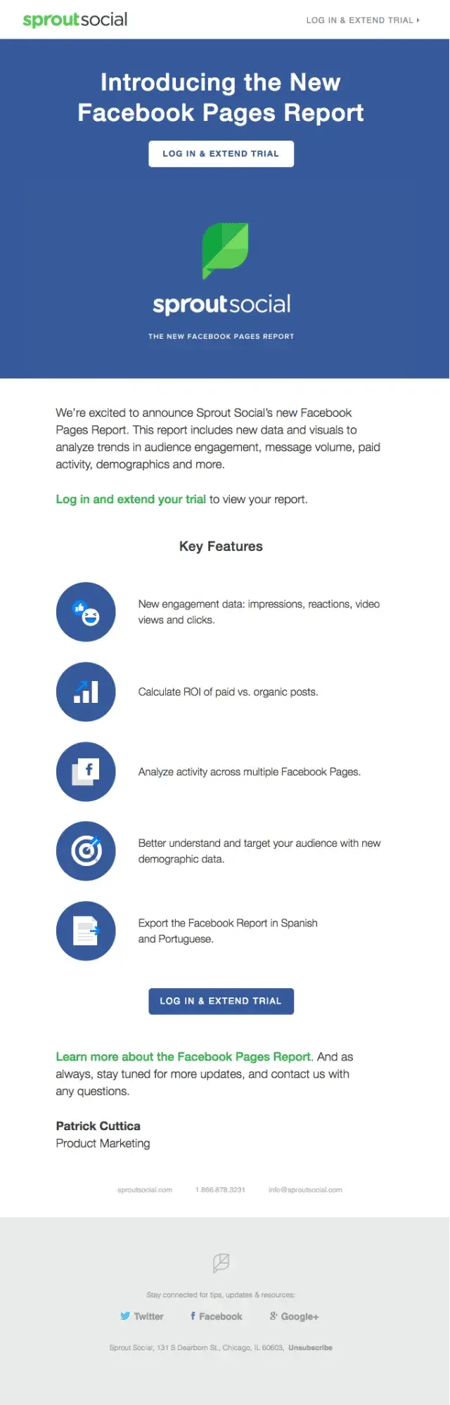
What the email does: Sprout Social uses this message to re?engage leads who have shown interest but haven’t fully activated or converted yet. It highlights a new feature in the product, shares educational details about what the feature does, and gently reminds the reader that their trial is expiring soon. The goal is to inspire interest through value and education rather than pressure with a hard sell.
Why this works:
This is a solid example of nurture through product value and education, especially effective in a B2B context where prospects need more than one touchpoint to understand real value.
- Feature focus adds relevance. Instead of a generic “come back,” Sprout Social uses a specific new capability to create a reason for engagement. It gives the reader a concrete thing to learn about.
- Education before transaction. By explaining what the feature is and how it works, the email positions Sprout Social as a partner in the lead’s success, not just a vendor asking for money.
- Trial reminder adds context. Reminding the reader that their trial is ending is a smart way to create gentle urgency, paired with the value element rather than as a blunt sales push.
This combo of feature?driven education plus lifecycle context makes the email feel helpful instead of salesy, which is critical in longer B2B nurture journeys.
Where it could be even better:
There’s a strong foundation here, but the email could level up with a bit more personalization and segmentation.
- Tie the feature to user behavior. If Sprout Social knows what a lead has already explored or struggled with during their trial or browsing, linking the feature directly to that experience would make the email feel even more tailored and relevant.
- Clear next step. Education is great, but pairing it with a specific CTA that bridges learning to action, like “See the feature in your dashboard” or “Watch a quick demo tailored to your use case,” would reduce friction for the reader ready to move forward.
Key takeaway: Highlighting new features can be a powerful form of nurture, especially when paired with timely context like an expiring trial. The key is to make the value crystal clear and tie it back to what the lead has already shown interest in. That turns a product update into a relationship builder.
13.
Assessment: Honest outreach with a secondary CTA.
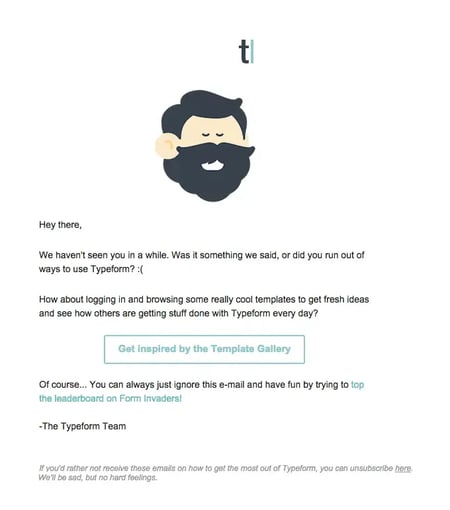
What the email does: Typeform sends an email to lapsed or inactive users, folks who signed up or showed interest but haven’t been actively engaging with the product. Instead of a hard sell, the message is relatable and straightforward about why they’re reaching out, and it invites recipients to check out something engaging (like their leaderboard) without pushing them immediately back into a paid plan.
Why this works:
This email is a textbook example of soft, human-centric nurture that doesn’t rely on heavy incentives or big promotions.
- Relatability over pressure. Rather than guilt-tripping the reader into action (“We miss you, come back!”), Typeform acknowledges inactivity honestly and uses that as the starting point for the conversation. That feels respectful, not nagging.
- Secondary engagement option. The inclusion of a leaderboard as a secondary CTA is smart because it gives an alternative path, something fun or intriguing, that isn’t about a purchase or upgrade. This kind of low?commitment interaction can re?spark interest on the user’s terms.
- Trust?building tone. By being honest about why they’re reaching out (“we noticed you haven’t been active”), the email avoids the awkward sales pitch that a lot of re?engagement emails fall into. It positions Typeform as curious rather than desperate.
Where it could be even better:
Even though the tone is refreshingly human, there’s a missed opportunity for personalization.
- No reference to past behavior. There’s no hint of what the user did before, what type of forms or surveys they built, or even why they might have gone quiet. A simple line like “We saw you started a survey about X…” or “When was your last form published?” would make the message feel truly tailored rather than generic.
- Leaderboard isn’t clearly tied to the user. A leaderboard can be fun, but why should I care about it? If it showed relevant metrics (e.g., “See how your forms compare to others in your industry”), it would feel less like a sidebar and more like a value?driven hook.
- Missing a clear next step toward value. A CTA to “Check your forms” or “See tips to improve responses” could pair nicely with the leaderboard link, giving the user both a quick diversion and a practical reason to re?engage with Typeform’s core product.
Key takeaway: Lapsing leads don’t always need a discount or aggressive outreach. Sometimes, a relatable, honest note coupled with a fun or low?pressure CTA is enough to bring someone back into the fold. But make sure the hooks you choose are relevant to the individual. Otherwise, they risk feeling interesting but irrelevant.
14.
Assessment: Personalized activation and support guidance.
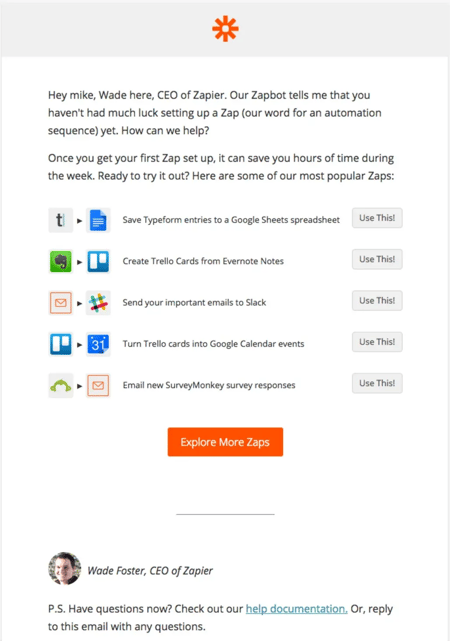
What the email does: Zapier sends a gentle, personalized activation email to users who have signed up but haven’t yet created an automation (“Zap”). It notes the specific behavior (or lack of it), offers helpful resources, and even closes with a personal sign?off from the CEO, complete with a headshot, to humanize the brand and lower the activation barrier.
Why this works:
This email hits several lead?nurturing sweet spots all at once.
- Personalization is front and center. The message explicitly acknowledges that the user hasn’t set up a Zap yet. That’s not creepy tracking, it’s intelligent tailoring that makes the email feel relevant, not random.
- It offers help, not guilt. Instead of saying “You signed up but haven’t done anything,” Zapier focuses on value and support:
- Quick links to help documentation.
- Suggestions for exploring pre?built Zaps.
- Lightweight guidance that meets the user where they are/
- This is classic nurture: Remove friction first, then invite action.
- The CEO sign?off humanizes the brand. Including a headshot and personal sign?off, especially from a founder or executive, makes the message feel like a note from a real person, not a broadcast. It builds trust and reminds users there’s a team behind the product who cares about their success.
Where it could be even better:
While this email is strong, a few refinements could make it even more effective.
- Add a micro?CTA tied to behavioral insight. Zapier could invite users to try a Zap based on their stated interests or past activity (e.g., “Try this Gmail → Slack Zap” if they’ve connected Gmail). That would make the action feel less generic and more tailored.
- Tie resources to user intent. Instead of generic documentation links, a line like “Here are the top 3 Zaps created by people like you” or “If your goal was automating X, start here…” would reduce cognitive load and increase relevance.
- Surface quick wins. Because Zapier can enable automation in under a minute, including a “build with one click” example right in the email (or even embedded in the design) could shorten the path from idle to active.
Key takeaway: Zapier’s email works because it meets the user where they are, not where the company wants them to be. By acknowledging inactivity with empathy, offering actionable help, and humanizing the message with a CEO sign?off, it nurtures activation without pressure. That’s a model worth studying for any product with onboarding friction.
Holiday Lead Nurturing Examples
15.
Assessment: Celebrating milestones with personalized inspiration.
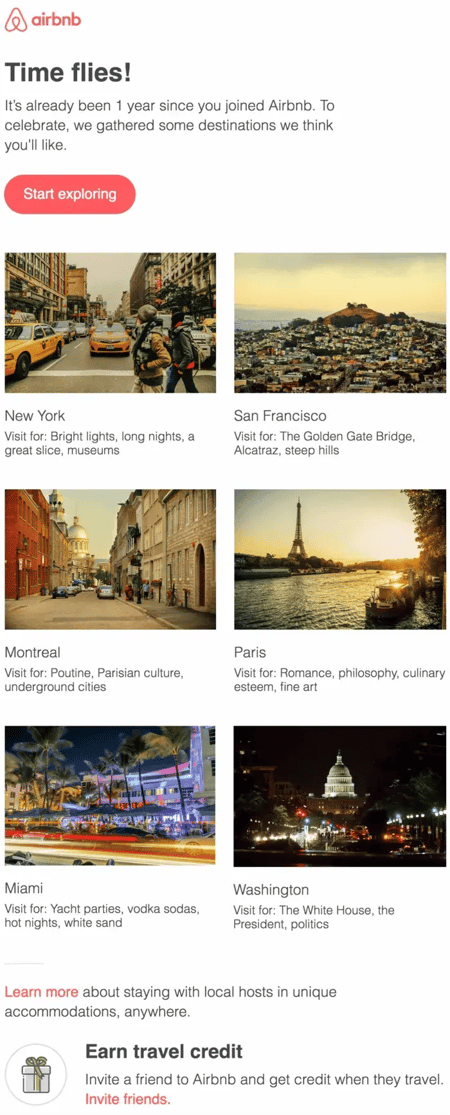
What the email does: Airbnb sends a thoughtful anniversary email to commemorate the date a guest first booked with them. Instead of a standard promo, the message recognizes the relationship milestone and couples that with a curated list of destinations, a light, inspiring email that feels more friendly than sales-forward.
Why this works:
This is a great example of emotion?based nurture. 滨迟’蝉 not about pushing an offer. 滨迟’蝉 about acknowledging the customer’s history with the brand. A few things this email gets right:
- Recognition creates connection. By celebrating a milestone, Airbnb signals that it remembers you, and that strengthens brand affinity.
- Inspiration over sales. Offering dreamy destination ideas taps into wanderlust and curiosity, which is more engaging than a generic discount.
- Light, visual, scannable content. The design feels like a travel mood board: easy to scan, pleasant to look at, and low commitment.
This kind of message works especially well for brands with an experiential offering like travel. People don’t just buy nights, they buy memories, and Airbnb’s email mirrors that emotional value.
Where it could be even better:
As lovely as the destination suggestions are, the email misses a chance to connect the recommendations directly to the recipient’s preferences. For example:
- Why were these places chosen? Based on past stays? Wish list activity? Searches?
- Do these destinations match traveler interests, beach vs. mountains, city vs. countryside, etc.?
Including a hint of personalization logic like “Based on stays like yours in X and Y…” would make the recommendations feel more relevant and less like a generic list.
Also, a gentle CTA tied to exploration, such as “See similar stays” or “Save these for later,” could help translate inspiration into action without losing the warm tone.
Key takeaway: Anniversary emails are a wonderful opportunity to deepen a relationship without selling too hard. By combining emotional recognition with relevant suggestions, you can remind people why they chose you in the first place and give them a reason to come back. Just make sure the why behind your recommendations is clear, so the email feels personal, not random.
16.
Assessment: Sentimental storytelling with subscription potential.
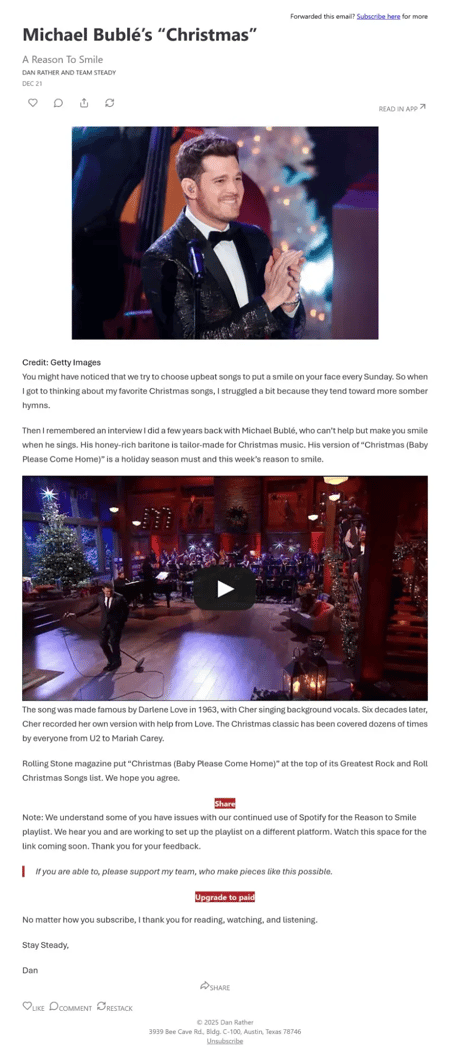
What the email does: In this seasonal edition of his Reason to Smile newsletter, Dan Rather shares a personal reflection on holiday music, anchored around Michael Bublé’s rendition of “Christmas (Baby Please Come Home).” There’s a video, a bit of history, and a heartfelt tone, all designed to make the reader feel something. 滨迟’蝉 part nostalgia, part music trivia, part soft sales pitch.
Why this works: The video is the clear centerpiece here, and it’s a smart one. Music is emotionally resonant, highly shareable, and a great way to stop scrolling during a busy time of year. The write-up offers light education (the Darlene Love backstory, Cher’s involvement, etc.), and the tone feels personal without oversharing.
There’s also a gentle call to support the team and a visible upgrade button, nice reminders that free content still has a cost. Bonus points for addressing feedback about Spotify limitations in a gracious, transparent way.
Where it falls short: While the content is lovely, there’s one big hole: We don’t really know what the newsletter is. If you’re not already a subscriber, this reads like a one-off music moment. Is this a playlist series? A weekly editorial column? A broader commentary platform?
The CTA to “Upgrade to paid” is prominent, but there’s no clear value proposition about what you’d get if you did. More Bublé? More journalism? More curated playlists? A simple line like:
“Every Sunday we share a feel-good song, a bit of backstory, and something to start your week with a smile…”
… would give new readers the context they need to decide if they want in.
Also, the button formatting is broken. The “Share” and “Upgrade to paid” buttons are misaligned with their cells, making the design feel crunched and distracting from the actual message. (Small fix, big perception shift.)
Key takeaway: Emotional content builds connection, but if you want that connection to turn into subscriptions, clarity matters. Make sure new readers know what your content is, why it’s valuable, and what they’ll get if they sign up (or pay). And don’t let small design issues undermine your credibility. Clean buttons matter more than we think.
17.
Assessment: Two-way nurture that builds community.
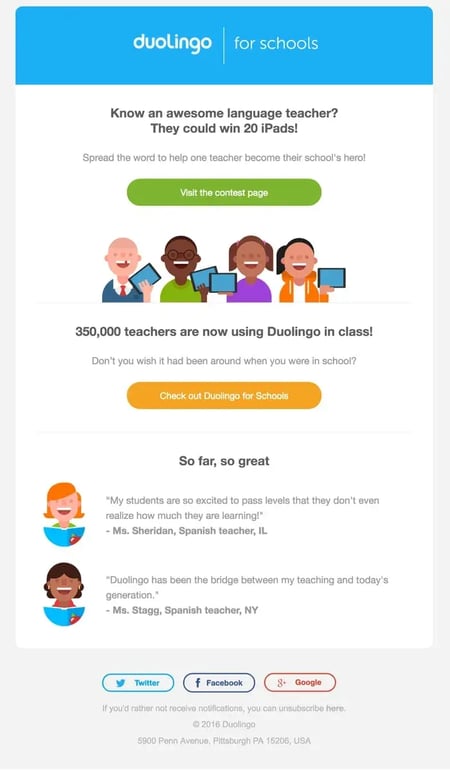
What the email does: This email from Duolingo invites users to nominate a teacher for recognition, a clever way to foster engagement without selling anything. 滨迟’蝉 short, well-designed, and invites the recipient into a shared moment of appreciation during Teacher Appreciation Week.
Why this works:
This is a strong example of community-building nurture, the kind of email that doesn’t just talk at your audience, but invites them to participate. Here’s what it gets right:
- 滨迟’蝉 two-way. This isn’t a “look at what we’re doing” email. 滨迟’蝉 a “join us” email. That shift from broadcast to invitation makes all the difference in engagement.
- It aligns with the brand. Duolingo is all about education and learning, so recognizing teachers is more than a nice gesture. It reinforces the company’s mission and values.
- The form of the CTA matches the message. “Nominate your teacher” feels personal, not transactional. It turns a passive reader into an active participant.
- No hard sell. This email nurtures emotional connection and goodwill, which is just as important as product nudges, especially for long-term engagement.
Where it could be even better:
While the message is sweet and clear, there’s a missed opportunity to tie the campaign more directly to the user’s own experience. For example:
- Did the reader recently complete a course with a teacher?
- Do they have a learning streak worth celebrating?
- Could they get a badge or reward for participating?
Even a simple line like “We’ve seen how committed you are to learning, now help us thank the people who make it possible” would help the message feel more tailored and relevant.
Also, including a post-nomination action, like “Meet some of last year’s winners” or “Read our favorite teacher stories,” could help extend the engagement loop.
Key takeaway: Sometimes the best nurture emails don’t talk about your product at all. They invite the reader to participate in something meaningful. When you can align that moment with your mission and let your audience shape the story, you’re not just sending an email. You’re building community.
18.
Assessment: Seasonal storytelling that aligns with the brand.

What the email does: Rather than defaulting to a Christmas or holiday promotion, Gardener’s Supply Company centers this nurture email around the winter solstice, a bold and brand-aligned choice. The message reflects on rest, renewal, and preparation for spring, beautifully paralleling the cycles of gardening. 滨迟’蝉 not selling, it’s centering. And it works.
Why this works: This is seasonal content done right. It stands out because it skips the usual red-and-green, Santa-and-sales approach and instead anchors itself in something quieter and more meaningful, especially for gardeners. The solstice theme ties directly to the customer’s passion: growing things.
A few things this email really nails:
- Tone and message are perfectly aligned with both the brand and audience values.
- The imagery is seasonal but serene, not gimmicky.
- The copy doesn’t push a product, but it gently encourages planning, flipping through seed catalogs, and dreaming up new beds. That’s nurturing behavior if ever there was one.
And just when it risks feeling a little too poetic? The final paragraph pulls it back into purpose: reminding readers that Gardener’s Supply will be there to support them with tools, experience, and community. It reconnects the emotional message to the business model, and that’s what makes it work as a nurture email, not just a pretty solstice card.
Where it falls short: This one’s strong, but there’s still a light missed opportunity — no CTA. A soft one would’ve been enough, something like:
- “Browse new arrivals for spring.”
- “Start planning next season’s garden.”
- “Download our printable planting calendar.”
… anything that offers next steps for the reader who is ready to shift from dreaming to doing. Without that, it risks ending on a beautiful note, but a passive one.
Key takeaway: Not every nurture email needs to push a product. Sometimes, the most strategic move is to remind people why they love what they do and why your brand belongs in that story. But even in the quietest moments, give your reader a gentle handhold toward the next step.
19.
Assessment: Puppies, personality, and a pivot to purpose.
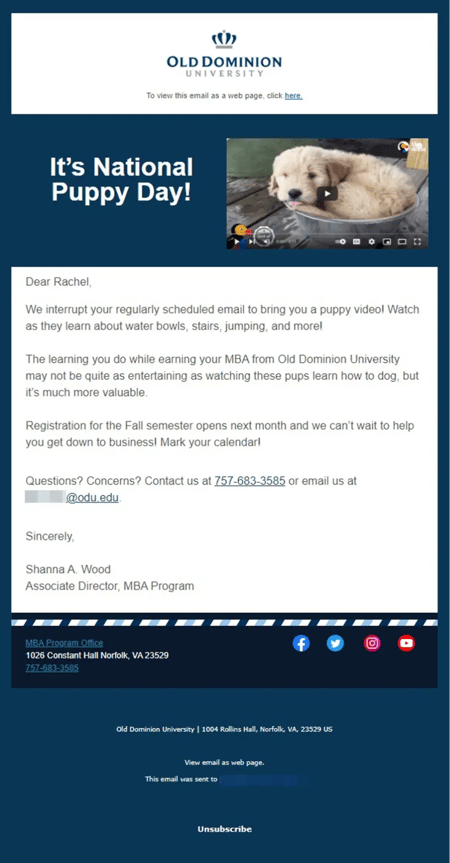
What the email does: Old Dominion University leans into the whimsy of National Puppy Day (March 23) with this unexpected email. Instead of another “start your MBA” pitch, they lead with a puppy video. And yes, it’s adorable. But it’s not random: The email draws a clever parallel between puppies “learning how to dog” and humans learning how to “business” via ODU’s MBA program.
Why this works: This is a great example of lighthearted content with a strategic point. The video gives immediate value — a smile, a break, something fun to forward — without asking anything in return. And that emotional boost builds affinity for the brand, especially if the reader wasn’t quite ready for another promotional message.
Here’s why this email is more than just fluff:
- Timely but low-stakes holiday gives them a reason to show personality.
- Video content drives clicks and keeps readers engaged.
- The copy connects the concept to the offer without being heavy-handed.
- It shows the brand isn’t taking itself too seriously, which is rare and refreshing in higher ed.
Where it falls short: The light tone is great, but the transition from puppies to MBA is doing a lot of work, and it could be a bit tighter. The message risks feeling disjointed if the reader isn’t in the mood to bridge that metaphor themselves. A sentence or two showing how ODU’s program is also beginner-friendly, or how they support students through the learning process (just like the puppies), would help land the analogy more solidly.
Also, while the CTA to “mark your calendar” is gentle, it’s also vague. A direct next step, like “Get notified when registration opens” or “Start your application checklist,” could keep the momentum going without pushing too hard.
Key takeaway: Fun, surprising content can be a powerful nurture tool, especially when it leads somewhere. Use moments of delight to humanize your brand, but always tie them back to a clear purpose and give the reader a next step that matches the tone.
20.
Assessment: Seasonal enablement for B2B users.
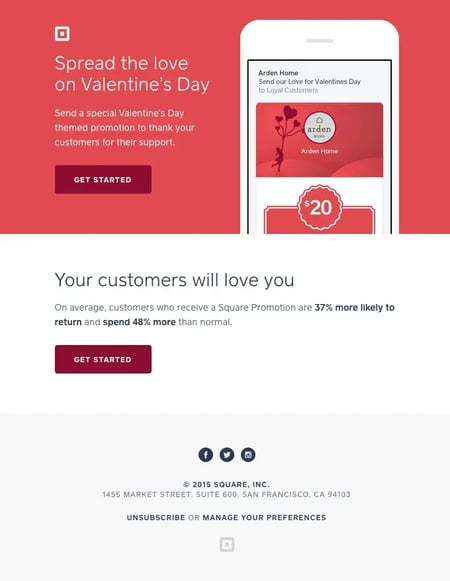
What the email does: Square sends this Valentine’s Day-themed message to its merchants, encouraging them to launch a customer promotion using Square’s built-in campaign tools. The copy is simple and clear: “Spread the love,” and we’ll help you do it with a $20 offer. Bonus: They back it up with stats showing the impact of running promotions through Square.
Why this works:
This is a solid example of seasonal B2B nurture that supports platform engagement, not just sales.
- 滨迟’蝉 actionable and timely. Square gives merchants a specific reason to take action now (Valentine’s Day) and the tool to do it.
- It builds platform stickiness. Helping users promote their business increases Square’s value as more than just a transaction processor.
- Stats make the case. “37% more likely to return, 48% higher spend” — this isn’t just a warm fuzzy campaign, it’s backed by performance data.
- Design is clean and CTA-focused. The entire email is visually structured around a single goal: getting the reader to launch a campaign.
Where it could be even better:
This email is high on clarity, but a little low on contextual relevance.
- Could they pre-load the campaign with user data? Suggest an offer based on past behavior?
- Could they show example results from similar businesses (e.g., “Coffee shops like yours saw a 12% revenue boost last Valentine’s with this template”)?
Even a touch of personalization, industry, business size, or past promotion history would make this feel less like a mass send and more like a smart nudge.
Also, while “Get Started” is a solid CTA, it’s used twice with no variation. Testing a “Customize Your Campaign” or “See How It Works” button might reduce friction.
Key takeaway: When you’re nurturing B2B users, it’s not just about inspiration; it’s about empowerment. Square gives its customers a reason, the tool, and the proof to act — all in one tight, timely email. Add a little personalization, and this becomes a standout seasonal engagement piece.
A Better Way to Nurture
Circling back to my personal experience with that AI certification program… Imagine if, instead of a weekly barrage of “Enroll now!” emails, I’d received something like this:
- A quick story from a past student who landed a dream job thanks to the program.
- A peek inside the course dashboard or a sample lesson from week one.
- An intro to the lead instructor, maybe with a short video or AMA link.
- A roundup of the most common career paths people take after certification.
- A note saying, “We know this might not be the right time, but we’re here when you’re ready.”
That’s what lead nurturing is supposed to be: helpful, human, and relevant. Not pushy. Not premature. Not stuck in an endless “Enroll Now!” loop.
When you get nurture right, people don’t just buy, they trust. They feel seen. They feel smarter for having read your email. And they stay in the conversation, even if “not now” turns into “not yet.”
So go forth and build nurture emails that do what nurture is meant to do: Not push. Not pester. Build a relationship. Provide value. Guide the reader to a solution. One valuable step at a time.
Editor's note: This post was originally published in August 2016 and has been updated for comprehensiveness.
Email Newsletter Guide
In-depth research on how to create a revenue-driving newsletter.
- Newsletter ad sales.
- Paid acquisition.
- Newsletter structure.
- And More!
Download Free
All fields are required.
Form not available
You're all set!
Click this link to access this resource at any time.
Email 糖心Vlog