.png?width=112&height=112&name=ebook%20cover%20-%20%20transparent%20-%20financial%20planning%20templates%20(1).png)
Budgeting and forecasting have become more challenging as businesses grow, competition intensifies, and market conditions shift. Traditional approaches built around static spreadsheets and periodic updates struggle to keep pace, often forcing finance teams to respond after the numbers are already outdated.
AI in budgeting and forecasting takes a different approach. By analyzing live data, continuously updating forecasts, and surfacing risks and opportunities earlier, AI helps organizations plan with greater accuracy and flexibility.
This guide explores how AI is reshaping budgeting and forecasting in practice. It covers:
Table of Contents
- What is AI in budgeting and forecasting?
- AI Budgeting and Forecasting Benefits
- How AI Is Used In Budgeting and Forecasting
- How AI Transforms Your Forecasting Process
- How to Implement AI In Forecasting
- Challenges of Using AI for Budgeting and Forecasting
What is AI in budgeting and forecasting?
AI in budgeting and forecasting refers to the use of machine learning, predictive analytics, and automation to automatically build, update, and refine budgets and forecasts using real business data. Instead of relying on static spreadsheets, assumptions, and periodic updates, AI systems continuously analyze transactions, revenue signals, costs, and cash flow to produce forecasts that evolve as the business changes.
Unlike traditional budgeting methods that often rely on historical averages, manual inputs, and linear models, AI learns from patterns, detects shifts early, and recalculates projections as new data arrives. For example, rather than creating a quarterly forecast and revisiting it weeks later, an AI-powered forecast can reflect changes in demand, pipeline movement, or spending within days or even hours.
This means finance teams can model multiple scenarios quickly, adjust budgets mid-period, and spot risks before they become problems. For instance, AI might flag an unexpected spike in customer acquisition costs (CAC) or predict a seasonal drop in cash flow. These insights allow leaders to mitigate risks and capitalize on opportunities sooner rather than later.
AI in budgeting and forecasting is powered by several core technologies:
- Machine learning (ML): ML models learn from historical financial data and improve forecasts over time. For example, an ML model can study years of revenue, costs, and seasonality to predict future performance more accurately than a fixed formula, then adjust predictions as new data flows in.
- Natural language processing (NLP): NLP allows AI systems to read and interpret unstructured data such as budget notes, contracts, emails, and earnings commentary. In real-world use, NLP can pull cost drivers from vendor agreements or summarize financial narratives alongside numeric forecasts.
- Predictive analytics: Predictive models estimate what’s likely to happen next based on patterns and probabilities. This includes forecasting revenue shortfalls, identifying overspend risk, and projecting demand changes before they appear in financial statements.
- Automation and data integration: AI systems connect directly to ERPs, CRMs, and financial tools to pull live data without anyone having to manually upload anything. Automation of these tasks reduces errors and ensures that forecasts reflect current activity, such as open deals, invoices, or operational spend.
- Scenario modeling and simulation: AI can run multiple “what-if” scenarios quickly, such as changes in pricing, hiring plans, or market conditions. Modeling helps finance leaders understand trade-offs and plan budgets that remain flexible in the face of uncertainty.
.png)
Free Financial Planning Templates
Manage your business and personal finances with these five financial planning templates.
- Balance Sheet Template
- Profit & Loss Statement Template
- Financial Projection Template
- And More!
Download Free
All fields are required.
Form not available
You're all set!
Click this link to access this resource at any time.
Traditional Budgeting and Forecasting vs. AI-Driven Budgeting and Forecasting
Here’s a table breaking down the difference between traditional and AI-driven budgeting and forecasting.
|
Traditional budgeting and Forecasting |
AI-driven budgeting and forecasting |
|
|
Planning approach |
Budgets and forecasts are created at set intervals, often quarterly or annually, based on fixed assumptions agreed on during planning cycles. |
Budgets and forecasts update continuously as new data flows in, allowing plans to adjust to current business conditions. |
|
Data usage |
Relies heavily on historical financial data and manually consolidated inputs from multiple teams. |
Combines historical data with real-time operational, sales, and external data pulled directly from connected systems, like CRMs, ERPs, and invoicing systems. |
|
Accuracy over time |
Accuracy tends to decline as conditions change, requiring manual re-forecasting to correct course. |
Accuracy improves as models adjust projections based on recent performance and emerging trends. |
|
Speed of updates |
Updates require manual effort, cross-team coordination, and time-consuming spreadsheet revisions. |
Updates occur automatically, reducing delays and enabling teams to respond faster to changes in revenue, costs, or demand. |
|
Scenario planning |
Scenario analysis is limited and time-intensive, often restricting teams to one or two alternative models. |
AI can run multiple scenarios quickly, helping leaders compare outcomes of different decisions before taking action. |
|
Risk detection |
Risks such as overspending or revenue shortfalls are often identified after results fall short of the plan. |
AI surfaces potential risks earlier by detecting changes in patterns as they begin to form. |
|
Scalability |
Traditional methods become harder to manage as data volume increases and the business becomes more complex. |
AI-driven methods scale more easily as data grows, making them better suited for fast-growing or multi-entity organizations. |
AI Budgeting and Forecasting Benefits
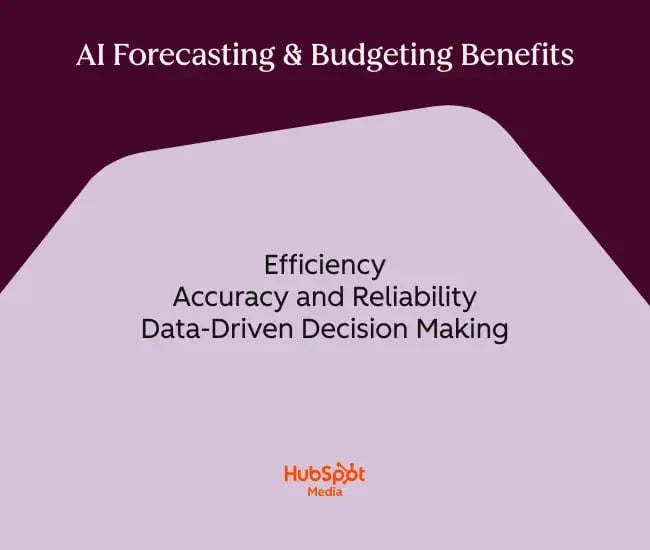
Efficiency
Data analysis was a manual task assigned to humans, who needed time to gather, analyze, and spot patterns and trends. With AI, this work can be done in minutes. Plus, AI can continuously analyze data and alert humans when changes occur.
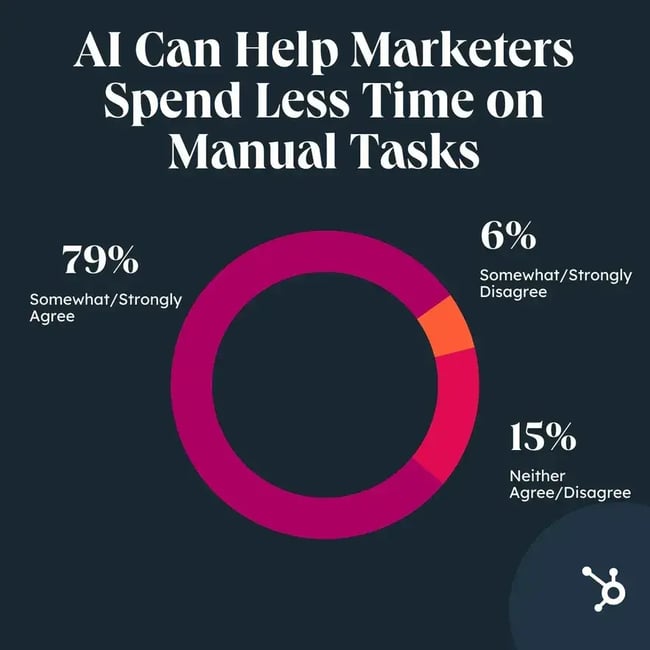
According to HubSpot’s AI Trends for Marketers report, as many as 79% of marketers agree that AI and automation tools can help them spend less time on manual tasks, while 66% say AI tools can help them spend more time on the creative aspects of their jobs.
When researching the benefits of AI, eight different people mentioned the role AI plays in efficiently managing budgets and forecasting.
, Owner and CMO at , has extensive experience in this space. At his bookkeeping company, Gillivan uses AI to analyze budgeting and forecasting data in real time.
He says, “We've integrated AI tools to analyze cash flow, sales data, and expenses in real time. For instance, AI flags potential cash flow issues early by comparing historical spending patterns with current income, helping us adjust budgets more efficiently.
These tools also project future revenue based on customer trends and market conditions, which takes the guesswork out of planning.”
Gillivan's experience reflects a broader shift in how finance teams approach budgeting — moving away from reactive adjustments and toward continuous, data-driven planning that keeps pace with business conditions.
Accuracy and Reliability
AI improves forecasting and budgeting accuracy by analyzing large volumes of financial and operational data, identifying patterns humans often miss, and updating projections as new information arrives. This leads to forecasts that better reflect seasonality, demand shifts, and historical trends, reducing surprises and helping finance teams make sound decisions.
I spoke to many experts who credited AI with improving the accuracy of data analysis and forecasting. In fact, 17 experts mentioned accuracy 27 times.
, chief commercial officer at , measured AI's impact on forecasting accuracy.
He said, “AI assists in identifying patterns of seasonality in our business, allowing us to better prepare for fluctuations in demand. This ensures, in the long run, that our budget aligns with periods of high and low sales activity, preventing financial surprises. Overall, AI has increased our forecasting accuracy by 25%, which has been key in optimizing our financial strategy, reducing waste, and improving our bottom line.”
However, to get the most accurate forecasts, organizations must look after their AI and raw data.
, CEO of Keylabs, and offers tips on improving it. In his article, Abramov notes that model accuracy is fundamental for financial services and invaluable for risk assessment in the financial industry.
Abramov’s tips for maintaining model accuracy include:
- Data preprocessing. This is important for accurate AI and includes cleaning, transforming, and preparing data to improve quality. With AI, outcomes reflect the quality of the input data.
- Feature engineering. The practice of creating new or enhanced features to improve a model's ability to identify patterns and relationships. For example, upon receiving data analysis results, teams might add new mathematical functions to better represent the relationships between variables.
- Hyperparameter optimization. The method of adjusting parameters for better accuracy.
Data-Driven Decision Making
Budgeting and forecasting become far more grounded when AI is part of the process. Instead of relying on scattered reports or intuition, organizations can base their financial decisions on patterns pulled from historical results, customer behavior, and shifting market conditions.
, mentioned above, credits AI with helping make data-driven decisions.
He said, “We started experimenting with AI tools to enhance our sales forecasting and budgeting. We developed our processes, and now, these tools help us to make smarter, data-driven decisions. For example, analyzing historical sales data, customer behavior, and market trends improves the accuracy of our sales forecasts.”
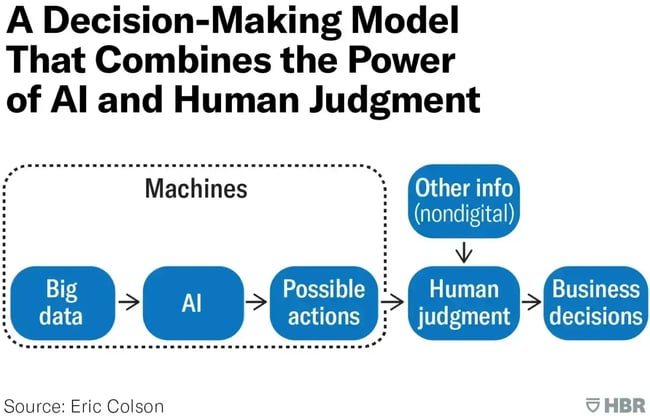
first shared the above screenshot in this . In it, Colson provides a process for making business decisions using AI. Importantly, Colson includes a human later in the analysis.
Big data is fed into the AI, which analyzes it and provides possible actions. These findings are then judged by humans in conjunction with other non-digital data (something AI simply cannot do). Finally, with all of the above, a business decision is made.
Colson is looping in the all-important human in the process. While AI is amazing, it will never replace human insight.
Colson puts it best when he says, “The key is that humans are not interfacing directly with data but rather with the possibilities produced by AI’s processing of the data. Values, strategy, and culture are our way of reconciling decisions with objective rationality. This is best done explicitly and fully informed. By leveraging AI and humans, we can make better decisions than using either alone.”
Colson's framework reinforces that AI in budgeting and forecasting is most effective when human judgment remains part of the process. Translating data possibilities into decisions that reflect organizational values and strategy is something AI cannot do alone.
How AI Is Used In Budgeting and Forecasting
With efficiency gains, improved accuracy, and stronger data-driven decision-making in mind, here's a look at how AI is actually applied to budgeting and forecasting in practice.
Time Savings
AI shortens budgeting cycles by automating data collection, updating forecasts as transactions happen, and removing manual steps that slow finance teams down. This allows organizations to respond faster to changes in revenue, costs, and cash flow without adding operational overhead.
is a CPA, CFO, and software engineer who focuses on AI. At , Rosario uses AI to save time, speed up processes, and reduce errors. Rosario shared some excellent use cases, including saving time and reporting.
Rosario says, “AI speeds up the process and reduces errors for budgeting. I worked with a startup that spent weeks on manual data entry and couldn't keep up with rapid growth. We implemented an automated system that updated budgets in real time as orders came in. The founders now check budgets daily and make adjustments, boosting cash flow visibility.”
Reporting
AI-driven reporting reduces the time spent pulling data, formatting reports, and reconciling numbers across systems. By automating recurring reports and dashboards, finance teams can spend less time generating reports and more time interpreting results and advising the business.
Russell Rosario, for example, saves eight hours per week by automating his reports.
He says, “AI handles routine reporting, freeing us to advise clients. AI provides insights impossible alone, while we guide complex decisions beyond AI.
“AI handles routine reporting, freeing teams to focus on strategy. A consulting firm I advised was bogged down producing monthly reports, costing 10 hours per week. We set up dynamic dashboards that pulled data from their systems, saving 8 hours weekly. They reinvested that time in business development, growing revenue by 22% year over year.”
Improving Forecast Accuracy
AI improves forecast accuracy by detecting patterns that traditional models often overlook, such as subtle seasonality and short-term demand shifts. This allows finance and sales leaders to adjust budgets and targets mid-cycle rather than wait for end-of-quarter corrections.
, CEO and Co-Founder at , uses AI to improve forecast accuracy.
He says, “We use AI to identify hidden seasonality patterns that go beyond typical calendar cycles, helping us forecast spikes in unexpected months.”
For example, AI alerted McDermott’s team to a surge in manufacturing sign-ups during February — something they wouldn‘t have caught without it. This helped the team allocate sales efforts and budgets precisely where they’ll have the most impact.
“We rely on Salesforce Einstein AI for real-time forecasting, giving us up-to-the-minute projections on revenue, which we can adjust mid-quarter if needed. Since adopting it, we've improved forecast accuracy by nearly 18%, which has helped us hit revenue targets more consistently,” McDermott says.
In . As part of Sales Hub, forecast data is delivered directly through the CRM. Teams can view sales forecasts, review categorization, and even see reports showing where prospects are in the pipeline. This helps leaders understand where to invest effort to meet objectives.
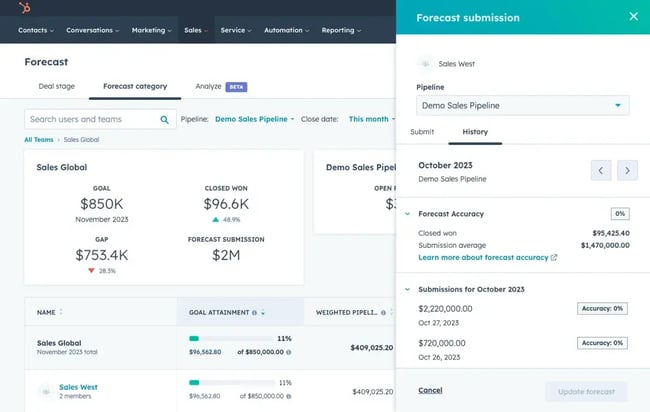
If , there are lessons available on this and sales forecasting.
Demand Forecasting
AI-powered demand forecasting helps organizations anticipate shifts in customer needs by analyzing usage patterns, service adoption, and historical behavior. This allows leaders to test new offerings, allocate resources, and plan expansions with greater confidence.
One specific example of how AI significantly impacted sales forecasts as director and physiotherapist at was when he expanded his pilates and wellness services.
Hunt says, “By analyzing the data from our physiotherapy clients, AI helped us identify a growing demand for these additional services, leading to a 20% increase in pilates bookings within six months.”
With over 30 years of experience in private practice and sports physio clinics, Hunt says his background enabled him to implement these tools strategically. This ensures that AI solutions complement existing processes rather than overwhelming the team.
“AI has not only improved our financial forecasting but also empowered us to make data-driven decisions, supporting sustainable business growth,” Hunt says.
Hunt’s use case perfectly illustrates how AI and human insights have been combined to drive data-driven business decisions. In this case, Hunt is using AI for demand forecasting, and the insights provide the data he needs to decide whether to launch a new service.
How AI Transforms Your Forecasting Process
Once AI is embedded into forecasting, the process itself changes. Forecasting moves away from static planning cycles and becomes a continuous system that responds to real business signals as they emerge.
1. From static budgets to dynamic planning.
AI replaces fixed budgets with rolling forecasts that update as business conditions change. So, instead of revisiting plans only at quarter-end, finance teams can continuously adjust forecasts based on current revenue trends, pipeline movement, seasonality, and external signals.
, Founder and CEO of , says AI changed how he approaches forecasting by shifting it from a static, quarterly exercise to an ongoing, data-driven process.
“Instead of manually reconciling spreadsheets, we use AI models to analyze historical performance, pipeline velocity, seasonality, and external signals in near real time. As a result, our rolling forecasts are materially more accurate, and our revenue forecast variance dropped from roughly ±15% to under ±5% within two quarters.”
2. Intelligent pattern recognition.
AI excels at identifying patterns that are difficult to spot in traditional reports, especially when risks develop gradually across multiple data points. By monitoring timing, behavioral changes, and workflow delays, AI can surface issues long before they appear in headline numbers.
, VP of AI Agentic Solutions at , told me about a time when AI flagged that a multi-quarter enterprise deal was at risk due to delayed approvals, something his team could not spot from standard reports alone.
“By reallocating resources proactively, we avoided a $450K revenue shortfall that quarter. For me, the real value of AI in budgeting isn’t just precision, it’s the ability to uncover hidden risks and opportunities before they impact the business.”
3. From assumption to prescription.
Traditional forecasting often relies on assumptions about what might happen next. AI, however, shifts forecasting toward prescription by analyzing outcomes and recommending specific actions tied to expected impact.
, Head of Website at , explained, “AI helped us flag that certain freemium users were unlikely to convert unless nudged at specific touchpoints. By reallocating just 10% of our marketing budget to targeted onboarding emails and in-app prompts, we increased conversions by 9% over two months.”
This shift — from estimating outcomes to recommending actions — is where AI fundamentally changes how budgeting and forecasting support decision-making.
How to Implement AI In Forecasting
The effectiveness of AI in forecasting depends on how it’s integrated into existing financial processes.
I asked experts to share their best tips for implementation, and here’s what they said.
Start small.
Organizations get the best forecasts when they implement AI incrementally. Starting with a single workflow or familiar financial tool helps teams understand how AI fits into existing processes without disrupting day-to-day operations. Once they’re confident with how it works, they can expand.
, Founder of , recommends starting small when implementing AI.
Marasco uses AI in budgeting and forecasting in her flower shop to manage financials and forecast future sales. She says, “AI-powered platforms analyze our sales history and predict future cash flow based on various factors, such as seasonal trends and customer behaviors. This gives us a clearer picture of how much to budget for things like supplies, marketing, and labor.”
When starting with AI, Marasco says, “Start small, maybe with an AI-driven accounting tool, and slowly incorporate more advanced analytics as you become comfortable. This gradual integration has worked well for us, and the data-backed decisions have made our financial operations more resilient.”
What I like about this: From researching AI previously and in other verticals, I know the benefit of integrating AI simply and on a smaller scale. For example, .
The mental leap and process adaptation are likely much smaller/easier if the organization is already using and enhancing a tool with AI. As Marasco said, start with an accounting tool and see what can be enhanced with AI.
Don’t skip human insights.
When implementing AI, it’s important to know that it isn’t a complete replacement for human insights. Instead, it’s a tool that can enhance the budgeting and forecasting process and help humans, not replace them.
Russell Rosario shared his insights on how AI saves time above, but he also warns that human judgment is still vital. The key, Rosario says, is “Using AI for routine tasks so experts can focus on high-value work. AI improves decision-making by providing data-driven insights. With the right tools and guidance, any business can leverage AI to gain a competitive advantage.”
Dávid Breitenbach, another key contributor to this article, stressed the importance of human oversight.
He said, “While AI can provide predictive analytics and trends, our team reviews these insights regularly to adjust for any unforeseen factors like changes in the market or internal priorities. This hybrid approach we developed ensures we stay flexible and responsive while leveraging the power of AI.”
What I like about this: I think that a company recognizing that human insights are key, and having this message at the forefront of its internal processes and dialogue around AI and human collaboration, is important. I’d like to think it brings comfort to employees who may be concerned about their jobs with the integration of AI.
Regularly expand data.
AI forecasting models improve as more relevant and up-to-date data is added over time. Expanding datasets enables AI to better reflect changes in customer behavior, seasonality, and demand patterns.
, Wholesale Sales Manager at , has found success by regularly adding data.
Kirkby says, “[Adding] seasonal trends or shifts in customer behavior really helped us set more accurate goals, manage resources better, and ultimately be more efficient at hitting our targets. This is the most important thing to remember: AI is only as good as the data fed to it.”
What I like about this: I think that data quality can be the difference between a good experience with AI that builds trust and a poor one that creates frustration. It would be a shame to discount AI when the underlying issue is the data itself.
Choose AI-driven forecasting tools that fit the existing tech stack.
AI forecasting works best when the forecasting tool connects directly to the systems that already run the business. When AI models pull data directly from connected systems, budgets and forecasts update faster, reflect real performance, and require far less manual reconciliation. This makes it easier for finance teams to adjust plans as revenue, costs, or demand change.
When evaluating AI-driven forecasting tools, check that they integrate with platforms like:
- CRM systems (e.g., Salesforce, HubSpot, Pipedrive)
- ERP and accounting systems (e.g., NetSuite, QuickBooks, Xero)
- Billing and subscription tools (e.g., Stripe, Chargebee, Recurly)
- 糖心Vlog platforms (e.g., HubSpot 糖心Vlog Hub, Google Ads, Meta Ads)
- Data and analytics tools (e.g., Snowflake, BigQuery, Looker)
What I like about this: integrates with a broad ecosystem of CRM, finance, sales, and operations tools (available in the ). This means it uses live pipeline and revenue data to build forecasts and budgets that reflect real activity across the business.
Challenges of Using AI for Budgeting and Forecasting
While AI-driven budgeting and forecasting offer significant benefits, they also pose challenges that finance leaders need to address upfront. Here are some of them:
1. Data Quality Concerns
AI raises the bar for data quality. When financial, sales, and marketing data are inconsistent or poorly governed, AI models can surface those gaps faster and at greater scale, undermining confidence in forecasts.
told me that the biggest challenge of implementing AI for forecasting and budgeting was data quality.
“AI simply amplified inconsistencies across finance, sales, and marketing systems,” Kinneman said. “We addressed this by standardizing definitions, cleaning historical data, and limiting models to a smaller set of high-confidence inputs before expanding.”
2. Change Management
AI adoption also requires deliberate change management. Teams accustomed to spreadsheets and manual forecasts often need time and support to adjust to new workflows and decision-making processes.
Finance leaders can ease this transition by clearly communicating how AI supports, rather than replaces, human judgment. Investing in training, rolling out AI features gradually, and tying early use cases to familiar metrics helps teams build confidence and see value in the new system.
3. Low Trust In AI-Driven Forecasts
Moving from traditional forecasting methods to AI-driven approaches can be uncomfortable, especially when AI recommendations challenge long-held assumptions. Resistance often comes from uncertainty about how predictions are generated and whether they can be trusted.
of Skan AI has seen this firsthand. “Finance and operational teams were skeptical about relying on AI predictions, especially when recommendations went against intuition. We solved this by building transparent AI dashboards that show the ‘why’ behind every forecast, so teams could trust the insights while still applying human judgment.”
Transparency in how AI generates forecasts is often the deciding factor in whether finance teams adopt and trust the technology or revert to familiar manual processes.
Making Your Budget Forecasts Future-Ready
AI in budgeting and forecasting is reshaping financial planning, moving organizations away from static spreadsheets toward continuous, data-driven processes. When forecasting models learn from historical performance and real-time signals, finance teams gain earlier visibility into risks and opportunities. The experts in this article consistently show that the strongest results come from combining AI's pattern recognition with human judgment.
For organizations looking to put this into practice, HubSpot's AI-powered forecasting tools integrate directly into the CRM, giving finance and sales teams a shared, live view of projected revenue and pipeline health.
Free Financial Planning Templates
Manage your business and personal finances with these five financial planning templates.
- Balance Sheet Template
- Profit & Loss Statement Template
- Financial Projection Template
- And More!
Download Free
All fields are required.
Form not available
You're all set!
Click this link to access this resource at any time.
Artificial Intelligence