
An AI sales agent is software that can analyze sales context and take actions such as qualifying leads, drafting outreach, updating CRM records, and scheduling meetings without a rep managing every step. AI sales agents are reshaping how sales teams operate, automating repetitive pipeline tasks and ensuring no lead goes cold while reps focus on closing.
I’ve felt the end-of-quarter crunch firsthand, both as a business owner and as a sales leader. This guide covers the practical information I wish I had reviewed when I first started evaluating AI sales agent tools. It covers what AI sales agents are, how they work, how teams use them across the funnel, and a practical buying checklist.
Table of Contents
- What is an AI sales agent?
- How AI Sales Agents Work
- Benefits of AI Sales Agents
- Types of AI Sales Agents
- AI Sales Agent Use Cases Across the Funnel
- Examples of AI Sales Agents in Action
- How to Choose the Right AI Sales Agent
- Frequently Asked Questions About AI Sales Agents
What is an AI sales agent?
An AI sales agent is software that can analyze sales context and take actions such as qualifying leads, drafting outreach, and updating CRM records. A typical sales lifecycle requires an entire team moving through multiple stages: prospecting, qualifying, answering inquiries, and closing. Working that process manually consumes a significant share of a rep’s day. An AI sales agent automates and streamlines those workflows, eliminating repetitive tasks and freeing reps to focus on higher-value selling.
AI sales agents use machine learning, natural language processing, and large language models to understand inputs and generate sales actions. Some agents operate autonomously, engaging with prospects and qualifying leads with minimal human intervention. Others act as assistive copilots, supporting reps with research, drafts, and recommendations while a human stays in the driver’s seat.
AI sales agents differ from chatbots in scope. A chatbot answers a question within a single conversation. An AI sales agent researches the account, drafts the email, schedules the meeting, and logs the activity in the CRM. That ability to complete multi-step tasks across systems is what makes agents a meaningful step beyond the chatbot era.
My take: AI sales agents no longer require constant prompting — a significant shift I have noticed personally in how these tools operate. Earlier AI tools needed a human prompt for every output. With today’s agents, I can kick off a workflow with one instruction, and the system handles research, drafts outreach, and proposes next steps without me hovering. That is a real change, and it is what makes the term “agent” earned rather than just AI hype.
Free Report: Smarter Selling with AI
New data and insights from 600+ sales pros on how they’re using AI and the results they’ve seen.
- How Sales Teams are Using AI
- Giving Time Back to Sales Reps
- Keeping Up with AI Trends
- And More!
Download Free
All fields are required.
Form not available
You're all set!
Click this link to access this resource at any time.
How AI Sales Agents Work
AI sales agents gather and centralize customer data from CRMs, website activity, and other digital touchpoints. The agent builds a profile of each prospect and interprets messages using natural language processing. From there, machine learning is used to predict lead behavior and prioritize the highest-potential conversations.
Once a lead is identified, the agent automates outreach, scheduling, and follow-ups so engagement never stalls. It analyzes interactions in real time, produces recommendations that sharpen messaging, and learns from successful patterns as more reps use it.
The underlying mechanics are familiar technologies combined in a new way. Machine learning identifies patterns in past deals. Natural language processing reads buyer messages and detects intent. Large language models generate draft emails and call summaries. CRM integration gives the agent the data it needs and a place to log what it does. Combining all these in a single sales workflow is what makes modern AI agents genuinely useful.
Benefits of AI Sales Agents
AI sales agents deliver value across three dimensions: time saved, work elevated, and customer experience improved. Each one reinforces the others. Reclaiming time enables strategic work, which produces better customer experiences, which generates more pipeline that AI agents help manage.
1. AI never sleeps.
Potential buyers might visit websites at any time of day, and their needs don’t pause after business hours. Most sales teams cannot staff reps around the clock, leaving valuable inbound interest unaddressed overnight or on weekends. AI sales agents close that gap by responding to inquiries and triggering follow-ups when necessary.
Speed matters more than most teams realize. According to , which analyzed roughly 4 million form submissions, 66.7% of qualified form submissions convert to a booked meeting when prospects are connected instantly, which is more than double the 30% industry average for standard follow-up. This tracks with my own experience, and I’ve watched businesses lose very valuable deals simply because nobody followed up fast enough. AI sales agents help maintain the vigilance that human bandwidth alone cannot.
2. Human reps can spend more time on strategic work.
, director at Sterling Recruitment, notes that sales teams often have to choose between accurate reporting and high sales activity, since reps hate burning hours on admin. “Would you prefer your BDM to be 120% to target YTD or have Salesforce 100% accurate and up to date? You’re probably thinking, ‘I want both,‘ but more often than not, you need to make a choice because that is reality,” Gallantree writes on LinkedIn.
AI sales reps help teams get the best of both worlds. Agentic AI takes over the repetitive, administrative tasks so human reps can focus on complex negotiations, relationship building, and closing high-value deals. According to HubSpot’s State of AI in Sales research, 78% of sales professionals say AI can help them spend more time on the most critical aspects of their role.
3. Customers leave happier.
Today’s customers expect immediate, personalized service. Anything less can cost businesses real revenue. A smooth, tailored sales experience is no longer a bonus but a baseline expectation. According to , 66% of customers expect companies to understand their unique needs. Yet only 34% say companies usually do. AI sales agents can help close this gap at scale.
AI agents can analyze customer preferences, anticipate questions, and provide instant, relevant responses. These agents can also research prospects and use that information to customize outreach. Personalization at this level makes interactions more engaging, builds trust, and ultimately leads to higher conversion rates and stronger customer loyalty.
The surveyed over 1,000 sales professionals. It found that 81% of sales leaders believe AI can help reduce time spent on manual tasks. The report also found that 91% of sales teams maintained or increased their win rates last year as teams leaned into AI. Download the full report for the data behind these shifts.
Types of AI Sales Agents
AI sales agents fall into two broad categories: autonomous agents that complete multi-step workflows with little human input, and assistive agents that operate as copilots alongside reps. Within those categories, four agent types do most of the work in sales organizations today: prospecting and SDR agents, conversational agents, coaching and enablement agents, and deal acceleration and follow-up agents.
The right mix depends on where a team is weakest. Teams short on pipeline lean into prospecting agents. Teams that are losing inbound traffic to slow response times invest in conversational agents. Teams with new reps benefit most from coaching and enablement agents. Teams with leaky pipelines turn to deal acceleration agents.
AI Prospecting and SDR Agents
Prospecting AI sales agents help with lead research, account prioritization, and personalized outbound outreach. These agents handle the top-of-funnel work that most reps find tedious. For a deeper look at the field, the guide to the best AI prospecting tools provides more detail.
A typical prospecting agent monitors enrolled accounts for buying signals such as job postings, funding rounds, and leadership changes. It sources and enriches contacts, drafts personalized outreach based on what it finds, and either presents the draft for human review or sends autonomously once trust is established. The result is a constantly refreshed pipeline rather than a stale list a rep has to manually maintain.
Best for: Sales teams that need more pipeline without adding SDR headcount, especially those with strong data and a clear ideal customer profile.
Pro tip: When setting up a prospecting agent for the first time, start in “draft for review” mode rather than “send autonomously.” Read the first 50 emails the agent produces before turning on auto-send. This feedback loop teaches both the agent and the team what good outreach looks like before scale-up.
Conversational AI Agents
Conversational AI sales agents handle real-time interactions with prospects across web chat, email, SMS, and phone. They engage inbound visitors instantly, answer common product questions, qualify leads, and route high-intent conversations to human reps.
Some advanced agents can handle outbound calls using natural-sounding speech, though that capability comes with adoption-curve issues worth understanding before deploying. For service-side coverage of the same technology, the AI customer service software guide goes deeper.
In web chat, a well-tuned conversational agent captures visitors who would otherwise leave the site without filling out a form. For email and SMS, the agent can handle the back-and-forth scheduling and clarification that eats rep time. For voice, the most defensible use cases today are transactional (appointment reminders, order confirmations, simple inquiries) rather than relationship-driven selling.
There’s a real trust issue with AI voice. Robocalls and spam have left many people, including me, unwilling to pick up the phone. If I received an AI call that didn’t disclose its identity, I’d be equally impressed and freaked out. Any team using an AI voice should be transparent and tell the receiver they’re speaking with a voice assistant. That honesty manages expectations and builds trust rather than burning it.
Best for: High-volume inbound businesses, transactional outbound use cases like reminders and confirmations, and teams with clear scripts for the first conversation that don’t require human judgment to navigate.
What we like: The best conversational agents don’t pretend to be human. These agents identify themselves clearly, handle what they can handle, and hand off to a rep the moment the conversation needs human judgment.
Assistive Coaching and Enablement Agents
Assistive coaching and enablement agents support reps with guidance, summaries, and objection responses rather than replacing them. Enablement agents sit alongside the workflow as a copilot, generating call summaries, surfacing next-best actions, and tailoring training to the specific deals on a rep’s plate. This category is where generative AI in sales is most visible, as LLM outputs sit closest to the rep’s daily workflow.
These agents are most useful when a less experienced rep would otherwise stall. After a discovery call, the agent produces a summary and recommends what to send next. During deal prep, it pulls the buyer’s recent activity and suggests talking points. For new reps, it can run role-play sessions tied to real deals before they join a live call.
Assistive coaching and enablement agents most directly benefit AI sales managers who use AI to coach a team rather than replace one. Aggregated call summaries, pattern detection across deals, and automated 1:1 prep all sit naturally inside the coaching agent’s workflow.
Best for: Sales teams hiring at scale, organizations with long ramp times for new reps, and managers who want consistent coaching across a team without spending all their time in 1:1s.
Pro tip: Use the coaching agent’s call summaries as the seed for your weekly 1:1s. Walking through what the agent flagged together produces sharper coaching than starting from a blank notebook.
Deal Acceleration and Follow-up Agents
Deal acceleration AI sales agents monitor stalled opportunities and trigger follow-up recommendations. These agents watch the pipeline for signs that a deal is going cold, such as gaps in activity, missed milestones, and dropped engagement, then surface the moments where a well-timed nudge is most likely to revive the conversation. For a broader look at how deal acceleration overlaps with workflow automation, see the round-up of AI sales automation examples.
The mechanics are straightforward. The agent monitors every active opportunity and compares the current activity pattern to what successful deals at the same stage looked like. When a deal goes quiet for longer than expected, the agent prompts the rep with a suggested follow-up, either drafting the actual message or surfacing an alert. The result is fewer deals going cold because they got forgotten during a busy week
Best for: Sales teams with long, complex sales cycles where deals can stall for weeks before anyone notices, and managers who want better forecast confidence without micro-managing rep activity.
Pro Tip: Pair deal acceleration agents with a simple response rule. Every flagged stalled deal should get a response within 48 hours, even if that response is “decided not to push.” The discipline matters more than the agent.
Free Report: Smarter Selling with AI
New data and insights from 600+ sales pros on how they’re using AI and the results they’ve seen.
- How Sales Teams are Using AI
- Giving Time Back to Sales Reps
- Keeping Up with AI Trends
- And More!
Download Free
All fields are required.
Form not available
You're all set!
Click this link to access this resource at any time.
AI Sales Agent Use Cases Across the Funnel
AI sales agents create day-to-day value at four points across the funnel: inbound lead qualification, outbound prospecting, meeting scheduling, and post-call follow-up and deal acceleration. The use cases below are the ones I see deliver the most measurable lift when a team adopts agents thoughtfully.
Inbound Lead Qualification
AI sales agents improve lead response time by engaging prospects as soon as they convert or reply. When a form gets submitted at 11 PM, the agent can respond within seconds with a relevant question, surface the most useful resource, and book a meeting for the right rep, all before the prospect closes the tab.
Inbound qualification is where the speed-to-lead math is most visible. Research has consistently shown that response time within the first five minutes dramatically outperforms responses later in the day. Most sales teams cannot staff humans to hit that window consistently. AI sales agents can, and the lift on qualified meetings booked is usually the easiest ROI to demonstrate in the first 90 days of adoption.
Outbound Prospecting
Outbound prospecting is where AI sales agents save the most rep hours. Building target account lists, finding contacts, researching companies, drafting outreach, and tracking responses across channels are all now automatable. can produce a researched, personalized outbound sequence in the time it would have taken a rep to research a single account manually.
The tradeoff is quality control. Buyers can spot generic AI outreach from the first line. The teams getting real value from AI prospecting combine the agent’s speed with tight ICP definitions, specific buying signals as triggers, and human review of early sequences before scaling up.
Meeting Scheduling
Meeting scheduling is the use case where AI agents quietly remove hours from every rep’s week. The back-and-forth of finding a time that works across multiple calendars and time zones used to eat 15 to 30 minutes per meeting. An AI agent that watches both calendars, proposes options, and confirms the booking turns that into a 30-second exchange.
The bigger win is the more lost meetings. Stalled scheduling threads, “let’s find a time next week” that never resolves, kill more pipeline than most teams track. An agent that proactively proposes times and follows up until the meeting is on the calendar measurably increases the number of qualified conversations that actually happen.
CRM Hygiene and Pipeline Updates
AI sales agents support RevOps by routing leads, maintaining pipeline hygiene, and improving forecast visibility. Most sales teams share the same CRM problem: deals go stale, fields stay empty, and the pipeline report stops reflecting reality. An AI agent that automatically logs activity, updates deal stages based on conversation content, and prompts reps to fill missing fields addresses all of this without changing how reps sell.
The forecast benefits follow naturally. When deal stages reflect what is actually happening, forecast accuracy improves. RevOps teams that resist AI in selling often become its biggest advocates once they see what it does to data quality.
Post-call Follow-up and Deal Acceleration
The post-call follow-up is where most deals quietly stall. Reps mean to send the summary, the next-steps doc, and the supporting case study within a day. Then the next call hits, and the follow-up slides. AI sales agents fix that by drafting the summary email, attaching the right collateral, and prompting the rep to review and send, usually within minutes of the call ending.
The same agents then watch for the deal-acceleration triggers covered above. The combination of immediate, high-quality follow-up and ongoing monitoring for stalled patterns produces the compound lift in win rate that mature AI-using teams report. found that early AI deployments in sales boosted win rates by 30% or more for teams that mapped the full sales process rather than bolting AI onto a single step.
Examples of AI Sales Agents in Action
Four AI sales agents stand out as worth knowing in 2026: from HubSpot, Salesforce Agentforce, Cognism, and Artisan. The four cover different parts of the funnel and price points, making them useful as a comparison set even if a team ultimately picks something else. For a wider survey of the field beyond these four, the round-up of AI sales tools covers the broader category.
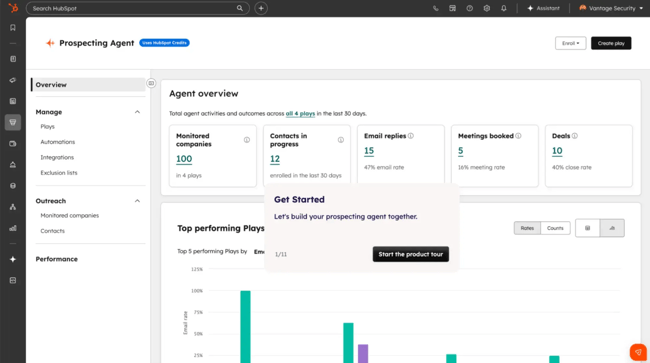
is an AI sales teammate that handles research and outreach while reps focus on closing. It is HubSpot’s native AI sales agent, built directly into HubSpot , and it’s the option I’d recommend first for any team already on the platform. Because the agent lives inside the CRM, it doesn’t require a complex integration or a data sync project and it already has access to every contact, deal, email, and activity record the team has logged.
Breeze monitors enrolled accounts for buying signals like job postings, funding rounds, leadership changes, and technology adoption, then alerts reps when accounts are ready to buy. The tool sources and enriches contacts through connected data providers, pulling in phone numbers, emails, and job titles automatically. When an account heats up, Breeze drafts personalized outreach based on the account signals and the research it just did. Reps can review every draft before sending or, once trust is established, set the agent to auto-send.
Beyond the core prospecting loop, Breeze supports customizable plays by product, market segment, or persona, with advanced outreach prompts and guardrails to keep messaging on-brand. Prospect research from multiple sources consolidates directly in HubSpot Smart CRM, eliminating the tool-switching that eats hours every week. Breeze also sets reminders to call or message on LinkedIn as part of multi-channel outreach, and supports multiple languages in Beta for global sales motions.
Pricing: Breeze Prospecting Agent is available in HubSpot Starter ($7/seat/month), Professional ($90/seat/month), and Enterprise ($150/seat/month) editions. It works on HubSpot Credits. Existing HubSpot customers can typically turn it on without procuring a separate tool.
What we like: Breeze doesn’t need a six-week setup to start producing value. If a team is already on HubSpot, the agent has the data it needs from day one, and the first researched account brief usually lands within minutes of turning it on. The combination of buying-signal monitoring and one-click-drafted outreach is the workflow I use most.
Best for: Sales teams already using HubSpot who want a native AI prospecting agent without a complex integration project, especially mid-market and SMB teams that need pipeline lift without enterprise AI overhead.
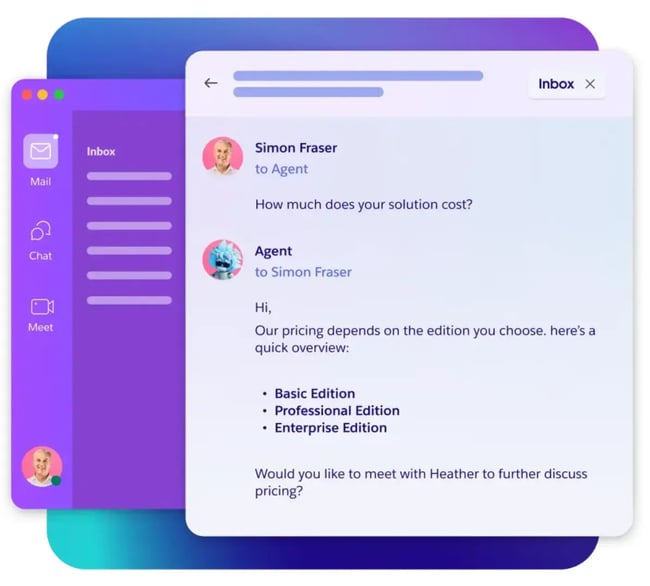
Salesforce Agentforce is Salesforce’s family of AI agents for sales, service, and operations. The two most relevant for sales are the SDR Agent, which nurtures inbound prospects around the clock, and the Sales Coach Agent, which runs role-play sessions tailored to specific deals so reps can practice before live customer interactions.
The Sales Coach Agent adapts to each rep rather than delivering a one-size-fits-all script. It provides contextual coaching based on real deals and real objections in the rep’s pipeline, making it genuinely useful for enterprise orgs with consistent ramp challenges.
Pricing: Agentforce uses a Flex Credits model introduced in 2025, with standard add-ons starting at $125 per user per month and Agentforce 1 Editions starting at $550 per user per month. Salesforce also raised list prices on Enterprise and Unlimited editions of Sales Cloud, Service Cloud, and Field Service by an average of 6% on August 1, 2025.
What I like: The Sales Coach Agent’s role-play feature is the most distinctive part of Agentforce for sales. Practicing objection handling against an AI that knows the actual deal is materially different from practicing against a generic script.
Best for: Enterprise sales orgs already standardized on Salesforce, especially those investing heavily in rep enablement and willing to navigate Salesforce’s more complex pricing model.
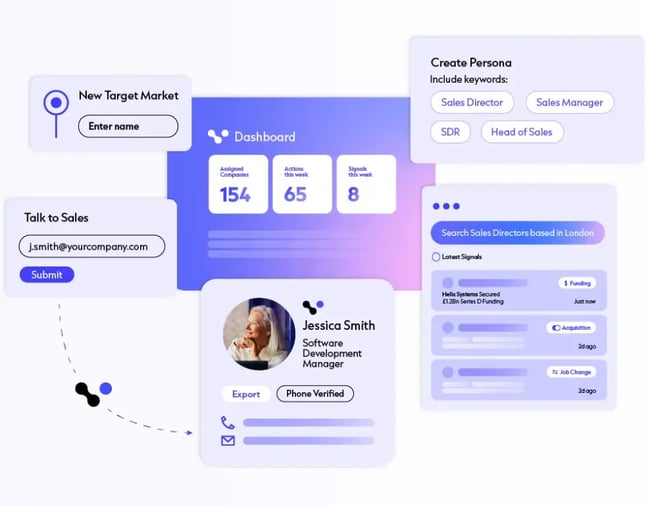
Cognism is a B2B sales intelligence and prospecting platform that has layered AI agents on top of its core data product. Its database covers over 400 million business profiles and 200 million verified business emails, with Diamond Data, phone-verified mobile numbers, as its standout differentiator. Cognism’s strongest position is in European markets, where its GDPR-compliant data and Do Not Call list checking across 13 countries is a real moat.
The AI features layer on top of that data. Cognism’s AI automatically surfaces verified insights and context on target accounts (funding announcements, leadership changes, strategic shifts), eliminating the manual research that used to eat up 45 minutes per account. It also provides AI-driven segmentation in higher tiers and an AI writing assistant for personality-aware outreach.
Pricing: Cognism doesn’t publish public pricing. Based on third-party sources, the Platinum tier typically runs from around $1,500 to $10,000 per year for smaller teams, while Diamond tier (which adds verified mobile numbers and intent data from Bombora) ranges from roughly $15,000 to $25,000+ annually depending on team size and feature mix. All pricing is quote-based behind a sales conversation.
What I like: Cognism’s AI account-research feature genuinely compresses the prep time before a call.
Best for: B2B sales teams running outbound motions into European markets, especially those who need GDPR-compliant data and verified mobile numbers more than they need a fully autonomous agent.
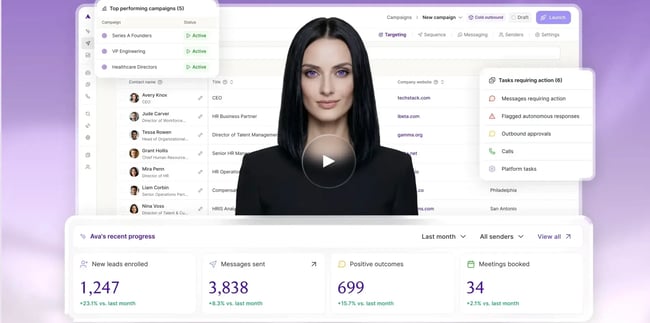
Artisan’s Ava is designed to operate as a fully autonomous AI sales agent, handling lead qualification, personalized outreach, email campaigns, and qualified-lead delivery without human intervention. Unlike assistive AI agents that sit beside the rep, Ava is built to run the SDR workflow end-to-end.
The platform includes a built-in database of over 300 million verified B2B contacts, which removes the need for a separate prospecting data tool. Ava can also run LinkedIn automation, sending connection requests and follow-up messages on the team’s behalf as part of multi-channel sequences.
Pricing: Artisan uses custom quote-based pricing depending on workflows, contact volume, and seat count. Pricing typically requires a sales conversation.
What I like: For teams that want a true autonomous SDR motion, not a copilot, Ava is one of the more honest implementations of that promise. The bundled contact database removes a common stack complication.
Best for: Sales teams that want to add outbound capacity without adding SDR headcount and are comfortable handing significant authority to an autonomous agent rather than keeping a rep in the loop on every email.
How to Choose the Right AI Sales Agent
Choosing the right AI sales agent comes down to five practical factors. The checklist below is the one I’d run any candidate tool through before buying.
- CRM integration: Does the agent read from and write to the team’s CRM natively, or does it require a sync project? Native integration is the difference between an agent that adds value on day one and one that becomes a six-month implementation. AI sales agents require high-quality CRM data, clear rules, and human oversight to perform reliably, and that starts with how cleanly the agent connects to the system of record.
- Data quality: What data does the agent rely on, and how is that data sourced, refreshed, and verified? An AI agent producing fast outreach on stale data just sends fast bad emails. Ask vendors specifically about verification methods, refresh cadence, and what happens when the agent hits a contact it can’t verify.
- Autonomy level: Is the agent autonomous, assistive, or configurable between the two? Match the autonomy level to the team’s comfort with handing over judgment. Teams new to AI usually do best starting in assistive mode and graduating to autonomous workflows once trust is established.
- Scalability: Will the agent’s pricing model and architecture still make sense at 10x the current usage? Some vendors price aggressively at low volume and become prohibitive at scale; others have set up overhead that only pays back at scale. Project usage two years out, not just for next quarter.
- Human oversight: What guardrails exist, what audit trails does the agent produce, and how easy is it for a manager to intervene? AI sales agents do not replace human reps in strategic work such as negotiation, relationship building, and complex deal management. The agent has to make it easy for humans to stay in the loop on the moments that matter.
For teams still evaluating options beyond these four, the broader catalog of AI agent tools is a good next step.
Frequently Asked Questions About AI Sales Agents
What can an AI sales agent do?
An AI sales agent can research prospects, draft and send personalized outreach, qualify leads, schedule meetings, log activity in the CRM, monitor deals for stalled patterns, and recommend next-best actions. The most advanced agents complete multi-step workflows autonomously without a rep clicking through each step. AI sales agents should always operate under human oversight during high-stakes moments, such as final proposals, negotiation calls, and sensitive customer relationships.
Will AI sales agents replace human sales reps?
No. AI sales agents automate repetitive, low-value work but cannot replace human empathy, judgment, or relationship management. HubSpot’s State of AI in Sales research found that 78% of sales professionals say AI helps them focus on high-value tasks rather than replace them. The shift is not from human to AI but from human alone to human plus AI, with reps spending less time on research and admin and more time on the moments that actually need a human.
How are AI sales agents different from chatbots?
A chatbot answers questions within a single conversation. An AI sales agent completes multi-step tasks across systems, researching a visitor’s company, identifying the right contact, drafting a personalized follow-up, scheduling a discovery call, and updating the CRM, all from a single interaction. The shorthand: chatbots respond, agents act.
Optimize with an AI sales agent.
AI sales agents are most effective when treated as partners rather than replacements. The repetitive work, research, admin, and follow-up go to the agent. The judgment calls, negotiation, relationship building, complex deal management, stay with the rep.
The best place to start is with one well-scoped use case, such as inbound lead qualification, outbound prospecting, or post-call follow-up, and a single agent that fits the existing tech stack. Get one motion working end-to-end before adding the next. For HubSpot customers, Breeze Prospecting Agent is the easiest first step, already inside the CRM and requiring no separate integration. For everyone else, the checklist above is the most efficient way to filter the field.
Editor's note: This post was originally published in July 2025 and has been updated for comprehensiveness.
Free Report: Smarter Selling with AI
New data and insights from 600+ sales pros on how they’re using AI and the results they’ve seen.
- How Sales Teams are Using AI
- Giving Time Back to Sales Reps
- Keeping Up with AI Trends
- And More!
Download Free
All fields are required.
Form not available
You're all set!
Click this link to access this resource at any time.
Artificial Intelligence