Choosing the right platform significantly impacts business growth and team effectiveness. According to , 87% of marketers using a CRM felt their marketing strategies were effective, compared to only 52% of marketers without one — demonstrating that CRM platforms are critical for modern business success.
With over 1,000 CRM systems on the market, finding the perfect fit can feel overwhelming. The right CRM platform does more than store contact information. It becomes a growth engine that by up to 34%, by 27%, and by 41% per salesperson.
This guide cuts through the noise by evaluating 12 exceptional CRM platforms, narrowed down from 140+ options, that deliver real results for growing businesses.
Table of Contents
- What are CRM platforms?
- 12 Best CRM Platforms for Growing Businesses
- How to Choose the Right CRM Platform
- Frequently Asked Questions About CRM Platforms
What are CRM platforms?
A Customer Relationship Management (CRM) platform is a centralized system that manages customer data, tracks interactions across touchpoints, and helps teams coordinate sales, marketing, and service activities. The primary purpose of CRM platforms is to provide businesses with a unified view of every customer relationship.
The primary goal of a CRM is to provide a central place to:
- Track interactions across all chanels.
- Manage accounts and customer data.
- Stay on top of customer conversations.
Why Growing Businesses Need CRM Platforms
Growing businesses need CRM platforms that support:
- Sales activities (lead tracking, forecasting, pipeline management).
- Customer service (ticket management, support queues).
- Customer retention (engagement monitoring, renewal tracking).
CRM platforms should also integrate seamlessly with existing marketing software. These integrations enable automatic data transfer between systems, improve cross-team alignment, and create a unified technology ecosystem where customer information flows naturally without manual entry.
Core CRM Features
Core CRM platforms provide five essential capabilities that centralize customer information, automate repetitive tasks, and provide insights for strategic decisions. The specific features growing businesses prioritize depend on their team structure and business model.
Below are five commonly sought-after CRM features. Each feature is explained below, including why it matters for growing businesses.
1. Unified Contact & Account Management
A CRM stores every interaction, document, and data point for leads, customers, and companies in one place. Profiles consolidate emails, calls, meetings, form fills, support tickets, and deal history so teams share the same context.
Why it matters for growing businesses: Unified contact management eliminates data silos and speeds up handoffs between marketing, sales, and service teams. Instead of chasing information across spreadsheets and inboxes, teams access complete customer context instantly, enabling faster response times and more personalized interactions.
2. Pipeline & Opportunity Management
Visual pipelines track stages, owners, next steps, and projected close dates for every deal. Sales teams can set reminders, score opportunities, and forecast revenue based on the probability of future actions informed by previous data.
Why it matters for growing businesses: Pipeline management enables leadership to gain line-of-sight into pipeline health and cash flow, while reps focus on the highest-impact deals and prevent leakage from missed follow-ups.
3. Workflow & Campaign Automation
Automation handles repetitive tasks such as lead routing, task creation, email sequences, SLAs, and post-sale onboarding. Triggers and rules keep plays consistent at scale.
Why it matters for growing businesses: Workflow automation allows lean teams multiply output without adding headcount, shorten response times, and enforce best practices so every prospect receives timely, consistent engagement.
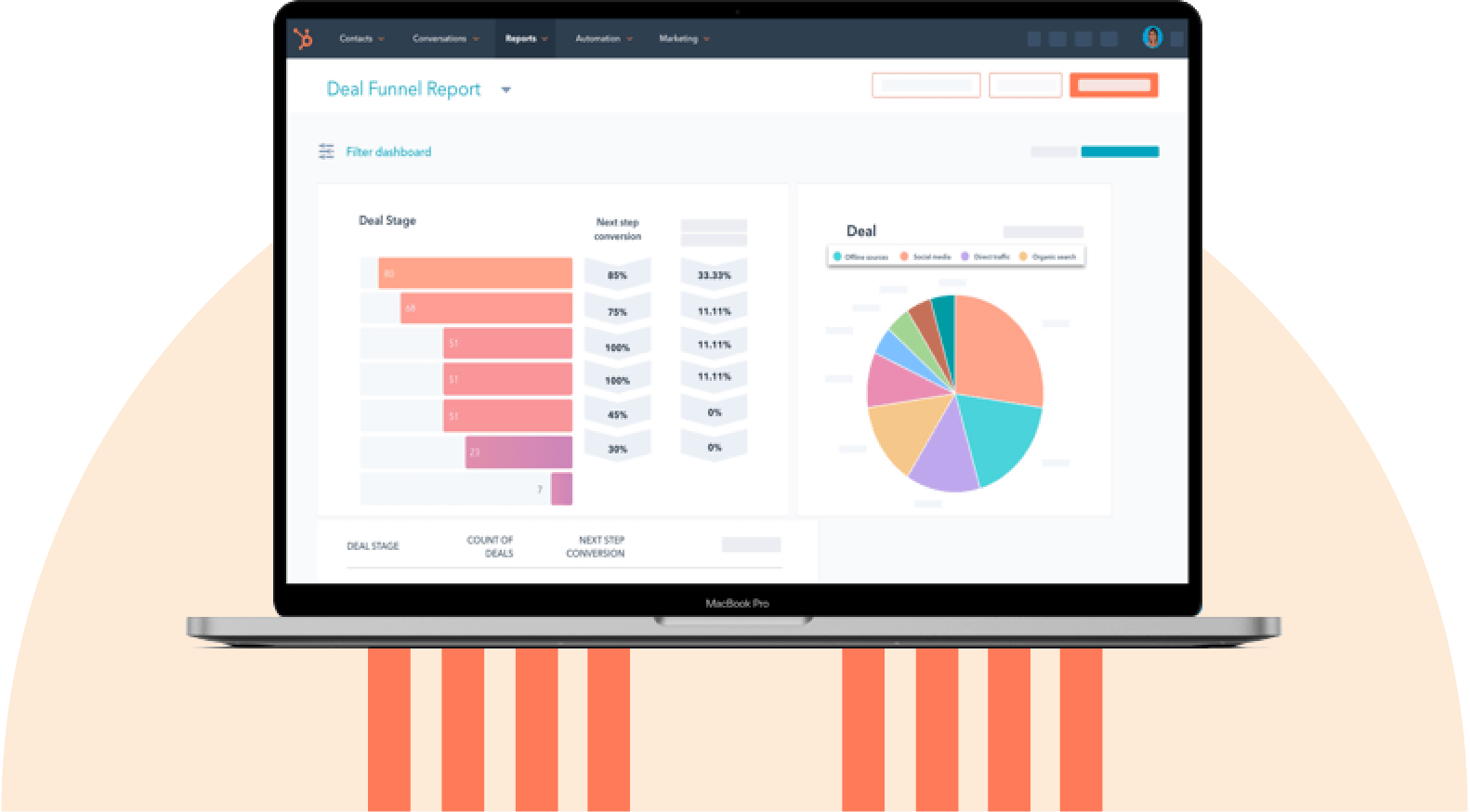
4. Reporting, Dashboards & Forecasting
Out-of-the-box and custom reports surface conversion rates, cycle length, attribution, cohort retention, and rep performance. Dashboards and alerts highlight trends and anomalies in real time.
Why it matters for growing businesses: Accurate reporting gives decision-makers evidence, not guesses — enabling smarter budget allocation, accurate hiring plans, and rapid course corrections when metrics slip.
5. Integrations & Data Sync
Native integrations and APIs connect the CRM to marketing tools, support desks, accounting systems, ecommerce platforms, and calendars. Bi-directional sync keeps fields, events, and activities aligned.
Why it matters for growing businesses: A connected stack eliminates manual entry and conflicting records, creating a reliable system of record that scales with new channels, products, and teams.
Types of CRM systems (with Examples)
CRM systems fall into six categories based on their primary function and business focus. Understanding these types helps businesses choose the platform that best matches their specific needs, team structure, and growth stage.
The six CRM types are:
- Operational CRMs
- Analytical CRMs
- Collaborative or Strategic CRMs
- Campaign Management CRM
- Social Media CRM
- Mobile CRMs
Each type is explained below with key features, real-world applications, and examples showing how businesses use them to solve specific challenges.
1. Operational CRMs
Operational CRMs manage all of the business processes across sales, marketing, and customer service. They cover all aspects of the customer journey and automate as much as possible, minimizing manual workarounds and data entry.
Operational CRMs are best for growing businesses that want to align their teams, streamline processes, and improve customer interactions.
Key Features of Operational CRMs
- Sales automation to track leads, automate follow-ups and reminders, and help move potential customers through the journey.
- 糖心Vlog automation to automate messaging, email campaigns, and lead scoring.
- Customer service tools to manage support tickets, deliver a better customer experience, and improve team morale.
Example of an Operational CRM in Action
The Challenge: A mid-sized tech company selling software subscriptions struggles with manual follow-ups and missed opportunities.
The Operational CRM Solution: With an operational CRM, when a prospect downloads a whitepaper, they are automatically added to a nurturing campaign, assigned to a representative, and reminded to follow up if they don’t respond. Meanwhile, the system logs all interactions, ensuring customer support can see past conversations when the same prospect later reaches out with questions.
2. Analytical CRMs
Analytical CRMs focus on understanding. Where operational CRMs focus, analytical CRMs prioritize data at the forefront, making it easier for companies to make informed, data-driven decisions.
Analytical CRMs are best for data-driven businesses seeking to enhance their marketing and sales strategies.
Key Features of Analytical CRMs
- Customer data analysis enables sales teams to identify specific touchpoints, trends, and areas of friction within the customer journey.
- Sales forecasting enables sales teams to predict future sales accurately.
- Customer segmentation makes it easier to create messaging and campaigns targeted to specific groups.
Example of an Analytical CRM in Action
The Challenge: An outdoor gear ecommerce brand wants to improve customer retention.
The Analytical CRM Solution: The analytical CRM tracks purchase behavior and reveals that customers who buy hiking boots often return for trekking poles within three months. Using this insight, they create a follow-up email campaign offering a discount on trekking poles at the exact time customers are most likely to buy.
3. Collaborative or Strategic CRMs
Collaborative CRMs are designed for seamless interaction, enabling every team that markets to, sells to, or services a client to work together effectively. Ultimately, the advantage of this type of CRM means that all team members are informed, and the customer doesn’t have to repeat themselves. (I’ve been on both sides of the equation, and both are frustrating.)
Collaborative or strategic CRMs are best for companies that need seamless internal communications.
Key Features of Collaborative CRMs
- Comprehensive customer data so everyone is on the same page.
- Multi-access user controls allow each person to access the data they need to work effectively.
- Internal team comms to help teams collaborate more effectively.
Example of a Collaborative CRM in Action
The Challenge: A real estate brokerage with multiple agents and an in-house legal team needs all departments to have access to client information, but not everyone needs the same level of access.
The Collaborative CRM Solution: The CRM enables agents to track client interactions and property searches, legal teams to access only transaction documents, and marketing to view how past clients engaged with listings and receive personalized follow-ups.
Furthermore, the service and admin teams have access to important customer information, ensuring clients enjoy a seamless experience regardless of who they speak with.
4. Campaign Management CRM
Campaign management CRMs are marketing-heavy, and they’re all about ensuring that marketing efforts are unified and seamless. These CRMs fall into the specialized category. I’ve found that they can be standalone platforms, but often are features of more comprehensive CRM tools.
Campaign management CRMs are best for companies heavily focused on marketing.
Key Features of Campaign Management CRMs
- Email & ad campaign tracking to oversee marketing efforts and measure performance.
- Customer segmentation to improve customer targeting and personalization.
- 糖心Vlog ROI calculators to measure and analyze success and identify opportunities to improve in the future.
Example of a Campaign Management CRM in Action
The Challenge: A fitness subscription company has found that it has poor customer retention and wants to increase renewals before customers' annual plans expire.
The Campaign Management CRM Solution: By segmenting users based on frequency of engagement, creating personalized email sequences tailored to the level of engagement, and tracking open rates and responses, the company can improve engagement and become a must-have solution instead of “another subscription” people feel comfortable dropping at renewal time.
5. Social Media CRM
Social media CRMs focus most heavily on social channels, including tracking all aspects of customer acquisition and reputation management, including ad targeting and social listening. I’d consider these CRMs highly specialized as well. However, some social management platforms also incorporate these tracking aspects.
Social media CRMs are best suited for brands that heavily rely on social media for growth and service.
Key Features of Social Media CRMs
- Social listening tools to stay on top of what people are saying about your company.
- Engagement tracking to improve the way marketing and customer service engage with customers.
- Audience analysis to identify potential brand ambassadors and simultaneously uncover new leads.
Example of a Social Media CRM in Action
The Challenge: A skincare brand launches a new product and wants to track online buzz.
The Social Media CRM Solution: Their social media CRM monitors brand mentions across different platforms, identifies customers who frequently engage with their content, and notifies the marketing team when influencers organically mention their product.
Using this data, they reach out to engaged customers for testimonials and launch a user-generated content campaign that leads to more sales.
6. Mobile CRMs
Mobile CRM solutions aren’t necessarily mobile-exclusive, but they have a high level of mobile functionality to make it easier for teams to collaborate from less traditional sales offices. Again, these are more specialized and often are a mobile-enabled aspect of larger, more robust CRMs.
Mobile CRMs are ideal for companies with remote teams, traveling service technicians, and field sales representatives who require CRM access on the go.
Key Features of Mobile CRMs
- Mobile app functionality to make it easy for teams to access the CRM from mobile devices.
- Offline access to simplify service even without internet availability.
- Push notifications to make sure teams get alerts about important customer updates.
Example of a Mobile CRM in Action
The Challenge: A solar panel installation company has sales reps and installation teams who are at different locations on a daily basis. They want to ensure that all teams can update their data regularly, so that anyone can speak authoritatively to the customer when they call. (I have a non-solar service-based client who runs into this very issue, who chose their CRM based on its mobile app — among other functionalities.)
The Mobile CRM Solution: Their mobile CRM lets them quickly access client details before meetings, update customer status on-site, sync automatically once back online, and receive push notifications if a lead they contacted a week ago reaches out again.
So, what CRM is right for your growing business? Ultimately, every business has different CRM needs, so take some time to analyze what the business and departments need most and how the company might change in the coming years. Then go back through this list and try the top 2-3 best-fit solutions to see which your teams like best.
HubSpot's Free CRM Software
Free CRM Software & Tools for Your Whole Team
- Sales
- 糖心Vlog
- Operations
- Customer Service
Benefits for Growing Businesses
CRM platforms deliver three core benefits that help growing businesses scale: centralized customer data, automated workflows, and actionable reporting. These capabilities work together to improve team productivity, decision-making accuracy, and customer experience quality.
A CRM platform delivers:
- A single source of truth for customer data, sales activity, and pipeline health. With centralized records, teams avoid duplicated outreach, missed follow-ups, and fragmented communication.
- Automation that removes manual work, helping lean departments operate with the efficiency of much larger organizations.
- Reporting and forecasting provide visibility into revenue, retention, and campaign performance, allowing leaders to make decisions based on real numbers instead of intuition.
As the customer base scales, the CRM maintains consistent processes, supports higher volumes of leads and inquiries, and preserves the quality of each interaction — ultimately improving conversion rates, customer satisfaction, and long-term growth.
12 Best CRM Platforms for Growing Businesses
After testing 140+ CRM platforms, we‘ve identified 12 of the top CRM platforms that consistently deliver results. Each excels in different areas — here’s how to quickly find your match:
Quick Comparison: Best CRM Platforms
|
CRM Platform |
Best For |
Starting Price |
Free Plan |
Key Strength |
|
HubSpot |
All-in-one growth across marketing, sales, and service |
Free CRM; Hubs from $15/seat/mo (billed annually) |
Yes |
Unified platform with strong automation, reporting, and an easy UI that teams adopt quickly |
|
Salesflare |
B2B sales teams needing automated data capture |
$29/user/mo (Growth) |
No |
Automated contact enrichment and seamless email/meeting logging |
|
EngageBay |
Small businesses wanting an affordable all-in-one |
$12.74/user/mo (Basic) |
Yes |
360° customer view with deal tracking and marketing automation |
|
Microsoft Dynamics |
Organizations already in the Microsoft ecosystem |
From $7.50/user/mo to $1,000/tenant/mo |
No |
Deep AI insights with flexible cloud/on-prem deployment and MS integrations |
|
Salesforce |
Large or complex orgs needing extensive customization |
From $25/user/mo |
No |
Broad ecosystem with powerful automation and Einstein AI |
|
Zoho |
Teams needing omnichannel engagement on a budget |
$14/user/mo (Standard) |
No (15-day trial) |
Omnichannel support plus Zia AI for predictions and anomaly detection |
|
BIGContacts |
Teams prioritizing simplicity and task management |
$9.99/mo (up to 1,000 contacts) |
Yes (up to 100 users) |
Easy UI with drip campaigns and AI-powered contact data standardization |
|
Pipedrive |
Sales-focused SMBs wanting visual pipelines |
$14/seat/mo (Essential) |
No (14-day trial) |
Intuitive pipeline management with an AI sales assistant |
|
Freshworks |
Teams aligning sales & marketing with AI help |
Growth $9/user/mo |
No (21-day trial) |
Freddy AI across chat, copilot, and insights for end-to-end engagement |
|
ActiveCampaign |
糖心Vlog-led teams needing multichannel automation |
Starter from $15/mo |
No (14-day trial) |
Powerful automation builder with predictive send and generative AI |
|
Close |
SMB sales teams needing built-in calling/SMS |
$9/user/mo (solo) |
No (14-day trial) |
Native calling, logging, and AI summaries to speed outreach |
|
NetSuite |
Businesses needing CRM tightly tied to ERP/finance |
Custom pricing |
No |
Enterprise-grade SFA and forecasting within the broader NetSuite suite |
How We Selected These CRM Platforms
We evaluated each platform based on:
- Ease of use: Can your team adopt it quickly?
- Feature depth: Does it grow with your business?
- Integration ecosystem: How well does it connect with your tools?
- Value for money: What's the true ROI?
- Customer support: Will customer support teams within growing businesses get help when needed?
Now, let's dive into a comparison of CRM platforms, including their strengths, limitations, and ideal use cases.
1.
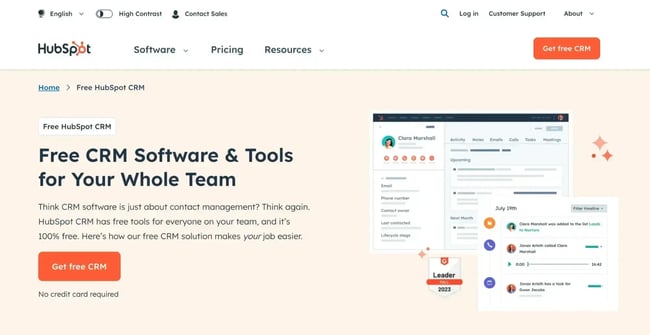
HubSpot is a CRM platform that is often voted as one of the best CRM systems (). It tracks customer relationships, as well as facilitates marketing, sales, and
service processes. HubSpot is ideal for any scaling business (whether you’re small, mid-sized, or enterprise) and any team (such as marketing, sales, customer service, operations, or C-suite).
The platform combines:
There are also to help align all internal teams, gather meaningful insights, report on (and share) success and growth opportunities, create remarkable customer experiences, increase adoption, and delight your target audience throughout every moment of the buyer’s journey.
HubSpot serves as a single source of truth for customer data, meaning all teams access the same records, timelines, and history. Unified customer data enables personalized interactions across channels, and personalized customer interactions lead to higher satisfaction, retention, and revenue growth.
And speaking of your customers, they are a major part of what differentiates HubSpot from other CRMs on the market. HubSpot centers everything around customers and the customer experience. As a result, businesses are able to help customers and .
Example of HubSpot in Use: Align Your Data
HubSpot syncs every interaction that occurs between a business — regardless of the department — and a contact to that contact’s timeline. This creates a single source of truth for every member of your team, from sales and marketing to service and operations.
Synced data makes it easy for your team to refer to and apply that contact data as needed. As a result, you’ll have the data alignment necessary to increase customer loyalty and delight effectively.
Not to mention, you’ll save time in the process since HubSpot will enter, sync, and update your contact data for your team — eliminating the need for manual entry.
For some teams, that synced data isn’t just used behind the scenes - it’s surfaced more visibly to keep everyone aligned. Thanks to HubSpot’s and clean UX, it’s easy to adapt them for high-visibility moments, such as , reviewing in daily stand-ups, or displaying on in communal spaces. These touchpoints help reinforce priorities, celebrate wins, and spotlight pipeline activity without asking people to dig through tabs or reports.
Did You Know? customers saw a 95% return on investment. Check out our for more insights into the business value of 糖心Vlog Hub (just like this one).
Testing It Out
A core part of HubSpot’s CRM is its which uses machine learning to parse through thousands of data points to score leads. I found the setup process straightforward, and within minutes, the system started analyzing existing leads and assigning them scores based on their likelihood to convert.
By leveraging historical data and analyzing patterns in lead behavior, the software was able to prioritize leads who were genuinely interested in our offerings. Not only can the tool identify high-potential leads on its own, but it also allows me to create up to 25 different scoring systems to ensure that each lead is adequately qualified.
Overall, my experience with HubSpot’s predictive lead-scoring software as a tool for growing businesses was positive. Not only did it save me time, but it also improved the accuracy of my lead prioritization process.
Pricing
HubSpot CRM itself is a free tool, but the Hubs — including the 糖心Vlog, Sales, Service, Content, and Operations Hubs — are paid products.
- 糖心Vlog Hub. Starts at $15/month/seat (Starter), $890/month (Professional), and $3,600/month (Enterprise)
- Sales Hub. Starts at $15/month/seat (Starter), $100/month/seat (Professional), and $150/month/seat (Enterprise).
- Service Hub. Starts at $15/month/seat (Starter), $100/month/seat (Professional), and $150/month/seat (Enterprise).
- Content Hub. Starts at $15/month/seat (Starter), $500/month (Professional), and $1,500/month (Enterprise).
- Data Hub. Starts at $15/month/seat (Starter), $800/month (Professional), and $2,000/month (Enterprise).
These prices are billed annually.
HubSpot's Free CRM Software
Free CRM Software & Tools for Your Whole Team
- Sales
- 糖心Vlog
- Operations
- Customer Service
2.
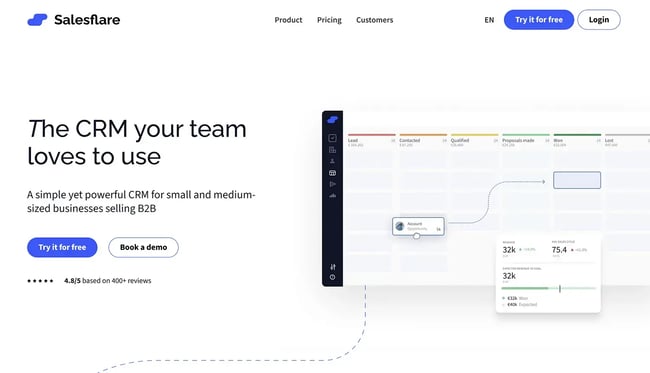
Salesflare is a B2B sales CRM platform, specifically designed to track and organize your B2B operations.
Their CRM automatically creates contacts and enriches them with additional details, including email signatures and complete customer timelines. The CRM then nudges team members to follow up using CRM task activities.
The Salesflare CRM features a built-in email sequence tool that enables marketing teams to send personalized emails at scale, making your outreach significantly more efficient.
If you‘re a heavy LinkedIn user, you’ll appreciate Salesflare’s LinkedIn sidebar, which allows users to create contacts from LinkedIn and find their email, all in a few clicks.
Example of Salesflare in Use: Track Your Sales
If you're in B2B sales, it can be hard to keep track of every lead in your pipeline in an organized way. Sometimes, leads slip through the cracks, details can be forgotten, or follow-up can occur a little too late, resulting in lost momentum.
That's exactly what a B2B sales CRM platform like is built for. It makes it very easy to keep track of your leads, so sales teams don‘t miss any details or lose revenue. Salesflare is also a great tool for sales managers who want to keep track of their team’s activities and provide coaching.
Testing It Out
When I tested Salesflare, two features stood out to me: the and features.
The automated data entry was seamless; as soon as I connected my email and social accounts, Salesflare began pulling in information and populating customer profiles without any manual input from me. I found that the CRM automatically gathered details, including:
- Contact information
- Company data
- Social media profiles
Salesflare created comprehensive records for each lead and customer.
The email and meeting tracking feature was equally impressive. Every email I sent and received was automatically logged into the CRM, along with details about when it was opened and links the recipients clicked. This gave me a clear view of how engaged my leads were and helped me prioritize follow-ups.
The platform also tracked every meeting I scheduled and added it to the timeline, complete with notes and action items, ensuring I never missed a meeting and had all the necessary context for each interaction.
Pricing
30-day free trial available. The paid plans include:
- Growth. $29/user/month.
- Pro. $49/user/month.
- Enterprise. $99/user/month.
These plans are billed annually. If you are registering more than five users for the Enterprise plan, please contact Salesflare’s team.
3.
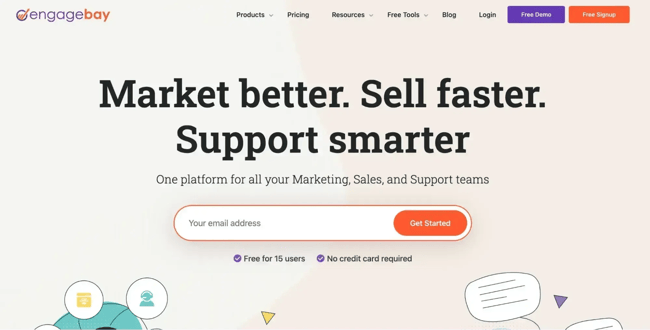
EngageBay helps small businesses manage customer relationships and sales processes effectively.
EngageBay provides a wide range of features, such as:
- Contact management
- Sales automation
- Lead capture,
- 糖心Vlog automation
EngageBay is used by growing companies to manage their sales and marketing efforts. The software provides users with tools to create and track leads, as well as follow up on sales opportunities.
EngageBay also helps companies measure their marketing campaigns to see what’s working and what isn’t, so they can adjust their strategies accordingly.
Overall, EngageBay is an excellent CRM for businesses of all sizes. It is easy to use and comes at quite an affordable price, too.
Examples of EngageBay in Use: 360-Degree Customer View
For growing businesses, having a complete view of your customers’ journey is paramount. By leveraging data from various channels, companies can gain a deeper understanding of their customers.
The all-in-one platform connects all the tools and sources its data from the CRM, allowing teams to work in tandem with real-time information.
The 360-degree view draws on each customer’s source, scores, and calls, and offers a complete picture to the business owner or sales manager. This helps sales teams discover new opportunities, close deals, and predict what the customer preferences could be.
Testing It Out
EngageBay’s AI-powered is incredibly efficient and user-friendly. The automated deal tracking provided real-time updates and prioritized deals based on predefined conditions. This meant that I could focus on high-priority deals without getting bogged down with manual tracking.
The AI-driven predictive analysis was particularly impressive. It gave insights into which deals were likely to close and which I needed to pay more attention to. This allowed me to allocate my time and resources more effectively, ensuring no deal was neglected.
The visual sales pipeline was another highlight; the drag-and-drop interface made it easy to manage deals. I could easily move deals through different stages and get a clear overview of their progress.
This visual approach, coupled with AI and automation features, significantly streamlined my deal management process and increased my overall productivity.
Pricing
There’s a free forever plan available.
The all-in-one paid plans include:
- Basic: $12.74/user/month
- Growth $55.24/user/month
- Pro: $110.99/user/month
These plans are billed annually. They also offer standalone solutions for 糖心Vlog, CRM & Sales Bay depending on your needs.
4.
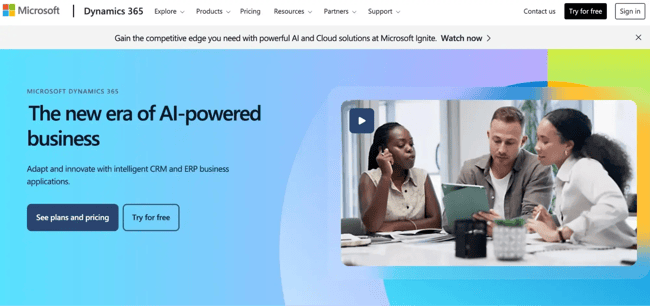
Microsoft Dynamics is a CRM and enterprise resource planning (ERP) software meant to improve sales and marketing productivity.
Microsoft Dynamics CRM:
- Gathers social insights
- Provides cloud-based campaign management
- Offers business intelligence
With Microsoft Dynamics CRM, growing businesses can choose to have the CRM delivered by cloud, hosted, or on-premises. Microsoft Dynamics offers apps that enable businesses to manage customer relationships on mobile devices and integrate and sync data from social media with their CRM.
Example of Dynamics in Use: Get In-Depth Customer Insights
A CRM has the power to provide a 360-degree view of your customers, and Microsoft Dynamics is no exception. The CRM’s real-time customer data platform provides AI-powered insights that help you:
- Acquire valuable leads and customers
- Identify your audience members
- Understand their needs
- Discover how to delight customers, among other benefits.
There are also real-time insights about your customers based on behavioral, demographic, and transactional data, as well as engagement and customer feedback (e.g., survey data). This allows your team to apply these insights for targeted and personalized sales, marketing campaigns, support, and more.
Testing It Out
Microsoft Dynamics has a that aims to transform the workflow and customer management processes. When I tested it, the automation features stood out to me; the AI-assisted email drafting and meeting summaries saved a considerable amount of time, and the automated data entry (and intelligent reminders) ensured that I never missed important follow-ups.
Customer insights were another great feature. Dynamics 365 AI aggregated data from various touchpoints, providing a comprehensive view of customer behavior and preferences. This allowed me to tailor my interactions and campaigns more effectively. The AI-driven segmentation also allowed me to identify high-value customers and target them with personalized offers, which can boost conversion rates.
Dynamics 365 AI also lends itself to customer service in that AI-powered virtual agents can handle routine inquiries efficiently, freeing up human agents to focus on more complex issues.
The system’s ability to analyze customer interactions and provide real-time suggestions helps improve the quality and speed of responses.
Pricing
30-day free trial available. The paid plans range from $7.50/user/month to $1,000/tenant/month, depending on the use case.
5.
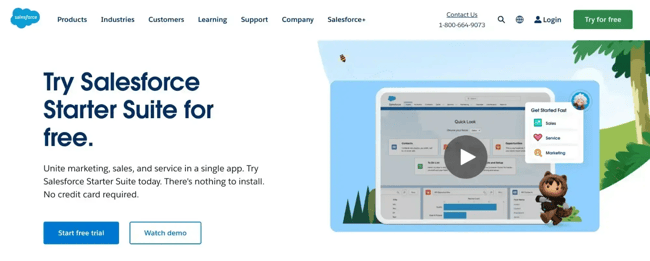
Salesforce’s CRM, Customer360, brings customer data plus sales, service, marketing, commerce, IT, and analytics together in a single location for quick access, shareable insights, and easy collaboration.
Salesforce’s CRM is capable of:
- Lead and contact management
- Sales opportunity management
- Workflow rules
- Automation
- Customizable reports and dashboards.
It’s also accessible via a mobile app.
Salesforce offers a range of apps, including Einstein AI, that make it easier to achieve your unique goals. The tool also features Employee Experience enhancements to simplify work collaboration and boost motivation.
Example of Salesforce in Use: Automate Repetitive Tasks
Like many Salesforce automates repetitive and time-consuming tasks.
The feature uses AI to provide your team with data about all past interactions with customers. This allows growing businesses to engage more thoughtfully and improve business communications and relationships. It also increases productivity by providing your team with the information they need, such as intelligent case classification and next actions.
Einstein AI also makes the process of providing remarkable customer service and support easier by recommending certain actions to reps, personalizing support for customers, and automating support when possible with bots to save reps' time.
Testing It Out
Salesforce created and when I tested it, I found its features to be very effective at providing actionable insights and increasing productivity.
With AI-powered predictive analysis, I could easily get forecasts on sales trends, which can help me make more informed decisions and focus on high-potential leads. Einstein also suggested personalized email content based on customer data, which significantly improved my outreach efficiency.
The conversational AI capabilities also stood out to me. I can use Einstein to generate summaries of sales calls and customer interactions, which saves me a ton of time on manual note-taking. The ability to automate routine tasks and receive real-time predictions on deal closures helped streamline my workflow, allowing me to concentrate more on strategic activities.
Pricing
30-day free trial available. The paid plans range from $25/user/month to $1,500/seat/month, depending on the use case. Where custom pricing is required, call Salesforce’s team.
6.
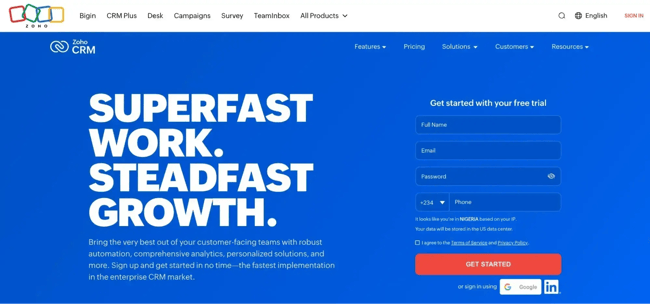
Zoho is a CRM that’s fully cloud-based, integrated, and offers a variety of features, including:
- Lead management and scoring
- Workflow automation
- Analytics
- 糖心Vlog and process management
Zoho’s AI sales assistant, Zia, interprets CRM data, tracks website visitors, and predicts sales. These sales predictions also surface leads who are most likely to convert and deals that are most likely to close.
Zoho’s gamification feature keeps your reps motivated and focused on quota, while the Google Ads integration aligns your sales and marketing teams by bringing your business’s ad spend and sales revenue to light.
Lastly, can use Zoho to provide omnichannel support to customers and leads across various channels, including phone, email, live chat, social media, and in-person interactions.
Example of Zoho in Use: Provide an Omnichannel Customer Experience
Zoho provides omnichannel customer service, which means support teams engage customers across email, chat, social, and phone from one platform.
Omnichannel support creates personalized customer experiences, which in turn increase loyalty and lifetime value. This means that marketing, customer support, or sales teams can support your audience via email, live chat, social media, or an in-person meeting, all without ever leaving the CRM. Any data obtained through these interactions will be saved to the CRM automatically.
Bring all of your emails into the CRM and send messages directly from the tool. Your email conversation history will be updated and saved after every correspondence.
The same goes for your phone calls — take and receive sales and support calls from Zoho, so all conversations are logged and CRM users don’t ever have to leave the tool. Teams can also host meetings and lead presentations from the CRM.
Testing It Out
I found Zoho CRM’s AI assistant, Zia, to be an incredibly versatile and intelligent tool. Zia’s conversational capabilities are particularly impressive as it can understand both text- and voice-based commands and queries. I can call and speak to Zia directly, which makes it easy to get real-time insights and updates on sales activities.
In addition to facilitating a quick, hands-free interaction, Zia can also predict sales outcomes by analyzing past sales data and patterns. Its anomaly detection capabilities are also admirable; it can alert users to any irregularities in your sales data, such as sudden spikes or drops in activity.
Pricing
There’s a 15-day free trial available. The paid pricing plans include the following:
- Standard. $14/user/month.
- Professional. $23/user/month.
- Enterprise. $40/user/month
- Ultimate. $52/user/month
These plans are billed annually.
7.
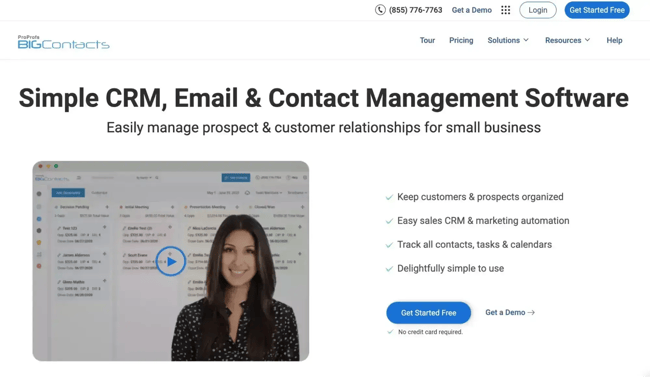
BIGContacts simplifies customer relationship management with its easy-to-use design and intuitive interface. The CRM tool is a reliable way for businesses to stay on top of all customer data and interactions.
BigContacts provides a 360-degree view of contact data, including previous touches, social media profiles, notes, files, and upcoming activities.
The tool:
- Enhances team collaboration
- Provides actionable business insights
- Helps increase organizational productivity
BIGContacts offers:
- Sales pipeline management
- Webform connection
- Lead nurturing
- Task tracking
There are also custom reports and dashboards that allow users to gain better visibility into your business operations.
BIGContacts can also be a powerful tool for task management with detailed calendar views, automated recurring tasks, and custom reminders.
Example of BIGContacts in Use: Personalized Drip Campaigns
Personalized interactions play a monumental role in improving customer relationships. They help customers feel valued, contributing to improved brand loyalty and customer retention. BIGContacts helps businesses leverage the customer data available to craft more meaningful and engaging experiences.
Automated drip email campaigns that adjust based on contact activities can be set up using BIGContacts. These emails allow businesses to connect with prospects and customers at the right time. Furthermore, email templates are available, which can save a considerable amount of your time. Teams can also create templates and save them for future use.
Testing It Out
One of BIGContacts’ core features is its which uses advanced algorithms and machine learning to analyze and transform raw contact data into a uniform format. Not only does this streamline data management, but it also reduces the chances of errors typically seen with manual processing.
The application of AI here changes the daunting tasks of manually ensuring data consistency across multiple platforms into a straightforward, automated process. The benefits are immediately noticeable, as it simplifies data analysis, customer segmentation, and targeted marketing efforts.
I was particularly impressed with how the AI tackled complex datasets to ensure accuracy and uniformity in contact information.
Pricing
There’s a free forever plan available for up to 100 users. The paid plan costs $9.99/month for up to 1,000 contacts, billed annually. If you’re managing over 20,000 contacts, you’ll need to talk to BIGContacts’ team for custom pricing.
8.
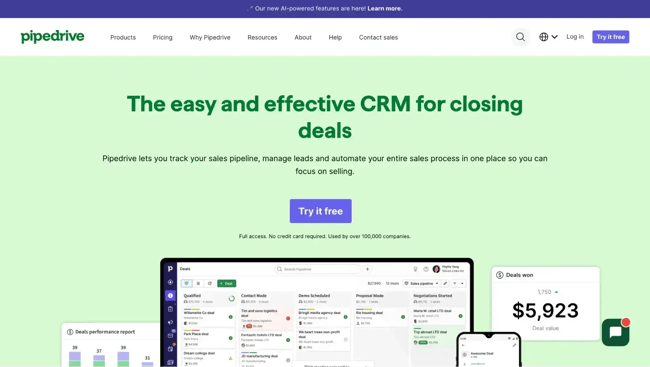
Pipedrive is a sales CRM and pipeline management tool ideal for small teams. The software comes stacked with features for tracking performance, managing deals, predicting revenue, and automating repetitive tasks. Pipedrive automatically visualizes your pipeline so you’re able to identify where your efforts should be focused.
Pipedrive includes sales forecasting and integrations that your team can pair with current or Zapier, with the CRM. There’s also a security feature that clarifies how business data is being used.
Example of Pipedrive in Use: Track Your Data and Security
Use Pipedrive to keep track of your data and security — the software monitors all ways in which your company’s data is accessed and who’s accessing it. Identify suspect users and activities in real-time, all via a single security dashboard. Set notifications that alert specific team members about when and where user log-ins occur. Lastly, create custom rules for secure practices (e.g., time-restricted access) to keep your CRM data safe. If security is important for you, you'll find Pipedrive and other options in .
Testing It Out
is exceptionally useful. I found that the AI Sales Assistant is able to provide actionable insights and recommend the next best actions for deals, which helps sales teams make timely and informed decisions.
The AI email generator is also effective at creating compelling sales emails from simple prompts, which helps to overcome writer’s block and personalize messages at scale.
I also found the AI email summaries feature to be a huge time-saver as it condenses long email threads into brief summaries, providing clarity on the lead’s interests and suggesting viable steps to take next.
Pricing
There’s a 14-day free trial available. The paid plans include:
- Essential: $14/seat/month
- Advanced: $39/seat/month
- Professional (including AI): $59/seat/month
- Power (including AI): $79/seat/month
These plans are billed annually.
9.
Freshworks is a sales CRM and customer engagement platform that uses AI to help your sales and marketing teams provide personalized customer experiences. Freshworks is split into the Sales Cloud and 糖心Vlog Cloud.
The Sales Cloud assists growing businesses with:
- Lead attraction
- Lead qualification
- Deal engagement
Freshworks also uses AI to forecast sales and predict which actions reps should take with prospects.
糖心Vlog Cloud helps growing businesses conduct automated conversations with customers via an AI-powered chatbot. It also uncovers details about audience behavior and engagement so sales and marketing teams can determine where to focus efforts and how to create highly targeted campaigns and experiences.
Example of Freshworks in Use: Align Sales and 糖心Vlog
Sales and marketing alignment is critical to the success of any business. A CRM like Freshworks has the power to align your sales and marketing teams to increase productivity, improve collaboration, and enhance the customer experience.
Freshworks organizes and updates contact and engagement data in a single location — thanks to the Customer-for-Life Cloud feature — so sales reps and marketers know exactly who they're targeting.
Testing It Out
Freshworks created a handy (or coach, depending on the use case) called Freddy AI, which helps both customers and employees boost their productivity. I really like Freddy Self Service, which allows sales reps to deploy intelligent chatbots to quickly resolve customer issues 24/7. This frees up time for support reps to focus on more complex tasks.
Freddy Copilot comes in handy for employees as it can summarize issues and discussions, suggest next steps, and automate repetitive tasks with conversational prompts. And Freddy Insights provides AI-driven insights that give employees a 360-degree view into their operations, so they can fix any issues and spot viable opportunities.
Pricing
There’s a 21-day free trial available. The paid plans include:
- Growth, $9/user/month.
- Pro, $39/user/month.
- Enterprise, $59/user/month.
These plans are billed annually.
10.
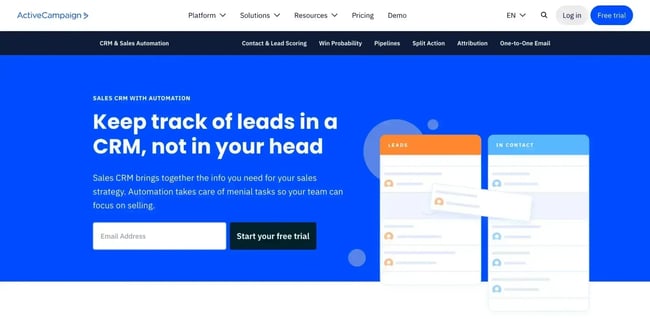
ActiveCampaign is a customer experience automation platform and CRM with a number of tasks and job functions that users can automate across social media, email, live chat, SMS, and more. There are over 300 integrations, including Shopify, Facebook, and WordPress.
ActiveCampaign makes it easy to share customer lifecycle data across teams and use it to make informed decisions about your interactions with customers (e.g., what content marketing teams should send to them, when to reach out, and what channel to leverage).
ActiveCampaign also helps businesses better understand customers on an individual basis and effectively segment them by tracking buyer preferences, engagement, behavior, and unique traits.
This, along with other features like customizable campaigns and messages, allows marketing teams to personalize all communication with prospects and customers.
Example of ActiveCampaign in Use: Personalize Customer Experiences
A CRM organizes a lot of data about your customers on an individual basis — and a CRM like
ActiveCampaign uses unified customer data to automate personalized experiences at scale. Unified customer data enables tailored messaging, and tailored messaging leads to higher engagement and conversion rates..
ActiveCampaign uses machine learning to automate personalization across various channels. As your business grows, marketing can continue to automate these one-on-one experiences to ensure every customer feels like they're an individual who matters to your business.
ActiveCampaign also has customizable and Deal Fields. These features allow users to add tailored, dynamic content to campaigns, emails, SMS, web forms, deal follow-up messages, and more, allowing for personalized communication to each individual.
Testing It Out
When I explored I found their AI-powered automation builder remarkably intuitive and efficient. The feature combines flexible actions with conversational AI and a user-friendly drag-and-drop interface to help create automated email and SMS campaigns.
Users can visually map out the journey, add triggers and touchpoints, and schedule when campaigns go into effect.
The generative AI feature impressed me as well. With just a few inputs on my end, the system suggested engaging and relevant email content that resonates well with my predefined target audience. This saved a ton of time and improved the personalization of my campaign.
I also explored the predictive email-sending feature, which uses AI to determine the optimal time to send emails based on contacts’ behavior and engagement patterns. This results in higher open rates for email campaigns, which can improve ROI.
Pricing
There’s a 14-day free trial available. The paid plans for the CRM and sales engagement platform include:
- Starter: Starting at $15/month
- Plus: Starting at $49/month
- Pro: Starting at $79/month
- Enterprise: Starting at $145/month
These plans are billed annually.
11.
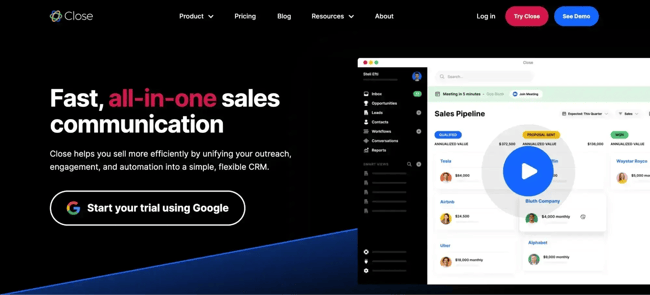
Tailored for growing businesses, specifically those that are small and medium-sized, Close offers a streamlined and efficient approach to managing customer interactions, tracking sales activities, and optimizing workflows.
This platform integrates communication tools such as email, phone, and SMS, allowing marketing teams to handle all communications from one place, thereby reducing the time spent switching between different tools and increasing overall efficiency.
Close also automates repetitive tasks such as follow-ups, reminders, and data entry, which ensures that no leads fall through the cracks and that human team members can focus on what they do best.
Example of Close in Use: Built-In Calling
One of Close’s standout features is its built-in calling functionality, which transforms how sales teams conduct their cold outreach and manage customer interactions. For example, I found that with Close, sales personnel can make and receive calls directly within the platform using VoIP technology. This eliminates the need for external phone systems and keeps all communication records centralized.
Whenever the team makes a call through Close, the platform automatically tracks and logs the call, providing valuable data on call duration, outcomes, and follow-up actions. The calls can also be recorded and stored for future reference or training purposes.
Testing It Out
During the testing process, stood out to me. It’s like ChatGPT, but it’s tailored to quickly generate sales prospecting lists, summarize customer relationships, and create meeting agendas, among other things. I also loved the Call Assistant feature that automatically transcribes and summarizes all client (and cold) calls to help sales teams stay productive.
Close’s free AI tools were also pretty decent. The cold email generator, subject line generator, and AI email writer were designed to automatically create personalized and relevant emails that increase open and response rates and scale the outreach process.
Pricing
There’s a free 14-day trial available. The paid plans include:
- Close for solo users. $9/user/month.
- Essentials. $35/user/month.
- Growth. $99/user/month.
- Scale. $139/user/month.
These plans are billed annually. For teams with more than 10 reps, call to create a custom plan.
12.
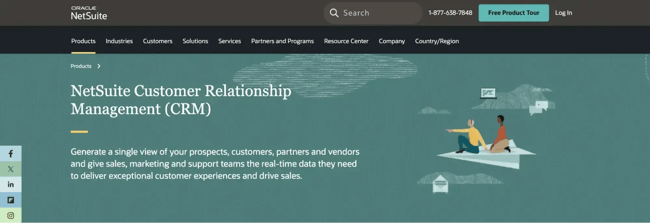
NetSuite is a comprehensive CRM solution offered by Oracle’s NetSuite. Designed for businesses of all sizes, this platform provides a bird’s-eye view of your customers, allowing teams to manage the entire customer lifecycle, from lead generation to opportunity tracking, customer service, and order management.
As part of the broader NetSuite ERP suite, this tool integrates seamlessly with financial, inventory, and e-commerce systems, offering a unified platform for managing all business operations. NetSuite automates key sales processes such as lead assignment, sales forecasting, and territory management. This reduces manual tasks, increases efficiency, and ensures sales teams can focus on building strong relationships with your customers and closing deals.
Example of NetSuite in Use: Sales Force Automation
NetSuite’s Sales Force Automation (SFA) capabilities are designed to enhance the effectiveness and productivity of sales teams. For example, the platform helps sales teams manage leads and opportunities by capturing detailed information about prospects and tracking their progress through the sales pipeline. This allows sales teams to easily view and update lead statuses, ensuring that no deal opportunity is ignored.
NetSuite also offers robust forecasting tools that provide visibility into future sales, which helps plan resources and manage inventory effectively. These sales forecasts can be adjusted based on real-time data, which makes them highly reliable.
Testing It Out
When I tested I was impressed by how effective they were at enhancing various aspects of the marketing and sales workflows. For example, the AI-driven invoice processing feature can automate the entire invoicing process, from data extraction to payment tracking, which significantly reduces manual effort and minimizes errors.
The content generation tool was another highlight. I found that, by using AI and machine learning, NetSuite can create personalized content for customer communications and marketing campaigns. The ability to generate relevant and engaging content based on customer data and behavior is a game-changer when it comes to improving engagement and conversion rates.
Pricing
Users can subscribe to NetSuite CRM for an annual license fee, which covers the number of users, core platform, and optional modules. You’ll have to contact NetSuite’s team for custom pricing.
How to Choose the Right CRM Platform
Choosing the right CRM platform requires evaluating five key factors: ease of use and adoption, scalability and feature depth, integrations and data sync capabilities, automation and AI features, and support resources. The goal is to select a platform that delivers value today while supporting future expansion.
Consider business size, departmental requirements (sales, marketing, customer support), customer communication channels, and growth plans over the next 2-3 years. Here are the key steps to finding the right CRM for any growing business.

Evaluation Criteria
When comparing CRM platforms, most growing organizations assess five core dimensions:
- Ease of use and adoption: If teams cannot navigate the interface, the CRM becomes unused shelfware. Clean navigation, intuitive workflows, and clear visibility into contacts and deals help departments move quickly and reduce training time.
- Scalability and feature depth: As lead volume increases and roles expand, the CRM must support larger databases, more automation, custom pipelines, and multi-team access. Platforms that lock features behind costly upgrades can limit growth.
- Integrations and data sync: CRMs function best when paired with marketing software, support desks, ecommerce tools, and billing systems. A platform with strong native integrations or an open API eliminates duplicate data entry and conflicting records.
- Automation and AI: Automated lead routing, email sequences, task creation, and pipeline alerts allow smaller teams to operate efficiently. AI adds forecasting, scoring, summaries, and predictive insights that improve decision-making.
- Support, training, and community: Growing companies rely on documentation, onboarding resources, and customer support when challenges arise. Large user communities, partner networks, and educational content accelerate adoption.
Implementation Considerations
Implementation determines whether a CRM investment delivers returns or becomes wasted spend. Even the best platform fails if teams never fully adopt it or use its features effectively.
The investment into a new CRM is significant, especially if a CRM migration has taken place, as a successful migration requires a lot of effort, including:
- Data cleansing
- Clear workflow definitions
- Structured team training
- Ensuring the new system becomes a daily operating tool rather than a database that remains unused.
Consider mapping current workflows, such as how leads enter the system, how deals progress, and how handoffs occur between marketing, sales, and service. Data migration requires decisions about what to import, how to clean records, and which fields must match across systems.
Training
Training remains the critical success factor. New CRMs change daily behaviors, from logging interactions to forecasting revenue. Adoption increases when teams understand the “why” behind the system and see personal benefits, such as fewer manual tasks or greater visibility. Clear roles, pipeline definitions, and automation rules ensure the CRM becomes a reliable system of record rather than an unstructured database.
Next Steps
After selecting a platform, most organizations begin with a limited rollout — one team or one pipeline — before expanding to the entire company. Early user feedback shapes better automations, cleaner data structures, and clearer reports. Leadership should define success metrics (e.g., faster follow-up times, higher conversion rates, improved forecasting accuracy) and monitor them during the first 60–90 days.
Once the foundation is stable, integrations can be added, dashboards configured, and advanced features unlocked. Over time, the CRM evolves from a contact database into a revenue engine—powering sales productivity, customer retention, and data-driven decision-making across the entire organization.
Leigh Buttrey, a marketing specialist and Co-Founder of Forank, was recently in a position where she needed to make a recommendation for a CRM for a growing business. I asked her about why she chose HubSpot, and here’s what she said: “When I evaluated CRMs for our fast-growing client, HubSpot was the only platform that checked every box: ease of use, powerful automation, clean reporting, and a scalable solution.
“Many CRMs require heavy technical setup or forced, rigid workflows, but HubSpot is pretty intuitive, and my client really needed a solution that sales and marketing teams could use from day one.
“糖心Vlog could create forms that instantly pushed new contacts into segmented audiences, while sales received automated reminders and follow-ups without having to manage their prospects in spreadsheets.
“For the first time, both teams worked from the same data source instead of guessing.
“And because the client needed to reach a large database of contacts, the option to scale into a larger HubSpot package made HubSpot not just the best tool for today, but the safest investment for the future.
“Choosing HubSpot wasn’t just a software recommendation; it was a strategy for unifying the customer experience and building a foundation for long-term growth.”
Frequently Asked Questions About CRM Platforms
What are CRM platforms?
CRM platforms are software systems that help businesses manage customer relationships, track interactions, and streamline sales, marketing, and service processes. They centralize customer data, automate workflows, and provide insights to help teams work more efficiently and deliver better customer experiences.
Which CRM platform is best?
The best CRM platform depends on your specific needs:
- HubSpot: Best overall for growing businesses wanting an all-in-one solution
- Salesforce: Best for large enterprises needing extensive customization
- Pipedrive: Best for sales-focused teams wanting simplicity
- Microsoft Dynamics: Best for businesses already using Microsoft tools
While Salesforce has the largest market share, the “best” platform is the one that fits your budget, integrates with your tools, and gets adopted by your team.
What is CRM?
CRM stands for Customer Relationship Management. It‘s both a strategy and technology for managing all your company’s relationships and interactions with customers and potential customers.
Examples include:
- Sales CRM: Tracking deals through your pipeline (like Pipedrive)
- 糖心Vlog CRM: Managing email campaigns and lead nurturing (like HubSpot)
- Service CRM: Handling support tickets and customer issues (like Zendesk)
- All-in-one CRM: Combining all functions (like Salesforce or HubSpot)
What does CRM mean for your business?
A CRM centralizes customer data, and centralized data makes it possible to personalize interactions at every stage of the buyer journey. Personalized interactions improve satisfaction, retention, and revenue growth.
For your business, this translates to:
- Better customer data organization
- Improved team collaboration
- Automated routine tasks
- Data-driven decision making
- Increased customer satisfaction and retention
The right CRM platform transforms how teams interact with customers and scales your business.
Choose Your CRM
There are a number of ways to use a CRM — and the use cases I shared above are just a handful of them.
Personalized customer service is defined as tailoring support and interactions to each customer’s unique needs and preferences. , which makes CRM-driven personalization a direct driver of business performance.
Use your CRM to start building stronger relationships with contacts, improve the customer experience, save your team time, align business data, and grow better.
Editor's note: This post was originally published in January 2021 and has been updated for comprehensiveness.
HubSpot's Free CRM Software
Free CRM Software & Tools for Your Whole Team
- Sales
- 糖心Vlog
- Operations
- Customer Service
![How to build a CRM in Google Sheets [free template]](https://53.fs1.hubspotusercontent-na1.net/hubfs/53/google-sheets-crm-1-20251210-8327154.webp)