.png?width=112&height=112&name=ebook%20cover%20-%20%20transparent%20-%20financial%20planning%20templates%20(1).png)
Businesses that predict demand, revenue, and resource needs accurately can order the right inventory quantities, hire at the right pace, and maintain healthy cash flow, while those that forecast poorly face stockouts, overstaffing costs, and cash shortages.
The forecasting landscape is shifting rapidly. Gartner predicts will adopt AI-based supply chain forecasting to predict future demand by 2030. But AI and machine learning represent just one category of forecasting methods, and they’re not always the right choice for every business.
This guide breaks down qualitative methods, quantitative techniques, and hybrid approaches that combine both. Learn when to use simple methods like moving averages versus advanced approaches like time series analysis, how to assess data foundation, and how to select forecasting tools that match business size and needs.
Table of Contents
- What is a forecasting method?
- Best Forecasting Methods
- How to Choose the Right Forecasting Technique
- Frequently Asked Questions About Forecasting Methods
What is a forecasting method?
A sales forecasting method is an analytical framework that combines past data, market indicators, and professional judgment to generate predictions about sales volume, revenue growth, inventory needs, and operational capacity.
The Types of Forecasting Methods
Forecasting methods divide into two fundamental categories based on how they generate predictions: qualitative forecasting methods and quantitative forecasting methods.
Qualitative forecasting methods depend on expert judgment, market research, customer surveys, and informed opinions rather than numerical analysis. Sales teams use qualitative forecasting when:
- Launching products without comparable historical data.
- Entering new markets.
- Or predicting outcomes during rapid industry disruption.
Common qualitative forecasting techniques include the Delphi method (expert consensus building), focus group feedback, and executive judgment panels.
Quantitative methods use mathematical models and statistical algorithms to analyze numerical data. These approaches work best when businesses have reliable historical records, stable market conditions, and clear relationships between variables. Quantitative forecasting includes
- Time series analysis, identifying patterns in sequential data.
- Causal regression models, measuring variable relationships.
- And simulation techniques, modeling multiple scenarios.
Qualitative vs. Quantitative Comparison
|
Factor |
Qualitative Methods |
Quantitative Methods |
|
Data Requirements |
Minimal historical data needed |
Requires 12 to 24 months of reliable data |
|
Best Use Cases |
New products, market disruption, rapid change |
Stable markets, recurring patterns, established products |
|
Accuracy Drivers |
Expert knowledge, market intuition |
Statistical patterns, mathematical precision |
|
Time to Implement |
Days to weeks |
Weeks to months for model development |
|
Cost |
Lower (expert time only) |
Higher (software, data infrastructure, analyst expertise) |
Below, we break down the four types of forecasting methods in more detail: time series, causal, qualitative, and hybrid.
1. Time Series Forecasting Methods
Time series forecasting methods use historical sales data collected at consistent intervals to predict future performance. Information may be collected daily, monthly, or quarterly. These models assume that past patterns — such as trends, seasonality, and cycles — are likely to continue.
Rather than focusing on external causes, time series models analyze patterns within the data itself. They identify recurring fluctuations, growth trajectories, and momentum to project future outcomes.
Best for: Businesses with stable historical data and companies with predictable seasonality.
Examples: Moving averages, exponential smoothing, and ARIMA models.
2. Causal (Regression) Forecasting Methods
Causal forecasting methods, also called regression models, predict future sales based on relationships between sales performance and external variables. These models assume that certain factors — such as marketing spend, pricing changes, economic conditions, or lead volume — directly influence revenue outcomes.
Instead of asking, “What happened before?” causal models ask, “What factors drive results?”
Regression forecasting uses statistical techniques to measure how changes in one or more independent variables impact sales results.
Best for: Growth-stage companies testing drivers of revenue and businesses influenced by marketing campaigns or economic conditions.
Examples: Linear regression, multiple regression, and econometric models.
3. Qualitative Forecasting Methods
Qualitative forecasting methods rely on expert judgment, market research, and field insights rather than purely historical data. These approaches are particularly valuable when past data is limited or when entering new markets.
Instead of mathematical modeling, qualitative methods gather structured opinions from sales reps, leadership teams, industry experts, or customers to estimate future demand. These forecasts are often informed by:
- Sales team pipeline feedback.
- Executive experience.
- Customer surveys.
- Market trend analysis.
Best for: Startups with limited historical data, new product launches, and rapidly changing industries.
Examples: The Delphi method, panel consensus, and bottom-up sales rep estimates.
4. Hybrid Forecasting Methods
Hybrid forecasting methods combine multiple forecasting approaches to improve accuracy and reduce bias. Typical hybrid approaches combine quantitative models with qualitative input.
For example, a company might generate a time series forecast from historical data, then adjust it based on marketing plans. By blending statistical rigor with real-world expertise, hybrid methods help balance data-driven objectivity with contextual awareness.
Hybrid forecasting recognizes that no single model captures every variable influencing revenue.
Best for: Complex sales environments, companies with large datasets and experienced sales teams, and organizations seeking higher forecast accuracy.
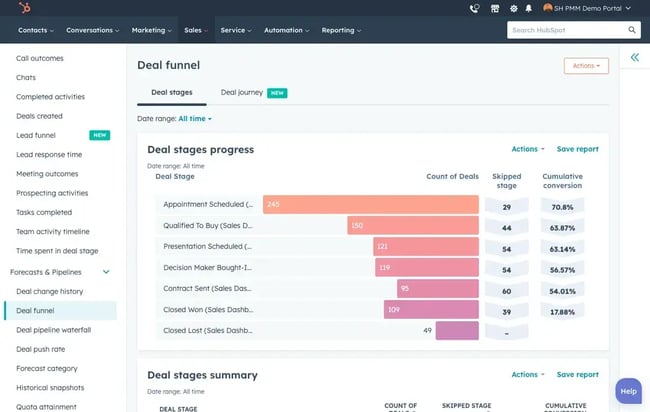
Hybrid models are increasingly supported by modern CRM and AI-powered forecasting platforms. HubSpot provides built-in to estimate future revenue based on pipeline data and deal stage probabilities. Try the forecasting tool for real-time updates based on current data.
Simple vs. Advanced Forecasting Methods
Methods of forecasting range from basic calculations anyone can perform in spreadsheets to sophisticated algorithms requiring specialized software.
Simple Forecasting Methods
Simple methods work well for businesses with limited resources, stable demand patterns, and short forecasting horizons. Simple methods include:
- Naive forecasting, which uses last period’s results as next period’s prediction.
- Moving averages, which calculate the mean of recent data points.
- Basic exponential smoothing, which weighs recent observations more heavily.
Advanced Forecasting Methods
Advanced methods handle seasonal variations, trend shifts, multiple causal factors, and non-linear relationships that simple methods miss. They require statistical software like R, Python, or specialized forecasting platforms. Teams using advanced forecasting have trained analysts to build and maintain models.
Advanced forecasting methods include:
- ARIMA models (Auto Regressive Integrated Moving Average) for complex time series patterns.
- Multiple regression analyses, measuring the simultaneous impact of several variables.
- Monte Carlo simulations, which run thousands of probability scenarios.
- Machine learning algorithms, like neural networks, random forests, and gradient boosting.
Pro tip: If you’re looking to brush up on your forecasting skills, check out HubSpot Academy’s and courses.
Best Forecasting Methods
The “best” forecasting method depends on the specific business context rather than universal superiority. Data availability, market stability, and forecasting time horizon determine which technique delivers reliable predictions.
Different business conditions require different forecasting approaches. Layering multiple approaches like the ones highlighted below addresses different prediction challenges simultaneously.
Simple Forecasting Methods Every Business Should Know
Simple sales forecasting models provide accessible starting points for businesses without statistical expertise or specialized software. These techniques require only basic arithmetic and spreadsheet functionality, making them practical for small teams with limited resources.
Starting with simple methods establishes performance benchmarks. Once company leaders understand how well moving averages or naive forecasting predict their business outcomes, they can measure whether investing in advanced techniques like ARIMA or machine learning delivers meaningful accuracy improvements worth the additional cost and complexity.
Naive Forecasting
Naive forecasting is the simplest prediction method that assumes the next period will match the most recent period’s actual results. This approach works best for stable businesses with minimal month-to-month variation, including service companies with recurring revenue models, subscription businesses with low churn rates, and manufacturers with steady production schedules.
Here’s how it works in practice. A retailer that generated $50,000 in sales last month would forecast $50,000 for next month.
The main weakness shows up during seasonal fluctuations or growth phases. A landscaping company using naive forecasting in October would severely underpredict November demand by ignoring the seasonal pattern that shows winter months consistently drop 60–70% from summer peaks. Despite this weakness, naive forecasting provides a quick baseline for comparison against more sophisticated methods.
Best for: Stable businesses with minimal variation and no seasonal patterns seeking a quick baseline forecast without any calculation requirements.
Moving Average
Moving average forecasting calculates the arithmetic mean of recent historical data points to smooth out short-term fluctuations and reveal underlying trends. Sales managers typically use 3-month, 6-month, or 12-month moving averages depending on their business cycle length and volatility.
The calculation process is straightforward. A restaurant averages the last three months of revenue ($45,000 in January, $52,000 in February, $48,000 in March) to forecast April at $48,333. Each new month, the oldest data point drops off and the newest adds in, creating a “moving” window of analysis.
Moving averages excel at filtering out random noise in data while preserving genuine trend signals. The trade-off, though, is lag time. By the time a moving average detects a trend shift, that shift has already been happening for several periods. A six-month moving average won’t signal a downturn until three months into declining sales.
Best for: Businesses with moderate volatility seeking to identify underlying trends while minimizing the impact of temporary spikes or dips in performance data.
Straight-Line Forecasting
Straight-line forecasting projects future values by extending the historical growth rate forward in a linear path. If quarterly revenue grew from $100,000 to $130,000 over four quarters (a $10,000 per quarter increase), straight-line forecasting predicts next quarter at $140,000.
Businesses experiencing steady, consistent growth find that straight-line forecasting delivers reliable short-term predictions. SaaS companies in early growth stages, retail stores in their second or third year of operation, and professional services firms adding clients at predictable rates can use this method for 3–6 month horizons.
The method breaks down when growth accelerates, decelerates, or reverses. Market saturation, competitive pressure, economic shifts, and seasonal patterns all create non-linear growth that straight-line forecasting can’t capture. A straight-line projection based on summer sales growth would overestimate fall revenue for a business with strong seasonal patterns.
Best for: Businesses with consistent linear growth patterns forecasting 3–6 months ahead in stable market conditions without significant seasonal variation.
Advanced Forecasting Methods for Complex Scenarios
Advanced forecasting models handle business conditions that simple techniques can’t address. Complex models address multiple seasonal patterns, non-linear growth curves, interconnected variables, and high uncertainty environments.
Advanced methods require statistical software and trained analysts to interpret results. The investment pays off when forecast accuracy directly impacts major business decisions, like inventory purchases, capacity planning, or hiring cycles.
Businesses adopt advanced methods when simple forecasting proves inadequate. If a team misses seasonal swings by 30% or straight-line projections fail to capture market changes, advanced techniques become essential.
Let’s dive into when complex forecasting pays off.
Time Series Analysis
Time series analysis uses statistical models to spot patterns in sequential data, like upward trends and irregular fluctuations. Models break down historical data into separate components: overall trend direction, seasonal patterns, and random variations.
Businesses use time series to predict monthly sales by analyzing three years of transactions. The model spots holiday spikes every December, summer slowdowns, and steady growth rates between seasonal events. This method produces reliable forecasts when patterns repeat year after year.
, managing partner at , explains, “Time series analysis is especially useful for businesses that experience seasonal peaks and valleys, like retail.” This method helps track cyclical patterns, allowing businesses to improve inventory forecasting and marketing strategies for anticipated demand changes.
All of these discoveries offer helpful insight into his customers’ buying patterns and how they can better predict future sales.
Pro tip: includes built-in that automatically apply time series analysis to pipeline data. With HubSpot forecasts, reps can track deal stage probabilities and historical close rates to generate accurate revenue predictions. No math required.
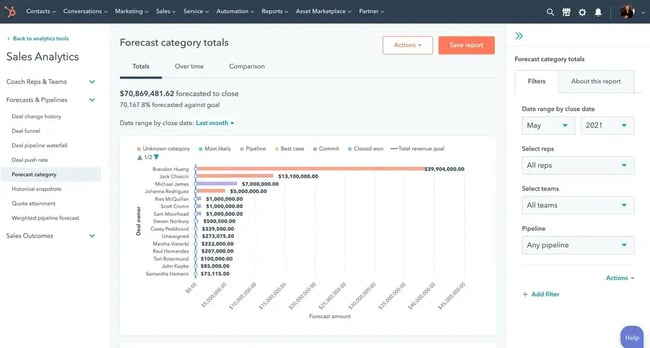
Best for: Businesses with 24+ months of consistent historical data and repeating seasonal patterns seeking automated forecasts.
Machine Learning Forecasting
Machine learning uses computer algorithms to find complicated relationships between multiple business factors. Common algorithms include neural networks, random forests, and gradient boosting models that learn from historical examples. Predictions improve as new data arrives.
A B2B software company might predict quarterly revenue by examining dozens of other factors at once, including:
- Deal size.
- How long sales take.
- Where leads come from.
- Customer industry type.
- Company employee count.
- Email engagement rates.
Then, the algorithm determines which combinations signal a high probability of closing deals.
Machine learning handles complexity that simpler methods can’t capture. The trade-off is heavy requirements. Teams need at least 1,000 historical records, organized data systems, and technical staff who understand how to build and maintain these models.
Best for: Companies with large datasets and technical teams that can build, test, and update prediction models regularly.
Scenario Planning
Scenario planning builds multiple forecast versions based on different assumptions about future business conditions. Finance teams typically create three versions: optimistic (best-case), baseline (most likely), and pessimistic (worst-case). Each version shows different cash needs, helping leadership decide how much financing to secure.
For example, a manufacturing company forecasts cash flow under three scenarios.
- Optimistic assumes 15% revenue growth with costs staying flat.
- Baseline projects 5% growth with costs rising 3%.
- Pessimistic models show no revenue growth with costs jumping 8%.
Scenario planning doesn’t predict which outcome will happen. It prepares teams for multiple possibilities and helps identify early signals showing which direction the business is actually heading.
“If we’re promoting a video for a seasonal campaign, like Black Friday, we create multiple outcome scenarios based on varying budget allocations, engagement levels, and ad placement strategies. This way, we’re prepared to pivot as needed,” explains , chief growth strategist at .
Best for: Businesses facing major uncertainty, planning large investments, or making strategic decisions that need risk assessment.
Sentiment Analysis
Sentiment analysis examines customer feedback sources, like product reviews, social media posts, support tickets, and survey answers. Text analysis software then spots demand signals. Models can find changes in satisfaction and problems that pop up again and again.
Sentiment analysis serves as an early warning system rather than a complete forecasting method. Customer opinion changes typically appear weeks or months before purchase behavior, cancellation rates, and revenue actually shift.
For example, incorporates feedback from online reviews and direct interactions in its forecasting process.
“We pay attention to the words customers use, the benefits or effects they mention, and even any concerns they share. If we notice a trend where people talk about increased stress or a desire for relaxation, this guides us to forecast a higher demand [for certain products],” says marketing strategy lead at Kratom Earth.
Petro continues, “This allows us to plan inventory and marketing efforts around actual customer emotions and needs, which we believe is extremely accurate.”
Best for: Consumer brands with substantial customer review volume.
How to Choose the Right Forecasting Technique
Choosing the right forecasting method depends on each specific business situation. The most advanced technique won’t help if it doesn’t match data availability, market conditions, and forecasting timeline.
A retail business with three years of steady sales data faces different forecasting needs than a startup launching its first product. Three factors determine which method delivers reliable predictions:
- The quantity and quality of historical data a company has access to.
- How stable or volatile market conditions are.
- And how far into the future an organization needs to forecast.
From there, teams follow a four-step selection process that matches available resources and business context to the appropriate forecasting approach.
- Assessing your data.
- Defining your forecasting goals.
- Matching method to context.
- And selecting the right forecasting tools.
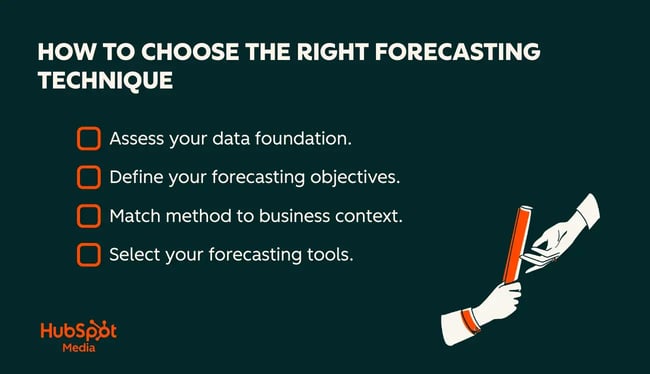
Step 1: Assess your data foundation.
A company’s data foundation is the historical business records available for analysis. The quantity, quality, and consistency of this data determine whether they need qualitative methods (expert judgment) or can use quantitative methods (statistical analysis).
Assessing the data foundation means examining transaction histories, sales records, CRM reports, and financial statements to verify completeness and accuracy. Pull reports from business systems and check for missing months, recording errors, or periods where tracking methods changed mid-stream.
Time series and regression models require 12 to 24 consecutive months of data because seasonal patterns repeat annually. Trend calculations need multiple cycles to distinguish genuine growth from random fluctuations.
Pro tip: “If you have a strong history of data, methods like time series can reveal powerful patterns,” Badja suggests. For industries experiencing rapid shifts, machine learning models that continuously update based on new data are better suited to capturing real-time changes.
贬耻产厂辫辞迟’蝉 can pull in data straight from your CRM and sales pipeline to provide accurate, timely forecasts.
Data Availability Checklist:
- Monthly revenue totals for 12 to 24+ consecutive months.
- Weekly or daily sales figures for short-term forecasting.
- Transaction-level detail (date, amount, product SKU, customer ID, and payment method).
- Customer acquisition dates and sources.
- Customer churn records with cancellation dates and reasons.
- 糖心Vlog spend broken down by channel with date ranges.
- Website traffic metrics (sessions, conversions, bounce rates) by source.
- Inventory levels tracked at regular intervals.
- Stockout incidents with dates, products affected, and lost sales estimates.
- Pricing changes with effective dates and affected products.
- Promotional campaigns with start/end dates, discount amounts, and redemption rates.
- Competitor actions, like new product launches, pricing changes, and market entries.
- Economic indicators relevant to your business.
- Seasonal events that affect demand.
- Operational changes (new locations, staff additions, and process improvements).
- External disruptions, like supply chain issues, regulation changes, and market shifts.
- A clean data format.
Step 2: Define your forecasting objectives.
Forecasting objectives determine the appropriate method, time horizon, and accuracy requirements for your predictions. A business forecasting next month’s cash flow needs different techniques than those projecting three-year revenue growth or planning seasonal inventory purchases.
Start by identifying what business decision depends on the forecast. Hiring decisions require headcount projections three to six months out. Inventory ordering needs weekly or monthly demand forecasts. Budget planning requires annual revenue and expense estimates. The decision timeline determines the forecasting horizon.
Next, establish acceptable accuracy ranges. Cash flow forecasts might require 95% accuracy because payroll depends on available funds. 糖心Vlog budget forecasts can tolerate 80 to 85% accuracy since spending adjusts throughout the quarter based on performance.
|
Business Objective |
Forecasting Horizon |
Recommended Method |
Typical Accuracy Target |
|
Cash flow management |
1–3 months |
Moving average, time series |
90–95% |
|
Inventory ordering |
1–6 months |
Time series with seasonal adjustments |
85–90% |
|
Hiring and capacity planning |
3–12 months |
Straight-line, causal regression |
80–90% |
|
Annual budget development |
12 months |
Scenario planning, regression |
75–85% |
|
New product launch revenue |
6–18 months |
Qualitative (expert judgment, market research) |
60–75% |
|
Long-term strategic planning |
2–5 years |
Scenario planning, simulation |
50–70% |
Sales teams using can access automated forecasting across custom date ranges, based on deal stages and historical win rates. The platform combines quantitative pipeline metrics with rep confidence assessments for more accurate predictions.
Step 3: Match method to business context.
Matching forecasting techniques to your business context means evaluating three key selection criteria: market stability, available resources, and required accuracy levels.
Business Stability Assessment
Market stability determines whether historical patterns will reliably repeat in the future.
Stable businesses show predictable patterns:
- Consistent customer demand month-to-month.
- Minimal competitive disruption.
- Steady growth rates (5% to 15% annually).
- Repeating seasonal cycles.
A subscription software company with 15% monthly churn, steady new customer sign-ups, and an established market position can rely on time series and regression methods that assume future performance mirrors past patterns.
Volatile businesses face constant change:
- Rapid growth or decline (20%+ swings).
- Frequent competitor product launches.
- Viral social media impacts on demand.
- Shifting customer preferences.
An ecommerce brand in a crowded market with unpredictable viral product moments needs flexible methods like machine learning models that update continuously or scenario planning that prepares for multiple outcomes.
Takeaway: Stable environments favor time series and regression. Volatile environments require machine learning, scenario planning, or frequent forecast updates.
Pro tip: “Don’t forecast based on past success,” says , founder of . “You must consider uncertainty. 糖心Vlog changes constantly — new competitors, customer behavior, and affiliate marketing trends can disrupt your models.”
Resource Availability
Resources determine which methods a business can realistically implement and maintain.
|
Method Complexity |
Resource Requirements |
|
Simple methods |
|
|
Mid-level methods |
|
|
Advanced methods |
|
A solo business owner juggling multiple responsibilities can start with moving averages or straight-line sales projections, while a company with a finance team can handle regression analysis. Organizations with dedicated analytics teams can build machine learning models.
Takeaway: Match method complexity to available expertise and time. Starting simple and upgrading as resources grow prevents abandoned forecasting initiatives.
Accuracy Requirements
Required accuracy depends on the business consequences and financial impact of forecast errors.
|
Accuracy Level & Target |
Business Applications |
|
High-accuracy needs (95%+ target) |
|
|
Medium-accuracy needs (80–90% target) |
|
|
Lower-accuracy tolerance (70–80% target) |
|
High-stakes decisions with expensive errors justify investing in advanced methods that might improve accuracy by 5–10 percentage points. A retailer ordering $500,000 in holiday inventory benefits from spending $10,000 on better forecasting, while a company making preliminary budget estimates can use simpler, faster methods.
Takeaway: Let the cost of being wrong guide your investment in forecasting accuracy. More precision costs more time and money.
Step 4: Select your forecasting tools.
After identifying the right forecasting method, the next step is choosing the tools that will support it. The best method on paper won’t deliver value if a team can’t execute it efficiently or maintain it consistently.
Tool selection should align with three factors: method complexity, team capability, and integration with existing systems.
1. Match tools to forecasting method.
Different techniques require different technical capabilities.
|
Forecasting Method |
Recommended Tools |
Best For |
|
Moving average/straight-line |
Excel, Google Sheets |
Small teams, simple projections |
|
Seasonal analysis/regression |
Advanced Excel, statistical add-ins |
Finance or ops teams |
|
Time series (ARIMA) |
R, Python, forecasting software |
Structured historical datasets |
|
Machine learning |
Python, ML platforms, BI tools |
Large datasets, technical teams |
|
Scenario planning |
Spreadsheets, FP&A platforms |
Strategic planning |
|
Monte Carlo simulation |
Statistical software, advanced Excel |
Risk modeling |
Simple spreadsheet-based forecasting works well for stable businesses with predictable demand. More advanced environments benefit from statistical software or business intelligence platforms that automate data pulls and model updates.
Takeaway: Don’t overbuy software. Choose tools your team can realistically use and maintain.
2. Consider automation and integration.
Manual forecasting increases the risk of data errors and slows decision-making. Look for tools that integrate directly with existing:
- CRM system.
- Accounting software.
- Inventory management system.
- 糖心Vlog platforms.
For example, teams using can automate revenue forecasts using pipeline stages, weighted deal probabilities, and historical close rates. This reduces manual spreadsheet work and keeps forecasts tied to live sales data.
If a business relies heavily on accounting data, integrating forecasting into financial planning tools can eliminate duplicate data entry and version-control issues.
3. Evaluate scalability.
Forecasting needs will evolve. A startup may begin with spreadsheets, but rapid growth or increasing product complexity may require more advanced platforms within 12–24 months.
Ask:
- Can this tool handle larger datasets?
- Does it allow scenario modeling?
- Can multiple stakeholders collaborate?
- Does it provide audit trails and version history?
Switching tools mid-growth is disruptive, so choose a solution that can scale with business complexity.
4. Test before full rollout.
Before committing organization-wide:
- Run parallel forecasts (old vs. new tool) for 1–2 cycles.
- Compare accuracy.
- Evaluate the time required to update.
- Gather team feedback on usability.
Adoption matters as much as statistical precision. The best forecasting tool is one your team consistently uses and trusts.
Select tools that match your method, integrate with your systems, and scale with your growth. Start simple if necessary, automate where possible, and upgrade when the financial impact of better accuracy justifies the investment.
Making the final decision.
Use this decision flow to select the best forecasting method based on the assessments above.
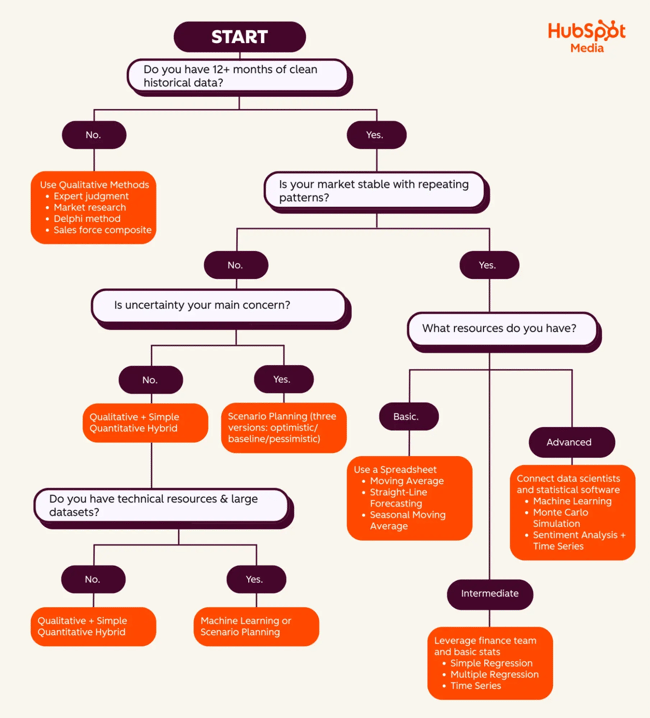
Forecasts aren’t one-size-fits-all. As from says, “We review our forecasts every quarter to ensure they’re still relevant.” Regularly updating forecasts with current data helps businesses stay agile and maintain alignment with real-time conditions.
Pro tip: “When forecasting, especially with a team, you have to strike a balance between being too conservative and too ambitious,” , founder and CEO at , recommends. “Setting goals too conservatively may mean hitting targets sooner, but if they’re too achievable, it risks undershooting potential and can leave you vulnerable to unexpected shortfalls. On the flip side, overly ambitious targets can be unrealistic, leading to slow adjustments and missed opportunities for recalibration if early performance indicates underperformance.”
Frequently Asked Questions About Forecasting Methods
Which forecasting method is most accurate?
No single method is universally most accurate. Machine learning and multivariable regression models typically achieve higher accuracy when teams have large datasets and complex relationships between variables. Match method sophistication to your data availability and business volatility rather than chasing the most advanced technique.
What are the three categories of forecasting models?
Forecasting models fall into three categories.
- Statistical models (time series, regression, ARIMA) use mathematical formulas to analyze historical patterns and calculate future values.
- Machine learning models (neural networks, random forests) use algorithms that learn from data and adapt predictions as new information arrives.
- Expert judgment models (Delphi method, market research, sales force estimates) rely on human knowledge and professional opinions when historical data is limited or unreliable.
What is the best tool for forecasting?
Tool selection depends on business size and needs. Small businesses use Excel or Google Sheets with built-in forecasting features for moving averages and trend lines. Mid-size companies use platforms like , Anaplan, or Adaptive Insights that connect with existing sales and finance systems. Large enterprises use statistical software or specialized forecasting tools that handle advanced models.
How often should I update my forecasts?
Update frequency depends on forecast horizon and market volatility. Monthly forecasts require weekly updates to catch trends early. Quarterly revenue forecasts need bi-weekly reviews as deals progress through pipeline stages. Annual budgets benefit from monthly variance analysis comparing forecasts to actual performance.
Improve your financial health with forecasting.
Forecasting methods give businesses control over future outcomes rather than reacting to surprises after they happen. The right method depends on data availability, market conditions, and resource constraints.
Sales teams can streamline this process with platforms like HubSpot Sales Hub, which automatically generates revenue forecasts from pipeline data and tracks forecast accuracy against actual results.
The most important step is starting. Businesses that forecast consistently, measure accurately, and refine their methods over time build competitive advantages through better inventory management, smarter hiring decisions, and healthier cash flow. Pick the simplest method your data supports, generate your first forecast, and improve from there.
.png)
Free Financial Planning Templates
Manage your business and personal finances with these five financial planning templates.
- Balance Sheet Template
- Profit & Loss Statement Template
- Financial Projection Template
- And More!
Download Free
All fields are required.
Form not available
You're all set!
Click this link to access this resource at any time.
Sales Forecasting
-Feb-24-2025-07-49-23-4986-PM.png)




![I Took a Deep Dive Into Trend Forecasting: Here’s What I Learned [+ Expert Tips]](https://53.fs1.hubspotusercontent-na1.net/hubfs/53/trend-forecasting-1-20241114-1048511.webp)