Getting consistent results from sales outreach ultimately comes down to one skill: how to get appointments in sales. Sales appointment setting is the bridge between prospecting activity and real pipeline, yet it’s also where many sales teams see the steepest drop-off.
Sales appointment setting refers to the process of securing a scheduled meeting between a sales representative and a qualified prospect to explore fit, needs, and next steps. In both B2B and more transactional sales environments, appointment setting directly impacts forecast accuracy, rep productivity, and cost per acquisition. Recent sales performance benchmarks show that while outreach volume continues to rise, meeting conversion and show rates have remained flat — signaling that how appointments are set matters more than ever.
I’ve worked with sales teams ranging from early-stage startups to established revenue organizations, and one pattern shows up consistently: Teams that treat appointment setting as a system outperform teams that treat it as a numbers game. This guide breaks down what actually works in 2026, using proven frameworks, current benchmarks, and real-world execution strategies.
Table of Contents
- What is sales appointment setting?
- Why Setting Sales Appointments Still Matters in 2026
- What Makes a Successful Sales Appointment
- How to Set an Appointment
- 12 Sales Appointment Setting Best Practices
- How to Ask for an Appointment Over the Phone
- How to Ask for a Sales Appointment by Email
- How Sales Teams Should Track Appointment Setting Performance
What is sales appointment setting?
Sales appointment setting is the structured process of with a prospective buyer for the purpose of qualifying interest, understanding needs, and advancing the sales process. It typically occurs after initial outreach but before a full discovery or demo conversation.
In most sales organizations, appointment setting is distinct from lead generation. Lead generation focuses on identifying potential buyers, while appointment setting focuses on converting interest into scheduled, attended conversations. In B2B sales, appointment setting often includes qualification around role, authority, and timing. In B2C or transactional sales, the emphasis is usually on immediacy and convenience.
From my experience, appointment setting is where pipeline quality is either protected or destroyed. Poorly set meetings (non-ICP, no buying power, no pain point) inflate activity metrics but drag down close rates, while well-qualified appointments create cleaner pipelines and more accurate forecasts.
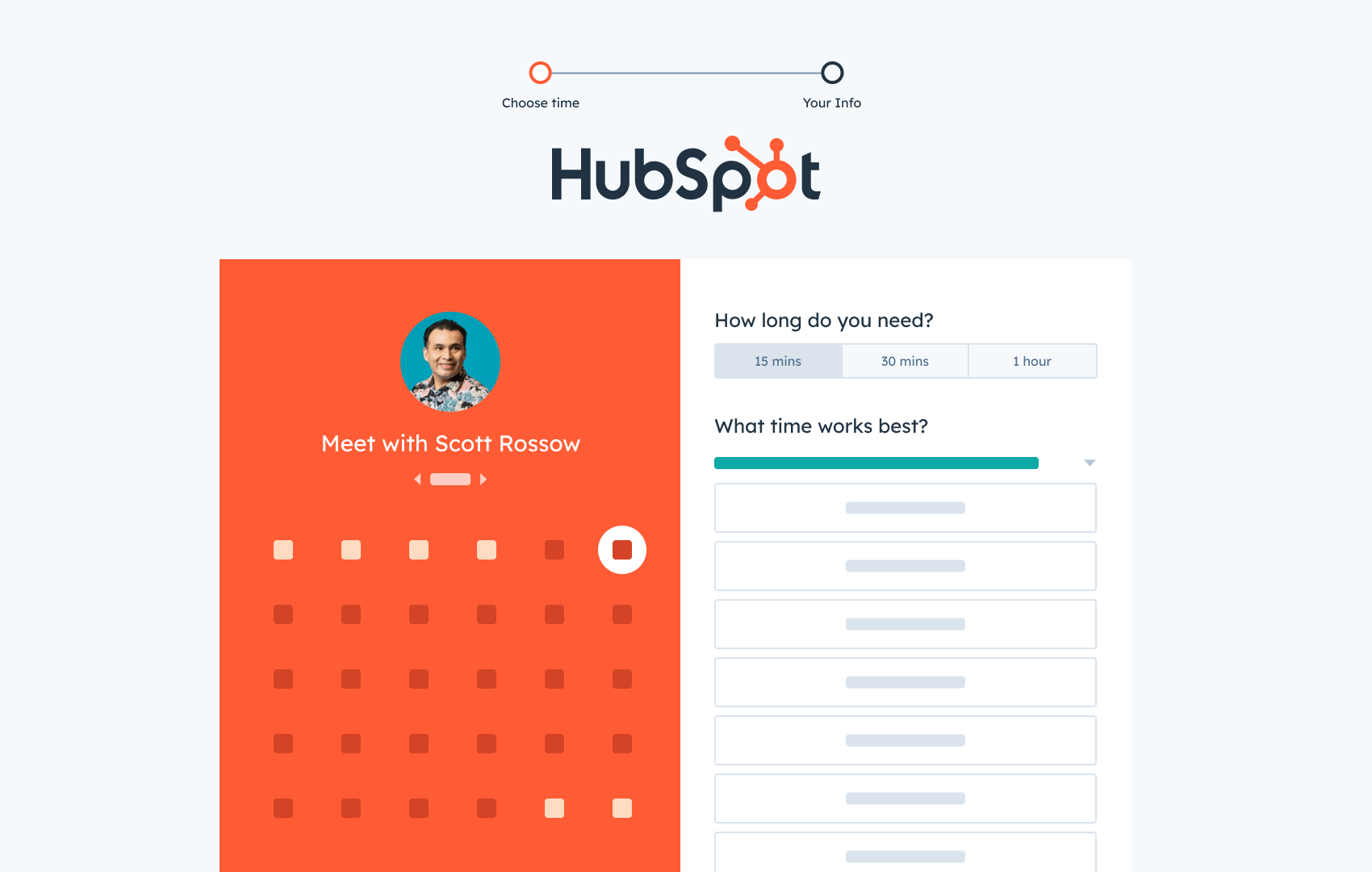
HubSpot's Free Meeting Scheduler
Schedule meetings faster and forget the back-and-forth emails. Your calendar stays full, and you stay productive.
- Let prospects book a meeting time
- Book more meetings and appointments
- Sync with Google and Office 365 Calendar
- And more!
Why Setting Sales Appointments Still Matters in 2026
Sales automation, AI outreach tools, and inbound marketing have changed how prospects enter pipelines — but they haven’t eliminated the need for effective appointment setting. In fact, they’ve raised the bar.
Appointment Setting’s Role in Modern Sales Funnels
Sales appointment setting sits between prospect engagement and sales qualification. It transforms passive interest into an intentional conversation with a clear purpose. In B2B funnels, appointment setting often determines whether a deal advances to discovery. In faster sales cycles, it determines whether a buyer engages at all.
The most effective funnels treat appointment setting as a conversion event, not an administrative task.
The Cost of Poor Appointment Quality
Low-quality appointments come with measurable costs. Sales teams commonly report low show rates, stalled opportunities, and wasted rep time when appointments are booked without proper context or qualification. Post-2024 sales operations data consistently shows that poor appointment quality correlates with longer sales cycles and lower win rates.
I’ve seen teams double outbound activity without improving revenue simply because meeting quality never improved.
Industry Benchmarks Sales Teams Should Know
While benchmarks vary by industry, several metrics remain consistent across markets:
- Cold outreach appointment conversion rates typically fall between 1% and 3%.
- Average meeting show rates range from 65 to 80%.
- High-performing teams track both appointments set and appointments held.
Pro tip: Teams that only track booked meetings miss the real signal. Held meetings — not calendar invites — are what predict revenue. According to RevenueHero, prospects only show up to meetings , so it’s crucial to tighten up the funnel and keep no-shows to a bare minimum. At , implementing automated meeting reminders was a simple step that helped reduce no-shows by roughly 5%. It’s a small number that has translated into real revenue over months and years.
With HubSpot’s free sales reps can create a calendar based on their availability. Then, leads can choose the time that works best for them. It eliminates the back-and-forth that could otherwise ensue.
|
Category |
B2B Appointment Setting |
B2C Appointment Setting |
|
Primary Goal |
Book qualified meetings that advance pipeline and lead to opportunities |
Drive immediate appointments that convert quickly to purchases |
|
Buyer Mindset |
Analytical, risk-aware, and focused on long-term business impact |
Emotional, convenience-driven, and focused on personal benefit |
|
Sales Cycle Length |
Longer, often weeks to months |
Short, often same day or within days |
|
Decision Makers |
Multiple stakeholders involved |
Typically, a single decision maker |
|
Conversation Focus |
Discovery, alignment, and business outcomes |
Urgency, offers, and personal value |
|
Call Structure |
Consultative and exploratory |
Transactional and direct |
|
Appointment Length |
15–30 minutes, often virtual |
5–15 minutes, phone or in-person |
|
Qualification Depth |
High — budget, authority, need, and timing matter |
Light — basic eligibility and interest |
|
Follow-Up Required |
Multiple touchpoints before and after booking |
Minimal follow-up once booked |
|
Key Success Metrics |
Meetings held, show rate, opportunity conversion, pipeline value |
Appointments booked, show rate, close rate |
|
Common Channels |
Phone, email, LinkedIn, multi-touch sequences |
Phone, SMS, email |
|
What High Performance Looks Like |
Fewer meetings with higher downstream conversion |
Higher volume with fast conversion |
What Makes a Successful Sales Appointment
A successful sales appointment is one that advances the sales process with mutual value for both parties. It is qualified, relevant, and clearly positioned.
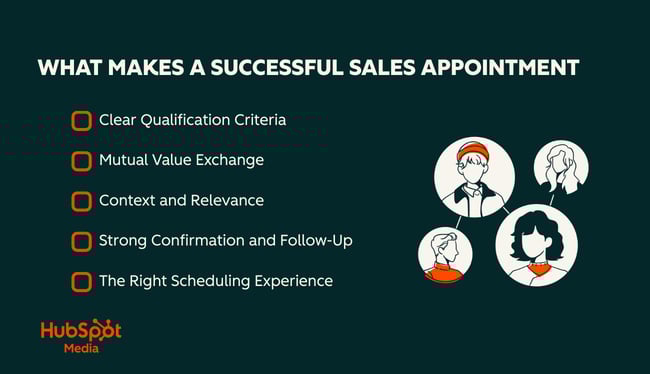
Clear Qualification Criteria
Successful appointments align with predefined qualification standards. These often include role relevance, business need, and buying timeframe. Without qualification, meetings inflate activity metrics while weakening pipeline integrity.
Mutual Value Exchange
Effective appointments are positioned as problem-solving conversations, not product walkthroughs. Prospects agree to meetings when they understand what they’ll gain — insight, clarity, or validation — not when they’re promised a generic overview.
Context and Relevance
Prospects expect sellers to understand their industry, role, or recent activity. Contextual relevance has become table stakes in appointment setting, particularly in B2B sales.
Strong Confirmation and Follow-Up
Meeting confirmations, calendar invites, and reminders significantly affect show rates. Appointments that lack clear agendas or reminders are far more likely to be skipped.
The Right Scheduling Experience
Friction during scheduling is a hidden conversion killer. Tools like reduce back-and-forth by allowing prospects to book directly based on real-time availability, improving both booking and attendance rates.
Best for: Sales teams that want to reduce no-shows and speed up time-to-meeting.
How to Set an Appointment
At an AA-ISP’s Inside Sales Leadership Summit, , CEO of , shared a three-step process proven to increase the chances of booking an appointment.
“We looked at different reps, and the ones that were most effective did three very simple things every time they had a key player on the phone,” Scher says. “Those three steps are called disarm, purpose, and question.”
1. Disarm: Get them to lower their guard.
On the off chance a buyer actually answers the phone, one thing is certain — they’re busy. With this in mind, Scher says that reps with the highest connection rates acknowledge this fact up front.
He suggests, “Introducing yourself and your company and acknowledging they’re busy.”
For example: “Hi, this is Ann Jones with ABC company. I’m sure I caught you in the middle of something.”
Why introduce yourself? Scher points out that people are naturally suspicious when they pick up the phone, and the best way to get them to lower their guard is by saying outright who you are and where you’re calling from.
“Disarming them gets their attention off whatever else they’re doing and gets them focused on you,” Scher says.
2. Purpose: Explain why you are calling.
Every sales rep knows the point of a first call is to set up an appointment. But according to Scher, “The number [of reps] that actually ask for an appointment is very small.”
After disarming the prospect, Scher advises reps to dive straight into their purpose — asking for a meeting. For instance, reps might say something like, “The purpose of this call is to get 20 to 30 minutes to discuss how we can reduce your operating costs by 20%.”
Why 20 or 30 minutes? Scher explains that this block of time was deliberately chosen.
“When you ask for less than a 20- or 30-minute block, you’re doing yourself a disservice,” he says. “Lots of times, people ask for five or 10 minutes — all you’re doing is indicating it’s not important.”
3. Question: End with a specific question on how to accomplish your purpose.
Scher advises reps to end their prepared speech with a specific question.
“Ask a question on how to accomplish your purpose — like, ‘Would Tuesday at 10 or Wednesday at 2 work best for such a call?’ If we ask the question, they have to answer it.”
Unless, they don’t. During Scher’s presentation, an audience member brought up the fact that a prospect might ignore the question entirely and ask, “What is this about, anyway?” In this case, Scher recommends a rinse and repeat — disarming, stating the purpose, and asking a question all over again.
If the prospect still evades an appointment after three cycles of this process, Scher suggests sending a piece of informational content in a calendar invite.
“The obligation for them to read the materials will never be higher than at [that moment], so use that opportunity to lock down the appointment,” Scher says.
12 Sales Appointment Setting Best Practices
Sales appointment setting works best when executed consistently across channels and continuously refined. Teams that treat appointment setting as a repeatable process — rather than an ad hoc activity — see higher conversion rates and a more predictable pipeline.
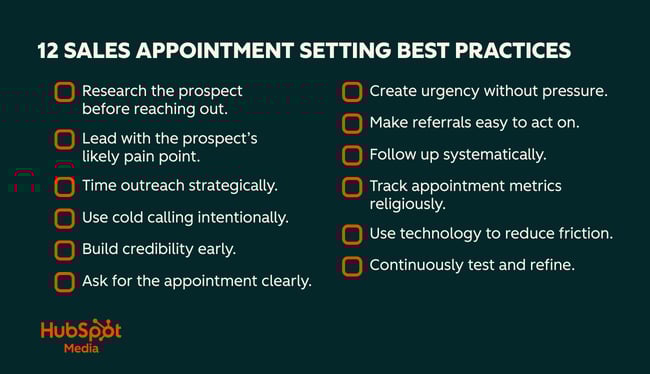
1. Research the prospect before reaching out.
Effective appointment setting begins with baseline research. This includes company context, role relevance, and recent signals such as funding, hiring, or technology changes. Even light personalization based on this research increases engagement and demonstrates respect for the prospect’s time.
2. Lead with the prospect’s likely pain point.
Strong appointment requests reference a relevant problem or opportunity. Industry-specific pain points outperform generic messaging across both calls and emails. When prospects immediately recognize the issue being discussed, they are more likely to see value in taking a meeting.
3. Time outreach strategically.
Call and email timing materially affect conversion. B2B appointment setting often performs best mid-week during core business hours, while transactional sales may benefit from extended windows. Testing timing by segment and region helps teams optimize outreach rather than relying on assumptions.
4. Use cold calling intentionally.
Cold call appointment setting remains effective when paired with context and purpose. Structured call frameworks outperform improvised outreach. Intentional cold calling helps reps stay focused on discovery and alignment instead of defaulting to feature-based pitches.
Pro tip: Grab some of HubSpot’s proven cold call scripts to get up to speed quicker and see results sooner.
5. Build credibility early.
Social proof, recognizable customers, or industry familiarity increase trust quickly. Credibility should be established before the appointment request to maximize the chance of conversion. Early credibility reduces skepticism and positions the meeting as a professional exchange rather than a sales interruption.
6. Ask for the appointment clearly.
Ambiguous next steps reduce conversions. High-performing sellers make direct, specific appointment requests tied to outcomes. Clear asks eliminate confusion and make it easier for prospects to say yes or propose an alternative.
7. Create urgency without pressure.
Urgency works best when tied to relevance — a timing trigger, upcoming change, or limited window — rather than artificial scarcity. This approach maintains trust while still encouraging timely action.
8. Make referrals easy to act on.
Referral-based appointments convert at higher rates when sellers handle logistics and framing, not just introductions. Providing clear context and proposed next steps removes friction for both the referrer and the prospect.
9. Follow up systematically.
Follow-up drives a significant percentage of booked meetings. Multi-touch follow-up across channels consistently outperforms single-channel persistence. Structured follow-up ensures opportunities are not lost due to timing or inbox fatigue.
10. Track appointment metrics religiously.
Sales teams should track both activity and quality metrics, including show rates and downstream conversion. These insights help leaders identify whether issues stem from outreach volume, qualification, or meeting execution.
11. Use technology to reduce friction.
Scheduling, CRM logging, and meeting prep tools eliminate manual work and improve consistency. and streamline this process end-to-end. Reducing friction allows reps to focus more time on high-value conversations.
12. Continuously test and refine.
Top-performing teams regularly test scripts, timing, and messaging. Small changes often produce outsized gains.
Pro tip: Teams that review appointment outcomes weekly tend to identify breakdowns before pipeline suffers. When a review process happens quarterly, issues go undetected and could have much more severe consequences. Schedule, track, and review meetings with .
How to Ask for an Appointment Over the Phone
Phone appointment setting works best when sellers follow a structured, outcome-focused framework. Even still, persistence is key. SalesHive cites a cold calling success rate , meaning reps can expect to book one meeting for every 40–45 dials. For top teams, the success rate can be as high as 5–8%.
The 3-Step Phone Appointment Framework
- Establish relevance and context. Open the call by clearly stating who you are and why you’re calling them specifically, not just anyone. Reference a trigger (a referral, recent action, or shared context) so the conversation immediately feels relevant rather than intrusive.
- Frame the value of the conversation. Briefly explain what’s in it for them and what problem, opportunity, or insight the conversation will address. Keep it outcome-focused and low-pressure, emphasizing that the goal is exploration or clarity — not a hard sell.
- Ask directly for a specific meeting. Confidently propose a clear next step with a defined time frame, such as two date-and-time options. Being direct signals professionalism and respect for their time, and it makes it easier for them to say yes or offer an alternative.
Sample Phone Script for Appointment Setting
Opening + Context
“Hi [Name], this is [Your Name] with [Company] — did I catch you with a quick minute?”
(Pause and listen.) “I’m reaching out because we’ve been working with a number of companies similar to yours, and a common theme we’re hearing is [relevant challenge or initiative].”
Value Framing
“Based on what companies like yours are dealing with right now, it usually makes sense to spend about 15 minutes walking through how they’re approaching this and comparing notes. The goal isn’t a pitch — it’s just to see what’s working elsewhere and whether any of it might be useful for you.”
Soft Alignment Check
“Does that sound relevant to what you’re seeing on your end?”
(Acknowledge response, clarify if needed.)
Ask With Specific Times
“Great. In that case, would Tuesday at 10 a.m. or Wednesday at 2 p.m. work better for a quick 15-minute conversation?”
(If neither works: “No problem — what does your schedule look like later this week?”)
Close + Expectation Setting
“Perfect. I’ll send over a quick calendar invite — no prep required on your end. Looking forward to connecting.”
Common Objections and How to Respond
“Send me information.”
When a prospect asks for information, clarify what they’re hoping to learn and reposition the meeting as a short working session rather than a generic follow-up. You might say, “Happy to — just so I send something useful, are you more interested in how others are approaching this or whether it’s relevant for your team?”
This is effective because it reframes the conversation from passive consumption to active problem-solving, which increases commitment and reduces the chance of being ignored.
“Not interested.”
Start by acknowledging and validating their response to remove pressure, then gently check whether the objection is about relevance or timing. For example: “Totally fair — can I ask if that’s because this isn’t a priority right now, or because it’s not something you’re responsible for?”
This works because it respects their autonomy while often uncovering a solvable issue, allowing you to either reposition the value or exit cleanly without damaging trust.
“Call me later.”
Agree with the request, but immediately anchor the next step to a specific date and time instead of leaving it open-ended. A simple response like, “Sure — would Thursday afternoon or Monday morning be better?” keeps momentum while honoring their schedule.
This is effective because it eliminates ambiguity, prevents stalled deals, and positions you as organized and respectful of their time.
Trust-Building Techniques That Increase Yes Rates
- Measured pacing. This means speaking slightly slower than conversational speed, using intentional pauses, and avoiding rushed or breathless delivery. It works because calm pacing signals confidence and control, reduces perceived pressure, and gives the prospect space to think — making the interaction feel safer and more professional.
- Active listening. Active listening involves acknowledging what the prospect says with verbal cues, asking brief clarifying questions, and responding directly to their concerns instead of jumping into a script. This is effective because people are far more likely to agree to a meeting when they feel heard and understood, not managed or pushed.
- Summarizing intent. Summarizing intent means restating the prospect’s situation, goals, or concerns in your own words before asking for the appointment. This builds trust by demonstrating comprehension and alignment, and it lowers resistance by framing the meeting as a collaborative next step rather than a sales pitch.
Pro tip: Restating the meeting goal before ending the call improves show rates.
How to Ask for a Sales Appointment by Email
Email appointment setting benefits from clarity, brevity, and relevance, but it’s also being scaled to death by companies armed with AI and automation. Data from Mailshake calls out a , but let’s face it — a significant portion of those replies might be “unsubscribe.”
When Email Appointment Setting Works Best
With the current mailing climate in mind, cold email performs well when it isn’t quite as cold. Turn to email for warm outreach, follow-ups with a prospect who knows the rep, and multi-threaded B2B conversations.
Email Framework for Booking Meetings
- Clear subject line. Use a concise, non-clickbait subject line that sets an accurate expectation for the email, such as the length or purpose of the conversation. Clear subjects work because they reduce uncertainty, increase open rates, and signal respect for the recipient’s time.
- Contextual opening. Start the email by grounding the message in relevant context — how you know them, why you’re reaching out now, or what prompted the outreach. This is effective because it answers the reader’s unspoken “why am I getting this?” question and immediately makes the email feel intentional rather than automated.
- Outcome-focused value statement. Describe the potential outcome of the conversation instead of your product or service, emphasizing insights, clarity, or comparison rather than a pitch. This works because buyers are more willing to accept meetings framed as low-risk learning opportunities rather than sales calls.
- Specific call-to-action (CTA). End with a clear, simple next step — either a direct scheduling link or two concrete time options. Specific CTAs reduce decision fatigue and friction, making it easier for the recipient to respond with a yes or a counterproposal.
Appointment-Setting Email Template
Subject: Quick 15-minute compare-notes chat?
Hi [First Name],
I’ve been speaking with a number of teams similar to yours, and a common theme I’m hearing is [brief relevant challenge or goal].
Based on what teams like yours are seeing right now, it may be useful to compare notes for 15 minutes and share what’s working (and what’s not). The goal would just be to see whether any of the patterns we’re seeing elsewhere might be relevant for you.
If it makes sense, you can grab a time that works best for you here: [calendar link].
If now isn’t the right time, no worries at all — happy to reconnect down the road.
Best,
[Your Name]
Scheduling Links and Conversion
Scheduling links make it easier to find a meeting time, and that reduced friction increases a team’s reply-to-meeting conversion rate.
Pro tip: The is free, and besides eliminating back-and-forth, it automatically logs meetings to records in your CRM.
How Sales Teams Should Track Appointment Setting Performance
Appointment setting should be measured as a revenue-driving activity, not just a top-of-funnel task. When teams only track surface-level activity, they miss whether meetings are actually progressing deals and contributing to the pipeline. Effective tracking connects appointment-setting behavior directly to downstream revenue outcomes.
Activity Metrics to Monitor
- Dials. Tracking dials helps managers understand effort and capacity, especially for outbound teams. While dials alone don’t indicate effectiveness, they provide context for diagnosing performance gaps and setting realistic expectations around volume.
- Conversations. Conversations measure how often reps actually connect with prospects and create opportunities to influence outcomes. This metric is more meaningful than dials because it reflects list quality, timing, and the rep’s ability to get prospects engaged.
- Emails sent. Email volume offers insight into outreach consistency and cadence execution. When paired with open and reply rates, it can also help identify messaging effectiveness and signal whether follow-ups are being executed properly.
Quality Metrics That Actually Matter
- Meetings held. Meetings held — not just meetings booked — are the first true indicator of appointment-setting success. This metric filters out low-intent or poorly qualified meetings and aligns appointment setters with the rest of the revenue team.
- Show rate. Show rate reveals how well reps set expectations, confirm value, and create commitment during the booking process. Low show rates often point to issues in messaging, qualification, or follow-up — not calendar availability.
- Conversion to opportunity. This metric connects appointment setting directly to pipeline creation. High conversion rates indicate strong qualification and relevance, while low rates suggest meetings are being booked with the wrong accounts or stakeholders.
- Cost per appointment. Cost per appointment helps leadership evaluate the efficiency of the appointment-setting motion across tools, headcount, and channels. This is especially important for scaling teams, where volume without efficiency can quickly erode ROI.
Benchmarks Sales Managers Can Use
High-performing teams optimize for meeting quality, not just volume. They set benchmarks around show rates and opportunity conversion, not just meetings booked per rep. By anchoring performance standards to downstream results, managers create alignment between appointment setting, pipeline health, and revenue growth.
Using AI to Improve Meetings Post-Booking
Tools like help sales reps focus on conversations by automating notes and summaries, improving follow-up consistency, and insight capture.
Systems, Not Scripts
Setting sales appointments is not a collection of scripts — it’s a system. Teams that define success clearly, track the right metrics, and continuously refine execution consistently outperform those that rely on volume alone.
In my experience, the strongest sales organizations treat appointment setting as a measurable, improvable process tied directly to revenue outcomes. When appointment quality improves, pipeline predictability follows.
Using HubSpot’s Meeting Scheduler is a frictionless way for sales teams to set up meetings with prospects and keep track of prep and follow-up.
HubSpot's Free Meeting Scheduler
Schedule meetings faster and forget the back-and-forth emails. Your calendar stays full, and you stay productive.
- Let prospects book a meeting time
- Book more meetings and appointments
- Sync with Google and Office 365 Calendar
- And more!

![How to find a meeting time that works for everyone [+ tools]](https://53.fs1.hubspotusercontent-na1.net/hubfs/53/Operation-everest-how-to-find-a-meeting-time-that-works-1-20250924-5040800.webp)