
Crafting a B2B cold means fighting for space in overflowing inboxes. That’s exactly why reusable, proven B2B cold email templates are so valuable. Templates give sales and marketing teams a repeatable way to test messaging and book meetings, without rewriting from scratch every time.
B2B cold email templates are pre-written, customizable messages designed to start conversations with new business contacts. The best cold outreach emails . Templates make achieving these results faster, saving teams hours on research, drafting, and follow-up.
Keep reading for B2B cold email templates that make a real impact. Looking to level up? Pair a template with research from . HubSpot AI agent can help teams research leads and make their emails even more personalized.
Table of Contents
- How to Write a Cold Sales Email
- How to Write B2B Cold Emails That Convert
- What is a B2B cold email template?
- Cold Sales Email Templates for B2B
- How Not to Send a Cold Email for Sales
How to Write a Cold Sales Email
The best-performing B2B cold email templates tend to be simple, outcome-focused, and tightly targeted. Templates that pair a concise problem statement with a proof-backed outcome (“helped similar teams cut churn by 18%”) and a natural CTA (“worth exploring?”) consistently outperform generic outreach.
At a high level, a strong cold sales email does six things:
- Targets a specific problem or outcome.
- Signals relevance in the subject line.
- Makes a focused, specific offer.
- Reduces perceived risk with proof.
- Respects the recipient’s time.
- Ends with one clear next step.
Those ideas show up in the nine steps below.
50 Free Sales Email Templates
Save time, find new ways to reach out to prospects, and send emails that actually convert.
- First-Touch Emails
- Follow-Up Emails
- Break-Up Emails
- ChatGPT Email Prompts
Download Free
All fields are required.
Form not available
You're all set!
Click this link to access this resource at any time.
1. Research and understand recipients’ pain points
In B2B, most cold emails fail long before sending. The biggest stumbling block for these messages is the research stage. When sales teams don’t understand a prospect’s priorities, every line of the email becomes guesswork.
Sales reps should research prospects to understand what their pain points actually are. The following resources offer a treasure trove of information that can turn a generic message into a timely, relevant one:
- Blog, press releases, product updates, and docs.
- Financial and growth signals, like funding, hiring trends, and headcount growth.
- Role-specific context, or what the prospect’s title is usually measured on.
- Firmographics, like industry and company size.
, Founder and CEO of , approaches it the same way. He says, “Before writing a cold email, I conduct thorough research on the potential client's business, industry trends, and even their competitors. This allows me to understand their specific needs, challenges, and opportunities.”
For teams looking to research leads faster, Breeze Prospecting Agent gives reps an extra boost. HubSpot’s AI researches prospects and gathers this information so reps can decide which leads to pursue.
Once those pain points are clear, reps can show how the offer connects to the reality of the prospect’s day-to-day. As Gavino notes, “This customization shows the recipient that I have a genuine interest in their success and am not just sending a generic sales pitch.”
Teams that treat this step as mandatory usually see higher reply rates and warmer conversations.
2. Craft an exciting subject line
The subject line is the gatekeeper. For a B2B cold email subject line to perform, it has to earn attention quickly without triggering spam filters or sounding gimmicky. Winning subject line patterns often include:
- A specific outcome or metric,
- A relevant trigger, including keywords like “Series B”, “new product launch”, “new CRO.”
- A concise phrase instead of a full sentence.
- Clear relevance to the recipient’s function or team.
, Vice President of Sales at , frames it this way, “Having spent a decade in sales, I’ve realized the importance of unique approaches when crafting cold emails. It all begins with prioritizing subject lines that capture attention, address specific problems, and offer value to recipients.”
To scale subject line testing, teams can lean on HubSpot’s . The AI-enabled tool generates multiple subject line variations based on the body copy. The email writer then automatically tracks opens and replies inside the CRM.
Pro tip: Use to generate engaging subject lines for your cold emails.
3. Include an enticing and specific offer
Successful B2B cold emails rarely sell the entire product in one shot. Instead, they sell the next step, like a short call, a targeted walkthrough, a tailored audit, or a resource that solves a specific pain point. The best offers are:
- Concrete and tied to one clear outcome or deliverable.
- Relevant and aligned with the prospect’s role and current goals.
Low-friction, or easy to say “yes” to with minimal time cost.
4. Back up all claims with proof.
Risk is often the biggest barrier in B2B deals. Prospects don’t want to champion an unproven vendor, especially if the contract is large or the implementation is complex. Strong proof in a cold email can include:
- One concise case study or success metric.
- A recognizable logo (where allowed).
- An outcome snapshot (“Reduced time-to-close by 23%”).
- Signals of credibility (certifications, security standards, compliance).
Director and Entrepreneur of uses a twist on standard social proof:
“The second weapon in my arsenal is social proof with a twist. Yes, testimonials are great, but everyone uses them. I go the extra mile and find a relevant industry influencer who's a happy customer.”
He often uses lines like, “Did you see [Influencer Name]’s recent article praising [Your Product]? They mentioned how it helped them achieve [Specific Result]” because a trusted name-drop “positions your product as the secret weapon of the ‘cool kids.’”
5. Be clear and concise
Modern buyers spend seconds, not minutes, on a cold email. Long blocks of text and meandering intros are where even promising messages go to die. Helpful constraints for B2B cold email format:
- Three to six short paragraphs or bullet clusters.
- One core idea (one problem, one offer).
- One clear CTA, not a menu of options.
- Plain language instead of jargon.
A clear, concise email makes it obvious what the sender offers and what happens next — and that clarity alone can significantly lift reply rates.
6. Make sure the copy feels human and natural.
Formality and corporate jargon create distance. On the other hand, conversational, precise language makes it feel like a real person is reaching out with something worth considering. The goal isn’t to be overly casual; it’s to sound like a thoughtful peer.
Kevin D’Arcy, CEO of ThinkFuel, leans on personality in a measured way. He says, “Humor is a great way to open the door and pique interest. Even a sprinkle of clever sarcasm can make your email stand out — just keep it light and clear.”
, Founder and CEO of , agrees: “In a sea of standard, formal emails, a dash of humor can be a refreshing change.”
He also cautions against going too far.
“Humor should be subtle and appropriate. It's not about cracking jokes, but about lightening the tone and humanizing your approach… humor should enhance your message, not distract from it. Always ensure that the main purpose of your email remains clear and compelling,” Pratap shares.
7. Personalize, personalize, personalize.
Personalization is one of the biggest levers for cold email performance. Personalization in B2B goes far beyond inserting a first name. Ways to go deeper include
- Role-level: KPIs, responsibilities, and internal stakeholders.
- Company-level: business model, motion (self-serve vs. sales-led), market segment.
- Context-level: events, funding, product launches, hiring, tech stack changes.
Done well, personalization shows the email could only have been sent to that contact — not to a list of 5,000.
Pro tip: Use to research leads and create messaging that’s truly personalized.
8. Give a clear CTA.
Even the strongest cold email falls flat without a next step. The CTA is where the message moves from “interesting” to “actionable.” Common approaches to B2B cold email CTAs include:
- Time-based (“Open to a 15-minute call next week?”).
- Choice-based (“Would a quick Loom walkthrough or a short call be more helpful?”).
- A soft pitch (“Worth a deeper look?” or “Open to exploring this?”).
The best CTAs match the size of the ask to the size of the relationship. A first-touch email to an executive might aim for a micro-commitment (a short reply, a forwarded intro) rather than a full demo.
9. Include a P.S. after the sign-off.
The P.S. line is often one of the most-read parts of any email — especially in skimmable B2B outreach. These statements should be short and focused, giving the email a memorable final impression. A P.S. can:
- Reiterate the core benefit.
- Add a subtle time constraint.
- Clarify the CTA.
- Highlight one proof point or stat
Patrick Beltran, 糖心Vlog Director at , has seen that play out repeatedly:
“In my experience, this is a powerful way to capture the reader's attention and reinforce the main point of the email…Incorporating a P.S. in a cold email allows us to highlight the most crucial elements of our message, boosting the chances that the recipient will respond as we hope.”
How to Write B2B Cold Emails That Convert
Of course, it’s not enough for an email to get read by the prospect. It’s the reply that matters. For most B2B sales teams, the cold emails that get replies are the ones that:
- Are sent to a well-defined, high-fit list.
- Reference a specific, recent, or ongoing problem.
- Communicate a clear, relevant outcome in one or two sentences.
- And (4) end with a simple, low-friction CTA.
In fact, strong lists and sharp positioning often matter more than clever copy.
This section turns those principles into a step-by-step playbook for B2B teams. Each step can be used as a checklist when building or adapting templates.
1. Define the ICP and list the criteria.
Conversion starts long before sending. B2B teams see the best results when:
- Every contact matches a clear ICP.
- The account has a real reason to care now (funding, growth, hiring, etc.).
- The contact has at least some influence over the problem being discussed.
Treat list-building as a core part of email performance, not an afterthought.
2. Choose the right B2B cold email format.
Different situations call for different B2B cold email formats. Common formats include:
- Value-led, or leading with the outcome (“shorten ramp time for new reps”).
- Problem-led, or describing a pain point the prospect already feels.
Trigger-led, which references a recent event (funding, launch, new hire). - Social-proof-led, which shows what similar companies have achieved. Resource-led, or an offer tailored to their needs, like an audit, benchmark, or guide.
Selecting the right format first makes writing faster and more consistent.
3. Draft a concise, role-specific subject line.
Subject lines should reflect what the role cares about — not just what the sender wants to talk about. Examples of B2B cold email subject lines geared toward roles:
- “Reducing ticket backlog for support teams.”
- “Shortening deal reviews for legal.”
- “Cutting churn in expansion accounts.”
Short, benefit-oriented subject lines that mirror the recipient’s language tend to outperform clever wordplay.
4. Personalize the opening line.
The opening line should prove that the sender understands the prospect’s context. Options that scale:
- A single sentence referencing a recent initiative, post, or announcement.
- A mention of a KPI the role is likely responsible for.
- A brief nod to something the company is publicly investing in.
This is where HubSpot’s AI email writer and Breeze, , can help. Breeze gathers public information about SQLs, including company context, recent events, and firmographics.
The AI email writer uses that context to generate tailored opening lines and body copy that reflect the prospect’s situation.
Together, they let teams personalize at scale without sacrificing relevance.
5. Connect the problem to a concrete outcome.
The core of a B2B cold sales email is the bridge between today’s problem and tomorrow’s outcome. Sales teams should make that link with one clear sentence:
- “[Comparable company] used [solution] to [achieve outcome] in [timeframe].”
From there, one or two bullet points can outline how that outcome was achieved, but the primary job of this section is to show that the offer is both relevant and realistic.
6. Use one clear, low-friction CTA.
For senior stakeholders, softer CTAs that encourage replying, forwarding, or delegating often perform better than fully booked meetings. High-performing CTAs:
- Ask for a small commitment (“worth a quick look?”).
- Offer a narrow next step (15-minute strategy review, short demo of one feature).
- Include a clear time frame (“next week”, “this month”).
7. Make testing and tracking non-negotiable.
B2B cold email is a testing problem as much as a writing problem. Without tracking, it’s impossible to know which templates and formats actually work.
helps teams share cold email templates and track opens after messages are sent. Teams can also experiment with different subject lines and CTAs to see what really works.
Over time, the data shows which B2B sales email templates are genuinely “best” for a particular segment — not just in theory, but in pipeline and revenue.
What is a B2B cold email template?
A B2B cold email template is a pre-written, reusable email that sales and marketing teams customize to start conversations with new business contacts who haven’t engaged before. Templates provide a structure for subject lines, the opening, the value prop, and the CTA. That structure helps sales teams maintain a consistent voice across outreach.
HubSpot Sales Hub provides an easy way to share B2B cold email templates, so teams can send, measure, and iterate from a single platform.
Cold Sales Email Templates for B2B
Benchmarks vary by industry and list quality, for cold B2B outreach, with high-performing campaigns exceeding that.
Templates are designed for speed, and fast personalization comes from combining a strong base template with a small number of variable fields: role, company, trigger event, and one specific observation.
Tools like HubSpot’s AI email writer and Breeze make this repeatable by and generating tailored first lines and value statements automatically, so reps only need to edit for nuance.
Below are refreshed, B2B-focused templates aligned with the formats above. Each one can be dropped into HubSpot Sales Hub, adapted by role or vertical, and tracked as a shared template.
1. Value-Led B2B Cold Email Template
Best for: High-intent segments where the main barrier is awareness or prioritization.
Subject: Idea to improve [metric] at [Company]
Hi [First Name],
Noticed [Company] is focused on [initiative/goal]. Teams in [industry] with a similar setup have been using [product/approach] to [specific outcome, e.g., “reduce onboarding time for new reps by 27% over a quarter”].
The short version:
- [Outcome 1] (e.g., “fewer manual handoffs between tools”)
- [Outcome 2] (e.g., “more reliable pipeline visibility”)
Open to a quick 15-minute call next week to see whether this would be useful for [Company]?
Best,
[Name]
[Title]
[Company]
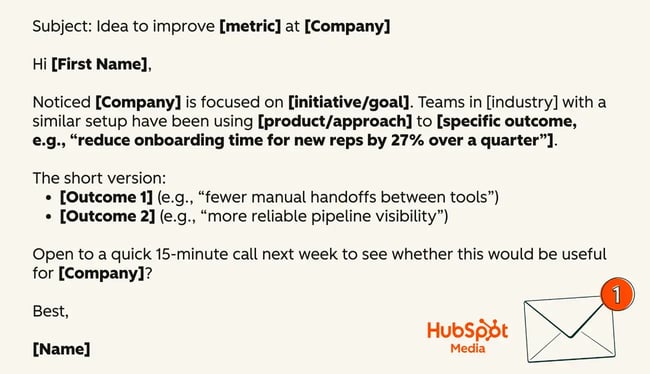
Pro tip: Notice how outcomes are clearly called out with their own bullets while features are conspicuously absent. There will be plenty of time to go into the most popular features on a full-length demo.
2. Decision-Maker Discovery Template
Best for: Situations where the right stakeholder is unclear.
Subject: Quick question about [area] at [Company]
Hi [First Name],
Reaching out about [topic, e.g., “sales enablement and rep ramp time”] at [Company]. Typically, this sits with [common title 1] or [common title 2], but the org chart can vary.
In short, [product/solution] helps teams [short outcome statement, e.g., “shorten ramp time and standardize coaching across offices”].
Are you the right person to speak with about this, or is there someone better to connect with on your team?
Thanks in advance,
[Name]
Pro tip: I’ve also had some luck leaving the outcome portion out of this email entirely and just asking the stakeholder question. Sometimes an email without a clear pitch just piques the recipient’s curiosity.
3. Warm Context/Rapport Builder Template
Best for: New contacts within an existing customer or warm account.
Subject: Welcome to [role/team] at [Company]
Hi [First Name],
Saw the news about [role/team change] at [Company] — congratulations on the new role. [Previous contact] and [Other contact, if relevant] worked with [team/product] on [brief result or initiative].
Given the transition, I thought it might be helpful to share what has worked well so far and where other teams typically see quick wins.
Would a short call to compare notes on [initiative/goal] be useful over the next week or two?
Best,
[Name]
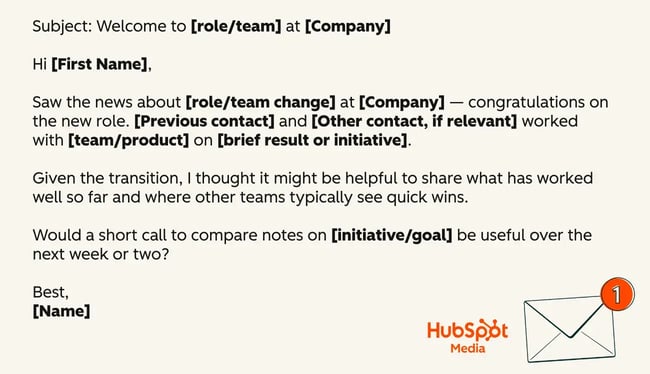
Pro tip: Despite the growing role of AI, business is still about relationships. Reach out to new contacts to build rapport before it’s time to sell them something and the selling process will be much easier down the line.
4. B2B Email Template to Establish Value Quickly
Best for: Prospects who have already interacted with content or the website.
Subject: Follow-up on [asset] for [Company]
Hi [First Name],
Noticed that someone from [Company] downloaded [asset/guide] on [topic]. Teams in [industry] often use that play to [specific outcome], especially when [context].
Here’s how [solution] typically helps:
- [Outcome 1]
- [Outcome 2]
- [Outcome 3]
If a 15-minute walkthrough of what this could look like at [Company] would be helpful, here’s a link to find a time that works: [Scheduling link].
Regards,
[Name]
5. B2B Email Template for a Free Diagnostic or Audit
Best for: Leading with a strong, no-cost offer.
Subject: Free [topic] audit for [Company]
Hi [First Name],
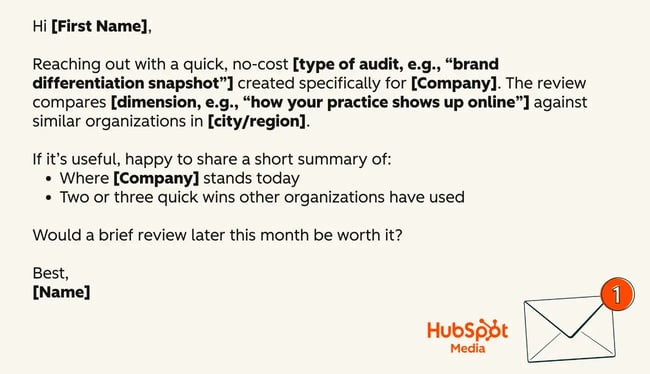
Reaching out with a quick, no-cost [type of audit, e.g., “brand differentiation snapshot”] created specifically for [Company]. The review compares [dimension, e.g., “how your practice shows up online”] against similar organizations in [city/region].
If it’s useful, happy to share a short summary of:
- Where [Company] stands today
- Two or three quick wins other organizations have used
Would a brief review later this month be worth it?
Best,
[Name]
Pro tip: Have a clear plan when someone accepts the free offer. Oftentimes, charging nothing can lower the perceived value of your service, and it can even be an obstacle to real engagement. Just think about the number of free trials you’ve signed up for and then let expire without going beyond a login.
6. B2B Introduction Template
Best for: First outreach after passive website engagement.
Subject: Quick intro from [Your Company]
Hi [First Name],
[Company] came across [Your Company] recently while exploring [topic, e.g., “how teams handle renewals”]. Spent a few minutes on [Company]’s site and saw [specific observation related to process/motion].
Teams similar to [Company] use [product] to:
- [Outcome 1]
- [Outcome 2]
Open to a short conversation about how teams in [industry] are approaching [topic] this year?
Best,
[Name]
7. B2B Voicemail + Email Combo Template
Best for: Following up when a voicemail has already been left.
Subject: Following up on today’s voicemail
Hi [First Name],
Left a brief voicemail earlier about [one-sentence reason for call or event/referral].
As mentioned, the reason for reaching out is that [solution] has helped [peer companies] [outcome] in [timeframe].
Planning to call again on [date] at [time]. If another time is easier, [link to calendar] might be faster.
Looking forward to connecting,
[Name]
8. B2B Re-Engagement Template (“Still on the radar?”)
Best for: Accounts that went quiet after initial interest.
Subject: Quick check-in on [initiative]
[First Name],
A while back, there was a conversation about [initiative / campaign] and a potential partnership, but timing didn’t line up.
Since then, [one relevant change: product update, case study, industry shift]. Curious whether [initiative] is still active for [Company] this quarter.
If it is, happy to share what similar teams are doing and where they’re seeing the quickest wins. If not, no reply needed.
Best,
[Name]
9. B2B “I Know Things Are Busy” Template
Best for: Respectful persistence with busy stakeholders.
Subject: Finding a time that works
Hi [First Name],
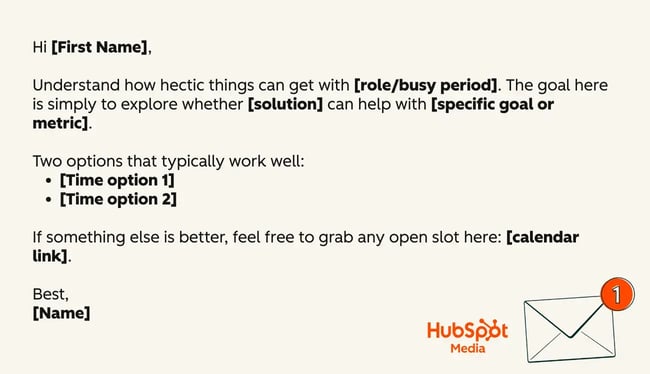
Understand how hectic things can get with [role/busy period]. The goal here is simply to explore whether [solution] can help with [specific goal or metric].
Two options that typically work well:
- [Time option 1]
- [Time option 2]
If something else is better, feel free to grab any open slot here: [calendar link].
Best,
[Name]
Pro tip: Include some time options in addition to a calendar link. Some prospects are understandably hesitant to click links, even when they appear to come from a trusted sender. Replying “Tuesday at 2 p.m.” is a safer bet.
10. B2B Email Template That Appeals to Pain Points
Best for: Showing a prospect you understand their needs.
Hi [First Name],
Many of our enterprise customers, like [Competitor], have huge sites and multiple domains, making it tough for them to manage their [Business Need] effectively.
After they started working with [Your Company], [Competitor] was able to use [Your Product] to improve [pain point].
The [X results] they achieved through their work with [Your Company] also drove over Y% growth in [clicks, followers, sales, etc.].
Want to dig in further to see how our [Your Product] can benefit your organization? I'd love to chat over a 15-minute call to share more.
You can simply reply to this email, and I'll set up a time for us to chat!
Chat soon,
[Your Name]
11. B2B Email Template for Connecting With People Who Downloaded From Your Website
Best for: Demonstrating that you’re ready to provide value immediately and offer a high-touch sales process.
Hi [First Name],
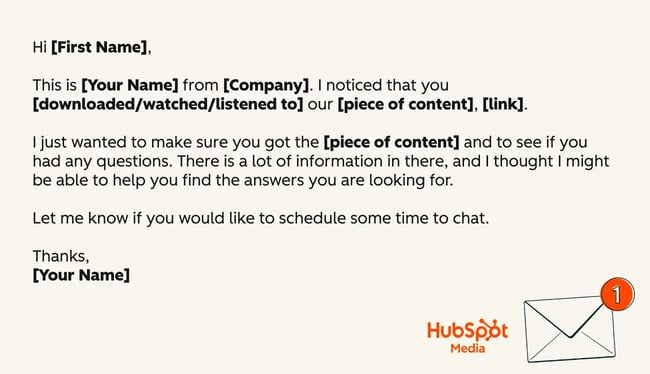
This is [Your Name] from [Company]. I noticed that you [downloaded/watched/listened to] our [piece of content], [link].
I just wanted to make sure you got the [piece of content] and to see if you had any questions. There is a lot of information in there, and I thought I might be able to help you find the answers you are looking for.
Let me know if you would like to schedule some time to chat.
Thanks,
[Your Name]
12. B2B Email Template for When You Keep Getting Ignored
Hi [First Name],
I‘ve tried to reach you a few times to go over suggestions on improving [Business Needs], but haven’t heard back, which tells me one of three things:
- You're all set with [Business Need], and I should stop bothering you.
- You‘re still interested but haven’t had the time to get back to me yet.
- You‘ve fallen and can’t get up, and in that case, let me know, and I'll call someone to help you.
Please let me know which one, as I'm starting to worry!
[Your Name]
Pro tip: If you’re sending cold email, be ready to try again. Most B2B teams see the best balance between persistence and respect at 3-5 follow-up emails over 10-21 days, often combined with calls and social touches for a true omnichannel approach.
Beyond that, response rates typically drop and the risk of fatigue increases, especially without new information or value in each touch.
13. The AIDA Formula Template
Best for: Prospects experiencing rapid growth or change
Hi [Name],
Noticed [Company] just expanded into [new market/launched product].
When companies scale this quickly, keeping sales and marketing aligned usually becomes a nightmare. Teams end up working from different data sets, leads fall through cracks, and revenue suffers.
We helped [Similar Company] solve this exact challenge — they saw 34% faster lead response times and closed 21% more deals within 90 days.
Worth a quick chat to see if we could help [Company] achieve similar results?
[Your name]
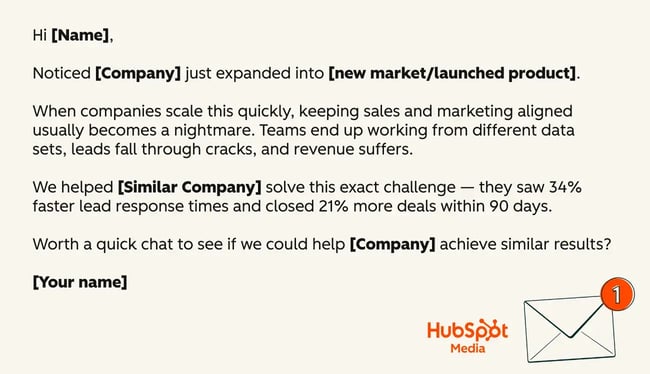
Why it works: AIDA is a century-old framework that mirrors natural decision-making. It grabs attention with relevance, builds interest through relatable challenges, creates desire with proof, and makes the next step crystal clear.
14. The Competitor Name-Drop Template
Best for: When you have successful customers in their industry
Subject: How [Competitor] increased [metric] by 40%
Hi [Name],
Your competitor [Competitor Name] just shared some impressive results with us — 40% increase in [relevant metric] in just 6 months.
They‘re using our [solution] to [specific benefit]. Given [Company]’s focus on [relevant goal from their website/LinkedIn], thought you might want to know what's working for others in your space.
Happy to share the playbook they used. Interested?
[Your name]
Pro tip: FOMO is real in B2B. Executives always want to know what competitors are doing successfully. This template leverages competitive intelligence ethically.
15. The Mutual Connection Template
Best for: When you have a warm introduction.
Subject: [Mutual connection] suggested we connect
Hi [Name],
[Mutual connection] mentioned you‘re the person to talk to about [Company]’s [specific area].
She thought we should connect because [specific reason related to their goals/challenges].
We recently helped [similar company] [achieve specific result]. [Mutual connection] thought our approach might be relevant for what you're building at [Company].
Worth a quick intro call? [Mutual connection] happy to join if that helps.
Best,
[Your name]
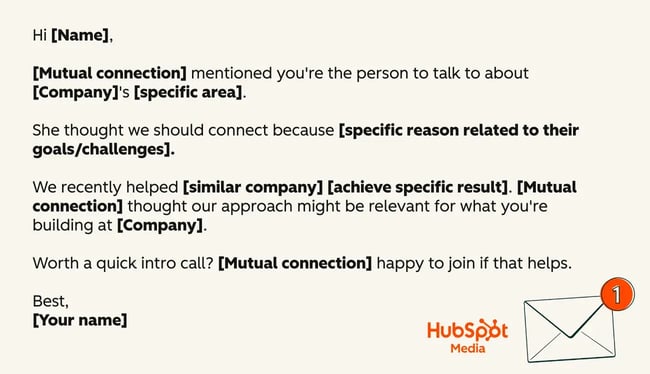
Pro tip: The best cold email isn’t cold at all. Referrals have 4x higher response rates, so leverage them as much as possible.
16. The Question-Based Template
Best for: Starting an open conversation.
Hi [Name],
Quick question — how does [Company] currently handle [specific process]?
I ask because I noticed [specific observation about their company], and typically that means [common challenge].
If that‘s the case, I might have some ideas that could help. We’ve worked through this exact scenario with [similar company].
Is this a challenge you're actively trying to solve?
Thanks, [Your name]
Pro tip: Questions engage the brain differently than statements. This template gets prospects thinking about their current state and whether it could be better.
17. The Straight-to-the-Point Template
Best for: Executives with limited time
Hi [Name],
I'll keep this brief.
We help [type of companies] [achieve specific outcome].
Recent example: [Company] saw [specific metric improvement] in [timeframe].
Based on [Company]'s [specific situation/goal], we could likely deliver similar results.
Worth exploring? Happy to jump on a 15-minute call to discuss.
[Your name]
Pro tip: Some prospects appreciate brevity above all. This template respects their time while still hitting key points.
18. The Break-Up Email (Final Touch)
Best for: Creating a sense of urgency
Subject: Should I close your file?
Hi [Name],
I‘ve reached out a few times about helping [Company] with [specific challenge], but haven’t heard back.
I'm assuming one of three things:
- This isn't a priority right now
- You're happy with your current solution
- You're the wrong person to speak with
Could you let me know which it is? If it's #3, who would you recommend I speak with?
If it‘s #1 or #2, I’ll close your file and stop reaching out.
Thanks either way, [Your name]
Pro tip: Some recipients are genuinely interested in an offer, but higher priorities continue to get in the way. This template creates urgency through loss aversion, and the multiple choice format makes it easy to respond and jump-start a stalled conversation.
19. The Video Prospecting Template
Best for: Showing a little more effort than a simple email.
Subject: 60-second video for [Name]
Hi [Name],
Just recorded a quick video for you: [Loom/Vidyard link]
In it, I show how [Similar Company] solved [specific challenge] and why I think it's relevant for [Company].
The video is 60 seconds, but the results they saw were game-changing: ? [Metric 1] ? [Metric 2] ? [Metric 3]
Worth a watch?
[Your name]
Pro tip: Video is still (for now) a quick way to show prospects you aren’t AI — which is becoming a large part of the sales battle.
20. The Objection-Handling Template
Best for: Industries with a high sales volume where recipients have heard every pitch.
Hi [Name],
I know what you're thinking — “another sales email about [topic].”
But here‘s why this one’s different: We don't require [common objection like long contracts, implementation time, etc.].
Instead, we [unique approach]. [Similar Company] went from skeptical to seeing [result] in just [timeframe].
The worst that can happen? You spend 15 minutes learning a new approach to [challenge].
The best? You solve [challenge] faster than you thought possible.
Worth the gamble?
[Your name]
Pro tip: Addressing objections upfront can disarm some prospects and decrease their tendency toward skepticism. The risk/reward framing makes the decision feel low-stakes.
21. The Insight-Sharing Template
Best for: Sharing a genuine insight about the recipient’s business
Hi [Name],
Just noticed something interesting about [Company]'s [specific area].
You‘re doing [specific thing] differently than most companies in [industry]. That’s smart because [reason], but it might be creating an unexpected challenge with [related area].
We've seen this pattern with [similar companies]. The ones who solved it fastest did [specific action].
Curious — is this something you've noticed too?
[Your name]
Pro tip: Sharing a surface-level insight can actually have the opposite effect you’re looking for, so don’t try to feign a level of understanding you don’t have.
22. The ROI-Focused Template
Best for: Targeting ROI-focused buyers (CFOs, ops leaders)
Subject: 3.2x ROI in 6 months?
Hi [Name],
Did some quick math based on [Company]'s size and industry benchmarks.
If you‘re like most companies we work with, you’re probably leaving $[amount] on the table annually due to [specific inefficiency].
Here's the breakdown: ? Current state: [assumption based on research] ? Potential improvement: [specific percentage] ? Estimated annual impact: $[amount]
[Similar Company] saw 3.2x ROI in 6 months using our approach.
Want to see the full calculation for [Company]?
[Your name]
Pro tip: Numbers speak louder than promises. Specific ROI calculations show you've done some homework and understand their business impact.
The best way to increase reply rates is to choose the right tool for the job:
- Use value-led templates when the prospect already understands the problem and needs a better way to achieve a clear outcome.
- Use problem-led templates when the issue is recognized but not yet prioritized.
- Use trigger-led templates when there’s a recent event that clearly creates urgency.
- Use social-proof-led templates when there are strong, relevant logos or outcomes to reference.
- Use resource-led templates when the best hook is a practical tool, benchmark, or diagnostic.
Above all, test which templates work best with different audiences and home in on the areas where performance is most promising.
How Not to Send a Cold Email for Sales
There are lots of ways to tank reply rates in a cold email campaign. The most common mistakes include poor targeting, vague or generic messaging, unclear CTAs, overlong emails, excessive automation with no personalization, inconsistent follow-up, and failing to log and learn from performance data. Many underperforming campaigns are fixable by tightening the list, clarifying the offer, and simplifying the copy.
Let’s break down some of the most common issues to avoid.
1. Overloading the email with multiple ideas and CTAs
Multi-topic, multi-ask emails create decision fatigue and make it unclear what action (if any) is expected. Get one main point across, and then follow it with a single call-to-action. Is the next step a phone call? A booked meeting? A whitepaper download? It shouldn’t be all three.
2. Writing long, dense paragraphs.
Walls of text are hard to scan, especially on mobile. Short paragraphs and judicious bullets are easier to process.
There’s a reason
Everyone on LinkedIn (and other major platforms).
Writes like this these days.
3. Focusing entirely on the sender, not the recipient.
Emails that read like company brochures (“we”, “our product”, “award-winning”) instead of speaking to the prospect’s world tend to be ignored. Just like in real life, focus on the other person and their needs to really connect, and always translate the features of your product into real benefits for the prospect.
4. Over-designing the email.
Heavy HTML, many images, and complex formatting can trigger filters, and at the same time feel less personal than a simple text-based note. The goal with a cold email is to resemble an internal team email as closely as possible, meaning it should be quick and unformatted.
5. Using robotic or over-automated language.
Messages that sound like they were generated and sent at scale with no human involvement erode trust. Templates are the beginning, but they shouldn’t be the end. Always add personalization and a human touch before hitting send.
6. Relying on excessive emojis or special characters.
A light touch is fine, but overuse can feel unprofessional in many B2B contexts. This advice may vary depending on the industry, but in general, higher-ticket sales demand a more professional approach than transactional sales.
7. Ignoring basic spelling and grammar.
Sloppy emails signal sloppy execution — and that can raise red flags about the underlying product or service. An obvious typo likely won’t set off any alarm bells, but using the wrong name or misspelling the recipient’s company might be unforgivable.
Contrary to what some recipients might think, B2B cold email isn’t about bothering as many people as possible. Teams need focused messages to actually make connections that last.
It’s also vital that teams adhere to regulations governing cold outreach in general. In many jurisdictions, B2B cold emails are legal as long as teams comply with regulations like CAN-SPAM and applicable privacy laws.
Legal requirements vary, so sales and marketing leaders should work with counsel to set compliant outreach policies for each region they target.
Send B2B Sales Emails That Prospects Will Read
B2B cold email templates are pre-written, customizable messages designed to help sales and marketing teams start conversations and book meetings with new business contacts. The most effective messages combine personalization, a clear subject line, a concise body, and a strong call-to-action.
HubSpot Sales Hub gives teams an easy way to build and use templates. Plus, HubSpot’s AI email writer and Breeze help teams research, write, and refine outreach at scale.
Ready to boost response rates? Try HubSpot’s free B2B cold email templates and AI tools inside Sales Hub.
50 Free Sales Email Templates
Save time, find new ways to reach out to prospects, and send emails that actually convert.
- First-Touch Emails
- Follow-Up Emails
- Break-Up Emails
- ChatGPT Email Prompts
Download Free
All fields are required.
Form not available
You're all set!
Click this link to access this resource at any time.
Email Templates




.jpg)

![What to Do When Your Prospect Ghosts [Free No-Show Follow-Up Email Templates]](https://53.fs1.hubspotusercontent-na1.net/hubfs/53/no-show-prospects-templates_3.webp)