

In a subscription-based economy, retaining and growing existing customers is just as important as acquiring new ones. Customer success managers (CSMs) are central to making that happen, acting as strategic partners who drive product adoption, deliver business value, and build long-lasting customer relationships.
This article explains what a customer success manager does, the skills the role requires, and how to break into the field.
Table of Contents
- What is a customer success manager?
- Top Customer Success Manager Skills
- What does a customer success manager do?
- Common Challenges Customer Success Managers Face
- How to Become a Customer Success Manager
- Customer Success Manager Salary and Jobs
What is a customer success manager?
A customer success manager (CSM) guides customers through the post-sale phase of the customer journey. Rather than functioning as customer support agents, CSMs build a direct relationship with customers and provide tailored guidance to help them see the value in the product. This helps customers grow and achieve goals while simultaneously strengthening their relationship with the business.
CSMs are typically responsible for driving product adoption, managing renewals, identifying expansion opportunities, and serving as the primary point of contact between the customer and the company. In many organizations, the CSM also serves as the internal voice of the customer, surfacing feedback to product, sales, and leadership teams.
Customer Success vs. Customer Service
Customer service is transactional, focused on solving and closing tickets as quickly as possible. Customer success is relational. CSMs build long-term, proactive relationships to help customers achieve measurable business outcomes.
Where customer service reacts to problems after they arise, customer success anticipates them before they do. Both functions matter, but they serve different purposes in the customer lifecycle.
.webp?)
Free Help Desk & Ticketing Software
Keep track of customer requests in one unified help desk that connects to your CRM database.
- Provide personalized, AI-powered support to your customers
- Save time, reduce errors, and streamline service processes
- Improve rep efficiency & time to resolution
- And more!
Top Customer Success Manager Skills
While customer success managers can come from a variety of backgrounds, there are a few key skill sets they need to succeed in the role. CSMs need communication, empathy, analytical thinking, and product knowledge, among other things. Below are the top eight customer success manager skills that today’s CSMs should have and why they matter.
1. Relationship Management
Customer success managers are responsible for building and maintaining relationships with stakeholders at varying levels, both externally with customers and internally across onboarding, sales, and product teams. Trust is at the core of relationship management. When CSMs take the time to listen, understand, and advocate for their customers, they earn both trust and loyalty.
In the age of AI and automation, , making this a critical skill for the role. Strong relationship management requires building trust, leading with authenticity, and being willing to navigate constructive conflict when needed, whether with a customer stakeholder or an internal team.
Pro tip: I keep a running note in each customer’s record of personal details they share, such as an upcoming vacation, a child’s graduation, or a recent promotion. I’ve found that referencing these moments in future conversations signals genuine interest and builds rapport, strengthening the relationship beyond the professional. Small gestures like these can be the difference between a customer who renews and one who quietly disengages.
2. Problem Solving
Customers trust their CSM to solve their problems, regardless of size or complexity.This means asking clarifying questions, finding the right internal stakeholders when needed, and communicating clearly with the customer throughout. A CSM can never adopt a “that’s not my problem” mindset — when a technical issue or outage arises, the CSM owns the next steps.
Every day, customer challenges require the same approach, even when the product doesn’t natively support what a customer is trying to do. I’ve found that asking “tell me more about what you’re trying to solve for” helps distinguish a real product gap from something that already exists in the platform. Customers want guidance and partnership, not just answers. The best CSMs treat problems as opportunities to exceed expectations.
3. Communication skills
Customer success managers need strong communication skills across multiple formats. Clear written communication keeps busy customers informed, while engaging presentation skills ensure customer touchpoints feel like conversations rather than slide readings. Great CSMs tailor their communication style to each stakeholder. The way a CSM engages with an everyday point of contact should differ from how they engage with an executive buyer.
Proactive communication is equally important. CSMs should never let a customer be blindsided by information, particularly around major events such as outages, contract changes, or company privacy updates. Handling difficult conversations with clarity and confidence is part of the role.
, CEO and founder of Mind Data, the number one thing he looks for in a CSM is communication, specifically “the ability to understand the audience you’re talking to, communicate very clearly, and explain something simply that might be a little bit more complex.” He reaffirms the importance of communication in relationship building, stating, “Ultimately, you are really just a human being building a relationship with another human being or set of human beings.”
4. Strategic Thinking
As more customer success teams leverage AI and automation, . In order to be strategic, customer success managers need to understand their customers’ goals and objectives, then build a joint success plan to collaborate on. When the CSM understands their customers’ challenges and goals, they can offer strategic guidance for achieving long-term value realization.
Many CSMs also have at their fingertips, making it easier than ever to identify when a customer’s product usage drops and might need strategic guidance. Strategic thinking goes beyond just driving general product adoption and instead relies on matching product functionality to customer goals and metrics.
Pro tip: I suggest including your customer’s goals and relevant metrics in the sales handoff process. If this isn’t happening, make this part of the process for the onboarding team or host a kickoff call with the customer right after signing to obtain this information. This information helps the CSM build credibility early by showing they understand what matters most to the customer and offering guidance tailored to their goals.
5. Active Listening & Professional Empathy
Active listening requires giving customers your full focus, understanding what they are saying, and responding in real time. It also involves remembering key details, picking up on nonverbal cues, and asking clarifying questions to gain deeper insight. Customers notice quickly when a CSM isn’t fully present, making this a skill worth bringing intentionally to every interaction.
Active listening goes hand in hand with . A CSM cannot validate a customer’s concerns without genuinely hearing them first. Professional empathy means understanding and feeling with someone without losing professional distance or objectivity. As AI becomes more prevalent in customer-facing roles, this distinctly human skill is increasingly a competitive differentiator.
that consumers believe AI cannot forge genuine human connections, making professional empathy one of the most important traits a CSM can develop. This quote from the sums it up nicely:
“Empathy, often dismissed as a ‘soft skill’, is actually the next competitive advantage – a measurable driver of business success.”
Pro tip: I think that active listening and empathy are two of the strongest traits that a CSM can develop, as these are inherently human traits that cannot be replaced with automation. Traits like these will continue to be a differentiator as the role of a CSM keeps evolving.
6. Assertiveness
While it’s tempting to always want to be the “good guy” in the customer relationship, sometimes the role of a CSM requires tough conversations and a strong point of view. Customers sometimes stand in their own way and default to doing things the way they’ve always been done. However, it’s the CSM’s job to help them achieve their goals, and that might mean challenging how the customer is doing something if there’s a better way.
Once a CSM has built trust with a customer, being assertive becomes much easier. Since customers trust their CSM to guide them in the right direction and they consider their CSM the product expert, a customer success manager shouldn’t be nervous about bringing a strong point of view to the table. Assertiveness is also important for commercial conversations around renewal, upsell or expansion opportunities.
Pro tip: This was one of the hardest skills for me to develop as a CSM, because I truly wanted to be the good guy all the time. However, I had to realize that my customers weren’t paying me to be a “yes wo-man.” They were paying for my strategic guidance. I’ve found that bringing data or industry benchmarks to back up your recommendations helps make these conversations go more smoothly. Don’t be afraid to ask questions about why customers are doing something a certain way and remind them it’s your job to help them hit your goals.
Collaborate seamlessly on commercial conversations between sales and customer success with HubSpot’s .
7. Data & Technical Fluency
Now that AI can do everything from to formulating success plans, CSM’s aren’t tasked with deep data analysis. However, customer success managers do need to be able to interpret trends in the data and speak to the story that it tells. CSMs need to be able to interpret data such as usage/product adoption, health scores, engagement metrics, and more to be able to spot trends, identify risk, create intervention strategies, and present the data to their customer, including executive stakeholders. CSMs need to be able to identify what datasets each type of stakeholder cares about, as the CRO probably doesn’t care about monthly active users, but they do care about pipeline and revenue generation.
CSMs also need to have a general handle on the product they’re supporting. While every company has different requirements for the level of product knowledge its customer success managers need, a good CSM will know their way around the product and its capabilities well enough to help customers identify features and functionality that solve their everyday challenges.
Finally, technical fluency extends to using AI and automation to work faster and more efficiently. Most B2B SaaS companies have AI mandates in place to encourage their employees to experiment with AI, so CSMs need to be comfortable with AI and automation tooling.
Pro tip: The ability to analyze data and tell a story is a critical part of a CSM’s role, and you’ll be required to demonstrate this skill in every single CSM interview process you go through. Connecting the dots between the data, the story it tells, and the recommendations you give a customer to improve their metrics is what companies are looking for here.
When it comes to product knowledge, I never shy away from using my company’s to help a customer. If I don’t know the answer to their question, I might say something like, “I’m not sure, let’s find out together.” And if my company has an AI Agent like , I can ask nuanced questions in real time and get immediate answers!
8. Prioritization and Time Management
It feels like there are never enough hours in the day as a CSM. Between customer escalations, risk mitigation plans, and preparing for customer meetings, it can be hard to find time for much else. Customer success managers need to be able to manage their day (and their calendar) in order to devote time to the tasks that are the most urgent. This means being able to quickly prioritize which accounts need attention, alongside ongoing strategic guidance and revenue-generating activities.
CSMs generally need to work well under pressure and put tools in place to help them prioritize the right activities. Having an AI-driven customer health score that alerts a CSM to changes in account health, upcoming renewals, and expansion opportunities is a great way to help with prioritization. I recommend for this, as it can alert CSMs to changes and automate next steps on their behalf.
Pro tip: I’m also seeing a lot of CSM’s use agents like Claude to scan their inbox, calendar, and (if connected to other internal systems) customer data, and then send them a plan for the day. Check out this episode of the for more ideas on using Claude Co-Work as a CSM!
For those looking to break into a customer success manager role, let’s explore what a CSM does, common challenges they face, and how to become a CSM.
What does a customer success manager do?
A customer success manager helps customers achieve their goals and maximize the value they receive from a product or service. CSMs manage the customer relationship post-sale, typically after onboarding is complete, though some CSMs also own the onboarding journey. They act as a strategic partner by making tailored recommendations to drive greater value from the product and serving as the voice of the customer internally.
CSMs are also responsible for the commercial health of their accounts. This includes identifying expansion opportunities, participating in the renewal process, and flagging risks before they become churn.
A Day in the Life of a CSM
While a customer success manager job description may vary, here’s what a typical day in the life of a CSM could look like.
Morning: CSMs usually start their day by reviewing their customer portfolio and health scores to quickly identify which accounts need attention or offer opportunities for expansion.
If any accounts are showing risk signals, the CSM will implement intervention strategies. CSMs will also review their calendar and make sure all slide decks and reports are prepared for the day’s upcoming customer meetings, as well as the next few days, to try to get ahead of presentation creation.
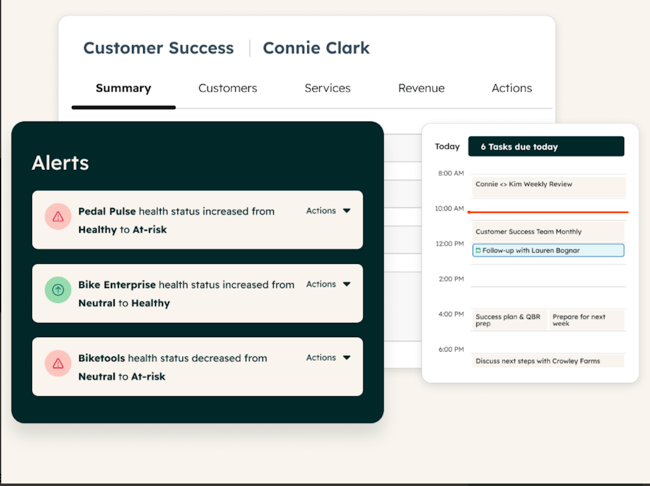
Pro tip: Check out the inside of HubSpot’s . This tool makes it easy for CSM’s to identify what accounts require action and review their upcoming daily tasks.
Mid-day through afternoon: CSMs conduct customer meetings and action follow-up items from each conversation. Between meetings, they respond to customer inquiries, coordinate with internal teams, update success plans, opportunities, and risk mitigation plans, and prepare data and QBR decks. Intervention plays are run as needed for at-risk accounts.
End of day: CSMs typically block time at the end of the day for admin work, including preparing data and slides for upcoming customer meetings, updating success plans and account records, and actioning follow-up items from the day’s interactions.
Pro tip: No two days in the life of a CSM look the same. Escalations, unexpected customer needs, and shifting priorities mean adaptability is essential. AI can help absorb much of the administrative load, including meeting summaries, follow-up drafts, quarterly business review (QBR) deck creation, and account record updates, freeing CSMs to focus on higher-value relationship work.
Free Help Desk & Ticketing Software
Keep track of customer requests in one unified help desk that connects to your CRM database.
- Provide personalized, AI-powered support to your customers
- Save time, reduce errors, and streamline service processes
- Improve rep efficiency & time to resolution
- And more!
Common Challenges Customer Success Managers Face
Customer success managers sit at the intersection of customer relationships and business growth, constantly balancing competing priorities. The most common challenges CSMs face include managing a large book of business, navigating account ownership changes, administrative overload, identifying churn risk early, and balancing retention with expansion goals. Here’s a look at each of these challenges in detail.
Managing a Large Book of Business
Account loads vary widely. High-touch CSMs may manage anywhere from one to 15 accounts, while scaled CSMs can manage hundreds at once. For CSMs with large books of business, keeping customers happy, identifying risk, proving business value, and spotting growth opportunities all compete for limited time.
Suggested solution: Digital customer success workflows help support all customer segments, but are especially valuable for CSMs managing high account volumes. Effective digital strategies include automated onboarding journeys, health-score-triggered outreach, lifecycle email campaigns, in-app guidance, and just-in-time resources. Weekly workshops and webinars are another way to offer dedicated CSM time across multiple accounts simultaneously.
Changes in Account Ownership
When CSMs leave, change roles, or a CS organization restructures, account ownership changes. This can be difficult for CSMs who have built strong relationships with their existing customers and now need to start fresh with a new portfolio.
Effective transitions require giving and receiving key customer context for both incoming and outgoing accounts. This includes business goals and objectives, current roadblocks, an updated success plan, and a transition call for a warm handoff.
Suggested solution: Implement AI workflows in your or that automatically update the account record with changes to key customer context. If your customer success workspace includes an or , ask it to create handoff summaries for your incoming and outgoing accounts, including next steps and existing commitments, to streamline the account transition process.
Administrative Overload
The role of a CSM includes substantial administrative work, including updating systems and following up with customers. shows that 66% of CSMs reported spending a significant portion of their workday on repeatable admin tasks, and 63% wish they had more time to dedicate to client engagement.
Administrative work for CSMs spans many areas, from pulling data and creating QBR decks to customer meeting follow-up and action items to updating success plans, account record details, and more.
Suggested solution: When customer success teams equip their CSMs with , repeatable admin tasks become automated, and CSMs can spend more time being a strategic partner to their customers. AI-powered workflows can actually help CSMs spot risk earlier, identify and act on expansion opportunities, and deliver exceptional customer service by automating meeting follow-up and action items.
Identifying Churn Risk Early
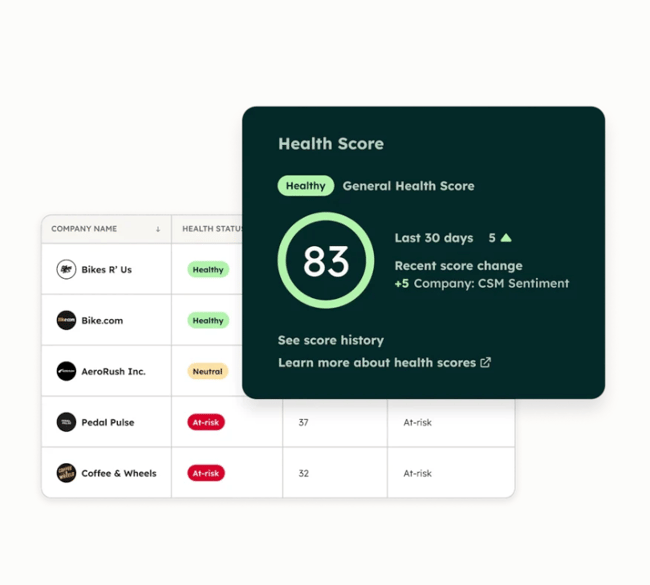
Customer success managers are responsible for identifying and mitigating risks before they turn into churn. Even with standard health scoring tools, this can be difficult. Most health scores rely on surface-level metrics like product usage, support tickets, NPS, and executive engagement, which can miss subtler risk signals.
Behavioral indicators such as meeting attendance, digital engagement patterns, customer sentiment, and stakeholder changes often go untracked, leaving CSMs without a complete picture of account health until it’s too late to intervene.
Suggested solution: Leverage an AI-powered customer health score that continually analyzes a combination of data, such as customer usage, behavior, and insights. HubSpot’s gives customer success teams a more holistic view of a customer and surfaces trends that reveal hidden risks not typically captured in metrics like product usage or adoption. I also suggest creating automations that trigger when risk is detected, both to alert CSMs and to digitally engage customers and guide them back on track towards success.
Balancing Retention and Growth
Retention and growth are both critical objectives for customer success teams, but they often compete for the same time and attention. CSMs are responsible for ensuring customers derive value from the product, identifying expansion opportunities, supporting renewals, and contributing to revenue growth.
In practice, this means CSMs constantly decide where to focus: helping at-risk customers get back on track or investing time in healthy accounts primed for expansion. Without clear prioritization signals, it is easy to default to the most urgent issue rather than the most impactful one.
Suggested solution: Customer success managers track metrics such as retention rate, churn rate, CSAT, NPS, and expansion revenue. Using AI-driven signals in your health score can help with daily account prioritization. I also suggest implementing automation or agentic workflows to help you prioritize your daily efforts.
Demonstrating Business Value
Customers buy and re-purchase software because it helps them achieve tangible business outcomes. CSMs are responsible for telling that story through data and measurable results, which can be challenging when value is difficult to quantify — such as gains in efficiency, risk mitigation, or incident prevention.
Customer priorities also shift over time. The goals a customer had at the start of a contract may not be the ones that matter at renewal. Changes in company leadership, loss of a point of contact (POC), and mergers and acquisitions all add complexity to an already difficult conversation.
Suggested solution: CSMs should identify what metrics each stakeholder cares about and what truly constitutes return on investment (ROI) for the product. Reporting on product adoption or monthly active users (MAUs) alone is rarely enough. I’ve found it helps to ask customers directly what data points their leadership team will care about at renewal, then build those metrics into the success plan and report on them consistently.
In one of my previous roles, our product’s entire purpose was preventing security incidents, which made proving ROI difficult. Asking customers upfront what success looked like to their executive team made those renewal conversations much easier.
Pro tip: Looking for the right tools to implement these suggested solutions? Check out , an AI-powered platform that connects data across the customer account, support tickets, sentiment, and more with workflows and automation to streamline digital engagement.
Now that we’ve discussed the daily duties and common challenges of a customer success manager, let’s look at how to break into a customer success manager role and a common career path.
How to Become a Customer Success Manager
Becoming a customer success manager doesn’t require a specific degree or a linear career path. CSMs commonly come from support, implementation, sales, account management, operations, and project management backgrounds. Many industry-specific software companies also hire practitioners with domain expertise in fields like healthcare, edtech, or audit directly into CSM roles.
Building the core skills covered earlier in this article is the best starting point. Early-career professionals should prioritize landing a customer-facing role first, then invest time in learning the fundamentals of the discipline: the customer lifecycle journey, health scoring, adoption and engagement, churn identification, and the renewal process.
Getting comfortable with the technology is equally important. CSMs work across CRMs, customer success platforms, product analytics tools, support ticketing systems, and AI and automation tooling. AI fluency is becoming an increasingly important differentiator in customer success careers.
Finally, the goal is to translate experience into transferable skills: relationship management, problem solving, data analysis and presentation, influencing decision making, and cross-functional collaboration. Real-world experience working with customers and driving value will go further than a certification.
Customer Success Manager Career Path
There are many different roles and team structures within a customer success organization, but here’s what a common career progression looks like. A typical customer success career path progresses from specialist or associate roles to manager, senior manager, director, and VP.
Customer Success Specialist/Associate Customer Success Manager
The specialist is an entry-level customer success role focused on learning customer success fundamentals. Responsibilities may include onboarding support, customer outreach, account administrative duties, scheduling, and helping to execute customer success programs. The role may have its own book of business, or the individual may work in tandem with other CSMs to support their “behind the scenes” work while they learn the ropes.
Scale Customer Success Manager
The scale CSM is a role focused on managing a high volume book of accounts while leveraging digital engagement strategies instead of 1-1, high-touch relationships. The focus of this role is to automate common touchpoints with customers and leverage digital campaigns, virtual events, self-service resources, and lifecycle programs to support hundreds (sometimes more) customers at once. Scaled CSMs usually have team-wide goals for retention and expansion instead of having individual revenue goals.
Customer Success Manager
The standard customer success manager owns a portfolio of accounts and is responsible for adoption, retention, customer satisfaction, and business outcomes. CSMs may or may not own onboarding (depending on the company size), but are directly responsible for customer health and revenue post-sale. In this role, the CSM has ownership over their book of business and is goaled on customer satisfaction, retention, and expansion.
Variations: CSMs are often segmented by touch level, such as high-touch or low-touch, based on the level of service contracted for their accounts. They may also be aligned to business segments, such as commercial, strategic, or enterprise.
Senior Customer Success Manager
Senior customer success managers typically manage more complex or higher-value accounts, or they may take on additional duties and ad hoc projects to support the rest of their team. Senior CSMs often have more complex customers and often serve as mentors to newer team members.
Team Lead/Manager of Customer Success
The team lead role is considered first-line leadership, and the duties include coaching CSMs, monitoring team metrics, improving processes, and helping with customer escalations. Many managers may even keep a reduced book of business while leading the team. This role is directly involved with driving retention and growth targets across the team.
Director of Customer Success
Directors oversee multiple teams and segments of customers and are responsible for the overall strategy, operational excellence, customer journey, retention, and expansion performance as well as resource planning and hiring. Directors also serve as liaisons between cross-functional teams such as sales, product, implementation, and support.
Variations: Companies may have different directors for different regions, business segments or customer segments, such as a director of scale, director of enterprise, etc.
VP of Customer Success
The vice president of customer success is the executive leadership role within the department, overseeing the vision and business outcomes across customer success. The VP typically oversees retention and expansion strategy, forecasting, organizational design, budgeting, board-level reporting, and aligning customer success goals with company-wide growth initiatives.
Now that we’ve looked at the career progression for a customer success manager, we’ll discuss customer success manager roles and salaries.
Customer Success Manager Salary and Jobs
Here is the average salary for a customer success manager in the United States. It’s important to note that customer success manager roles are typically structured around a base salary (usually 70% or more) and a bonus plan tied to NRR, GRR, or a combination of other metrics. This explains why many of the salaries below have a wide range, as bonus compensation can vary depending on multiple factors.
According to , the national median salary for a customer success manager in the United States is $147,000/year. This salary can range from about $113,000 on the low end to about $195,000 on the high end.
Within customer success, there are many roles, differing by seniority and specialization. These roles often have the same core duties but carry different titles and levels of responsibility.
Below are a few of those roles and their respective salaries.
Customer Success Specialist Salary
According to , the average salary for a customer success specialist in the United States is $89,000. This salary can range from about $68,000 to about $119,000. This entry-level position can be a good starting point to launch your career in customer success.
Scale Customer Success Manager Salary
While this is a somewhat newer role in the CS industry, a scale customer success manager’s salary averages around $120,000/year according to This salary can range from $94,000 on the low end to $157,000 on the high end, with a combination of base pay and bonus compensation. This role is also sometimes considered entry level, depending on the level of product and industry expertise a company is looking for, making it a good option for those trying to break into customer success.
Senior Customer Success Manager Salary
Higher-ranked positions bring higher salaries, according to . The average salary for a senior customer success manager is $176,000/year. This can range from about $136,000 on the low end to $234,000 on the high end. The higher salary for this role is likely a reflection of handling more complex customer accounts, managing higher ARR, and more seniority from the individual in the role.
Client Onboarder Salary
A Client Onboarder is slightly different from a customer success manager role in that it’s focused solely on onboarding and implementation. According to , the average salary for a client onboarder in the United States is $116,000. This salary can range from about $89,000 on the low end to about $152,000 on the high end.
Customer Success Operations Specialist Salary
Interested in moving into an operations and strategy role? A customer success operations specialist commands $105,000, according to . This ranges from about $82,000 on the low end to about $135,000.
Customer Experience Manager Salary
According to , the median salary for a customer experience manager is $108,000/year. The salary range spans from about $81,000 on the low end to about $147,000 on the high end.
Customer success managers unlock customer growth.
Customer success managers play a pivotal role in helping customers achieve value while driving growth and retention for their organizations. CSMs go beyond issue escalation and one-time support, building long-term relationships that foster trust, loyalty, and revenue growth.
As AI and automation take on more of the administrative load, the role of a CSM becomes increasingly strategic and relationship-focused. Aspiring CSMs should focus on building customer-facing experience and relationship management skills while getting comfortable using AI and data to work more effectively.
Editor's note: This article was originally published in July 2021 and has since been updated for comprehensiveness.
Free Help Desk & Ticketing Software
Keep track of customer requests in one unified help desk that connects to your CRM database.
- Provide personalized, AI-powered support to your customers
- Save time, reduce errors, and streamline service processes
- Improve rep efficiency & time to resolution
- And more!
Customer Success






![How To Write a CSM Resume [+ Free Templates]](https://53.fs1.hubspotusercontent-na1.net/hubfs/53/customer-success-manager-resume-1-20241031-2293336.webp)