.png?width=112&height=112&name=Image%20Hackathon%20%E2%80%93%20Vertical%20(9).png)

A product launch, a system migration, or a new customer’s first week can all go sideways quickly. If customers encounter friction before realizing a product’s value, churn risk becomes significant. Hypercare is the support strategy built to prevent that.
Hypercare is a proactive, intensive support phase offered to customers right after a go-live event, whether that’s a new product launch, a migration, a major design change, or a new customer coming on board. It reduces friction during the most sensitive stretch of the customer relationship and shortens the time it takes customers to realize value.
This guide explains what hypercare is, when teams need it, the key benefits, and how to roll out a hypercare phase.
Table of Contents
- What is hypercare?
- The Benefits of Hypercare in Customer Support
- How to Provide Hypercare Support
- Frequently Asked Questions About Hypercare

What is hypercare?
Hypercare is a temporary period of intensive, proactive support offered to customers right after a major change, such as a product launch, system migration, or new onboarding. It covers the most sensitive stretch of the customer journey, from the moment of change to the moment a customer becomes a confident, successful user of the product.
Many customers churn during this window, before they ever realize value, because they encounter friction during onboarding or struggle to understand the key features and workflows that drive product success. Hypercare support mitigates this early churn risk with a hands-on, proactive approach rather than waiting for problems to surface.
Hypercare vs. Regular Customer Support
Regular customer support is ongoing throughout the customer relationship. It’s reactive, meaning that when a customer encounters a problem, they reach out, and the support team responds by troubleshooting and helping resolve it.
Hypercare flips this model on its head. It’s a short-term, proactive support strategy with a dedicated support team that’s in regular contact with new customers, guiding them through early onboarding stages or checking in at key milestones during sensitive moments, such as migrations and major product updates.
When do you need hypercare?
Businesses need to offer hypercare immediately following significant go-live events or major changes to the customer experience. Teams typically implement hypercare during:
- New product launches.
- New feature rollouts.
- System migrations.
- Major redesigns or rebrands.
- Onboarding.
Significant changes cause churn risk to spike by leaving customers confused or unsure how to use a product and realize its value. That’s precisely when hypercare is needed most. A hypercare support strategy mitigates churn risk by intentionally and proactively guiding customers toward success during sensitive, churn-prone moments in the customer journey.
A hypercare strategy requires a platform that manages customer requests, routes tickets, handles escalations, and automates support workflows. helps teams provide hypercare to customers at the moments that matter.
Hypercare Phase Length
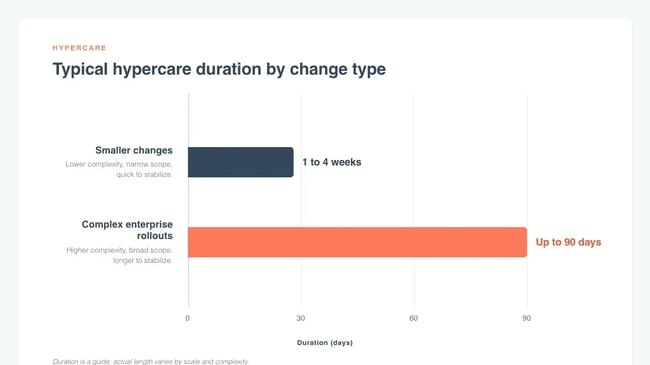
Hypercare is time-boxed and typically runs 1 to 4 weeks, though for complex enterprise rollouts, the duration can sometimes extend to 90 days. The appropriate duration for a hypercare phase depends on the scale of the rollout or change to the customer experience, as well as the product’s complexity.
.png?)
Free Customer Support Training Template
Train and onboard your new customer support hires with this downloadable template.
- Training Timeline
- People to Meet
- 100 Day Goals
- And More!
Download Free
All fields are required.
Form not available
You're all set!
Click this link to access this resource at any time.
The Benefits of Hypercare in Customer Support
The main benefit of hypercare in customer support is retention. Hypercare reduces customer churn through a proactive support strategy that addresses friction at moments when customers are likely to resist change, become confused, and abandon the product. Below are the key benefits of a hypercare strategy in customer support.
Adoption
Hands-on guidance during hypercare helps customers learn the features and workflows that unlock a product’s value, so more of them reach confident, regular use.
Increased Retention and Reduced Churn
Customers are likely to resist change, encounter friction, and potentially become frustrated and abandon a product if they aren’t experiencing early wins. Through hypercare, a dedicated support team proactively works with customers during sensitive times to guide them toward early wins and proactively solve any frustrations that could snowball into churn.
Trust
Offering hands-on, dedicated support shows customers that the business cares about them and their well-being, and that it wants them to succeed in using the product. That goodwill compounds into increased trust and a stronger long-term customer relationship.
Faster Issue Detection
Because the support team is in active contact with customers instead of waiting for tickets, problems surface and are resolved sooner, often before they spread to other customers or escalate.
Product Feedback
Support teams can gather more high-quality feedback during a hypercare phase since they are actively and proactively in contact with customers. A steady stream of high-quality product feedback during hypercare feeds directly into improved documentation and insights that drive features customers actually need.
Pro tip: helps teams collect crucial customer feedback during hypercare.
Brand Protection
Customer support quality is part of brand identity. When companies offer a hypercare phase for new or existing customers during a go-live event, they strengthen customer relationships and brand perception by demonstrating their dedication to customer success.
Delivering on these benefits takes the right tooling. HubSpot’s helps teams monitor customer health, manage renewals, and prioritize outreach to the accounts most at risk during a transition.
How to Provide Hypercare Support
Providing hypercare support requires careful planning, a dedicated team, and a platform that can handle customer communications, escalations, and complex ticket routing. is built for high-powered customer service teams, such as those that provide hypercare after go-live events.
Dedicate a team to field communications.
Hypercare support requires a dedicated team. Customer support leaders should build a hypercare team, through hiring or reorganization, whose sole responsibility is to deliver proactive support during major go-live events. Concentrating that work on one team keeps the surge of questions from overwhelming everyday support and gives customers a consistent point of contact. A x gives that team a single place to manage every hypercare conversation, so requests get tracked and answered without slipping through the cracks.
Pro tip: Hypercare representatives need empathy and relationship management skills, in addition to product knowledge and troubleshooting expertise. Support management should assign hypercare duty only to their most experienced reps.
Prepare your customers for changes.
It’s important to prepare customers for upcoming changes during major go-live events, such as product changes and migrations. Explain which surfaces and workflows will change and how that will affect their day-to-day operations. Make sure to frame it positively and demonstrate how the upcoming changes will improve their workflows and give them more value from the product.
Most importantly, let them know they’ll have access to a dedicated hypercare support team to guide them through the transition, and tell them exactly how to contact them. Clearly set expectations regarding their relationship with the hypercare team, the length of the hypercare phase, and the team’s proactive contact. With , the hypercare team can meet customers on whatever channel they already use, whether that’s email, chat, phone, or messaging, instead of pushing them onto an unfamiliar one during an already disruptive change.
Create digestible training content.
Hypercare isn’t only about proactive contact from the hypercare team. Throughout the phase, customers should also have access to a , including troubleshooting articles, how-to guides, and short video walkthroughs, built specifically for the onboarding or product change they are navigating. Teams build a support content library faster by using dedicated , which provides one centralized place to write, organize, and publish help articles.
resources for simple issues rather than contacting a rep. Giving customers the resources to help themselves increases satisfaction and lightens the load on the broader support organization, freeing the hypercare team to focus on the complex, high-stakes cases that increase retention and reduce churn.
Hypercare support teams can create hypercare content using ’s knowledge base software. HubSpot’s identifies content gaps based on support interactions, drafts new articles for team review, and flags underperforming content so teams can keep resources current throughout the hypercare phase.
Pro tip: Don’t wait for customers to come looking for the content. Build an automated email flow that delivers the right resource at the right moment, either on a set cadence throughout the hypercare phase or in response to specific milestones.
Prepare for unexpected obstacles.
Significant go-live events inevitably reveal unexpected technical issues and customer friction points, regardless of the thoroughness of planning. The hypercare team should expect issues to arise and have escalation paths ready to address them.
Support leaders should provide explicit instructions on how to route different types of issues and how to raise a bug to the engineering team for review. If escalation paths and potential issues are mapped out in advance, the hypercare team can operate smoothly, even when things start to break. A , like the one in , provides hypercare teams with a single system to log incoming issues, to the right owner, and quickly escalate urgent ones.
Pro tip: Establish a direct communication channel between engineering and hypercare teams ahead of the go-live event. Bugs surface fast during hypercare, and a real-time channel helps teams resolve issues more quickly than a standard ticket queue.
Monitor and measure hypercare success.
Monitoring and measuring hypercare success requires tracking key support and customer success metrics. A handful of support metrics, scoped from go-live through the end of hypercare, will reveal how customers are adapting to the change, where they are struggling, and when it’s time to wind down hypercare and transition back to regular support.
- Adoption rate: The rate at which customers are using a new product or feature. Rising adoption rates indicate hypercare success, as customers overcome friction and incorporate new products or features into their workflows, while flat or declining adoption rates indicate customers are getting stuck.
- Customer satisfaction (CSAT): A post-interaction score that measures how satisfied customers are with the support they received. During hypercare, increased CSAT scores show that customers are responding well to high-touch, proactive support.
- Net promoter score (NPS): A customer loyalty metric that measures how likely customers are to recommend a company to others. NPS is a major indicator of customer health, and a successful hypercare strategy should increase NPS among customers receiving white-glove support.
- Ticket volume: The number of incoming support requests. A spike in ticket volume after a go-live event is expected, but a massive, ongoing increase indicates that customers are experiencing friction. A steady decrease in ticket volume during hypercare shows that customers are settling into using a new product or feature.
- Resolution time: How long it takes the team to close a support ticket. A dedicated support team should consistently deliver fast resolutions to customers during hypercare, so rising resolution times indicate the team is overwhelmed or that significant product issues are surfacing.
- Churn: The rate at which customers cancel. Hypercare exists to mitigate churn during major changes, so the churn rate during a hypercare period is a crucial metric indicating the program’s success or failure. Successful hypercare should result in lower churn than in previous periods.
These metrics together tell a story of customers’ adaptation to a major change. When ticket volumes level off, CSAT scores rise, and adoption holds steady, these signals indicate that customers have adapted to the change and hypercare can transition back to regular support operations. Organizations exit hypercare when support volumes stabilize, critical issues are resolved, and ownership returns to standard support teams.
Pro tip: Track all of these metrics in one place using in .
Frequently Asked Questions About Hypercare
What is the meaning of hypercare?
Hypercare is a temporary period of intensive, proactive support after a product launch, system migration, or major operational change. A dedicated support team provides high-touch guidance to customers during a period of significant change, monitoring ticket volume, resolution time, CSAT, adoption rate, and churn risk to maintain satisfaction and reduce churn.
What is the hypercare phase in a project?
The hypercare phase in a project is the period directly following a product launch, system migration, or major change, including new customer onboarding. A dedicated hypercare team provides hands-on support focused on rapid responses, real-time monitoring, fast escalation, and proactive customer communication. The phase typically lasts one to four weeks for smaller changes and up to 90 days for complex enterprise rollouts.
What is hypercare after go-live?
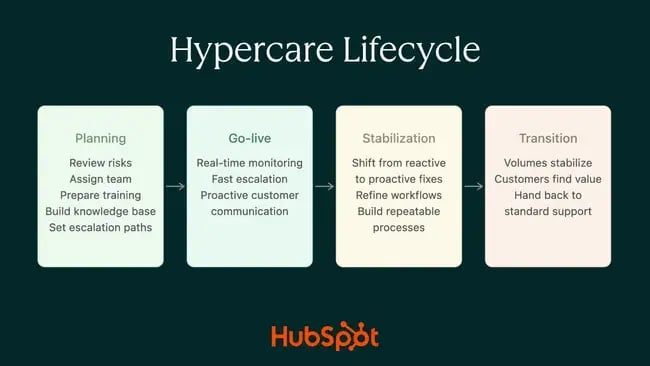
Hypercare after go-live is the intensive support period that begins following a product launch, migration, or major change. It is one stage in a larger process that moves through planning, go-live, stabilization, and the transition back to normal operations. A dedicated hypercare team offers proactive, white-glove support to guide customers through the change with a focus on maintaining satisfaction and reducing churn.
What is a hypercare job description?
A hypercare job description outlines the responsibilities and skills required of a support representative during a hypercare phase. In some organizations, it is a dedicated title such as hypercare specialist or hypercare lead, while in others it is a temporary assignment filled by experienced support reps during a product launch, major update, or migration. The role requires both technical support skills and the empathy and communication skills needed to guide customers through high-volume, potentially turbulent periods.
Make hypercare part of your launch playbook.
A hypercare strategy should be a standard part of any product launch, migration, or major change. With the right team and clear escalation paths in place, the riskiest stretch of the customer journey becomes an opportunity to build trust. Businesses that invest in hypercare consistently see lower churn, faster adoption, and stronger customer relationships coming out of major transitions.
Editor’s note: This article was originally published in December 2020 and has been updated for comprehensiveness.
Free Customer Support Training Template
Train and onboard your new customer support hires with this downloadable template.
- Training Timeline
- People to Meet
- 100 Day Goals
- And More!
Download Free
All fields are required.
Form not available
You're all set!
Click this link to access this resource at any time.
Customer Support