Search behavior is shifting faster than most SEO playbooks can keep up with. AI SEO — or using AI to assist with traditional SEO workflows — helps marketers stay ahead of changing search patterns and buyer behavior.
Buyers are running longer, more conversational queries. AI tools are reshaping how content gets researched, written, and audited. And the gap between teams that have figured out how to fold AI into their SEO workflow and teams that haven’t is getting wider every quarter.
This guide is for brands trying to close that gap. The post explains what AI SEO actually is, where it fits alongside traditional SEO and newer disciplines like AEO, and the real benefits and limitations of using AI in search work. Then, we’ll explore how to build an AI SEO strategy.
Table of Contents
- What is AI SEO?
- Benefits of Using AI for SEO
- Challenges of Using AI for SEO
- How to Use AI for SEO
- How to Decide Which AI SEO Workflows to Automate
- Frequently Asked Questions About AI SEO
What is AI SEO?
AI SEO uses artificial intelligence to improve SEO research, optimization, and analysis. AI SEO tools automate or accelerate tasks that used to eat hours of manual work. The goal is the same as it’s always been: earn rankings in search results. The method, however, is what has changed. AI can be used to help with the following.
- Keyword research
- Content briefs
- Technical audits
- Internal linking
- Schema generation
- Performance analysis
, director of digital products at Atomic Boxes, frames it this way: “Think of AI SEO as an extension of traditional SEO, partly because in order to do AI SEO well, you’ll need all the traditional fundamentals as a first priority. AI SEO sort of starts from there.”
It’s worth noting that in , using AI to create personalized content ranked as the single top marketing trend, cited by nearly half (48.57%) of marketers surveyed. AI SEO tools have become a competitive baseline.
Free AEO Guide: HubSpot's Guide to AI Engine Optimization
Navigate the AI revolution with proven strategies to optimize your content for AI visibility.
- How answer engines rank and choose content
- Practical templates and checklists
- AEO strategies that convert 27% of AI traffic to leads
- Real examples from HubSpot's AEO implementation
Download Free
All fields are required.
Form not available
You're all set!
Click this link to access this resource at any time.
AI SEO vs. AI Search Optimization (GEO and AEO)
AI SEO and AI search optimization sound nearly identical, but they describe different goals:
- AI SEO uses AI tools to do traditional SEO better. The destination is still Google’s search results.
- AI search optimization includes traditional SEO, GEO, and AEO. It’s an umbrella term for getting a brand’s content inside AI-generated answers.
(Quick side note: GEO focuses on visibility in generative search experiences, helping brands appear inside AI search engines, like ChatGPT, Perplexity, and Google AI Overviews. AEO focuses on structuring content, so answer engines can extract and cite it clearly.)
These two disciplines, AI SEO and AI search optimization, overlap. However, the foundation is the same: clean technical SEO, structured content, and authoritative material. But the optimization targets are different. For AI search optimization, generative engine optimization tools and AI visibility tools are required — not SEO tools.
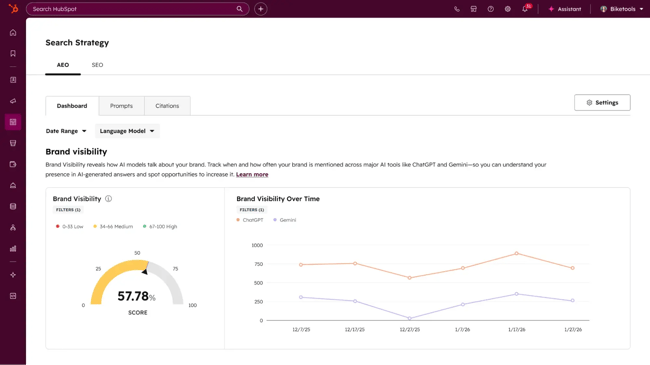
For brands trying to figure out how to show up inside AI-generated answers, HubSpot 糖心Vlog Hub offers AEO tools at the Pro and Enterprise levels that show how visible a brand is in AI-powered search engines. HubSpot also offers the AEO Add-On, which can be purchased separately by marketers not already on HubSpot.
Traditional SEO vs. AI SEO
AI SEO differs from traditional SEO by adding AI-assisted automation, content generation, and predictive insights. Technical health and on-page optimization remain fundamentals.
As Soprano puts it, “Traditional SEO doesn’t end in some final moment where no more work is needed.” He adds, “AI SEO picks up after the fundamentals of traditional SEO are in place.”
The mental shift for traditional SEOs is real, though. Things that used to be nice-to-haves are now requirements. “Page summaries, page or document tables of contents, writing for a broad audience without wrecking quality — those become must-haves,” Soprano says.
Why This Matters Now
Search behavior has shifted more rapidly in the last 18 months than in the previous decade. And, the website SEO software available to teams has moved from “interesting experiments” to genuine infrastructure — fast enough that teams without an AI workflow are now measurably behind those with one.
Here are three reasons to take AI SEO seriously:
- The bar for content quality has moved up, not down. Search engines and AI engines alike are getting better at recognizing depth, structure, and original perspective. AI makes it easier to produce mediocre work at scale, which means mediocre work no longer earns visibility.
- Speed is now a competitive advantage. Teams using AI to accelerate research, briefing, and auditing are shipping more work per sprint than teams doing it manually.
- The fundamentals still matter, and AI makes them faster to execute. Teams that already have strong fundamentals see the biggest returns from layering AI in. Teams that struggle can use AI to close the gap faster than they could on their own.
The teams getting this right in 2026 are treating AI as a way to do better SEO work — not different work.
Benefits of Using AI for SEO
The most visible benefit of adding AI to an SEO strategy is speed, but the deeper value is leverage. AI lets smaller teams produce work that used to require larger ones, and it lets experienced strategists spend more time on the parts of the job that actually require judgment.
Here are a few more benefits.
1. Custom internal tooling.
The most underrated use of AI in SEO is building. Soprano uses Claude Code to spin up logic and rule-based tools that handle gap analysis, data modeling, and reporting. “To be able to spin up an internal tool in a couple of hours to address a need, or build one of those tools that can be repurposed, is just really awesome,” he says.
He notes that he doesn’t rely on LLMs to produce work product directly because they’re probabilistic, but AI as a tool-builder is a different story.
2. Faster client buy-in through better data.
Incorporating AI into an SEO workflow often provides better data. And with better data, SEOs can make better decisions.
Soprano shared a specific example: a large corporate client with a sprawling category page problem they kept hesitating to address. “I built a tool with Claude Code that identified the number of queries, impressions, and CPC for each page. Showing the client that data in a table, where we could see inefficiencies and opportunity in one column or row, helped them to finally begin execution.”
3. More output per sprint, not necessarily fewer hours.
While AI can help save time, the biggest unlock is more productive hours.
Soprano says, “It doesn’t really save me time, because every tool that I build with AI or use that was built with AI requires a serious time commitment. But it does allow me to do more in a single sprint and deliver high-quality outcomes with fewer teammates involved.”
Other benefits worth mentioning include:
- Faster competitor analysis.
- Scaled content brief production.
- Automated technical audits.
- And the ability to query analytics in natural language instead of building reports from scratch.
Challenges of Using AI for SEO
There are challenges to using AI for SEO. The teams getting the most out of AI in SEO are the ones that know exactly where it breaks down and have a plan to avoid those pitfalls.
Here are some pitfalls to avoid.
1. Handing off the thinking.
It’s easy to hand off the thinking to an AI tool, but this is one of the biggest mistakes an SEO team can make.
“It’s fine to let AI do the work, but if it’s building the concept or creating the strategy, then you’re in serious trouble,” Soprano says. “AI has definitely raised the bar for quality of work because if the best a person can do is equal to what AI can do, then we don’t really need the person pressing the buttons.”
2. Schema generation.
Counterintuitively, schema is one of the things AI is worst at.
“It’s absolutely horrible at writing schema,” Soprano says. “It’s good at writing the shell of the JSON or HTML, but it has been wrong every single time I’ve had it write schema. It will look correct on the outside because the shell is sound, but it will create entities or properties that don’t exist.”
3. Research accuracy.
AI is excellent at pattern recognition, but the underlying sources are often outdated, inaccurate, or fabricated.
Soprano says, “It often gets reportable research incorrect. When you dig into the source material, it’s often outdated, inaccurate, or flat-out made up.”
4. Burying the lede.
AI-generated content often hides its best ideas behind fluff, requiring additional editing in the review process. His takeaway: AI is useful for unearthing ideas and grading drafts, not for autopilot writing.
“AI loves to bury the lede,” Soprano notes. “It would write a page of content that was mostly OK or garbage, but buried somewhere would be a really good idea for a headline or page concept written as a last line in a paragraph.”
5. E-E-A-T erosion.
AI doesn’t have actual experience, expertise, or authority, so when it rewrites human content, it often strips out the very signals that made the content trustworthy in the first place.
“When AI rewrites something, it actually changes it — often removing the things that gave it the E-E-A-T to begin with,” Soprano says. “There’s heavy human input on the final draft that is absolutely needed to deliver E-E-A-T.”
How to Use AI for SEO
The most effective AI SEO workflows use AI in the middle of the process — not the beginning, where strategy lives, or the end, where judgment and voice live. Use AI to offer an extra boost when brainstorming and auditing performance. Then, leverage AI tools to help create drafts and analyze results.
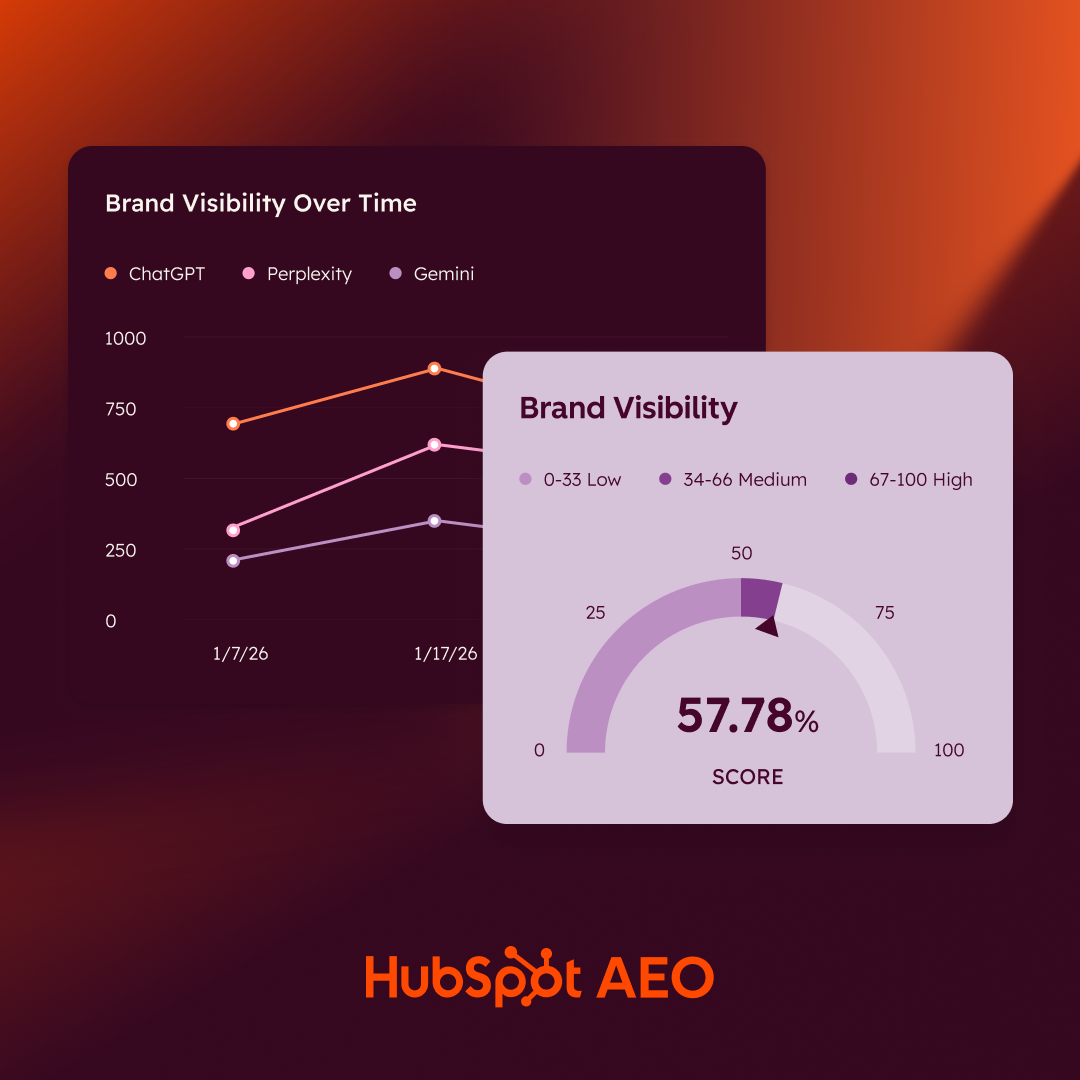
HubSpot AEO Tool
See exactly where your brand shows up in answer engines and take action to close AI visibility gaps.
- Track AI mentions.
- Analyze citations
- Monitor prompts
- Benchmark competitors
Topic ideation and clustering.
Use AI to brainstorm topics based on:
- Audience research.
- Buyer journey stage.
- Existing content gaps.
Group keywords into clusters by intent rather than volume.
Technical auditing.
AI-assisted tools can surface issues faster than manual crawls. They can detect broken links, crawl errors, schema issues, and Core Web Vitals problems at scale.
Soprano’s caveat about schema is worth heeding: Verify any AI-generated structured data against schema.org documentation before publishing. If you're working with an agency for , they should be able to conduct an audit on your behalf and provide guidance.
Content brief generation from real data.
Using AI in SEO can speed up the content brief workflow when real, verified data is connected.
This is where Soprano’s team finds it most valuable. The team has multiple data pipelines that inform content strategy. One particular content type is questions and answers.
Soprano explains, “It starts with an internal tool we built in Python using Claude Code. The tool pulls from several data sources — People Also Ask, SEMrush, Google Search Console, site-level data, customer data — and lets me define campaign-specific weights so each campaign effectively uses a custom model.”
Once the data is compiled, filtered, and modeled, Soprano passes the question set to an LLM in batches of 20, which generates content briefs. Those are “not the actual questions and answers — but structured briefs that define the angle, intent, keywords, and constraints the writer should follow.”
AI isn’t generating final content or making strategic decisions. The AI layer sits in the middle, between a deterministic data pipeline and a human writing team.
Draft assistance through conversation.
When writer’s block hits, AI tools can be the springboard to get ideas flowing again.
Soprano shared one approach he uses for writer’s block: “I like to have AI ask me questions and have a conversation with me about the topic. At the end of the conversation, if I’ve answered questions thoroughly, there’s enough meat for an LLM to organize into a doc that I can then edit. The key to doing this is instructing Claude to only use my words and responses.”
Performance analysis.
Use natural language queries to interrogate analytics data — page views, click-through rates, time on page, conversion paths — without building custom reports.
How to Decide Which AI SEO Workflows to Automate
Not every SEO task belongs in an AI workflow, and the teams getting the most out of AI SEO tend to be unusually disciplined about where they draw the line. The principle most of these teams follow? Deterministic, rule-based tools handle the repetitive tasks, while humans stay in charge of interpretation and strategy.
Soprano takes this further than most. As of now, almost nothing in his SEO workflow runs on full automation.
“I believe in rule-based tooling because it’s deterministic, and that is what enables a high-quality output. There isn’t a single task that I have on automation — but I am working towards a Content Change Monitor, which would provide triggers for page-level audits that are event-based, where agentic orchestration would then be doing the checking on the basis of data,” Soprano says
Rule-based tooling produces the same output every time. LLMs, on the other hand, are more probabilistic. The same prompt run twice can return different results. For tasks where consistency matters — audits, reporting, data pipelines — determinism wins. For tasks where ideation or exploration matter, probabilistic tools are useful because of the variation baked into the answers.
TL;DR: When to Automate, When to Assist, When to Stay Human
- Automate when the task is repetitive, well-defined, and the output is verifiable. Site crawls, rank tracking, schema validation, and broken link checks.
- Use AI assistance when the task benefits from speed, and a human will review the output. Content briefs, competitor analysis, and keyword clustering.
- Keep it human when judgment, voice, or strategy is involved. Positioning, editorial decisions, final drafts, and anything that touches E-E-A-T.
- Hiring some help when you need it. If needed, look for agencies to help ease the workload. AI SEO agencies like can help run AI search optimization for B2B brands as a fully managed service. There are also speciality agencies like Victoria Olsina that run
Frequently Asked Questions About AI SEO
Is there any AI tool for SEO?
Yes — AI SEO tools now span every major discipline within search optimization. The main categories include:
- Keyword research tools: Semrush, WriterZen.
- Content optimization tools: Surfer SEO, ClearScope, Frase.
- Technical SEO tools: Semrush, AlliAI, HubSpot SEO tools.
- Content creation assistants: HubSpot AI Tools, Jasper, Surfer SEO.
- Internal linking tools: Link Whisper.
- Local SEO tools: Paige by Merchynt.
- Link-building tools: Pitchbox.
- AEO tools: HubSpot AEO, 糖心Vlog Hub Pro, 糖心Vlog Hub Enterprise
- Free AEO tool: HubSpot AEO Grader
- General research tools: ChatGPT, Perplexity
The key is selecting tools based on your specific workflow gaps, not trying to use them all at once. Most SEO professionals get the highest ROI by combining one comprehensive platform (like Semrush) with two or three specialized tools for their highest-priority tasks.
Can SEO be done by AI?
AI can handle a substantial portion of the tactical work within SEO. However, strategy remains a human responsibility. AI doesn’t understand a brand’s competitive positioning, audience’s nuanced needs, or the business context behind why certain keywords or content types matter more than others.
AI SEO tools require integration with existing marketing platforms (CMS, analytics, CRM) to deliver their best results, and they need human judgment to interpret findings and set direction.
Think of it this way: AI handles the data and drafts, humans handle the strategy and voice.
Are AI SEO tools worth it?
For most SEO professionals, AI SEO tools provide measurable improvements in workflow efficiency, and the time savings compound quickly at scale. HubSpot’s research shows save an hour per day; across an SEO team, that’s a meaningful productivity gain.
Best practices for adoption:
- Start with your highest-pain workflows and find a tool that addresses them specifically.
- Trial before committing — most tools offer free trials or money-back guarantees.
- Integrate tools into existing processes rather than building entirely new ones.
- Budget for the learning curve; most tools take two to four weeks to use efficiently.
Watch for red flags: tools that promise fully automated SEO without human oversight, vendors that can’t explain how their AI works, and platforms with no verifiable user reviews.
Is ChatGPT good for SEO?
ChatGPT is useful for specific SEO tasks, but shouldn’t be your primary SEO tool. It excels at ideation, keyword brainstorming, and categorization. It can also offer schema generation and meta description drafting.
However, ChatGPT’s limitations are significant for core SEO work. ChatGPT can’t audit a website. It has no backlink data, and its long-form content output often lacks the specificity and E-E-A-T signals needed to rank competitively. For best results, use ChatGPT as a fast-thinking collaborator for the creative and organizational parts of your SEO work, paired with dedicated platforms for data and technical tasks.
Build Your AI SEO Stack Around Judgment, Not Automation
The teams winning with AI SEO are the ones treating AI as leverage for human expertise. They build deterministic tooling where it makes sense, keeping strategy and final judgment in human hands, and recognizing that the bar for “good enough” has moved up, not down.
Traditional SEO fundamentals still matter. AI SEO makes those fundamentals faster to execute. And, AI search optimization extends them into the surfaces where buyers are starting to make decisions. The teams that connect all three will be the ones that stay visible as search continues to change.
For marketers to understand where they stand in the broader AI search landscape — not just traditional rankings, start with a baseline measurement. HubSpot AEO Grader shows how often a brand is being cited across AI-powered search engines and where the gaps are. Then, dive deeper with HubSpot 糖心Vlog Hub Pro, 糖心Vlog Hub Enterprise, or HubSpot AEO to get specific recommendations for improvement.
Editor’s Note: This post was originally published in May 2023 and has been updated for comprehensiveness in 2025.
HubSpot AEO Tool
See exactly where your brand shows up in answer engines and take action to close AI visibility gaps.
- Track AI mentions.
- Analyze citations
- Monitor prompts
- Benchmark competitors