.png?width=112&height=112&name=Image%20Hackathon%20%E2%80%93%20Horizontal%20(64).png)

Whether you’re a small business owner or competing with global brands, a competitive analysis is a critical component of any business strategy.
In this guide, I’ll walk you through each step of the process — from building a competitive matrix to providing foundational competitive content how-tos that’ll inform more complex analyses, like a PPC competitor analysis.
Overall, in this guide, you’ll get:
- A step-by-step framework for conducting competitor analysis across your market
- Methods for competitive content analysis that reveal keyword and topic opportunities
- Techniques to evaluate competitor content strategy and benchmark your performance
- Tools for content competitor analysis, including templates and reporting dashboards
- Guidance on competitor analysis of user experience to identify UX advantages
- A competitive matrix template to organize and prioritize your findings
Let’s dive in!
Table of Contents
- What is competitive (content) analysis?
- Why do a competitor analysis?
- How to Conduct Competitive Content Analysis: A 5-step Framework
- Competitor Content Research
- Content Benchmarking
- Content Gap Analysis
- How to Do a Competitive Analysis (Extended Cut)
- Competitor Content Strategy
- Competitive Analysis Templates
- Competitive Content Analysis Example: HubSpot vs. Competitor Blogs
- Frequently Asked Questions (FAQ) about Competitive Analysis
.webp)
10 Free Competitive Analysis Templates
Track and analyze your competitors with these ten free planning templates.
- SWOT Analysis
- Battle Cards
- Feature Comparison
- Strategic Overview
Download Free
All fields are required.
Form not available
You're all set!
Click this link to access this resource at any time.
What is competitive (content) analysis?
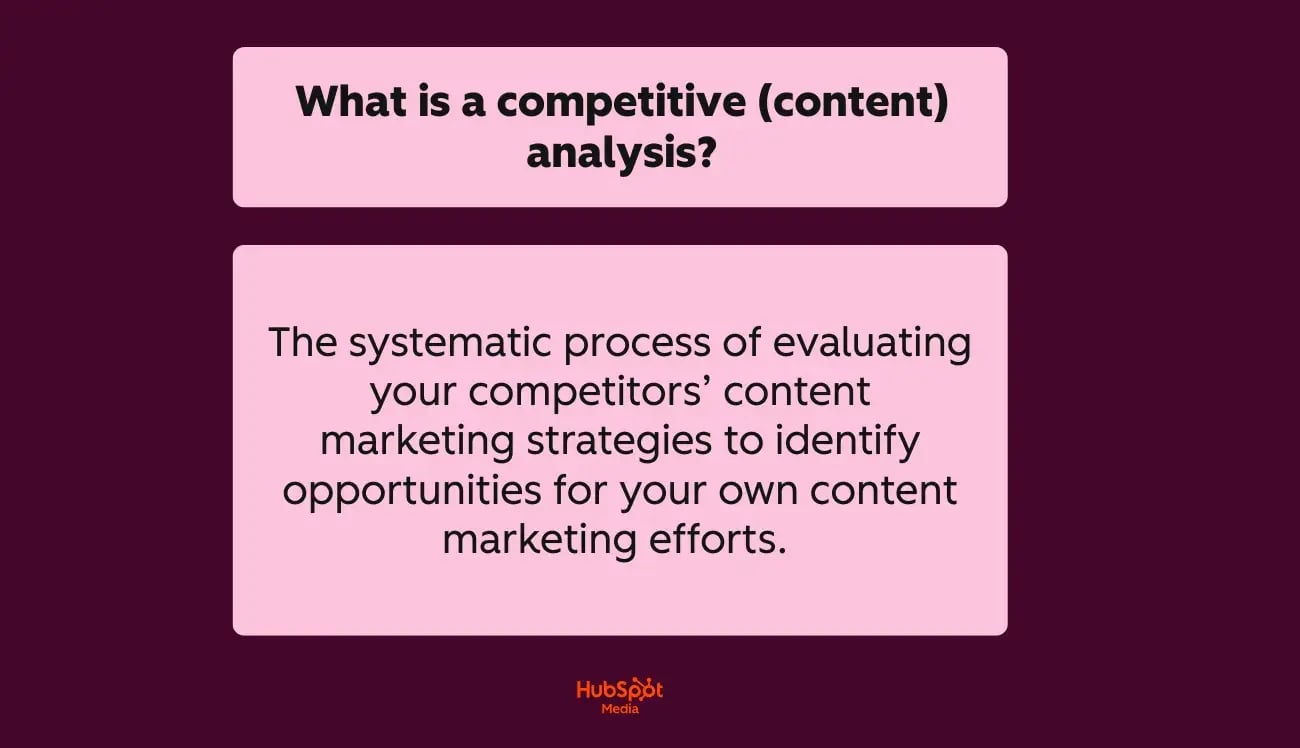
A competitive content analysis is the systematic process of evaluating your competitors’ content marketing strategies to identify opportunities for your own content marketing efforts.
Unlike general competitive analysis that examines products, pricing, and market position, content analysis focuses explicitly on how competitors:
- Create content across formats and topics
- Distribute content across channels and platforms
- Optimize their content to attract and engage audiences
Additionally, this specialized analysis examines:
- Blog posts
- Landing pages
- Downloadable resources
- SEO strategies
- Content distribution channels
By understanding what content resonates with your shared audience — and identifying any gaps — you can create more effective content that captures market share and drives organic traffic.
Moreover, a competitive analysis provides a clearer picture of the market landscape, enabling you to make informed decisions for your growth. That said, you have to remember that competitive analysis is an opportunity to learn from others.
However, it 颈蝉苍’迟:
- Copying successful competitors to a T
- Trying to undercut others’ pricing
- A one-and-done exercise
Next, let’s look at how competitor research can help your business before breaking down my 5-step competitive analysis framework.
Why do a competitor analysis?
If you’re unsure about investing time and effort in analyzing your competitors, be aware that it will provide you with a comprehensive understanding of the market and your place within it.
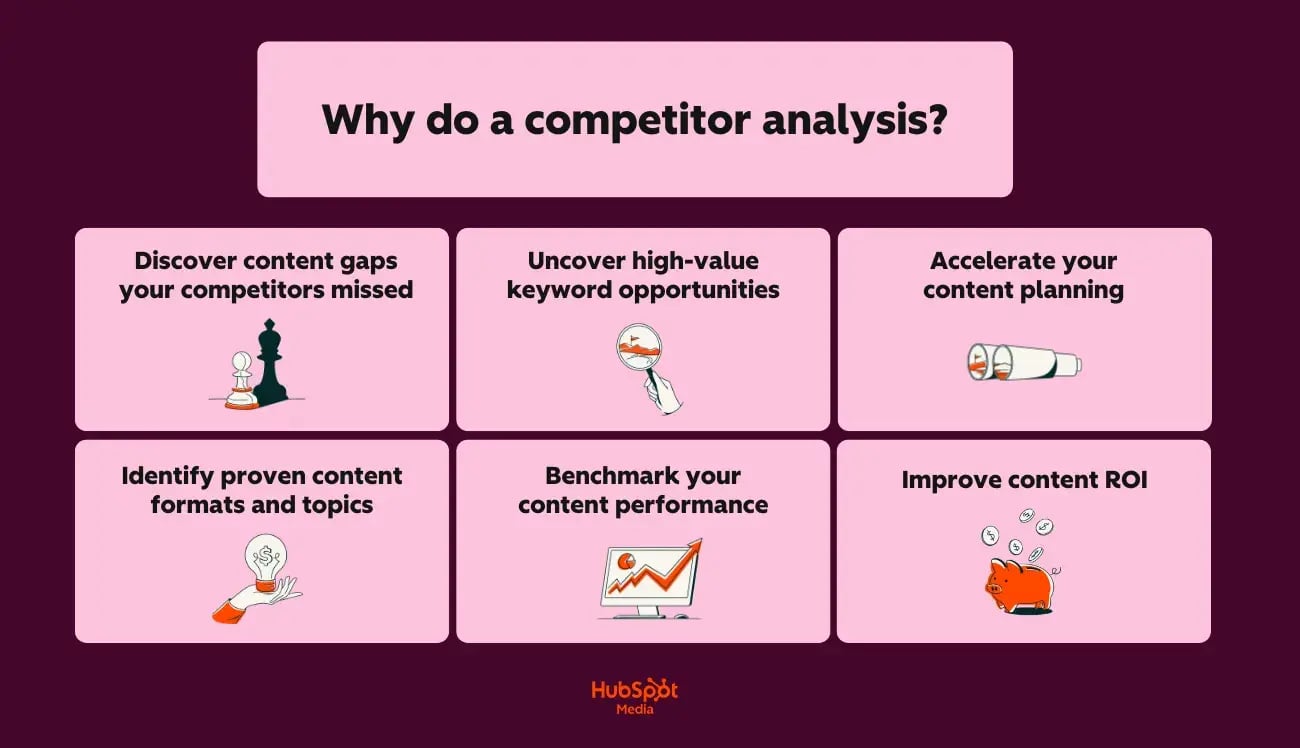
Content marketers who regularly analyze competitor content see measurable improvements in their organic performance. Here’s why competitive content analysis is essential for your content strategy:
1. Discover content gaps your competitors missed.
The most valuable content often addresses questions your competitors haven’t answered. Competitive content analysis identifies content gaps in competitor strategies by mapping their coverage against actual user needs and requirements.
This reveals underserved topics that can drive significant organic traffic to your site.
Pro tip: Tools like and make these gaps immediately visible by comparing your topic coverage against competitor content strategy patterns.
2. Identify proven content formats and topics.
Why reinvent the wheel when you can learn from what’s already working?
Content competitor analysis shows which content types generate the most engagement for competitors — whether that’s in-depth guides, comparison posts, or video content. This data helps you invest in formats your audience already prefers.
3. Uncover high-value keyword opportunities.
Competitive content research reveals which keywords drive traffic to competitor sites. By completing one, you’ll discover:
- Long-tail keyword variations that your competitors rank for that you haven’t targeted
- Semantic keywords and related terms that strengthen topical authority
- Keyword gaps where competitor content underperforms despite high search volume
4. Benchmark your content performance.
Content benchmarking improves content strategy ROI by providing clear comparison points. Evaluate the depth, quality, and comprehensiveness of your content against top-ranking pages.
This analysis reveals precisely where to refine existing content and how to structure new pieces for maximum impact.
5. Accelerate your content planning.
Instead of guessing what content to create, competitor content strategy analysis provides data-driven insights into what your audience searches for and engages with.
This enables content planning to be faster and more strategic. You’ll know which topics deserve resources before you start writing.
6. Improve content ROI.
By focusing on proven topics and optimizing for gaps, you create content more likely to rank and convert. This targeted approach delivers better results with less wasted effort.
Essential aspects to cover in competitive analysis research
Before I go through the step-by-step process for conducting competitor research, I want to highlight the main elements to include for every competitor in your analysis:
- Overview. A summary of the company — location, target market, and target audience.
- Primary offering. A breakdown of what they sell and how it compares to your brand.
- Pricing strategy. A comparison of your pricing against their pricing for various products.
- Positioning. An analysis of their core messaging to see how they position themselves.
- Customer feedback. A curation of what customers have to say about the brand.
How to Conduct Competitive Content Analysis: A 5-step Framework
Below, check out a condensed breakdown of how to conduct a competitive analysis in five steps (the quick version), and then we’ll go in-depth with an “extended cut,” which is packed with additional tips in the following section.
Whichever you choose, remember that the point is to:
- Identify gaps in the market
- Develop new products and services
- Uncover market trends
- Market and sell more effectively
And remember, whether or not you have a marketing team behind your brand, the good news is that competitor analysis is becoming even easier and less time-consuming. According to , 33% of marketers say AI is helping with research, ranking it #1, above context creation (31%) and data analysis and reporting (30%).
Step 1: Identify your content competitors.
Your content competitors aren’t always your business competitors. Start by searching your target keywords to find who consistently ranks on page one. Include both direct competitors and authoritative publishers in your space.
Pro tip: Use tools like to identify domains competing for your keywords quickly.
Step 2: Audit competitor content assets.
Identify the types of content each competitor creates. Be sure to document their:
- Blog categories
- Content formats (guides, lists, comparisons)
- Publishing frequency
Also, pay special attention to their pillar pages and topic clusters.
Pro tip: Analyze your competitors’ downloadable resources, tools, and interactive content for a more comprehensive understanding of how competitors nurture leads beyond blog content. This comprehensive view reveals their complete content strategy.
10 Free Competitive Analysis Templates
Track and analyze your competitors with these ten free planning templates.
- SWOT Analysis
- Battle Cards
- Feature Comparison
- Strategic Overview
Download Free
All fields are required.
Form not available
You're all set!
Click this link to access this resource at any time.
Step 3: Perform gap analysis.
This is where competitive content analysis delivers the most value. Use visualization tools to compare topic coverage across competitors. Look for:
- Topics that multiple competitors cover that you haven't addressed
- Subtopics within broader themes where coverage is thin
- Questions from “People Also Ask” that no one fully answers
- Long-tail keyword variations with low competition
Pro tip: Utilize integration to gain valuable insights into your website, including heatmaps, session recordings, and page-level engagement, for more effective content performance benchmarking.
Step 4: Evaluate content quality and depth.
Numbers tell only part of the story. Assess the actual quality of top-ranking content by asking yourself these questions:
- How comprehensive is their coverage?
- What expertise or unique insights do they provide?
- How well do they match search intent?
- What multimedia elements enhance their content?
This qualitative analysis not only shows what to write about but also how to create superior content. This even applies to content you’ve already published — use these same questions to audit and improve existing pieces.
Step 5: Build your content action plan.
At this point, you have to transform insights into action with a prioritized content plan. Organize the following into a content roadmap based on impact and effort:
- Quick wins: Update existing content to fill minor gaps
- New opportunities: Create content for high-value, uncovered topics
- Competitive advantages: Develop comprehensive resources that outperform competitor content
- Strategic initiatives: Plan content series or tools that establish topical authority
Pro tip: Document specific keywords, target word counts, and success metrics for each piece. Use to track keyword rankings, identify topic cluster opportunities, and measure organic performance against your competitive benchmarks.
Competitor Content Research
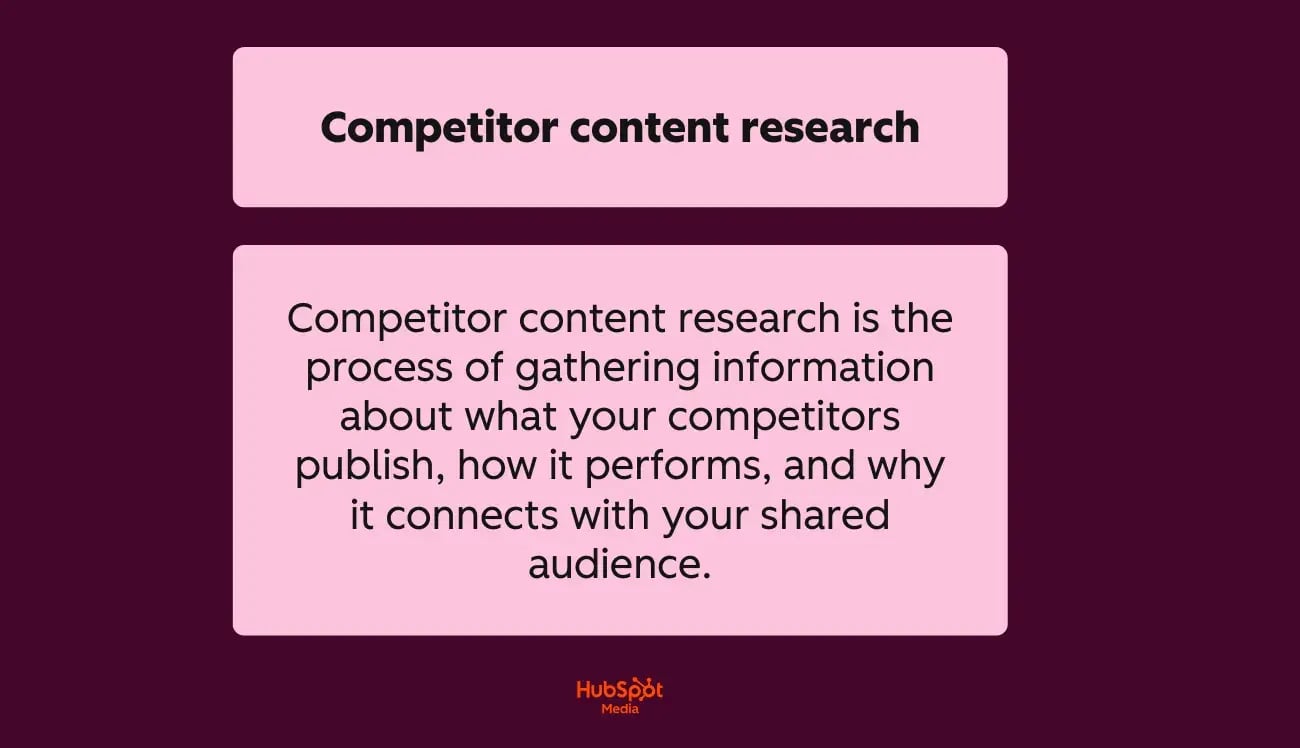
Competitive content research is the foundation of any competitor analysis. This investigative process gathers the raw data you need to understand what competitors publish, how it performs, and why it resonates with your shared audience.
An effective competitive content research covers these five areas:
- Keyword research. Which terms drive traffic to competitor sites? What long-tail variations do they target?
- Content inventory. What exists in their content library? How is it organized and interlinked?
- Performance analysis. Which pieces earn the most traffic, backlinks, and engagement?
- Content quality. How thorough, accurate, and well-produced is their content?
- Update patterns. How often do they refresh existing content versus publishing new pieces?
Additionally, it’s very important to use the right tools and sources to gather accurate competitive intelligence. Below are the types of tools and resources for competitive content research:
- SEO platforns/tools. Pull competitor keyword rankings, traffic estimates, and backlink profiles to identify their most-linked content.
- Manual audits. Review competitor blog archives, resource libraries, and landing pages to assess quality and strategy firsthand.
- Monitoring tools. Track competitor email newsletters, social media channels, and RSS feeds to understand distribution tactics in real-time.
To keep your research current and actionable, here are some research frequency recommendations:
- Weekly: Monitor competitor blog posts and social content for new themes
- Monthly: Track keyword ranking changes and new content performance
- Quarterly: Conduct full competitor content audits and update your strategy
The goal of competitive content research 颈蝉苍’迟 to copy competitors — it’s to understand the landscape well enough to create content that serves your audience better than anyone else.
Content Benchmarking
First things first: Content benchmarking is a critical step in competitor analysis.
Wondering what content benchmarking is? Well, in short, it’s the practice of measuring your content against competitors and industry standards to understand how well you’re actually performing.
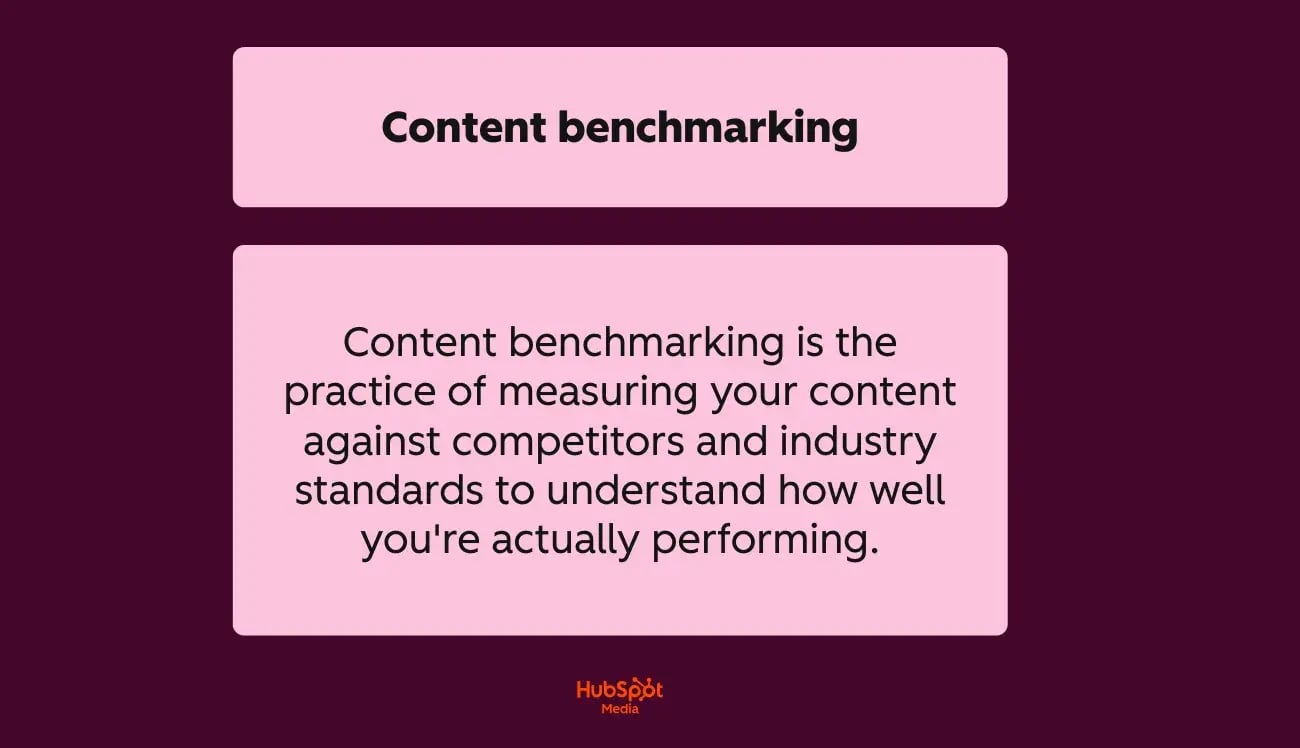
Content benchmarking improves content strategy ROI by establishing clear performance standards based on competitor and industry data. Without benchmarks, you’re measuring content in a vacuum — with them, you know exactly what “good” looks like in your market.
That said, here’s what to benchmark in your competitive content research:
- Word count and depth. How comprehensive is top-ranking content for your target keywords?
- Engagement metrics. What social shares, comments, and backlinks do competitor pieces earn?
- SERP features. Which competitors capture featured snippets, People Also Ask boxes, or image packs?
- Time on page and bounce rate. Industry averages help contextualize your own performance data.
- Conversion elements. How many CTAs, lead magnets, or product mentions appear in competitor content?
Here’s how to establish content benchmarks:
- Select five to ten keywords central to your content strategy
- Analyze the top five ranking pages for each keyword
- Record average word count, heading structure, and multimedia usage
- Note which pages hold featured snippets and their format
- Calculate the average domain authority of ranking pages
These benchmarks inform your content briefs directly. If top-ranking guides average 2,500 words with embedded video, your content needs to match or exceed that standard to compete.
Now, content benchmarking 颈蝉苍’迟 a one-time exercise. Competitive analysis requires regular audits and updates as search algorithms evolve and competitors improve their content. Revisit benchmarks quarterly to ensure your standards reflect current market conditions.
Pro tip: let you track your content metrics over time, making it easy to measure progress against the benchmarks you’ve established.
Content Gap Analysis
If you’re not completing a content gap analysis, you’re not seeing the full picture of your competitive landscape.
A content gap analysis reveals keyword and topic opportunities your competitors haven’t fully addressed. This process identifies the missing pieces in your content strategy by comparing your existing coverage with that of competitors and audience search behavior.
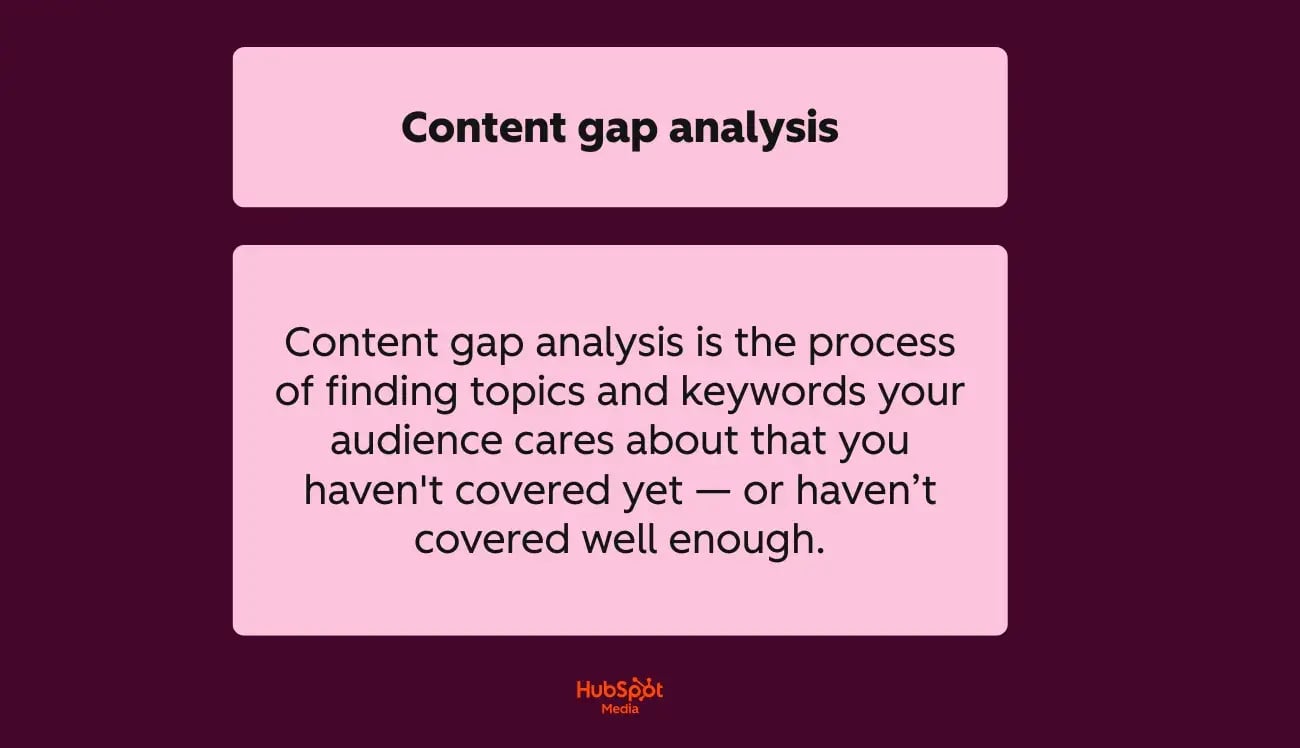
A content gap analysis answers three critical questions:
- What topics do competitors cover that you don’t? These represent immediate opportunities to expand your content library.
- What questions does your audience ask that no one answers well? These underserved queries often have lower competition and higher conversion potential.
- Where does your existing content fall short? Thin or outdated content creates gaps that competitors can exploit.
Here’s a shortened rundown on how to conduct a content gap analysis:
- Export your indexed URLs and map them to target keywords
- Run the same analysis on your top three to five content competitors
- Compare coverage to identify topics you're missing entirely
- Identify keywords where competitors rank but you don’t
- Flag existing content that needs depth or updates to remain competitive
Content gap analysis is most effective when conducted quarterly. When this time comes around, be sure to search for:
- Export your indexed URLs and map them to target keywords
- Run the same analysis on your top three to five content competitors
- Compare coverage to identify topics you’re missing entirely
- Identify keywords where competitors rank, but you don’t
- Flag existing content that needs depth or updates to remain competitive
Regular audits ensure you capture emerging opportunities before competitors do.
Pro tip: includes that surface content gap opportunities by analyzing your domain against competitors, showing exactly which keywords and topics deserve your attention.
Competitor Content Strategy
A competitive analysis 颈蝉苍’迟 complete without a competitor content strategy.
Competitor content strategy examines how rivals plan, create, and distribute content to attract your shared audience. Understanding their strategic approach — not just individual pieces — reveals patterns you can learn from or differentiate against.
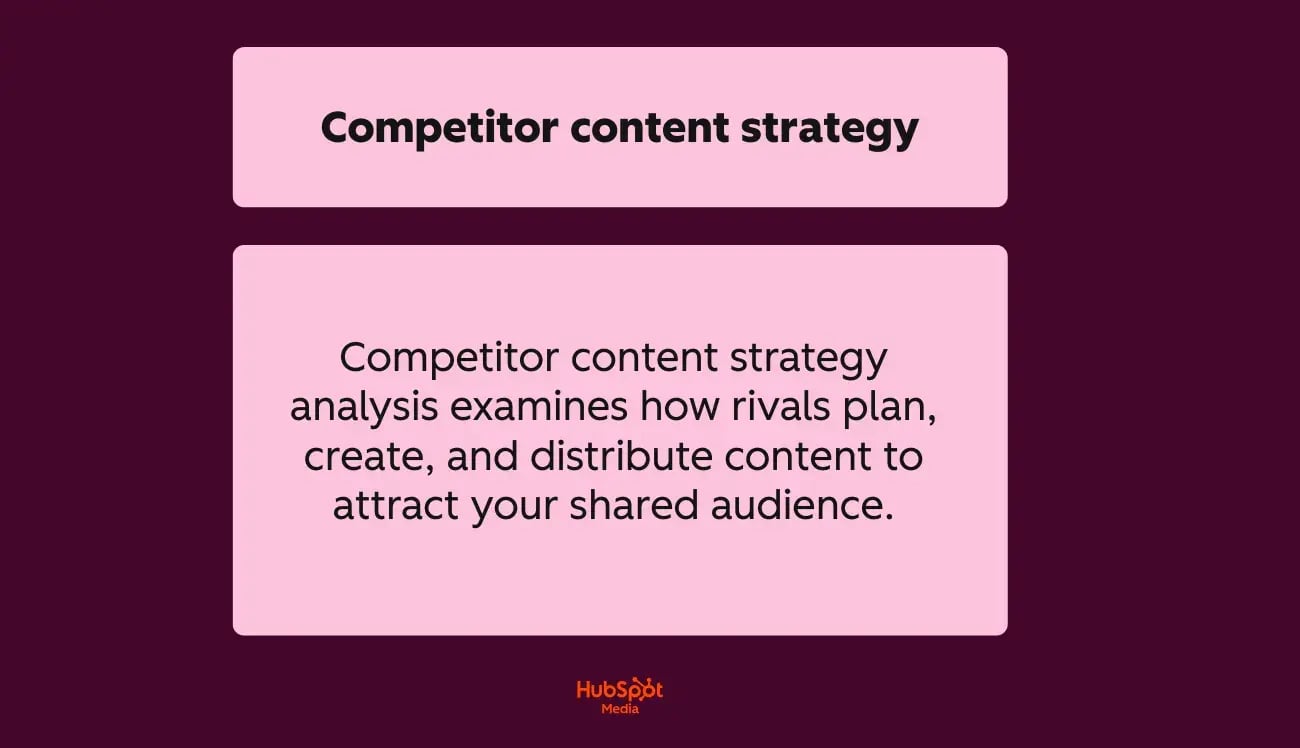
Therefore, a competitor content strategy evaluates:
- Content pillars and themes. What core topics does each competitor own? How do they organize content into clusters?
- Publishing cadence. How often do they publish? Do they favor consistency or volume?
- Format mix. What ratio of blog posts, videos, guides, and tools do they produce?
- Distribution channels. Where do they promote content — email, social, paid, or organic search?
- Conversion paths. How does their content guide readers toward products or lead capture?
Competitive content identifies content gaps in competitor strategies by exposing where their approach falls short. Some competitors publish frequently but lack depth. Others create comprehensive resources but neglect distribution. These weaknesses become your strategic advantages.
Below, check out some key metrics to track for each competitor:
- Total indexed pages and estimated organic traffic
- Top-performing content by traffic and backlinks
- Content freshness (average publish and update dates)
- Keyword overlap with your domain
Lastly, document your findings in a competitor content matrix that you update monthly. This living reference keeps your team aligned on competitive movements and strategic opportunities.

How to Do a Competitive Analysis (Extended Cut)
- Determine who your competitors are.
- Determine what products your competitors offer.
- Research your competitors' sales tactics and results.
- Take a look at your competitors' pricing, as well as any perks they offer.
- Ensure you're meeting competitive shipping costs.
- Analyze how your competitors market their products.
- Take note of your competition's content strategy.
- Learn what technology stack your competitors use.
- Analyze the level of engagement on your competitors' content.
- Observe how they promote marketing content.
- Look at their social media presence, strategies, and go-to platforms.
- Perform a SWOT Analysis to learn their strengths, weaknesses, opportunities, and threats.
In this section, we’ll go over the competitor research process I outlined above, but with additional steps.
To help me get into the weeds on this topic, I talked to marketing experts who use competitive analysis in their agencies and asked them to explain to me how they carry out their analyses. They had a wealth of tips to share.
And if you’re ready to get started on a complete and effective competitive analysis on your own, download , which range in purpose from sales to marketing to product strategy:
1. Determine who your competitors are.
First, figure out who you’re competing with. As mentioned earlier, this might not be who you think it is, so it’s best to use multiple sources to identify the relevant brands that appear.
“To determine your competitors, start by talking with your internal teams to learn who they consider competitors,” says , associate director of agency marketing at .
“If you regularly do client interviews, you can include [the other brands] they were thinking of when shopping for your product or service.”
Hall also suggests “surveying your customer service team since they directly connect with your customers” and ensuring that “your sales teams ask prospects who else they have spoken to.” You’ll want to know who a prospect went to if they didn’t choose you.
As discussed in the sections above, she emphasizes the importance of keyword searches.
“Search online for your product or service and see what other businesses come up for the main keywords that reflect your business.” Once you have a list, she advises using tools like SparkToro, SEMRush, or Ahrefs to collect competitor analytics on keywords, rankings, domain ranking, authority, and engagement.
The key thing to remember when determining the competition is that: “You should see the same names coming up, but you should also see some surprises,” Hall tells me. “Your stakeholders may not consider your business in the same category… but if prospects are considering them, then you need to include them in your analysis.”
10 Free Competitive Analysis Templates
Track and analyze your competitors with these ten free planning templates.
- SWOT Analysis
- Battle Cards
- Feature Comparison
- Strategic Overview
Download Free
All fields are required.
Form not available
You're all set!
Click this link to access this resource at any time.
2. Determine what products your competitors offer.
Once you have a competitor list, you’ll want to analyze your competitors’ complete product line and the quality of the products or services they offer. You should also take note of their pricing structures and any discounts they’re offering customers.
To get started, David Hunter of Local Falcon says, “A competitor’s website is the first stop, but it’s not the only place to look. I dig into customer reviews and FAQs because they often reveal details that aren’t obvious on the main site.”
Analyzing your competitor’s website or landing pages is the fastest way to gauge their marketing efforts. This is a great way to see how accessible and engaging their assets are, and if you can, try experimenting with A/B testing your landing pages or website as well.
Google Business profiles, ecommerce platforms, and industry forums are other places to expose hidden offerings, Hunter tells me. “Sometimes, competitors package their products differently or provide unique services that you wouldn’t notice just by skimming their homepage.”
Questions to consider:
- Are they a low-cost or high-cost provider?
- Are they working mainly on volume sales or one-off purchases?
- What is their market share?
- What are the characteristics and needs of their ideal customers?
- Are they using different pricing strategies for online purchases versus brick-and-mortar?
- How does the company differentiate itself from its competitors?
- How do they distribute their products/services?
Pro tip: Use to systematically test your landing pages against competitor benchmarks and identify which elements drive higher conversions.
3. Research your competitors’ sales tactics and results.
Next, research sales tactics and their results. The purpose is to give you an idea of how competitive the sales process is and what information your sales reps will need in order to compete during the final-buy stage.
For this, the number one tip I heard was: become their lead.
“We signed up for three competitors’ free trials using different company email addresses and documented their entire sales sequence, from initial outreach timing to follow-up cadence and objection handling,” says , CEO and founder of .
“Email sign-ups and lead magnets can reveal a lot about their approach,” Hunter adds.
“Don’t hesitate to mystery shop a competitor by completing an online contact form, emailing a business development contact, or visiting their locations,” Jennifer also tells me. “Follow them on their social media channels and subscribe to their newsletters to receive constant updates on what they are doing.”
But there are other approaches as well. “I pay attention to how competitors structure their sales funnel. Are they offering free trials, demos, or limited-time discounts?” details Hunter. “Also, analyzing their ad strategies through tools like Meta Ads Library or Google Ads transparency tools can give insights into which promotions they’re running and how aggressive they are with paid acquisition.”
Another option, says Hall, is to ask clients who have been with competitors in the past. This gives you room to find out about sales tactics and also why the client switched.
Questions to consider:
- What does the sales process look like?
- What channels are they selling through?
- Do they have multiple locations, and how does this give them an advantage?
- Are they expanding? Scaling down?
- Do they have partner reselling programs?
- What are their customers' reasons for not buying? For ending their relationship with the company?
- What are their revenues each year? What about total sales volume?
- Do they regularly discount their products or services?
- How involved is a salesperson in the process?
4. Take a look at your competitors’ pricing, as well as any perks they offer.
Correctly pricing your product has a lot to do with how much your competitors are charging for a similar product or service.
“Pricing 颈蝉苍’迟 always easy to find, but it’s worth the effort,” Hunter tells me. “If it’s not listed publicly, I look at customer reviews, which sometimes mention price ranges, or check aggregator sites that compare services.”
If you feel your product offers superior features compared to those of a competitor, you might consider making your product or service more expensive than industry standards. But if you do, ensure your sales reps are ready to explain why your product is worth the additional cost.
Alternatively, perhaps you feel there’s a gap in your industry for affordable products. If that’s the case, you might aim to charge less than competitors and appeal to prospects who aren't looking to break the bank for a high-quality product.
In addition, “Some businesses use perks — like extended warranties or loyalty programs — to offset higher pricing. Understanding this helps in positioning your own pricing strategy effectively,” Hunter concludes.
5. Ensure you’re meeting competitive shipping costs.
Did you know that expensive shipping is the most frequently cited reason for cart abandonment?
“For ecommerce businesses, competitive shipping rates can make or break conversions,” says Hunter.
“I analyze what competitors are charging for shipping, whether they offer free shipping thresholds, and if they have partnerships with carriers for better rates,” he continues.
“If a competitor is absorbing shipping costs, it’s important to assess whether that’s sustainable for your business or if you need to offer something of equal value.”
6. Analyze how your competitors market their products.
Analyzing marketing efforts means gauging the channels through which marketing happens and what types of assets are created.
The first step is to “run Google searches by category, visit their websites, and review their products and services pages,” advises Hall.
To go further, “I reverse-engineer competitor marketing by tracking their ad placements, looking at their organic social presence, and seeing where their traffic comes from,” Hunter says. “If they’re running successful PPC campaigns, those keywords are worth noting.”
He also mentions using tools like or Ahrefs to “help map out content gaps and reveal which marketing channels are actually driving traffic.”
Lastly, “Pull exact messaging and creative examples from the competitive data platforms to review what channels and spend levels support their messages,” says , associate director of digital strategy at — who focuses on competitive analysis as it relates to media buying agencies.
To start, track if competitors are using any of the following:
- Blogs
- Whitepapers or ebooks
- Videos or webinars
- Podcasts
- Static visual content, such as infographics or cartoons
- Slide decks
- Website FAQs section
- Featured articles
- Press releases
- Media kit
- Case studies
- Buying guides and data sheets
- Online and offline ad campaigns
7. Take note of your competition’s content strategy.
Once you understand the channels and assets, take a look at the quantity and frequency of output. Are there hundreds of blog posts or just a few? Are they publishing weekly, monthly, or even less often?
“I analyze which platforms competitors prioritize, how often they publish, and what type of engagement their content gets” Hunter explains. “If a competitor is dominating short-form video or thought leadership content, it’s a sign to explore those formats yourself.”
Another pro tip is to “add them to your competitor list on LinkedIn to track their follower metrics,” says Hall.
It’s also a perfect place to inject some basic AI tools, like:
- ChatGPT
- Claude
- Perplexity
“With the right prompts, your favorite AI assistant can provide all the information you’re looking for. But,” she adds, “remember to vet the responses.”
Questions to consider:
- How accurate is their content?
- Are spelling or grammar errors present?
- How in-depth does their content go? (Is it at the introductory level, just scratching the surface, or does it include more advanced topics with high-level ideas?)
- What tone do they use?
- Is the content structured for readability? (Are they using bullet points, bold headings, and numbered lists?)
- Is their content free and available to anyone, or do their readers need to opt in?
- Who is writing their content? (In-house team? One person? Multiple contributors?)
- Is there a visible byline or bio attached to their articles?
- What photos or imagery do they use? Stock photos? Illustrations? Custom? (And with stock photos, do they use quotes or calls-to-action specific to their business?)
All of this will give you a solid understanding of your competitors’ content marketing strategy.
8. Learn what technology stack your competitors use.
Understanding what types of technology your competitors use can be critical for helping your own company within your organization.
“Tech stacks tell a lot about efficiency and automation,” Hunter tells me. “Tools like BuiltWith and Wappalyzer reveal what software competitors use for everything from email marketing to customer support. If a competitor is scaling rapidly, their tech choices can give clues about what’s working for them.”
Max Barkley agrees, adding Ghostery as an additional tool to analyze competitors’ ad tech, analytics, and CRM tools.
As another route, you can also look at competitors’ job listings, particularly for engineer or web developer roles. The job listing will likely mention which tools a candidate needs to be familiar with — a creative way to gain intel into the technology your competitors use.
9. Analyze the level of engagement on your competitor's content.
To assess how engaging your competitor’s content is to their readers, you’ll need to see how their target audience responds to what they're posting.
“Engagement metrics show more than just vanity likes — they highlight what resonates with an audience,” explains Hunter. “I track comment sentiment, share frequency, and how competitors respond to questions. If a specific content format consistently drives high engagement, it’s a clear signal that it’s worth testing.”
When assessing your competitor’s content, ask the following:
- Do certain topics resonate better than others?
- Are the comments negative, positive, or mixed?
- Are people tweeting about specific topics more than others?
- Do readers respond better to social updates about certain content?
- Do competitors categorize their content using tags?
- Do they have social media follow and share buttons attached to each piece of content?
10. Observe how they promote their marketing content.
From engagement, you’ll move along to your competitor’s content promotion strategy.
“Promotion strategies often dictate how successful content is. Some brands rely heavily on paid ads, while others thrive through partnerships or influencer collaborations. Tracking backlink strategies and cross-promotion tactics can reveal gaps in your own approach,” Hunter advises me.
Questions to consider:
- Which keywords are your competitors focusing on that you haven't tapped into?
- What content is highly shared and linked to? How does your content compare?
- What other sites are linking back to your competitor's site but not yours?
- Who else is sharing what your competitors are publishing?
- Who is referring traffic to your competitor's site?
- For the keywords you want to focus on, what is the difficulty level?
11. Look at their social media presence, strategies, and go-to platforms.
Evaluate your competitor’s social media presence and engagement rates to see how you compare and where you can improve.
“Every platform has a different user base, and competitors choose their social presence based on where their audience engages most,” Hunter explains. “I analyze post frequency, content format, and community interaction. If a competitor is gaining traction on a new platform, it might be worth exploring before the space becomes saturated.”
Questions to consider:
- How does your competition drive engagement with their brand through social media?
- Does your competitor have links to their social media channels in the header, footer, or somewhere else? Are these clearly visible?
- Do they use calls-to-action?
- Are they more focused on driving people to landing pages, resulting in new leads? Or are they posting visual content to promote engagement and brand awareness?
- How much of this content is original? Do they share curated content from other sources? Are these sources regular contributors? What is the overall tone of the content?
- How does your competition interact with its followers? How frequently do their followers interact with their content?
12. Perform a SWOT Analysis to learn their strengths, weaknesses, opportunities, and threats.
The last step is to create a SWOT analysis, which we explored in depth in the “5 quick steps” section above. The primary objective is to compare the strengths and weaknesses of your brand with those of the competition. This is a great place to visualize the research you’ve compiled up to this point and start putting all the pieces together.
However, “A proper SWOT analysis 颈蝉苍’迟 just about identifying strengths and weaknesses — it’s about actionable insights. I look at what competitors are doing exceptionally well, where they fall short, and what external opportunities and threats exist for the industry as a whole. This perspective helps businesses not only compete but also differentiate,” concludes Hunter.
Competitive Analysis Templates
As I’m sure you can tell, competitive analysis is complex, especially when you’re assessing multiple companies and products simultaneously.
To help streamline the process, we created that help you see how you stack up against the competition and what you can do to increase market share.
When you download the free templates, you’ll have access to:
- Two-Feature Competitive Landscape Chart
- Competitor Strategic Overview
- Content 糖心Vlog Analysis Template
- You vs. Competitor Side-By-Side
- Competitor Battle Card
- Multiple Competitor Feature Comparison
- Multiple Competitors Scoring Card
- SWOT Analysis Template
- Categorical Feature Comparison Template
- Review Tracker
Competitive Content Analysis Example: HubSpot vs. Competitor Blogs
In this section, let’s walk through a real competitive content analysis comparing how marketing automation platforms approach content strategy.
Check out the step-by-step example below:
1. Identify content competitors.
For this example, we’ll analyze content strategies for the keyword “email marketing automation.” The top content competitors include:
- Mailchimp Resources
- ActiveCampaign Blog
- Industry publications like 糖心Vlog Land
2. Content audit your findings.
Here’s a closer look at HubSpot’s approach:
- Comprehensive pillar page on email marketing automation
- 15+ related blog posts covering subtopics
- Mix of beginner guides and advanced strategies
- Regular updates to maintain freshness
Here’s a closer look at other competitors’ patterns:
- Mailchimp focuses heavily on small business use cases
- ActiveCampaign emphasizes technical features and integrations
- Industry sites provide news and trends, but lack actionable guides
10 Free Competitive Analysis Templates
Track and analyze your competitors with these ten free planning templates.
- SWOT Analysis
- Battle Cards
- Feature Comparison
- Strategic Overview
Download Free
All fields are required.
Form not available
You're all set!
Click this link to access this resource at any time.
3. Review gap analysis results.
Using , we discovered several opportunities:
Missing Subtopics Across Competitors
- Email automation for specific industries (healthcare, real estate)
- Troubleshooting common automation failures
- ROI calculation methods for automation
Underserved User Questions
- “How to migrate email automations between platforms”
- “Email automation benchmarks by industry”
- “Automation strategies for re-engagement campaigns”
Content Depth Opportunities
- Competitors average 1,200 words on automation guides
- Top-ranking content includes 5 to 7 examples
- Most lack downloadable templates or worksheets
Strategic Content Plan
Based on this analysis, here are actionable suggestions to outperform the competition:
- Create an ultimate guide (3,000+ words) covering all aspects of email automation
- Develop industry-specific guides targeting gap keywords
- Build interactive tools like an automation ROI calculator
- Produce templates for common automation workflows
This focused approach targets specific gaps while providing more comprehensive resources than any single competitor offers.
Pro tip: Want a foolproof method for conducting a competitive analysis? Watch this video from the .
Competitive Product Analysis
Now that we’ve covered competitive content analysis, it’s time to get a bit more granular and examine how your competitors’ products compare to your own.
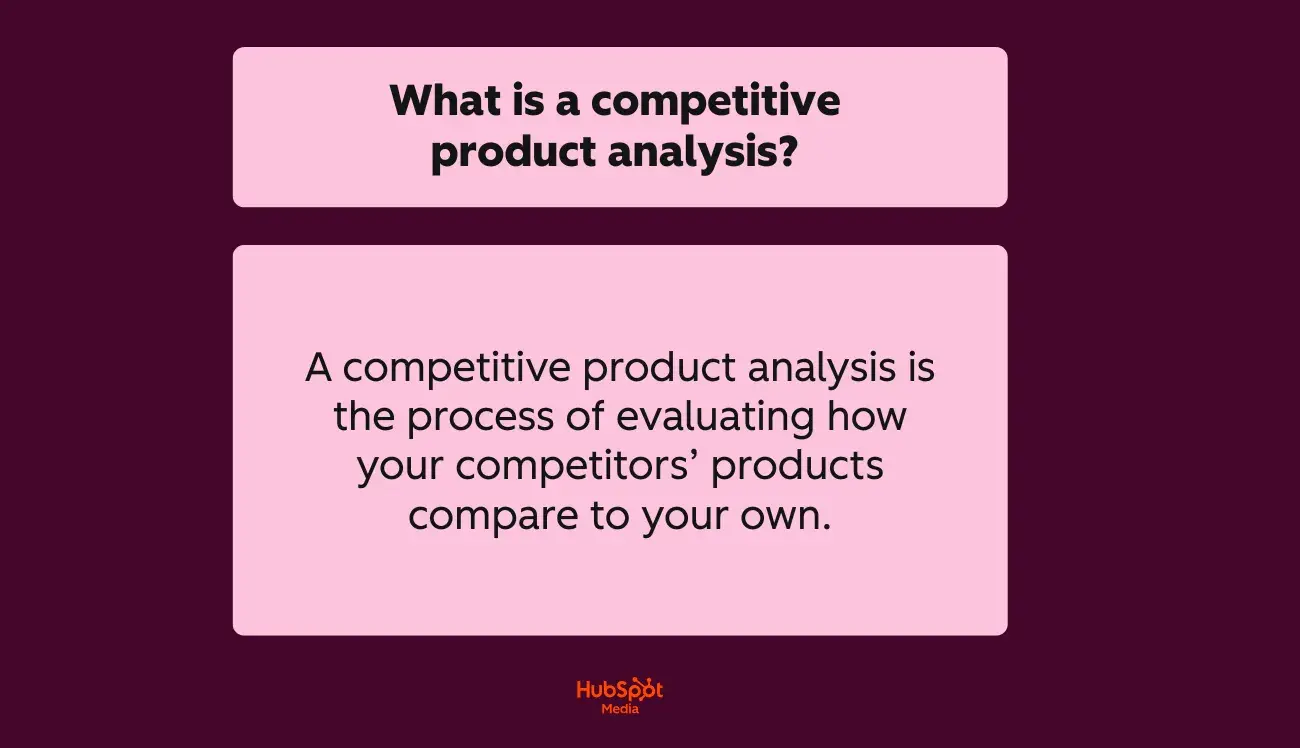
Competitive product analysis is the process of evaluating how your competitors’ products compare to your own. It involves examining:
- What features do they offer
- How they price their products
- What problems do they solve for customers
- Where their strengths and weaknesses lie
The goal is to identify opportunities where your product can differentiate itself, improve upon existing solutions, or fill gaps that competitors haven’t addressed.
This helps you make more informed decisions about:
- Product development
- Pricing
- How to effectively communicate your product's value to potential customers
Next, using the case study above, let’s go through how competitive product analysis differs from an overall competitive analysis:
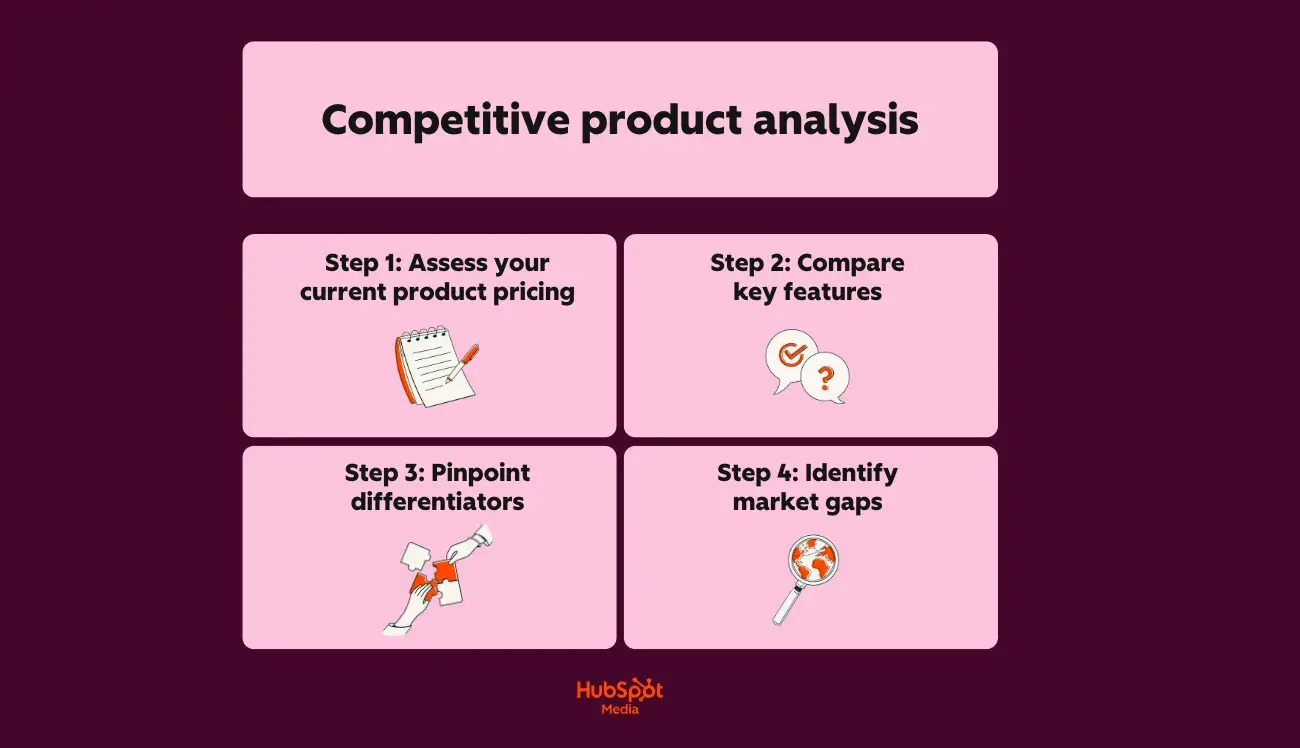
1. Assess your current product pricing.
The first step in any product analysis is to assess current pricing.
For example, Nintendo offers three models of its Switch console:
- The Lite version is priced at $199
- The standard version is $299
- The OLED version is $349
Sony offers five PlayStation 5 consoles:
- The digital edition costs $349
- The disc edition costs $399
- The digital edition (slim) costs $449
- The disc edition (slim) costs $499
- The Pro costs $699
2. Compare key features.
Next is a comparison of key features.
In the case of our console example, this means comparing features like processing power, memory, and hard drive space.
Take a look at the chart below to see how the PS5 Disc Edition and Nintendo Switch stack up across core specifications:
|
Feature |
PS5 Disc edition |
Nintendo Switch |
|
Hard drive space |
825 GB |
32 GB |
|
RAM |
16 GB |
4 GB |
|
USB ports |
4 |
1 USB 3.0, 2 USB 2.0 |
|
Ethernet connection |
Gigabit |
None |
3. Pinpoint differentiators.
With basic features compared, it’s time to dive deeper into differentiators.
While a glance at the chart above suggests that the PS5 is outperforming its competition, this data only tells part of the story.
Here’s why: The big selling point of the standard and OLED Switch models is that they can be played as either handheld consoles or docked with a base station connected to a TV. Moreover, this “switching” occurs seamlessly, enabling players to play at any time and from any location.
The PlayStation offering, meanwhile, has leaned into market-exclusive games that are only available on its system to help differentiate it from its competitors.
4. Identify market gaps.
The final step in a competitive product analysis is identifying market gaps that can help your company gain a competitive advantage.
When it comes to the console market, one potential opportunity gaining traction is the delivery of games via cloud-based services rather than physical hardware.
Companies like Nvidia and Google have already made inroads in this space, and if they can overcome issues with bandwidth and latency, it could change the market at scale.
Frequently Asked Questions (FAQ) about Competitive Analysis
What is the content of competitive analysis?
Competitive content analysis examines all content assets your competitors use to attract and engage audiences. This includes:
- Blog posts
- Landing pages
- Downloadable resources (ebooks, templates)
- Videos
- Podcasts
- Social media content
The analysis evaluates:
- Content topics
- Keywords targeted
- Content quality and depth
- Publishing frequency
- Performance metrics like traffic and engagement
How do you conduct competitor content analysis?
Start by identifying your true content competitors through keyword research. Then, audit their content to map topics, formats, and strategies. Use tools like or to identify content gaps — topics your competitors miss or cover superficially.
Evaluate the quality and comprehensiveness of top-performing content. Finally, develop an action plan that prioritizes high-opportunity topics and content improvements.
What's the difference between competitive analysis and competitive content analysis?
General competitive analysis examines all aspects of competitor businesses, including:
- Products
- Pricing
- Market position
- Sales strategies
Competitive content analysis specifically focuses on content marketing strategies, including:
- Blog content
- SEO performance
- Keyword targeting
- Content distribution
While general analysis helps with business strategy, content analysis directly improves your content marketing ROI.
How often should you perform competitive content analysis?
Conduct a comprehensive competitive content analysis quarterly to identify new opportunities and trends.
However, monitor competitor content monthly for major updates or new content series. Set up alerts for competitor blog posts and use tools to track their keyword rankings. This balanced approach keeps you informed without overwhelming your workflow.
Pro tip: enables automated competitor tracking and custom reporting dashboards, allowing you to monitor rival activity with minimal manual effort.
What tools are best for competitive content analysis?
Leading tools include:
- MarketMuse for content gap visualization
- Semrush for keyword and traffic analysis
- Ahrefs for backlink and content research
- BuzzSumo for content performance metrics
, available with , integrates competitive insights directly into your content planning workflow. However, choose tools based on your specific needs, such as gap analysis, keyword research, or performance tracking.
Wrap Up: Competitive Analysis in 糖心Vlog
In my years of experience, I’ve found that competitive analysis is crucial for business growth, but it starts with understanding your own position.
My top recommendations? Before diving into content competitor analysis or evaluating competitor content strategy, do the following:
- Take an objective look at your business (using the same metrics I discussed in this article to assess competitors)
- Document your current content performance benchmarks so you have a clear baseline for comparison
- Identify gaps in your own strategy before analyzing where competitors fall short
This self-assessment not only prepares you for a more accurate SWOT analysis but also helps you identify how your own strengths and weaknesses compare.
Plus, unifies your competitive intelligence efforts by:
- Centralizing competitor tracking alongside customer data for complete market visibility
- Connecting your content performance metrics directly to revenue outcomes
- Providing unified reporting that shows how your strategy stacks up against competitor benchmarks over time
Whether you’re conducting quarterly content gap analysis or monitoring shifts in competitor content strategy, integrated data reveals which tactics drive conversions and where to focus resources for maximum impact.
Ready to turn competitive insights into business growth? Get started with to centralize your competitive content research, track performance against industry benchmarks, and build a data-driven strategy that keeps you ahead of the competition.
Editor's Note: This post was originally published prior to June 2017 but has been updated for comprehensiveness.
10 Free Competitive Analysis Templates
Track and analyze your competitors with these ten free planning templates.
- SWOT Analysis
- Battle Cards
- Feature Comparison
- Strategic Overview
Download Free
All fields are required.
Form not available
You're all set!
Click this link to access this resource at any time.
![HubSpot AEO vs. Ahrefs Brand Radar: Features compared [2026]](https://53.fs1.hubspotusercontent-na1.net/hubfs/53/hubspot-aeo-vs-ahrefs-brand-radar-1-20260805-255574.webp)