
SEO ranking factors determine where your pages appear in Google's search results — traditional blue links, AI Overviews, featured snippets, local packs, and ChatGPT-style answers. Understanding which seo ranking factors actually matter is what separates marketers who grow organic visibility from those who stall.
Google's ranking system has evolved well beyond simple keyword matching. Today, the top seo ranking factors include helpful content, quality backlinks, mobile optimization, page speed, user experience, search intent alignment, and technical SEO fundamentals — and increasingly, whether your content appears in AI-generated results at all. To improve your Google search ranking, regularly update your content, earn authoritative links, and use SEO analysis tools for ongoing optimization.
In this article, discover how Google's ranking system works, a breakdown of 200+ known signals, and a deep dive into the top 10 ranking factors that produce the most consistent results.
.png)
Complete SEO Starter Pack
An introductory kit to optimize your website for search.
- Increase your organic traffic.
- Plan your keyword strategy.
- Debunk SEO myths.
- Build a blog strategy.
Download Free
All fields are required.
Form not available
You're all set!
Click this link to access this resource at any time.
Table of Contents
- Understanding SEO Ranking: How Google Decides Who Ranks First
- Did the algorithm leak teach us anything new?
- Quick Summary: The 10 Most Critical SEO Ranking Factors
- Top 10 Google Ranking Factors 2026
- All Currently Known SEO Ranking Factors: The Complete List
- Frequently Asked Questions About SEO Ranking Factors
Understanding SEO Ranking: How Google Decides Who Ranks First
Google uses ranking factors to determine search engine positioning. Understanding these ranking factors is necessary for effective SEO. When buyers search, they expect the best, clearest, and most trustworthy answer to rise to the top — and with AI Overviews and generative results now competing for attention alongside organic links, that standard has only gotten harder to meet.
Below is the high-level breakdown of how ranking works today (and why the path to page one is more predictable than it feels).
What is SEO ranking?
Search engine optimization (SEO) ranking refers to where a web page appears on a search engine results page (SERP) for a specific query. In simple terms, it’s a page’s position in line when a buyer asks Google a question.
Here are a few truths worth mentioning about SEO ranking:
- Rankings are earned, not assigned. Google doesn’t hand out positions. Instead, it evaluates the best possible answer for a searcher.
- Rankings change constantly. Google adjusts rankings when new content is published, competitors update pages, or search behavior shifts.
- Rankings reflect usefulness. The most helpful, relevant answer is often the page that is ranked first — not who shouts the loudest, publishes the most words, or has been around the longest.
Want to create an SEO strategy and track its performance using a single platform? Check out that is part of .
What is a ranking factor on Google?
For Google specifically, ranking factors are the criteria it uses to evaluate pages and determine the best order of relevant results for a search query. They are not the end-all, be-all of SEO, but ranking factors help content perform better in traditional and AI search results. They also help create a better user experience, which drives more leads and conversions.
HubSpot's content optimization tools help optimize content for top ranking factors, making it easy to see how content performs on Google. HubSpot's is one of the first tools on the market designed to help marketers track how content performs across AI search engines — because visibility in AI-generated answers is increasingly part of how google search ranking is measured.
How many Google ranking factors are there?
There are over 200 ranking factors that are generally considered correct (but again, it’s debatable). Since 2006, there have been thousands of algorithm updates, including an .
With each update and ranking factor, SEO specialists constantly test to see what’s changed. So, some of these factors are proven, but others are speculation.
That said, in recent years, Google has started providing more information about ranking factors and . For marketers and SEO professionals, this insight provides a strategic look at how to improve content efforts so that it ranks on the first page of search results.
How does Google determine rankings?
Google uses hundreds of signals, but the ranking system ultimately answers three questions:
1. Can Google understand your content?
When a web page is structured well, it's easier for Google to interpret and index it. This includes clean structure, clear hierarchy, scannable formatting, and proper technical markup.
2. Is your content the most helpful and relevant answer?
Google evaluates whether content directly satisfies the searcher's intent. This means the search engine zeroes in on depth, clarity, authority, freshness, and credibility. E-E-A-T (experience, expertise, authoritativeness, trust) is central here — Google is constantly asking whether a given voice should be trusted.
3. Does the page offer a good user experience?
Google understands that a searcher has found what they were looking for by analyzing page speed, mobile-friendliness, website design, and bounce rate. If visitors land on a page and stay, Google sees that as a vote of confidence.
Google ranks the page that is easiest to understand, most trustworthy, and most satisfying to the searcher. When all three pieces align, brands earn visibility and clicks. Using website research tools and a strong makes it easier to align on these essentials.
Did the algorithm leak teach us anything new?
Google’s recent updates heavily emphasize helpful content, entity-based understanding, and user experience signals over traditional keyword tricks.
The API leak didn’t give us a full blueprint, but it reinforced the importance of freshness, authorship, brand mentions, and authority signals. Here are the important things to note about the March 2024 :
- While thousands of documents were released, we don’t know how much of the algorithm we actually got insights into.
- From the API leak, we can infer that factors are ranking factors, but we don’t really know.
- Although the documentation has been analyzed by some of the best in the industry, we’re relying on their interpretation of the documentation.
- We don’t know how much each factor contributes to the algorithm in terms of weighting.
For the most conscientious SEOs, the leak wasn’t a surprise. But the biggest shift to know is that Google is aggressively devaluing low-quality AI content and rewarding trustworthy, well-maintained sites.
Not every rumored ranking factor is real. Domain age, keyword density, and exact-match domains matter far less than people think. The factors that consistently prove true are content quality, backlinks, mobile performance, and internal linking. Everything else should be treated as a supporting signal, not a strategic priority.
Let’s look at the top 10 ranking factors and how to use them to improve an SEO strategy.
Quick Summary: The 10 Most Critical SEO Ranking Factors
Before diving into all 200+ seo ranking factors, here are the ones that will move the needle most for businesses:
- Helpful, reliable content. Google’s top priority remains content that genuinely helps users.
- Content freshness. Keeping content updated and factually accurate maintains rankings.
- Author bylines. Clear authorship builds trust and signals expertise to both users and Google.
- Internal Linking. Strategic links between pages help users and search engines discover content.
- Keyword Placements. Using keywords naturally in titles, headers, and body text signals relevance.
- Quality Backlinks. Links from authoritative, relevant sites carry significant weight.
- Website Domain Authority. Overall site authority influences ranking potential for competitive keywords.
- Branding. Brand mentions, searches, and recognition boost search engine success.
- Website Architecture and Crawlability. Well-organized sites that are easy to crawl perform better.
- Accessibility and Page Speed. Fast, accessible sites provide better user experiences across all devices.
Complete SEO Starter Pack
An introductory kit to optimize your website for search.
- Increase your organic traffic.
- Plan your keyword strategy.
- Debunk SEO myths.
- Build a blog strategy.
Download Free
All fields are required.
Form not available
You're all set!
Click this link to access this resource at any time.
Top 10 Google Ranking Factors 2026
SEO ranking factors don’t operate in isolation. Google evaluates the combined strength of content, authority, user experience, and technical health. A page with great content but weak authority won’t rank, and a highly authoritative domain won’t help thin or outdated content succeed. The best results come when multiple factors reinforce each other, signaling to Google that the page is both trustworthy and satisfying for users.
Here we’ll go over the top 10 seo ranking factors and how marketing and SEO professionals can create content that meets and exceeds Google’s standards.
1. Helpful, Reliable Content
High-quality content is the top SEO ranking factor in 2026. But, Google has always emphasized . Providing content that provides value and unique insights not found on every other website can improve a page’s ranking.
With the rise of AI, many websites are categorically failing to create quality content.
There’s good news for those who work hard to craft every word and do their due diligence. As Google algorithms develop and get smarter, the poor, unhelpful, unreliable content will eventually get penalized or even fall out of Google’s index entirely.
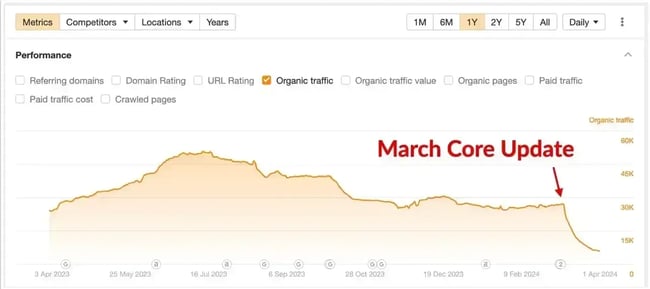
The image below demonstrates how a site with less-than-reliable and helpful content lost the majority of its organic traffic along with the .
How to Create Helpful and Reliable Content
Now, AI content is not inherently bad. Marketers can use AI as part of their content production process using tools like HubSpot’s , but generally, it’s important to edit it and add unique insights.
To create helpful content:
- Ensure the author is a subject expert, or that content is thoroughly researched.
- Provide factual information that answers the most important questions your audience has.
- Add links to research and credible sources.
- Conduct SERP analysis: study competitors' content and cover what they missed.
- Check what ranking articles have covered in terms of depth and word count — match or exceed that standard.
is deeply integrated with SEO, helping marketers:
- Discover relevant topics based on relevance, competition, and popularity.
- Build topic clusters that signal authority to search engines (improving topical visibility).
- Organize content around core business themes for better organic performance.
How to Conduct SERP Analysis
To rank on the first page, stop writing thin content. Research has proven time and time again that content that covers all areas, whether long or short form, tends to do better in search results.
Conduct SERP analysis and:
- Study competitors' content and write about what they missed.
- Cover all relevant areas and answer all questions that readers might have.
- Make the text readable by adding elements like images, a clickable table of contents, jump links, and calls-to-action (CTAs) to relevant information.
How to Hit the Mark on Content Length
Content length is one thing that several people debate about when it comes to SEO. Some believe an upward of 2,000 words should be the standard. However, this isn’t always the case.
Sure, long-form content seems to , but it’s crucial to write long-form only when you need it to cover the entire topic.
Check what ranking articles have covered in terms of word count because that can be an indicator of what Google is prioritizing. If all ranking articles have between 2,000 and 4,000 words and a team writes 200 words, it will likely not rank high for that term.
2. Content Freshness
If a brand is ranking well for a desired keyword, it should maintain that rank by editing content when the time is right.
For conscientious content creators, when they hit publish, the contents of their article are true and correct. But, as things develop, it may be that their content could benefit from an edit to keep it factually accurate and reliable.
Go back to content when it’s necessary to make an adjustment and edit it. Don’t edit content for the sake of it or try to game the system by altering publication dates when nothing has changed.
Just be honest and diligent (remember: helpful and reliable).
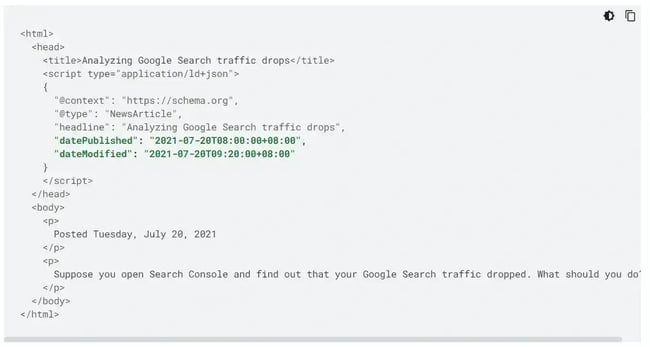
As mentioned, when it comes to SEO and ranking factors, the best approach is to provide helpful content for those seeking it.
Using the publication date above as an example, sharing the data from an article that was published (and modified) is genuinely helpful for users. They will understand whether or not they’re getting updated information.
It’s important to note that in its , Google says, “Add a user-visible date to the page and feature it prominently. Label dates appropriately with text like ‘Published’ or ‘Last updated.’”
Be warned: Google doesn’t want content creators to game the system. They have a section titled “.”
It provides the reader with questions to ask to determine whether or not the content is helpful and reliable. The documentation probes the question, “Are you changing the date of pages to make them seem fresh when the content has not substantially changed?”
, freelance CMO and SEO consultant at , believes the same about content freshness being a ranking factor. He says, “One key takeaway from the Google leak was the importance of content freshness, evaluated through metrics like ‘byline date,’ ‘syntactic date,’ and ‘semantic date.’
“While I‘ve always advised my clients to keep their content updated, I’m now emphasizing this more than ever.
“Keeping material current and relevant has become crucial. I’ve implemented a rigorous update schedule, encouraging clients to revisit articles and guides to add the latest information and improvements.”
How to Create Fresh Content
To keep content fresh, follow these best practices:
- Edit content when it needs it.
- Be diligent and update published or modified dates. At least add the date to the article; if you have some developer support, , too.
- Keep on top of trending topics within your niche.
3. Author Bylines
Author bylines are useful for readers, as they help them see who wrote the article, which can help build trust. While authors help people understand that an article was written by a credible source, some evidence suggests that Google also considers authorship a ranking factor.
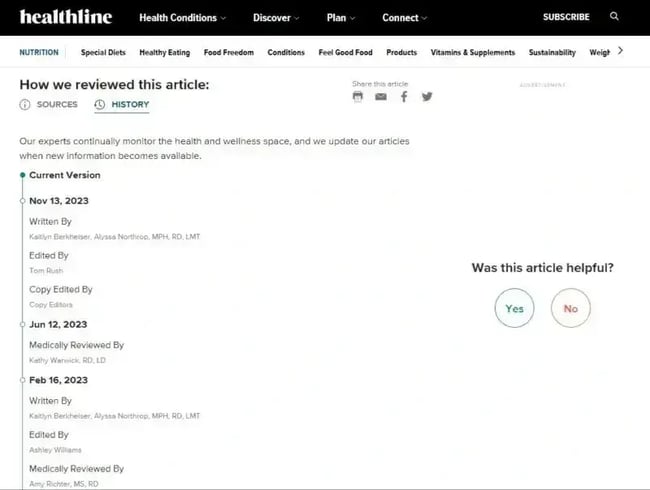
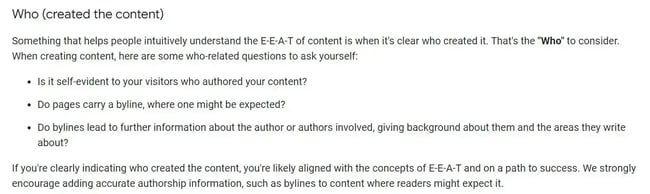
First, Google Search Central suggests that the authority of the content creator is important. Google Search Content suggests that articles should have:
- Author bylines where users might expect them.
- Evidence of who created content.
- Linkable bylines leading to author pages with further details.
It’s worth saying, for balance, that authors are not completely necessary for ranking, and neither is any factor in isolation. Author-less pages rank well in many cases, as long as the is strong.
Second, I have some anecdotal evidence that authors are useful for ranking. On one site, in particular, my client and I were struggling to rank a cluster of content. We’d written eight to twelve articles on a topic, all written by an industry expert. Every piece of content was well-researched, cited, and in-depth, and all my best SEO tactics were in place, but nothing was happening.
We decided to add author functionality to the site in the form of a byline and schema. Days after the schema went live, the articles gained traction in the SERPs. After six months, clicks increased from 94 to 3,250 (+3,357%).
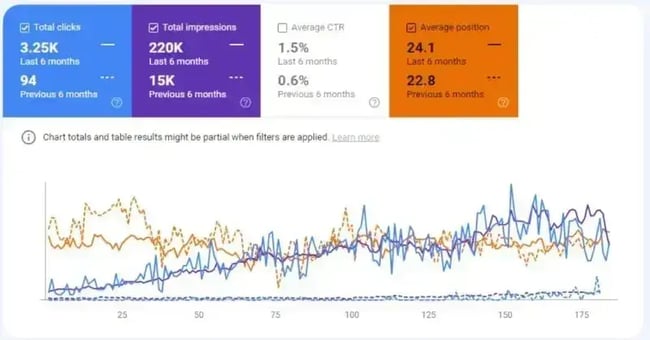
Other SEOs have found author bylines and schema to be effective.
, founder at , says, “Google values and stores information on content creators and website owners, using Boolean ‘isPublisher’ and ‘isAuthor’ features. This suggests Google may use this data to assess expertise and authoritativeness, aligning with E-E-A-T principles.”
Oliver continues, “[It’s implied] that Google’s ability to identify these entities could significantly impact a site’s credibility, underscoring the importance of clear authorship and publisher information for SEO success.”
How to Add Author Bylines
To add author bylines, follow these steps:
- Simply add an author byline to articles.
- Understand that crediting “company team” as an author isn’t useful. Instead, use full names.
- Take it a step further and include an .
- Create detailed author pages to link to from the article byline. Here’s mine on HubSpot.
4. Internal Linking
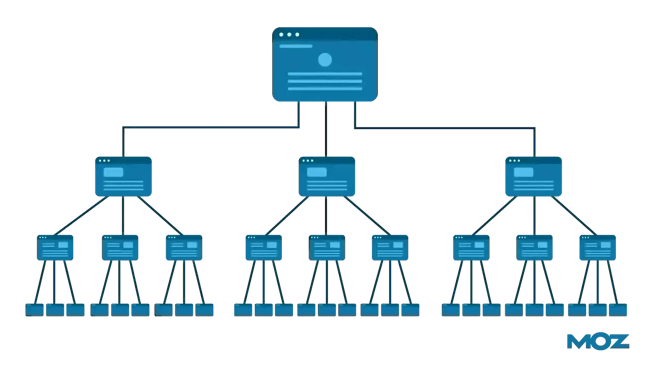
Internal links are simply inline links like this one: A link that goes from one page on a website to another link on the same website. If a company links to a site that isn’t theirs (read: a site on another domain), that’s an external link.
Internal links are powerful for SEO. They’re incredibly useful for Google, and most importantly, they’re useful for users. By linking from one page to another, users (and Google bots) discover and move around the website. A click from one page to another is a sign of engagement.
, SEO and content marketing expert at , pays attention to engagement factors like internal linking.
May says, “I’ll increase my focus on optimizing for on-site user engagement metrics and click-through rates from search. This involves testing titles and descriptions, improving content formatting, internal linking, and incorporating more multimedia to maximize CTR and time on page.”
Internal links help Google discover and index website content. The bots follow from one page on one subject and find other high-quality, related content. Eventually, Google starts to trust and rank the website.
How to Use Internal Links
Here are some tips on how to incorporate internal linking:
- Use links naturally.
- Link relevant content pages together.
- Add a “you may also like” section to the bottom of articles.
5. Keyword Placements
Google is getting smarter every day, but using keywords wisely will give marketers the best chance of ranking.
There’s one thing to note: A natural-reading article is more important than keyword placements.
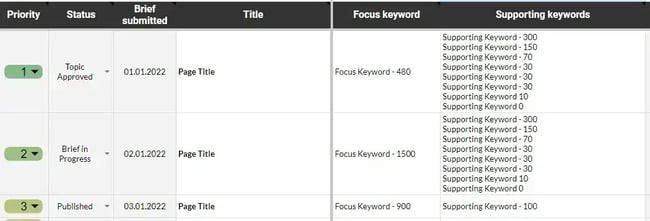
Most pages on a website should have an assigned focus keyword and supporting keywords, which is why it’s important to conduct keyword research.
Generally, use the assigned focus keyword in the:
- Page’s H1 (usually the title).
- URL.
- H2s, and maybe H3s, where natural.
- Body text, where natural, and ideally in the first paragraph if it makes sense.
The H1 is an indication of what the content is about. So, include the keyword in the H1. Be careful, though; some SEOs say that using the same sentence in the H1 and meta title is an indication of keyword stuffing.
Spice it up a bit while still ensuring that the keyword is present. Do this in combination with all on-page optimization (metadata, URL, other headings).
I like to keep track of my focus keywords in a spreadsheet. Here’s what it looks like:
On the subject of keyword placements, it’s really important that blog and website content is high-quality and person-focused, not keyword-focused.
Fellow SEO , founder at , said it best: “[Good content] satisfies the user-intent queries along with being in-depth and experience-driven rather than just keyword-focused… One well-written piece of content can get the audience to keep coming back for more as it helps to build trust and credibility.”
let businesses monitor keyword data and understand how search demand translates into traffic or opportunities for growth:
- View keyword performance metrics right inside HubSpot.
- Estimate how ranking for new topics could grow organic traffic.
- Track canonical URLs and important SEO topics on a central dashboard.
Complete SEO Starter Pack
An introductory kit to optimize your website for search.
- Increase your organic traffic.
- Plan your keyword strategy.
- Debunk SEO myths.
- Build a blog strategy.
Download Free
All fields are required.
Form not available
You're all set!
Click this link to access this resource at any time.
6. Quality Backlinks
Backlinks are a controversial topic in SEO. Many SEOs believe that they are a ranking factor, while others say they are not. But the consensus is: Backlinks improve website authority and rankings.
On a podcast, said, “Over time, the weight on the links will drop off a little bit as we can’t figure out a little bit better how the content fits in within the context of the whole web.”
However, other important documents suggest that links are important.
In Google’s , it says, “One of several factors that we use to help determine this is understanding if other prominent websites link or refer to the content.”
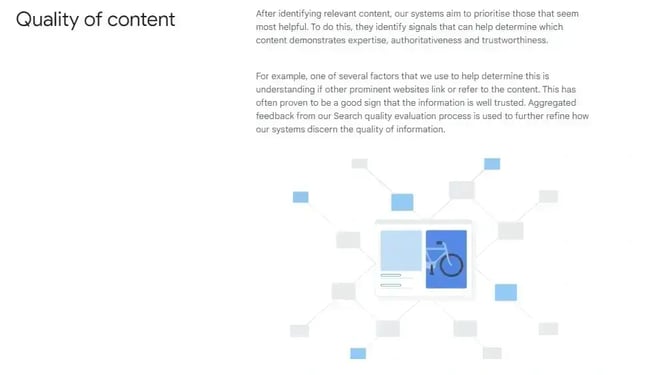
When it comes to , we know that Google also factors in links. “If other prominent websites link or refer to the content.”
This is important because it suggests that low-quality links won’t get a website anywhere. Instead, focus efforts on earning links honestly from credible industry sources.
How to Use Backlinks
- Write great content that earns links organically (remember from earlier: in-depth content naturally earns more links).
- Earn links from PR.
- Don’t pay for links from spammy or irrelevant sites.
The total number of backlinks and referring domains is important, but only when they are from relevant sources. Rather than focusing on building millions of backlinks, focus on more relevant and quality backlinks.
, leading SEO, AI search, and online visibility at Semrush, wasn’t surprised when backlinks appeared to be a ranking factor according to the API leak.
McKenzie said, “I’m personally locked in on its backlink findings. Particularly, that backlink profile quality matters way more than quantity when it comes to rewarding your site.”
McKenzie notes that this shouldn’t be a shock to anyone who takes SEO seriously, but having it spelled out so clearly is telling.
According to McKenzie, some folks, especially if their site is younger, still see link building as a numbers game. The leak only emphasizes that receiving dofollow backlinks from a handful of high-DA, authoritative websites moves the needle way more than fishing for any link.
“These quality sites give Google’s algorithms a nod of approval back to your own website, with ranking and organic traffic positively influenced accordingly,” McKenzie says.
McKenzie says her team was already focusing on white-hat link-building tactics, but the leak further emphasizes that work.
“We’re funneling more team time and strategy into earned guest posting on third-party sites with a high relevance match to our audience, reclaiming link schemes, intentional and SEO-guided blogger outreach, and converting site mentions into dofollows,” she shares.
7. Website Domain Authority
Domain Authority (DA) is a third-party metric, not a direct Google ranking factor — Google's has confirmed it's a Moz tool, not a Google signal. However, DA reflects signals that are similar to Google's own ranking criteria: quality backlinks, trustworthy content, and site credibility.
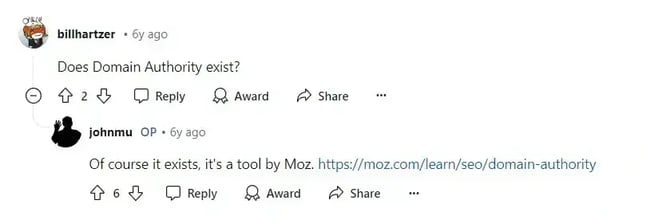
It's good to keep in mind because Moz uses particular signals to create that score (and other tools like SEMrush are similar to Google's ranking factors.
When more trusted sites are linking to yours, and you have content that ranks well, that is an indicator that you should be trusted, which in turn increases your rankings even further — all of which plays into DA.
I still use Domain Authority. When I’m thinking about a site and whether or not I can rank for a desired keyword, I use Domain Authority to help me decide if it’s possible. For example, if I want to rank for a keyword like “Google ranking factors,” I might Google it and check the authority of the site’s ranking. In the screenshot below, we can see that the top three articles have a Moz Domain Authority of 45 to 74.
HubSpot has a domain authority of 93, so it has a good chance of making the top spots for this keyword. My agency website, with a domain authority of 20, has a low chance of making the top spots.
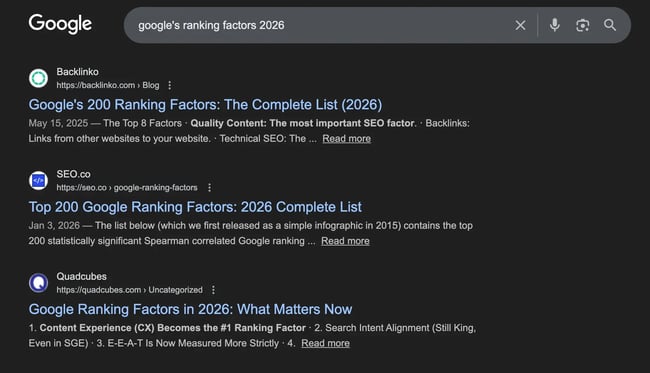
All this said, domain authority should never derail a keyword strategy. In fact, for less competitive SERPs, even a site with a very low domain authority can rank well enough. I’ve got a brand new blog with a domain authority of two, ranking on page one for carefully selected keywords.
, SEO strategist at , understands the nuance of using domain authority as an indicator of a website’s ranking potential. Taylor says, “Despite what has been said over the last 12 months, link building is still a core aspect of the algorithm, and site authority is a very real thing.”
This doesn‘t mean that an SEO can work off estimated domain authority alone, Taylor notes. “However, it’s certainly a factor when considering your link-building strategies and justifies long-term link-building as a means of developing the authority and level of trust for your own website over time,” says Taylor.
8. Branding
Branding, specifically site mentions, stirred discussion within the SEO community after the Google algorithm leak.
, head of SEO at , explains the role of branding and the leak. Friend says, “The importance of brand for SEO was strongly implied by the fallout of Google’s Helpful Content Update, and the leaked API documentation seems to reinforce this as a key consideration for continued ranking success with Google.”
Friend says that Google’s documents bring into focus the importance of creating a compelling offer and a strong brand in your niche, even if a lot of this work is done primarily outside of Google’s organic search ecosystem.
“One clear example of brand-related activity that all SEOs should focus on is sourcing brand mentions and links from sites that will send real users your way.
“Earning real mentions, coverage, and links because your business is being legitimately talked about by relevant, industry-specific publications and other businesses in your niche seems to be the key, at least until the next leak!” Friend says.
, CEO at , shares the same sentiments as Friend. Kirksey says, “The leak confirmed what I always suspected: building a brand and getting it mentioned, clicked, and searched boosts search engine success.”
Kirksey says he now puts more of a focus on educating clients about brand building and implementing strategies to increase entity mentions. These include:
- Helping clients earn expert quotes and mentions by answering publisher questions.
- Encouraging user-generated content that naturally includes brand mentions, like on Reddit.
- Using PR and media relations to secure mentions in news articles and industry blogs.
- Optimizing websites with relevant entities to establish associations in the Knowledge Graph.
“The leak shows that SEO success is not just about backlinks but also about anchor texts, relevancy, mentions, and their quality. By prioritizing entity mentions, we’re further helping clients build authority, relevance, and search visibility — in other words, their brand and their success in organic search,” Kirksey says.
How You Can Get Your Brand Mentioned
- Get cited in industry publications.
- Engage a great PR team.
- Use brilliant tools like Featured, HARO, or Qwoted.
I’ve used Featured to pitch for opportunities to get mentioned and linked to my website, and I’ve had a 55% success rate. I highly recommend it!
9. Website Architecture and Crawlability
How well a website is built will impact how easily Google can crawl it and how easily users can explore it. A poor site architecture will result in a poor experience for users.
, senior technical SEO manager at , values the importance of a well-built site.
Rota says, “I’ve always focused on making a site easy to crawl for Google, having it well-organized, easy to use, and not wasting the user’s time by getting straight to the info.”
, founder of , shares Rota’s enthusiasm for a site that’s easy to use.
Poulton says, “With clicks and dwell time being factors, this means SEOs need to really think about how intuitive a website’s structure and navigation is. You want a website to be usable but also offer easy discovery paths for crawling bots.”
Interestingly, site architecture and crawlability are factors that have crossover with other ranking factors, engagement, and internal links, for example.
Site architecture relates strongly to internal linking, but it deserves a separate point here as a top 10 ranking factor because it considers the site a bit more holistically (the navigation, the footer, etc.).
My favorite way to see site architecture is with . I actually prefer the 2D version, but the 3D one looks cool.

I use this tool to audit the site’s pages. I can then see if Screaming Frog picks up on pages and how the tool “understands” the site architecture. Looking at site architecture using Screaming Frog allows me to see how a site is “put together.” Screaming Frog mimics Google crawling and provides insights into problems.
I recently found a site that was crawling infinitely due to a code bug. While this issue was an invisible problem for users, their website had 6,940 blank and useless pages indexed.
How to Think About Website Architecture and Crawlability
This one is a bit more technical:
- Use the robots.txt file to prevent search engines from crawling unhelpful pages.
- Keep the sitemap updated.
- Follow best practices and make sure navigation is logical.
10. Accessibility and Page Speed
Website accessibility and page speed impact user experience and SEO performance.
When talking about , a lot of SEOs will think about the value of alt text, and this does weigh in, but there’s a lot more to it than that. Accessibility covers a range of factors, such as providing text alternatives for non-text content, using appropriate heading structures, and ensuring that color contrasts meet readability standards. A website should be available for all people to use.
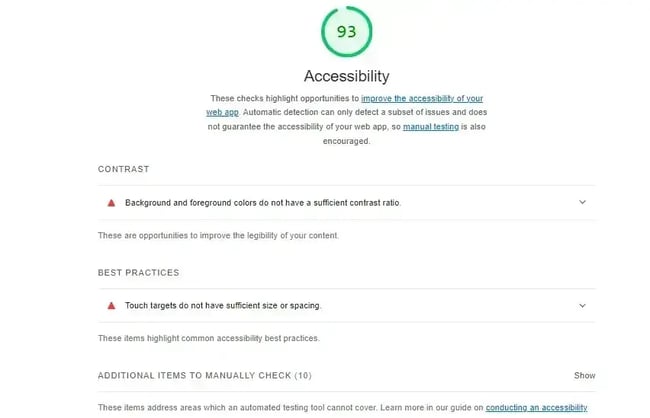
How to Implement Best-in-Class Accessibility and Page Speed
Google Lighthouse is a free tool that can help developers find accessibility and page speed issues. Go to any site, click F12, navigate to Lighthouse, and the report will be generated. A developer should be able to understand the report, which will explain what needs fixing and how to do it.
- Use Lighthouse to identify issues.
- Have a developer resolve as many problems as possible.
- Some problems will be very difficult to resolve, as in, they require a website rebuild, so start with tasks that are a) quick to do or b) the heavy hitters in terms of improvements.
Finally, mobile usability. No one’s building sites that aren’t mobile-friendly anymore, right? User experience is key for SEO success, and users are increasingly accessing websites via mobile. To score points with Google and, more importantly, users, work on improving mobile usability.
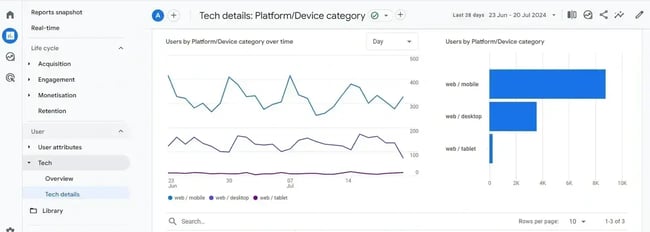
Some B2B companies might find that the majority of visitors are using desktops, but B2C brands are likely to have a high mobile or tablet usage. Use G4 to determine which devices people are viewing your website on.
All Currently Known SEO Ranking Factors: The Complete List
Now that the most important ranking factors have been covered in detail, it’s time to dive into Google’s 200 ranking factors. Remember: They don’t all matter equally. Following the 80/20 rule of SEO, about 20% of these factors drive 80% of results.
To help focus SEO professionals’ efforts, here’s a comprehensive list by category. Ranking factors are also marked by level of importance, using three categories:
- Critical (focus here first).
- High – Important (address after critical factors).
- Medium – Moderate (address after the critical and high factors).
- Low – Nice to have (optimize when possible).
Let’s dive in.
Complete SEO Starter Pack
An introductory kit to optimize your website for search.
- Increase your organic traffic.
- Plan your keyword strategy.
- Debunk SEO myths.
- Build a blog strategy.
Download Free
All fields are required.
Form not available
You're all set!
Click this link to access this resource at any time.
Domain Factors
Domain factors are all ranking factors that connect with the domain (the basic example.com version of a website), including the following.
1. Domain age is the length of time that a domain name has been registered. It’s possible to rank very new domains at the top of Google, so it doesn’t seem to be super impactful, but it likely plays a role.
- Importance Level: Low
2. Keyword in domain: Having a target keyword within the domain name.
- Importance Level: Low
3. Keyword is the first word in a domain: Having a target keyword as the first word in a domain name.
- Importance Level: Low
4. Domain registration length: The period for which a domain is registered.
- Importance Level: Low
5. Keyword in subdomain: Including a target keyword in the subdomain part of a website URL.
- Importance Level: Low
6. Domain history: The past ownership and usage records of a domain. I had issues with this when I bought my domain!
- Importance Level: Medium
7. Penalized WhoIs owner: A domain owner with a history of search engine penalties.
- Importance Level: High
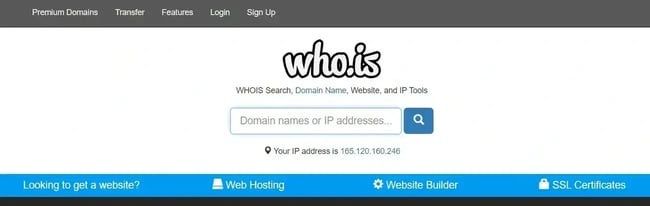
8. Public WhoIs instead of private WhoIs: Using public WHOIS information, making domain ownership details visible.
- Importance Level: Low
Page-Level Factors
Page-level factors are factors on each page that SEOs can optimize, such as the following.
1. Presence of the keyword in the title tag: Including the target keyword in the web page’s title.
- Importance Level: Critical
2. Having the keyword at the beginning of the title tag: Placing the target keyword at the start of the web page’s title.
- Importance Level: High
3. Presence of the keyword in the H1 tag: Including the target keyword in the main heading of the web page.
- Importance Level: High
4. Keyword is frequently used in the content: Using the target keyword throughout the content. Remember to be very natural about this.
- Importance Level: Medium
5. Content length: The total number of words in the content. HubSpot found that the ideal word count for SEO and articles was 2,100 to 2,400 words. But the ideal length for leads was 2,500 words.
- Importance Level: Medium
6. Word count rankings: The relationship between word count and how well a page ranks in search results.
- Importance Level: Low
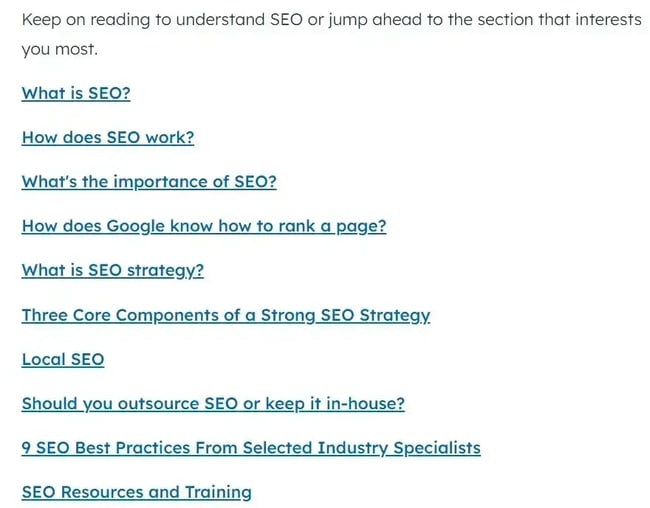
7. Presence of a linked table of contents: Having a table of contents with links to sections within the content. It makes the article more navigable for users, so it feels like a great feature to add.
- Importance Level: Medium
8. Keyword density: The percentage of times the target keyword appears in the content relative to the total word count. Keyword density may factor in, but it’s less important than it used to be.
- Importance Level: Low
9. Presence of semantically related keywords: Including keywords that are contextually related to the main keyword. Most good writers will include semantic keywords naturally.
- Importance Level: High
10. Semantically related keywords in meta title and description: This includes related keywords in the meta title and description tags.
- Importance Level: Medium
11. In-depth quality content: Providing thorough and comprehensive information on the topic.
- Importance Level: Critical
12. Useful content: Creating content that provides value and practical information to the user.
- Importance Level: Critical
13. Page loading speed via HTML: The speed at which a web page loads as measured by its HTML performance.
- Importance Level: High
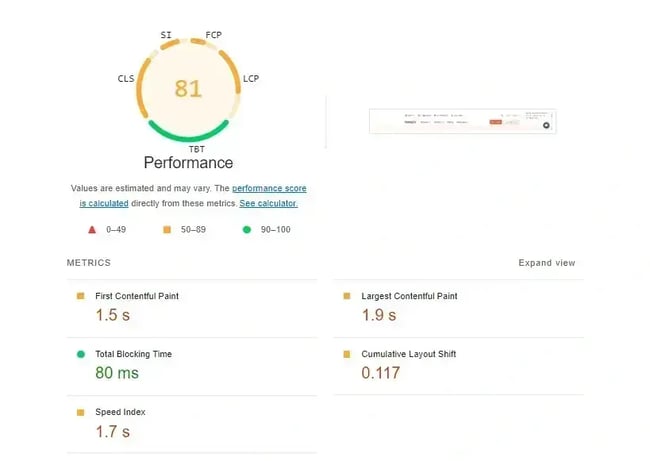
14. Page loading speed tested on Chrome: The speed at which a web page loads when tested using the Chrome browser.
- Importance Level: Medium
15. Core web vitals: Key metrics that measure the overall user experience of a web page, including loading, interactivity, and visual stability. Teams can find their .
- Importance Level: High
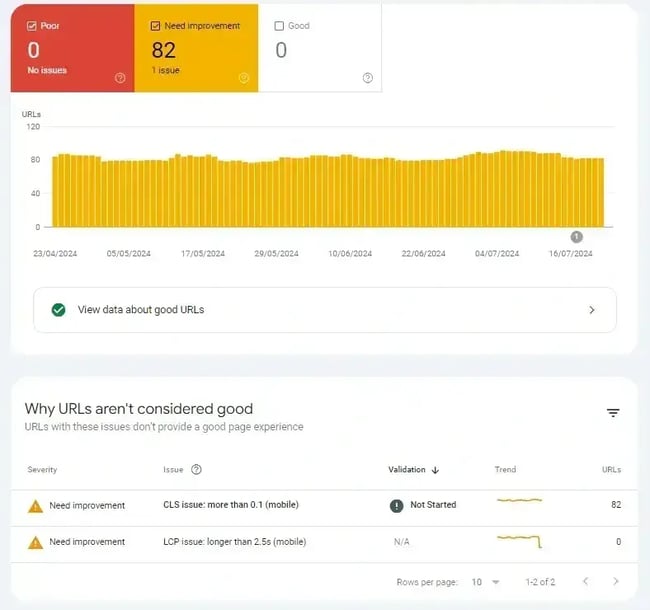
16. No duplicate content on the same site: Ensuring that content is unique and not repeated elsewhere on the same website. Some duplicate content is okay, but try not to overdo it. Never have content from another site without citing it or using canonicals.
- Importance Level: High
17. Image optimization through ALT, title, and file name: Improving images for SEO by using descriptive ALT text, titles, and file names. Image optimization also has some page speed benefits.
- Importance Level: Medium
18. Content recency (the newer, the better): The freshness of the content, with newer content being preferred.
- Importance Level: High
19. Page age: How long the web page has been published.
- Importance Level: Low
20. How many edits were made to the content during updates: The number of changes made to the content over time.
- Importance Level: Low
21. Historical data on page updates: Records of when and how often the page has been updated.
- Importance Level: Low
22. Proper use of rel=canonical: Using the rel=canonical tag to indicate the preferred version of a web page to avoid duplicate content issues.
- Importance Level: High
23. Presence of keyword in H2 and H3 tags: Including the target keyword in subheadings (H2 and H3 tags) of the content.
- Importance Level: Medium
24. Presence of keyword in the first 100 words: Using the target keyword within the first 100 words of the content. Generally, placing the keyword in the first paragraph or two is best.
- Importance Level: Medium
25. Grammar and spelling: Ensuring the content is free from grammatical and spelling errors. Top tip for grammar and spelling? Crawl for grammatical and spelling errors using Screaming Frog!
- Importance Level: Medium
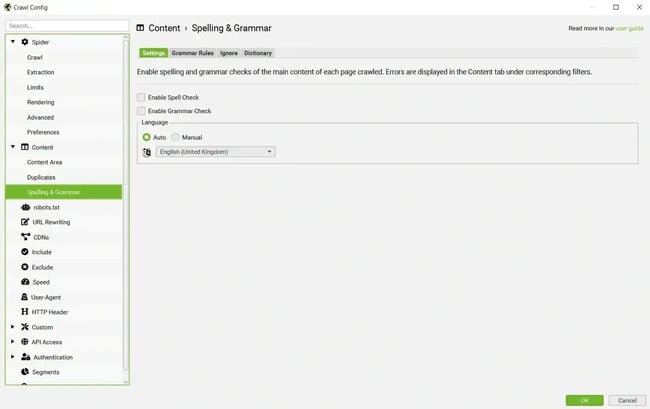
26. Originality of the page’s content: Ensuring the content is unique and not copied from other sources.
- Importance Level: Critical
27. Entity match: Including relevant entities (people, places, things) that match the topic of the content.
- Importance Level: High
28. Mobile usability and optimization: Ensuring the web page is easy to use and navigate on mobile devices.
- Importance Level: High
29. Hidden content on mobile (may not be indexed): Content that is hidden on mobile devices might not be indexed by search engines.
- Importance Level: Medium
30. Page optimized for mobile: Ensuring the web page performs well on mobile devices, including fast loading times and responsive design.
- Importance Level: Critical
31. Presence of multimedia, for example, images and videos: Including various types of media like images, videos, and infographics in the content.
- Importance Level: Medium
32. Number of outbound links: The count of links from one page to other websites.
- Importance Level: Low
33. The quality of outbound links: Ensuring the external links point to reputable and relevant sites.
- Importance Level: Medium
34. Theme of outbound links: Ensuring the outbound links are relevant to the content’s topic.
- Importance Level: Medium
35. Presence of helpful supplementary content, like free tools and calculators: Including additional resources such as tools, calculators, and guides that provide extra value.
- Importance Level: Medium
36. Number of internal links pointing to the page: The count of links from other pages on your site to the page in question.
- Importance Level: High
37. Quality of the internal links: Ensuring internal links come from high-quality and relevant pages within your site.
- Importance Level: High
38. Presence of too many broken links (could lower ranking capabilities): Having too many non-functional links on a page can negatively impact its ranking. It’s not good for users to click a link and not be able to access the content.
- Importance Level: Medium
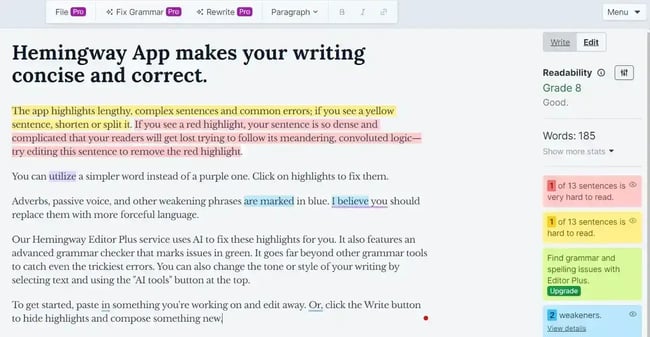
39. The reading level of the page: The complexity of the language used in the content, aimed at a specific audience’s comprehension level. The is a great way to check the “grade” of a site. Bear in mind, not all sites need to write to the same grade. It depends on the audience.
- Importance Level: Low
40. Presence of many affiliate links: Having a significant number of affiliate links, which might affect the page’s credibility and user experience. A lot of .
- Importance Level: Medium
41. Presence of many HTML errors: Having multiple coding errors in the HTML of the page, which can affect performance and SEO.
- Importance Level: Medium
42. Authority/trust level of the domain: The overall credibility and trustworthiness of the website’s domain.
- Importance Level: Critical
43. Authority/trust level of the page: The credibility and trustworthiness of a specific web page, often influenced by backlinks and content quality.
- Importance Level: Critical
44. PageRank: A Google algorithm metric that evaluates the importance of a web page based on the quality and quantity of its backlinks.
- Importance Level: High
45. Length of URL: The total number of characters in a web page’s URL, with shorter URLs often being preferred. Try to avoid spammy-looking URLs — a lot of irrelevant numbers, for example.
- Importance Level: Low
46. Closeness of URL to the homepage: The proximity of the web page to the homepage within the site’s URL structure. Good site structure resolves this.
- Importance Level: Low
47. Presence of keyword in URL: Including the target keyword in the web page’s URL.
- Importance Level: Medium
48. Opinion of human editors: The subjective evaluation of a web page’s quality by human reviewers. There is a team of real human editors according to Google’s rater guidelines.
- Importance Level: Low
49. Relevance of page’s category to page: Ensuring the page is categorized in a relevant section of the website.
- Importance Level: Medium
50. Content formatting for user-friendliness and readability: Structuring content with headings, bullet points, and short paragraphs to enhance readability.
- Importance Level: High
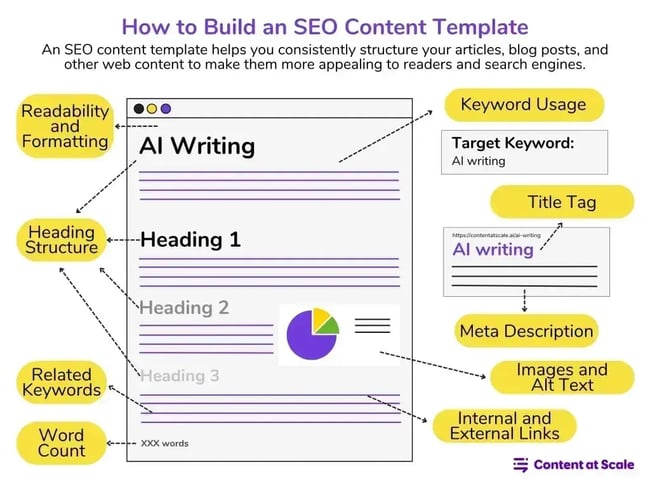
51. Priority of the page in the sitemap.xml: Assigning a priority level to the web page in the sitemap.xml file to guide search engine crawlers.
- Importance Level: Low
52. UX signal from pages ranking for the same keyword: User experience metrics from other pages ranking for the same keyword that influence search engine rankings.
- Importance Level: Medium
53. Citing references and sources: Including citations and references to support the content’s credibility and reliability.
- Importance Level: Medium
54. Use of a user-friendly layout: Designing the web page layout to be easy to navigate and visually appealing.
- Importance Level: High
55. URL string in Google search engine results: How the URL appears in Google search results, affecting click-through rates.
- Importance Level: Low
56. Internal link anchor text to the page: The clickable text of internal links pointing to the web page, ideally containing relevant keywords.
- Importance Level: High
57. Use of structured data: Implementing structured data (schema markup) to help search engines understand the content and context of the web page.
- Importance Level: High
Pro tip: can scan a site and give priority-ranked SEO recommendations showing what developers need to update to improve rankings. This helps them focus on the changes that will have the biggest impact on the site.
Site-level Factors
Site-level factors go above the page level and look at things on the entire site. They include the following.
1. Presence of a “contact us” page or an appropriate amount of contact information: Including a dedicated page or section with ways to contact the business enhances credibility.
- Importance Level: Medium
2. Content on site provides value or new insights: Creating content that is informative, useful, or offers fresh perspectives to users.
- Importance Level: Critical
3. TrustRank: A metric that measures how closely linked your site is to trusted and authoritative sites.
- Importance Level: High
4. Website updates for freshness factor: Regularly updating the content on the site to keep it current and relevant.
- Importance Level: High
5. Site architecture: The structure and organization of the website’s pages and links.
- Importance Level: High
6. Presence of a sitemap: Having a sitemap.xml file helps search engines crawl and index the site more efficiently. Find out what a sitemap is and how to create it.
- Importance Level: Medium
7. Long-term site downtime: Prolonged periods when the website is unavailable, negatively impacting user experience and SEO.
- Importance Level: High
8. Location of server: The physical location of the server hosting the website, which can affect loading speed and search rankings.
- Importance Level: Low
9. HTTPs/use of a valid SSL certificate: HTTPS is a confirmed ranking factor for Google. Using HTTPS to secure the website helps protect user data and can improve search rankings.
- Importance Level: High
10. Presence of legal pages (terms and conditions and privacy policy): Including legal information pages that enhance trust and comply with regulations.
- Importance Level: Medium
11. Unique metadata: Ensuring each page has distinct meta titles and descriptions to avoid duplication and improve SEO.
- Importance Level: Medium
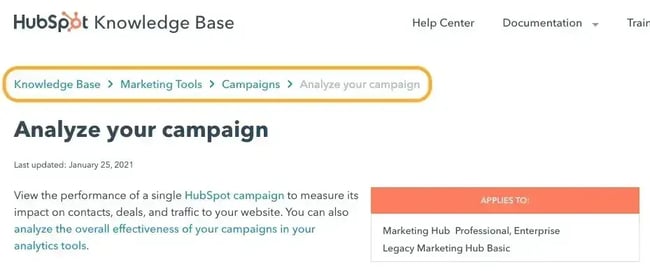
12. Use of breadcrumb markup: Implementing breadcrumb navigation to help users and search engines understand the site structure.
- Importance Level: Medium
Here are some great examples of breadcrumbs done well:
13. Sitewide mobile optimization: Ensuring the entire website is optimized for mobile devices. Mobile optimization affects search rankings on all devices.
- Importance Level: Critical
14. Sitewide user-friendliness (usability and interactiveness): Designing the website to be easy to use and interactive across all pages.
- Importance Level: High
15. Bounce rate: The percentage of visitors who leave the site after viewing only one page, indicating user engagement levels.
- Importance Level: Medium
16. User reviews: Feedback from users about the site or business, influencing reputation and trust.
- Importance Level: Medium
17. Site reputation: The overall perception and credibility of the site based on user feedback, reviews, and trust signals.
- Importance Level: High
Backlink Factors
Backlink factors look at the sites that are linking to a website to determine where to rank the page. Sites with better quality sites linking to them tend to be when they have quality content. The backlink factors are as follows.
1. Age of linking domain: How long the domain linking to a site has been registered.
- Importance Level: Low
2. Number of referring domains: The total count of unique domains that link to a site.
- Importance Level: Critical
3. Number of links from separate C-class IPs: The number of backlinks coming from different C-class IP addresses, indicating link diversity.
- Importance Level: Medium
4. Number of referring pages: The total count of individual pages that link to a site.
- Importance Level: High
5. Anchor text of backlinks: The clickable text in a hyperlink pointing to a site. It’s possible to overdo this with “exact match anchors,” so always try to be natural. There’s a .
- Importance Level: High
6. ALT tag of image links: The ALT text used in image links that point to a site describes the image content.
- Importance Level: Low
7. Number of links from .edu and .gov domains: The count of backlinks from educational and government domains.
- Importance Level: Medium
8. Trust factor of the linking page: The credibility and trustworthiness of the page linking to a site.
- Importance Level: High
9. Trust factor of the linking domain: The credibility and trustworthiness of the domain linking to a site.
- Importance Level: High
10. Presence of links from competitors: Links coming from competitor websites.
- Importance Level: Low
11. Number of links from expected sites in your industry: Backlinks from sites that are relevant and expected within an industry.
- Importance Level: High
12. Links from bad neighborhoods: Links from websites known for spam or low-quality content.
- Importance Level: High
13. Number of links that are not from ads: The count of backlinks that are not paid advertisements.
- Importance Level: Medium
14. Country TLD of referring domains: The country-specific top-level domain (TLD) of sites linking to you, indicating geographic relevance.
- Importance Level: Low
15. Presence of some nofollow links: Having backlinks with the “nofollow” attribute, indicating a natural link profile. When it comes to backlinks, worry less about dofollow or nofollow and focus on relevancy instead. Here’s a guide on how to obtain great backlinks.
- Importance Level: Medium
16. Diversity of link profile: A varied mix of backlinks from different types of sites and sources.
- Importance Level: High
17. Context of the content of the linking page: The relevance and quality of the content on the page linking to a site.
- Importance Level: High
18. Presence of more follow links than sponsored or UGC: Having more standard (follow) links compared to sponsored or user-generated content (UGC) links.
- Importance Level: Medium
19. Lots of backlinks to URLs with 301 redirects: Many backlinks pointing to URLs that have been redirected using a 301 redirect.
- Importance Level: Low
20. The text that appears when hovering over a link: The title attribute text that shows up when a visitor hovers over a hyperlink.
- Importance Level: Low
21. Link location on page: The specific area on the page where the link is placed, such as the header, footer, or content body.
- Importance Level: Low
22. Location of link in content: Where the link appears within the content, such as within the main text or a sidebar.
- Importance Level: Medium
23. Links from relevant domains: Backlinks from domains that are related to the site’s topic or industry.
- Importance Level: Critical
24. Links from relevant pages: Backlinks from individual pages that are contextually related to the site’s content.
- Importance Level: Critical
25. Presence of a page’s keyword in the title of the linking page: The linking page’s title contains the target keyword.
- Importance Level: Medium
26. Natural rate of growth in the number of links: A steady and organic increase in the number of backlinks over time.
- Importance Level: Medium
27. Spiky and unnatural rate of growth in the number of links: Sudden, unnatural surges in the number of backlinks, which may look suspicious.
- Importance Level: Medium
28. Links from top resources on a certain topic or hubs: Backlinks from authoritative and central sites in a specific topic area.
- Importance Level: High
29. Number of links from sites that are considered authority sites: The count of backlinks from well-established and respected sites.
- Importance Level: High
30. Linked as a source in a Wikipedia article: Your site is cited as a reference in Wikipedia entries.
- Importance Level: Medium
31. Words around the backlinks: The surrounding text near your backlinks, providing context and relevance.
- Importance Level: Medium
32. Backlink age: How long the backlink has been pointing to your site.
- Importance Level: Low
33. Links from real sites vs. fake blogs: Distinguishing backlinks from legitimate sites compared to spammy or fake blogs.
- Importance Level: High
34. Natural link profile: A backlink profile that appears organic and includes a variety of link types and sources.
- Importance Level: High
35. Excessive reciprocal links: Having too many mutual backlinks between two websites, which can be seen as manipulative.
- Importance Level: Medium
36. Links in real content vs. UGC: Backlinks within original content compared to UGC, like comments or forum posts.
- Importance Level: Medium
37. Backlinks from a page with a 301 redirect: Links coming from pages that have been permanently redirected to a new URL.
- Importance Level: Low
38. TrustRank of linking site: The overall trustworthiness and authority of the site linking to your page.
- Importance Level: High
39. Fewer outbound links on the linking page: Pages linking to your site have a limited number of outbound links, which can indicate higher link value.
- Importance Level: Medium
40. Links in real content vs. links in forums: Backlinks within the main content of a page compared to those found in forum discussions.
- Importance Level: Medium
41. Word count of linking content: The total number of words on the page that is linking to your site.
- Importance Level: Low
42. Quality of linking content: The overall relevance, usefulness, and credibility of the content that contains the backlink.
- Importance Level: High
43. Sitewide links = one link: Links that appear on every page of a site (sitewide links) are generally counted as a single backlink for SEO purposes.
- Importance Level: Low
Complete SEO Starter Pack
An introductory kit to optimize your website for search.
- Increase your organic traffic.
- Plan your keyword strategy.
- Debunk SEO myths.
- Build a blog strategy.
Download Free
All fields are required.
Form not available
You're all set!
Click this link to access this resource at any time.
User Interaction
Google always emphasizes in its update announcements how important it is to provide an excellent user experience to website visitors. These factors measure user interaction to rank pages accordingly.
1. Organic click-through rate for exact keyword: The percentage of users who click on your page in search results specifically for the exact keyword you’re targeting.
- Importance Level: High
2. Organic click-through rates for all ranking keywords: The average percentage of clicks a page receives for all the keywords it ranks for in search results.
- Importance Level: High
3. Dwell time: The amount of time a user spends on a page before returning to the search results.
- Importance Level: Medium
4. Bounce rate: The percentage of visitors who leave a site after viewing only one page, without interacting further.
- Importance Level: Medium
5. Measurement of how users interact on a site based on RankBrain: How Google’s RankBrain algorithm interprets and reacts to user engagement and behavior on a site.
- Importance Level: High
6. Total direct traffic: The number of visitors who come to your site by directly typing the URL into their browser or using a bookmark.
- Importance Level: Medium
7. Percentage of repeat visitors: The proportion of visitors who return to a site more than once.
- Importance Level: Low
8. Blocked sites: Websites that are restricted or blocked by users, often due to security or privacy concerns.
- Importance Level: Low
9. Percentage of visitors that click on other pages on the SERP after visiting your page: The proportion of users who click on other search results after visiting your page.
- Importance Level: Medium
10. Page frequently bookmarked by Chrome users: The number of times users save a page as a bookmark in Chrome.
- Importance Level: Low
11. Number of comments on page: The total count of user comments or interactions on a page.
- Importance Level: Low
Special Google Algorithm Rules
Some Google Algorithm rules are not directly connected to the page or domain. They include factors that look at personalizing search results for the user or better search results as a whole. Here are some of them.
1. Need for diversity in the SERP: The requirement for search engine results pages (SERPs) to show a variety of content types and sources.
- Importance Level: Medium
2. Need for freshness in the SERP: The importance of displaying up-to-date and recent content in search results.
- Importance Level: High
3. Browsing history of user: The record of websites and pages a user has visited, which can influence personalized search results.
- Importance Level: Low
4. Search history of user: The log of keywords and queries a user has previously searched for, affecting personalized search results.
- Importance Level: Low
5. Succinct answers, formatting, page authority, and HTTPS for featured snippets: The need for clear, well-formatted content on authoritative HTTPS pages to be selected as featured snippets.
- Importance Level: High
6. Geo-targeting: Tailoring search results to a user’s geographic location.
- Importance Level: Medium
7. Adult content or curse words (excluded from safe search results): The filtering out of explicit content or offensive language from safe search results.
- Importance Level: Low
8. High content quality standards for YMYL keywords: Ensuring high-quality, trustworthy content for “Your Money or Your Life” topics, which impact users’ health, finances, or safety.
- Importance Level: Critical
9. Legitimate DMCA complaints: Valid requests for removal of copyrighted content, which can affect search visibility.
- Importance Level: Medium
10. Need for domain diversity in SERP: The necessity for search results to include links from a variety of domains to provide balanced information.
- Importance Level: Medium
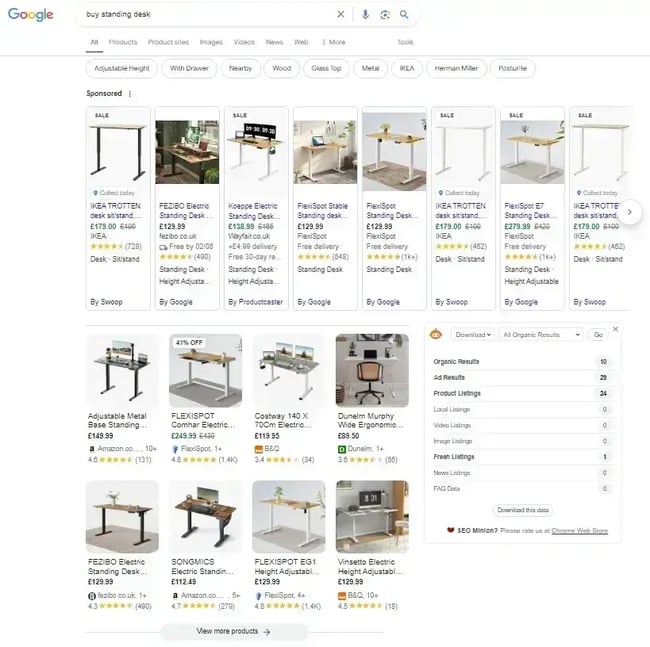
11. Transactional searches: Queries with commercial intent, often aimed at making a purchase or completing a transaction. The SERPs look very different for transaction keywords — look at the example below, that’s a lot of shopping ads!
- Importance Level: Low
12. Local search results: Search results that are tailored to the user’s local area or geographic location.
- Importance Level: Medium
13. Presence of news stories related to the keyword for the Top Stories box: The display of current news articles relevant to the search keyword in the Top Stories section.
- Importance Level: Low
14. Search intent: The underlying goal or purpose behind a user’s search query, such as finding information, making a purchase, or solving a problem. Search intent alignment increases the likelihood of ranking higher.
- Importance Level: High
15. Presence of big brands with relevant content (they are often ranked higher): The tendency for well-known brands to rank higher in search results due to their authority and relevance.
- Importance Level: Medium
16. Presence of results optimized for Google Shopping: The inclusion of product listings and ads from Google Shopping in search results for commercial queries.
- Importance Level: Medium
17. Image results: Search results that include images related to the search query.
- Importance Level: Low
18. Branded search: Queries that include a specific brand name, often leading to results related to that brand.
- Importance Level: Medium
19. Easter eggs and April Fools’ Day jokes and hoaxes from Google: Fun or playful surprises, like hidden features or jokes, created by Google, typically around April 1st.
- Importance Level: Low
20. Spammy queries: Search queries that are associated with low-quality or spammy content.
- Importance Level: Medium
21. Spammy sites: Websites that engage in spammy practices, such as keyword stuffing or link schemes, which can negatively impact search results.
- Importance Level: High
Brand Signals
How great is your business’s branding strategy in terms of SEO? If marketers haven’t taken care of their brand mentions and brand all over the Internet, they need to start now.
Because there are some serious ranking factors related to brands, including the following.
1. Brand + keyword searches (for example, HubSpot SEO): Searches that combine a brand name with a specific keyword or topic.
- Importance Level: High
2. Branded anchor text: Hyperlink text that includes the brand name, used in backlinks to enhance brand recognition.
- Importance Level: Medium
3. X profiles with followers: An X account for a brand or individual that has a substantial number of followers, indicating social influence. It’s best practice to join entities like social media accounts to websites using schema and “sameAs.”
- Importance Level: Low
4. Official LinkedIn page: A LinkedIn profile for a brand or individual that serves as the official business presence on the platform.
- Importance Level: Low
5. Facebook page with lots of likes: A Facebook page for a brand or business that has a high number of likes, reflecting popularity and engagement.
- Importance Level: Low
6. Branded searches: Queries that specifically include the brand name, often indicating user intent to find information about the brand.
- Importance Level: High
7. Known author or verified online profile: An author or individual with a recognized and verified online presence, adding credibility and authority.
- Importance Level: Medium
8. Real social media accounts: Authentic and active social media profiles for a brand or individual, as opposed to fake or inactive ones.
- Importance Level: Medium
9. Top stories with brand mentions: News stories or articles featured in search results that mention the brand.
- Importance Level: Low
10. Brand mentions without links: Instances where the brand is mentioned in content without a hyperlink pointing to the brand’s website.
- Importance Level: Medium
11. Physical location of offices: The geographical locations of a brand’s physical offices or business premises, which can influence local search results and credibility.
- Importance Level: Low
On-site Web
To rank high on search engine results, a business needs to ensure its site isn’t spammy and doesn’t look spammy — as with many things in life, looks play a role in how we’re perceived. Here are some factors around that.
1. Low-quality content: Content that is poorly written, not informative, or lacks value, often resulting in a poor user experience.
- Importance Level: High
2. Links to bad neighborhoods: Backlinks pointing to or from low-quality, spammy, or irrelevant sites, which can harm SEO.
- Importance Level: High
3. Multiple and sneaky redirects: Using excessive or deceptive redirects to manipulate search engine rankings or hide content.
- Importance Level: High
4. Flagged server IP address: An IP address associated with spammy or malicious activity, which can impact search engine trust.
- Importance Level: Medium
5. Distracting ads and popups: Advertisements and popups that interfere with the user experience and can detract from content readability.
- Importance Level: Medium
6. Popups that are spammy and difficult to close: Popups that are intrusive, hard to dismiss, and often used for spammy or aggressive marketing.
- Importance Level: Medium
7. Over-optimizing the site: Excessively applying SEO tactics, such as keyword stuffing or overusing meta tags, can negatively affect rankings.
- Importance Level: High
8. Gibberish content: Content that is nonsensical or meaningless, often generated by automated tools without real value.
- Importance Level: High
9. Use of doorway pages: Creating multiple low-quality pages designed solely to rank for specific keywords and redirect users to other sites.
- Importance Level: High
10. Lots of ads above the fold and not much content: Having a significant amount of advertisements visible before the user scrolls, with minimal content, which can harm the user experience.
- Importance Level: Medium
11. Hiding affiliate links: Concealing affiliate links to make them less noticeable or deceptive, which can be considered unethical and harmful to SEO.
- Importance Level: Low
12. Low-value content sites: Websites primarily filled with content that lacks substance or usefulness, often used for link building or ad revenue.
- Importance Level: Medium
13. Affiliate sites: Websites focused mainly on promoting affiliate products, which can be seen as low-quality if they lack original content.
- Importance Level: Low
14. Keyword stuffing in meta tags: Overloading meta tags with keywords in an attempt to manipulate search rankings, which can be penalized by search engines. This feels very old hat now!
- Importance Level: Medium
15. Computer-generated content: Content created by automated tools or algorithms without human oversight, often resulting in low quality or irrelevance.
- Importance Level: High
16. Nofollowing all outbound links: Using the “nofollow” attribute on all external links, which can prevent passing link equity and diminish content value.
- Importance Level: Low
Off-site Webspam Factors
The off-site webspam factors affect spam based on what’s done outside your website that connects with your website. They include the following.
1. Unnatural and sudden increase in backlinks: A rapid and unusual surge in the number of backlinks, which may indicate manipulative SEO practices.
- Importance Level: High
2. Hacked site: A website that has been compromised by malicious actors, often leading to security issues and a negative impact on search rankings.
- Importance Level: Critical
3. Lots of low-quality backlinks: An abundance of backlinks from poor-quality or spammy sites, which can harm SEO.
- Importance Level: Critical
4. High percentage of links from unrelated websites: A large portion of backlinks coming from sites that are not relevant to your content or industry.
- Importance Level: High
5. Low-quality directory links: Backlinks from directories that are of low value or are poorly maintained, which can negatively impact SEO.
- Importance Level: Medium
6. Automatic links in widgets: Backlinks generated automatically through widgets or plugins, which may be considered low-quality or manipulative.
- Importance Level: Medium
7. Links from sites with the same server IP: Backlinks from multiple sites hosted on the same IP address, which can indicate link manipulation.
- Importance Level: Medium
8. Using “poison” in the anchor text: Employing overly aggressive or irrelevant keywords in anchor text, which can lead to penalties.
- Importance Level: High
9. Ignored manual actions in search console: Failing to address or rectify penalties or warnings issued by Google Search Console regarding manual actions.
- Importance Level: Critical
10. Selling links: The practice of exchanging money for backlinks, which is against search engine guidelines and can lead to penalties.
- Importance Level: Critical
11. Temporary link schemes: Short-term, link-building tactics designed to artificially boost rankings, often leading to negative consequences when discovered.
- Importance Level: High
To see how your website and content are performing in Google SERPs, use a tool like that includes SEO performance reporting. Teams can measure results and ROI:
- Detailed reporting on what people are searching for and how your content ranks.
- Integration with Google Search Console to pull in impressions, click-through rates, and other key metrics.
Frequently Asked Questions About SEO Ranking Factors
What are the 4 Pillars of SEO?
The four pillars of SEO create a foundation for sustainable organic growth:
- Technical SEO. Ensuring search engines can crawl, index, and understand your site.
- On-Page SEO. Optimizing individual pages for target keywords and user intent.
- Content. Creating valuable, comprehensive content that serves user needs.
- Off-Page SEO. Building authority through backlinks and brand mentions.
Each pillar supports the others. A web page can’t rank well with great content on a broken website, just as perfect technical SEO won’t help thin content rank.
Do SEO ranking factors apply to AI search results and AI Overviews?
Yes — and this is one of the most important developments in modern SEO. AI search results, including Google's AI Overviews and answers in tools like ChatGPT, draw on many of the same trust and authority signals that influence traditional rankings. E-E-A-T, clear entity associations, structured data, and authoritative backlinks all influence whether a brand appears in AI-generated answers. AI rank tracking measures visibility in AI-generated search results and LLM answers — not just traditional blue-link positions. Marketers who track only keyword rankings may be missing a growing portion of their actual search visibility.
Tools like track where a brand appears in AI-generated answers, providing visibility into performance across AI search engines like ChatGPT and Google's AI Overviews. For a full picture, explore AI visibility tools and generative engine optimization tools alongside traditional SEO tracking.
Do SERP features like featured snippets affect my rankings?
SERP feature tracking covers featured snippets, local packs, and AI Overviews — and these can significantly affect clicks even when a page's organic position stays the same. Appearing in a featured snippet for a keyword can drive substantially more traffic than ranking #3 in standard blue-link results. Conversely, if a competitor wins a featured snippet for your top keyword, your traffic can drop even without a change in your organic position. Monitoring SERP features is as important as tracking keyword rank positions.
What is the 80/20 rule for SEO?
The Pareto Principle of SEO states that 20% of marketers’ efforts drive 80% of results. For most sites, this means focusing on:
- Creating exceptional content for the most valuable keywords.
- Earning high-quality backlinks from relevant sites.
- Optimizing Core Web Vitals and mobile experience.
- Matching search intent perfectly.
Instead of trying to optimize for all 200+ ranking factors, identify the high-impact opportunities that will actually move the needle for your specific situation.
What are the 3 C’s of SEO?
The fundamentals of SEO boil down to three C’s:
- Content. High-quality, helpful content that satisfies search intent.
- Code. Clean, crawlable technical implementation.
- Credibility. Authority signals like backlinks, E-E-A-T, and brand trust.
Master these three elements, and you’ll outrank competitors who chase every algorithm update.
Do all 200+ ranking factors matter equally?
Absolutely not. While Google uses hundreds of signals, their importance varies dramatically based on:
- Industry and competition level.
- The type of content (local, ecommerce, informational).
- Current algorithm priorities.
- A site’s existing strengths and weaknesses.
Focus on the factors that offer the biggest impact for your specific situation rather than trying to optimize everything at once.
How often do ranking factors change?
Google makes thousands of algorithm updates yearly, but core ranking factors remain relatively stable. What changes more often is their relative importance.
For example, mobile-friendliness went from a “nice to have” to absolutely critical when mobile-first indexing rolled out. Stay informed about major updates, but don’t chase every rumored change.
Should I optimize for Google or my audience?
Here’s the beautiful truth: They’re the same thing now. Google’s algorithm has evolved to reward what users want:
- Helpful, comprehensive content.
- Fast, accessible websites.
- Trustworthy information.
- Great user experiences.
When a brand optimizes for its audience, it’s automatically optimizing for Google too.
Ready to improve your rankings?
Understanding ranking factors is just the first step. The real results come from systematic implementation.
Start with the top 10 factors covered above. They’ll drive the majority of your SEO success. Once you’ve mastered those, you can explore the comprehensive list of 200+ factors for additional optimization opportunities.
Remember: SEO is a marathon, not a sprint. Focus on sustainable improvements that benefit both search engines and your users, and you’ll see lasting results.
Want to track your SEO progress? Try HubSpot’s free SEO tools to monitor your rankings and identify optimization opportunities.
Editor's note: This post was originally published in July 2021 and has been updated for comprehensiveness.
Complete SEO Starter Pack
An introductory kit to optimize your website for search.
- Increase your organic traffic.
- Plan your keyword strategy.
- Debunk SEO myths.
- Build a blog strategy.
Download Free
All fields are required.
Form not available
You're all set!
Click this link to access this resource at any time.
Technical SEO