
“I didn’t go into it thinking it would be a social media business per se; It was about adding value,” shares , a Gen Z career advocate, speaker and educator, on social media entrepreneurship.
In TikTok’s early days of mostly dance challenges and lip-syncing exchanges, West spotted a gap. “I decided I wanted to come on the platform to share tips and tricks from my career working in the media industry,” she says.
Now affectionately known as the “Big Sis to Young Creatives,” West has earned accolades, including Forbes 30 Under 30, and is building a digital brand focused on providing career advice to rising professionals. Now, it’s her full-time business, and she’s not alone.
In recent years, social media entrepreneurship has become a real career path. Many people in different countries and industries make money through brand partnerships, affiliate programs, and personal products like workshops and newsletters.
But why is it so popular? Let’s dive into the details, the biggest social media entrepreneurship trends, and pro tips to help you reap the benefits.
Table of Contents
- What is social media entrepreneurship?
- Why is social media entrepreneurship so popular?
- Top Social Media Entrepreneurship Trends & Tips
- Bottom Line: Social Media Entrepreneurship Is a Long Game
The State of Social Media in 2026
Explore the top trends in social media for brands to know and optimize your social strategy.
- AI Content Creation
- Community Building
- Social Media Shopping
- Social Vs. Search Engine
Download Free
All fields are required.
Form not available
You're all set!
Click this link to access this resource at any time.
What is social media entrepreneurship?
Social media entrepreneurship is building a business where social media is the primary platform for audience growth, customer relationships, and sales. A social media entrepreneur uses platforms like Instagram, TikTok, YouTube, or LinkedIn to attract an audience, build trust, and convert that attention into revenue. It’s not just a supporting marketing channel, but the core business itself.
In social media entrepreneurship, social platforms are where discovery, community, transactions, and even customer service all take place.
The concept is closely tied to the creator economy and online entrepreneurship, but is not limited to individuals who have built personal brands. Social media entrepreneurs include coaches, consultants, e-commerce sellers, service providers, educators, and anyone else who has built a business model around their social audience.
What they all share: without social, the business wouldn’t exist.
Read: A Look at Digital Entrepreneurship & How to Master It
The core components of social media entrepreneurship
Every social media entrepreneurship business is built on the same five pillars:
- Brand identity: Clear picture of who you help, what you help them do, and why your approach is different
- Content creation and distribution: The mechanism through which you build awareness, trust, and demand
- Community and engagement: The relationships that turn followers into customers and customers into advocates
- Monetization: The business model through which social attention becomes revenue. (More on that below)
- Operations: The systems, tools, and processes that make the whole thing repeatable and sustainable
Common business models
Social media entrepreneurs typically monetize through one or more of the following:
- Creator partnerships and brand deals: Sponsored content, affiliate programs, and platform revenue sharing
- E-commerce and social selling: Products sold directly through social storefronts, links, or DMs
- Consulting, coaching, and services: Expertise delivered one-on-one or in groups, with social as the primary lead generation channel
- Digital products and memberships: Courses, templates, newsletters, communities, or subscription content (i.e., Substack, Patreon, OnlyFans)
- Speaking, events, and workshops: In-person or virtual engagements built on a social-first reputation
Kenny is a language expert and creator known for his posts on mindset and inspiration.
Over the last few years, Kenny has turned his popular posts into best-selling books, online courses, a podcast, high-profile media appearances, and speaking engagements.
Why is social media entrepreneurship so popular?
It’s rare to encounter a business that’s not tapping into social media in some way. According to HubSpot’s 2026 State of 糖心Vlog Report, social media is now a cornerstone of marketing, second only to website, blog, and SEO as an ROI-generating channel.
In fact, Instagram leads in ROI perception, with 48% of brands ranking it among their top three marketing channels. This shift is largely driven by consumer behavior.
Recent HubSpot studies found that one in four consumers actually prefers searching for brands on social media over traditional search engines. Social platforms are increasingly serving as shopping tools and even search engines, with younger consumers discovering products, services, and brands in the feeds of TikTok, YouTube, and Instagram.
So, for a social media entrepreneur, that means organic discoverability is a real, viable acquisition channel.
The barrier to entry is also lower than ever, both financially and skill-wise.
Read: Entrepreneurial 糖心Vlog: Find New Customers on a Shoestring Budget [+Expert Tips]
Creators and entrepreneurs don’t need a production studio, an ad budget, or a distribution deal to build a brand or business on social media. They just need a point of view, a consistent content practice, and, as I’ll discuss, a system for turning attention into a real business.
Lastly, HubSpot’s State of Entrepreneurship found 45% of entrepreneurs started their business because they wanted to be their own boss or escape the typical “nine-to-five” work life.
Social media entrepreneurship gives you freedom and flexibility, unlike other business ventures, like franchises or professional services.
The State of Social Media in 2026
Explore the top trends in social media for brands to know and optimize your social strategy.
- AI Content Creation
- Community Building
- Social Media Shopping
- Social Vs. Search Engine
Download Free
All fields are required.
Form not available
You're all set!
Click this link to access this resource at any time.
Top Social Media Entrepreneurship Trends & Tips
Now that you know the perks of social media entrepreneurship, what do you need to know to succeed at it? Below, I’ve broken down some of the biggest trends facing social media entrepreneurs today and shared tips on how to navigate them.
1. Concern over platform volatility and dependency
This isn’t a trend so much as a price of admission.
Algorithm and feature changes are to be expected on social media platforms, but not only can they be difficult to keep up with (34% of marketers say keeping up with updates is their biggest social media challenge), but they can also work against businesses that rely on them.
When your entire business lives on a platform you don’t own, one algorithm update or policy change can significantly damage your revenue. Even worse, if the platform bars your access or shuts down entirely, your audience goes with them.
When someone follows you on Instagram, and you have no other way to reach them, you are entirely at the mercy of the algorithm. When they’re on your email list, you have a direct line to them.
What do you do?: Own your audience data
TikTok’s temporary U.S. ban made this point clear: you cannot assume platforms or the audiences you’ve built on them will always be available.
Social media entrepreneurs who build durable, scalable businesses treat their platforms as the top of the funnel, nurturing that visibility into owned channels like email lists, websites, and CRM contact databases.
Building these channels reduces platform dependency because they belong to you. Regardless of what any platform decides to do or change, you get to decide how and when you communicate with them because your audience connected with you directly.
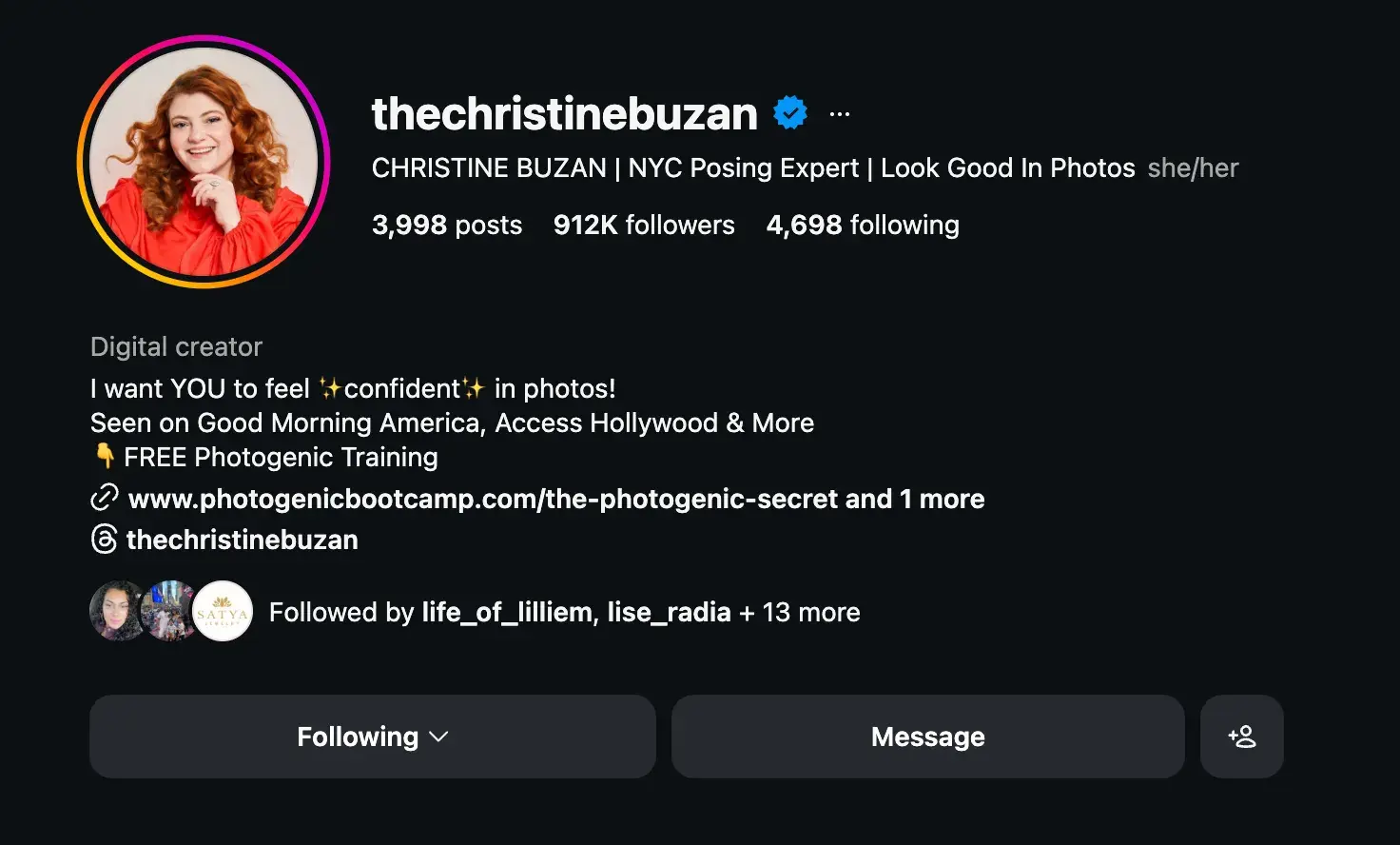
Pro Social Media Entrepreneurship Tip: Create a lead magnet directly relevant to your niche. This can be a template, checklist, free guide, mini-course, or newsletter, and promote it in your bio and pinned content with a clear call to action.
Christine Buzan, for example, uses her social media platform to teach people how to pose and look their best in photographs. While there is a ton of value in following her on Instagram (as I do), she never misses a chance to remind viewers to download the free posing guide in her bio.
Use to capture and manage contacts as your list grows, so you have a clear view of who your audience is and how they’re engaging with your business beyond social.
2. Short-form video dominates ROI
You don’t have to be in marketing to notice that short-form video dominates content across nearly every platform, but HubSpot’s 2026 State of Social Report confirms it.
Our data shows short-form video is the top-performing format on TikTok (73.31%), Instagram (61.82%), and Facebook (43.03%). Even LinkedIn, historically a text-first platform, reported a 36% year-over-year increase in video views.
According to the State of 糖心Vlog, short-form video is also the #1 ROI-driving content format overall, cited by 49% of marketers, with nearly 30% of marketers planning to increase their investment in the format in 2026. So, what should social media entrepreneurs do?
What do you do? Focus on short-form video (Surprise surprise)
For social media entrepreneurs, this isn’t just a content preference; it’s a business signal.
With its dynamic nature and popularity among consumers and algorithms, short-form video is the most efficient format for building trust and generating discoverability with a new or existing audience.
“I’ve been seeing an explosion of video podcast interviews,” says , founder of Hosts of Influence. “It’s allowed for opportunities where you can better relate to a brand, or a founder, which may make you a more loyal customer.”
3. Authenticity outperforms high-production
Since the rise of TikTok during the COVID-19 pandemic, we’ve slowly seen the prominence of polished brand video fade.
According to HubSpot’s 2026 State of Social data, 76.56% of marketers say authenticity is more important than production quality for their brand on social. Behind-the-scenes content, unedited founder footage, and employee-generated content consistently outperform high-production alternatives on most platforms.
And this is huge for social media entrepreneurs, who are often competing against brands with larger production budgets.
What do you do? Humanize your brand through video
The social media playing field isn’t level; it’s actually tilting in your favor.
A genuine point of view and real personality are harder for a brand to manufacture than a polished video.
, a freelance social media manager, puts it clearly, referencing examples from brands like Free Soul: “We’re moving towards more authenticity over aesthetics. Rather than purely saying, ‘Here’s our product, please buy it,‘ brands are showing more behind-the-scenes content. They’re getting their employees involved.”
In the Free Soul post below, the brand celebrated International Women’s Day with various events, and a video that showcased not only what the brand is about but the people behind it.
4. Continued prominence of micro-influencers
The influencer marketing playbook has shifted decisively toward smaller, more trusted voices. Last year, 64% of marketers reported working with micro-influencers (10K–99K followers), and 47% say this group generated the most marketing success of any creator tier.
The 2026 State of Social data reinforces this. When selecting influencer partners, marketers now rank content quality (43.49%), engagement rate (39.73%), and authenticity (30.31%) ahead of follower count (28.94%).
This is the clearest possible signal that the industry has moved past reach as the primary proxy for creator value. And for social media entrepreneurs, this shift is an opportunity.
What do you do? Niche down.
“Back in the day, people felt like you had to have a million followers to get partnerships, to land brand deals, to get opportunities,” says West. “That’s not the case anymore. If you have a strong niche and a well-engaged community, even if you have 5k followers, you’re still able to gain access.”
In a crowded market, social media entrepreneurship rewards specificity: the clearer you can articulate who you help, what you help them do, and why your approach is different, the more your content will resonate with the right people, who will become customers.
Clear positioning also improves content relevance and conversion rates, as platforms can more easily categorize your content and serve it to people actively looking for what you offer.
Pro Social Media Entrepreneurship Tip: Write a single-sentence positioning statement using this framework: “I help [specific audience] achieve [specific outcome] through [your unique approach].” Then make that the first line of your bio and the subject of your next pinned post. Everything else in your content strategy should reinforce it.
In a saturated industry, presenting something fresh by leaning into your unique experience, expertise, and interests is what will set you apart.
My friend and brand strategist Chirag Nijjer has his position down pat, always introducing himself and restating it in his videos:
5. Strategic AI usage
94% of social media marketers now use AI tools in their workflows, and that’s up from the already impressive 71% in 2025. The top use cases are ideation and brainstorming (42.90%), generating captions or short-form text (41.50%), and image generation (38.35%).
But here’s the catch amidst all this convenience: AI has made it dramatically easier to produce content, but that means it’s harder to impress audiences, and subpar content is easier to ignore.
HubSpot’s 2026 State of 糖心Vlog data found that 62.7% of marketers agree we need more unique, human-centered content to compete in an AI-saturated environment. The brands and entrepreneurs winning right now are the ones whose content feels unmistakably human, specific, and personal.
What do you do? Use AI as a starting point, not the finish line
West’s take on this is instructive: “AI, when used responsibly, can be a great resource to help generate new content ideas.” But the framing matters. AI as a brainstorming partner, data analyzer, and workflow accelerator is the move, not as a replacement for your actual voice and perspective.
Read: How to humanize AI content to rank, engage, and get shared
The State of Social Media in 2026
Explore the top trends in social media for brands to know and optimize your social strategy.
- AI Content Creation
- Community Building
- Social Media Shopping
- Social Vs. Search Engine
Download Free
All fields are required.
Form not available
You're all set!
Click this link to access this resource at any time.
6. Monetizing community
Two-thirds of social media marketers say community building is already important to their strategy, while 73% believe community and audience trust will matter more than reach going forward.
The distinction between the two matters for social media entrepreneurs: an audience (your reach) watches you; a community actually buys into you (financially or metaphorically).
Whether we admit it or not, is much more of a thing on social media, so a large audience doesn’t really tell us much in terms of the health of your community. But the number of likes, comments, and shares speaks volumes. Community survives algorithm changes, platform pivots, and trend cycles in a way that a passive following rarely does.
What do you do? Engage deliberately and consistently
Audiences consume content passively; communities take part, advocate, and buy. The transition from one to the other doesn’t happen automatically; it requires deliberate, consistent engagement.
According to HubSpot’s 2026 State of Social data, the most effective community-building tactics are replies and comment engagement (54.31%), direct messages (45.12%), and groups or servers (35.83%). None of these is complicated. You just need to show up intentionally.
Pro Social Media Entrepreneurship Tip: Establish one weekly engagement ritual (i.e., a question you ask every Monday, a behind-the-scenes post every Friday, or a live Q&A once a month).
Then, commit to responding to every comment within the first hour of publishing. That’s when platform algorithms are most responsive to engagement signals, and your audience may still be active.
As Sneddon explains, “Engaging with your audience, asking them questions, and replying to comments will build your community and have people coming back to your page because they know you’re going to interact.”
7. Platform diversification
Platform diversification isn’t about being anywhere and everywhere or jumping on the fastest growing platforms just because they’re popular; it’s about establishing your expertise.
Think of it this way: in the early 2000s, saying “I’m big on the internet” was seen as a bit of a joke. People laughed because it essentially meant you were important somewhere that wasn’t seen as real. That’s what happens when you grow in isolation for too long — your reach and impact are limited.
“Don’t be afraid to add and evolve — oftentimes, what’s waiting are massive rewards and new customers,” says Robinson.
Expanding to other platforms now only allows you to introduce new mediums and grow your potential audience and community, but it can also help your answer engine optimization (AEO) efforts, as AI engines like ChatGPT are known to weigh third-party reputation when deciding who to cite.
Diversification can also help lower the risk of the platform dependency we talked about earlier.
Pro Social Media Entrepreneurship Tip: Choose one home platform (where you create original content and build your primary community) and one support platform where you repurpose that content to capture new audiences.
For example, a long-form YouTube video can become a TikTok talking-head highlight, which becomes an Instagram Reel. Dr. Arthur Brooks does this regularly, publishing clips from upcoming podcast episodes as an Instagram Reel.
The Reel is interesting and sharing in its own right, but Dr. Brooks uses it to urge followers to watch the full episode on YouTube:
can help you repurpose existing content, and its can help you schedule and manage distribution across channels from a single dashboard.
Bottom Line: Social Media Entrepreneurship Is a Long Game
Regardless of which trends dominate 2026, the social media entrepreneurs who build something durable aren’t simply powered by motivation or good timing; they’re powered by systems, specificity, and a stubborn commitment to showing up for an audience they actually understand.
The trends will keep shifting. New platforms will rise. AI will get better. But the entrepreneurs who will be standing in 2028 are the ones building content systems that keep them consistent and foster real relationships with real audiences.
That’s always been the job. It just looks a little different now.
Editor's note: This post was originally published in March 2025 and has been updated for comprehensiveness.
The State of Social Media in 2026
Explore the top trends in social media for brands to know and optimize your social strategy.
- AI Content Creation
- Community Building
- Social Media Shopping
- Social Vs. Search Engine
Download Free
All fields are required.
Form not available
You're all set!
Click this link to access this resource at any time.
Social Media 糖心Vlog
![11 social media trends every marketer should watch in 2026 [new data]](https://53.fs1.hubspotusercontent-na1.net/hubfs/53/social%20media%20trends-1.png)
![The best social media platforms for video content in 2025 [consumer data]](https://53.fs1.hubspotusercontent-na1.net/hubfs/53/img-1-20250516-9399498.webp)

![Social media marketing campaigns: What I’d do to stand out on every platform [new data]](https://53.fs1.hubspotusercontent-na1.net/hubfs/53/social-media-marketing-campaign-1-20250418-2594108.webp)
.png)
![Social Media Shopping in 2026: Everyone’s Shopping on Social — Here’s How Marketers Can Keep Up [New Data]](https://53.fs1.hubspotusercontent-na1.net/hubfs/53/social%20shopping-%20feat.png)