Google doesn’t use latent semantic indexing (LSI) to rank web content, and spokespeople like John Mueller have said so directly. Yet LSI — and the idea of “LSI keywords” — keeps resurfacing, and the rise of AI search reignited the debate in 2025 as marketers asked all over again how semantic relevance actually works.
Here’s the truth: LSI is real. It’s an information retrieval technique developed in the late 1980s, a Natural Language Processing (NLP) method built to help computers understand the relationships between words and documents. It’s just not something Google uses to rank pages.
This article untangles what LSI actually is, what “LSI keywords” really mean, and how to use semantic keywords and modern semantic SEO to rank today.
Table of Contents
- What is latent semantic indexing?
- The Truth About ‘LSI Keywords’ in SEO
- How does LSI actually work?
- LSI vs. LSA: What’s the difference?
- 5 Ways to Research Semantic Keywords for Better SEO
- Is LSI still relevant?
- Frequently Asked Questions About Latent Semantic Indexing
What is latent semantic indexing?
Latent semantic indexing is an information retrieval technique. It’s a mathematical method developed in the late 1980s to help computers understand the relationships between words and documents — webpages, research papers, product descriptions, news articles, or any other form of text.
LSI was a breakthrough. Before LSI, search and retrieval systems were essentially doing exact-match lookups. If a query didn’t contain the precise words on a page, the results were poor or irrelevant. LSI fixed that.
Latent semantic indexing analyzes relationships between terms and documents, surfacing hidden patterns of meaning that go beyond simple keyword matching. The word “latent” is key here. It refers to those hidden connections between words that aren’t obvious on the surface but become clear when analyzed across a large body of text.
LSI solved two problems that had always tripped up keyword-matching systems, such as the following.
- Polysemy is where one word carries multiple meanings. Take the word “pitch.” Are we talking about a sales presentation, a baseball pitch, or a musical term? A simple exact-match keyword-matching system can’t tell the difference.
- Synonymy is where different words mean the same thing. “Sofa” and “couch” refer to the same piece of furniture, but a basic keyword system treats them as entirely separate terms. LSI recognizes they’re related because they consistently appear in similar contexts across many documents about home furnishings and interior design.
These two problems caused traditional retrieval systems to either return too many irrelevant results (polysemy) or miss relevant ones entirely (synonymy). LSI addressed both by looking at patterns of co-occurrence (how often words appear together across a large set of documents) rather than relying on exact matches alone.
Imagine running an online store selling “running shoes.” A customer searches for “footwear for jogging.” The store’s page doesn’t use those exact words, but LSI would recognize that “running shoes,” “athletic footwear,” and “jogging” consistently co-occur across fitness-related documents.
It’s worth being clear about what LSI is and isn’t. It’s a genuine piece of information retrieval history — a technique built in the 1980s for searching document collections. Despite a persistent SEO myth, it was never a Google ranking factor, a point we’ll come back to next.
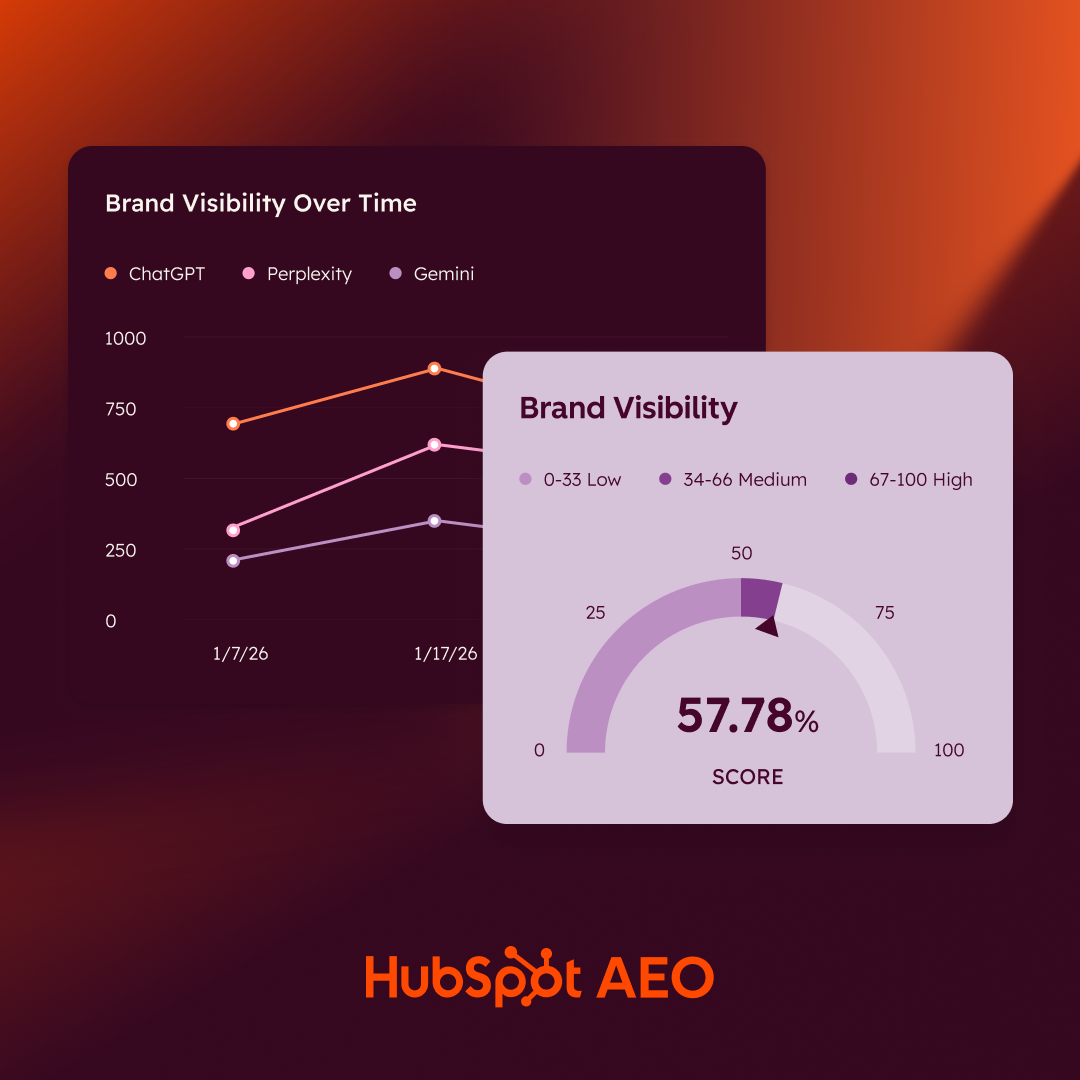
HubSpot AEO Tool
See exactly where your brand shows up in answer engines and take action to close AI visibility gaps.
- Track AI mentions.
- Analyze citations
- Monitor prompts
- Benchmark competitors
The Truth About ‘LSI Keywords’ in SEO
Google’s position on LSI is clear, and it has stated that position publicly more than once. In 2019, John Mueller : “There’s no such thing as LSI keywords — anyone who’s telling you otherwise is mistaken, sorry.” He in 2021, adding that while LSI is interesting “when you’re thinking about understanding information retrieval as a theoretical or computer science topic ... as an SEO, you probably don’t need to worry about that.”
So why does the phrase “LSI keywords” still appear in SEO guides, keyword tools, and content checklists? A few reasons:
- The underlying instinct is correct. Using related, contextually relevant language in content does help SEO. Marketers saw the results, attributed them to LSI, and the myth stuck.
- The terminology got muddled. Some marketers define LSI keywords when really they should refer to them as “semantically related keywords,” which is a real and valuable concept.
- Keyword tools kept the term alive. Tool makers built features like “LSI keyword generators,” which gave the concept a false sense of legitimacy and kept it circulating long after it should have faded.
What LSI Keywords Actually Mean (and How They Should Be Referred To)
When someone recommends adding “LSI keywords,” what they’re really gesturing at is semantic SEO practices such as:
- Semantic keywords and natural language variation. Google understands that “running shoes,” “jogging footwear,” and “athletic trainers” all point to the same thing, so writing the way an audience actually talks — varying phrasing naturally instead of stuffing in synonyms — signals topical relevance far better than repeating one exact term. Covering related concepts in the same space (for running shoes: arch support, cushioning, gait) reinforces it.
- Topic coverage and depth. Google’s systems assess how comprehensively a piece of content covers a subject. A page about “home coffee brewing” that also addresses grind size, water temperature, and brewing ratios will outperform a page that just repeats “home coffee brewing” twenty times. This is what keyword mapping helps plan for.
- Entity relationships. Modern search is built around entities (people, places, things, and concepts) and the relationships between them. Google doesn’t just read words; it recognizes that “espresso,” “barista,” and “coffee machine” belong to the same conceptual neighborhood.
- User intent. Perhaps the most important signal. Google’s priority is matching content to what a user is actually trying to accomplish, whether that’s learning something, buying something, or finding a specific answer. No amount of related keywords will save a page that doesn’t serve the right intent.
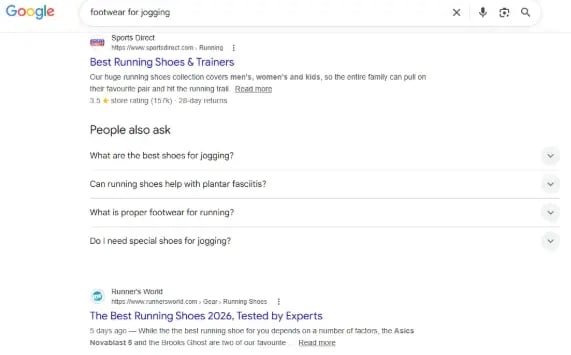
The bottom line: Don’t chase “LSI keywords” as a tactic. What matters is whether a page genuinely and thoroughly answers what its audience is searching for. That’s the framework that reflects how Google actually works today. Google already grasps these relationships well — it’ll rank a page titled ‘running trainers’ for the search ‘footwear for jogging,‘ as the screenshot below shows.
Benefits of Semantic Keyword Research
We’ve established that LSI keywords aren’t a Google ranking factor. But the instinct behind them — using contextually rich, related language to build more relevant content — points to something valuable. Here are some reframed benefits:
- Better topic coverage. Search engines reward content that covers a subject thoroughly, not just content that repeats a keyword. When SEO teams or content strategists research and incorporate semantically related terms, including the questions, subtopics, and related concepts an audience actually cares about, it signals to Google that a page is a comprehensive resource. That kind of depth earns rankings for multiple related keywords, not just the primary target keyword.
- More natural, human-sounding content. Writing with semantic variety means the same phrase isn’t forced over and over — it reads the way people actually talk and search, using natural synonyms, related phrases, and contextual language. That makes content better for readers first, and better for search engines.
- Stronger alignment with what people are actually searching for. Semantic keyword research asks SEO teams to think beyond the keyword itself and consider the intent behind it. Why is someone searching for this? What do they actually need? Content built around that question converts better, earns more engagement, and holds rankings more consistently than content optimized purely around keyword frequency.
My take on semantic keywords: 滨’惫别 never briefed a writer on semantic keywords. Doing so is busywork — maybe a controversial opinion, but it’s held up across my whole career. A talented writer who covers a topic comprehensively will use the relevant semantic terms naturally. Brief an article on “brewing the perfect espresso,” and you’ll get coffee, espresso shots, brew time, grind size, water temperature, extraction time, coffee-to-water ratios — without anyone spelling them out, because those terms are inseparable from the topic. So my advice: do good, holistic SEO and worry less about semantic SEO. It’s not that it doesn’t matter — it just doesn’t need a special briefing like it’s some SEO or AEO dark art.
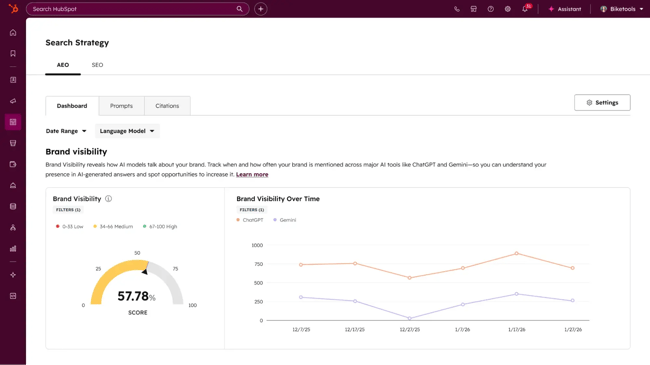
Semantic SEO focuses on topic coverage, context, and search intent — and those same qualities are exactly what answer engines like ChatGPT, Perplexity, and Gemini use to decide which sources to cite. Answer Engine Optimization (AEO) applies that thinking to those engines.
tracks where a brand appears in AI-generated answers, providing visibility into how brands show up across the answer engines where more buyers are now starting their research. Think of it as the natural extension of semantic SEO: the same content principles that help websites rank in Google are the ones that get them cited by answer engines.
How does LSI actually work?
LSI works by turning a collection of documents into a grid of numbers, then using math to surface the hidden relationships between words. It happens in three steps.
Step 1: Create a term-document matrix.
LSI uses a term-document matrix, a large grid in which each row represents a word (or term) and each column represents a document. Each cell in the grid shows how many times that term appears in that document. It’s essentially a map of which words show up where. Here’s a simple version:
Patterns are already forming: “cat” appears across all three documents, connecting them thematically.
Step 2: Apply singular value decomposition (SVD).
LSI applies singular value decomposition (SVD) to compress and simplify the matrix. SVD breaks the large term-document matrix down into smaller components, stripping out the noise and surfacing the strongest underlying themes and relationships. Think of it like compressing a photo: sometimes fine detail is lost, but the core image becomes clearer and easier to process.
Step 3: Identify semantic relationships.
Sticking with the matrix example above: through SVD, LSI recognizes that “yarn” and “cat” frequently appear together in Document 1. So even if a new document only mentions “cat,” LSI infers a possible connection to “yarn.”
LSI was impressive for its era. It moved information retrieval beyond rigid keyword matching and introduced a more contextual, pattern-based understanding of language. But it has limitations.
LSI is a statistical method. It identifies co-occurrence patterns, but it doesn’t actually understand meaning. It can’t interpret user intent, handle ambiguity in natural conversation, or scale effectively to the billions of web pages Google processes every day. It was built for document libraries, not the modern internet.
Which is why, despite what’s written elsewhere, Google does not use LSI for search rankings. It never did. The technology simply wasn’t designed for that purpose, and today, Google has far more powerful and sophisticated tools at its disposal. More on those shortly.
LSI vs. LSA: What’s the difference?
Anyone researching this topic has probably seen both “latent semantic indexing” and “latent semantic analysis” used, often interchangeably. They’re closely related, but they’re not identical. Here’s how to tell them apart.
Latent Semantic Analysis: The Broader Method
Latent semantic analysis is the umbrella term. It refers to the overall mathematical framework for analyzing relationships between words and the texts in which they appear. LSA is the technique itself: the process of applying singular value decomposition to a term-document matrix to uncover hidden patterns of meaning across a large body of text.
Latent Semantic Indexing: The Applied Version
Latent semantic indexing occurs when the analytical framework is applied to a specific purpose: information retrieval and search. LSI is LSA put to work. Where LSA is the analysis, LSI is the application — using those hidden semantic relationships to index documents and retrieve more relevant results in response to a query.
In practice, the labels are freely swapped, and in most SEO conversations, the distinction doesn’t change anything. If precision matters, “LSA” is the technically correct term for the underlying method, and “LSI” is correct only when referring specifically to its use in search and document retrieval.
HubSpot AEO Tool
See exactly where your brand shows up in answer engines and take action to close AI visibility gaps.
- Track AI mentions.
- Analyze citations
- Monitor prompts
- Benchmark competitors
5 Ways to Research Semantic Keywords for Better SEO
A common-sense approach to semantic keywords is usually enough. But for content strategists who want to research them deliberately, here are five practical ways — most of them free.
1. Google’s Related Searches
Google itself is one of the most underrated semantic research tools available, and it’s completely free. Search for any term, and Google surfaces three useful features.
A Dropdown Showing Related Searches
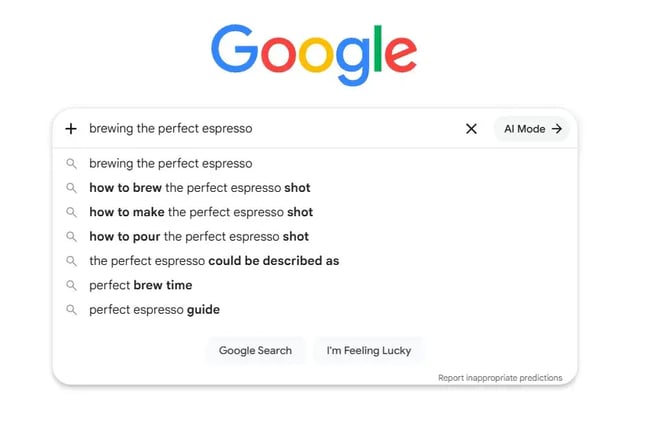
When typing a query into Google’s search bar, the autocomplete dropdown appears, and it’s more useful than most people realize. Those suggestions aren’t random. They’re pulled from the most common searches that begin with the same words, which means they show exactly how real users are phrasing their queries around the topic. In the example above, a search for “brewing the perfect espresso” is related to “how to brew the perfect espresso shot.”
“People also search for” Section at the Bottom of Google Search Results
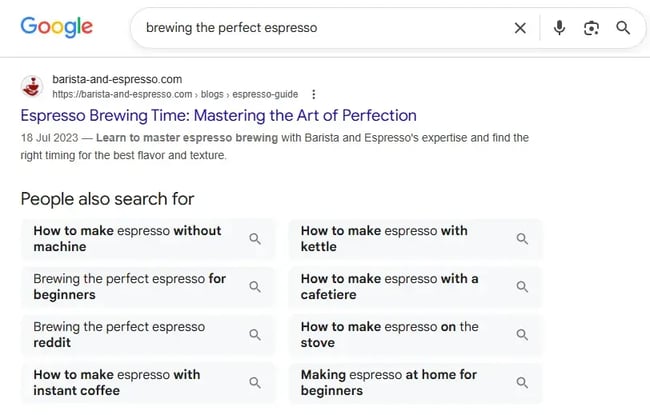
At the bottom of the results page, the “People also search for” section shows the queries Google associates most closely with the primary keyword. These reflect real search behavior from real users. That makes them a reliable signal of the language the audience actually uses and the subtopics they care about most.
People Also Ask
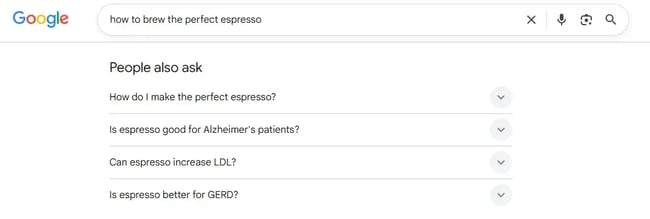
The People Also Ask box, which appears within the results themselves, is a great way to discover frequently asked questions that writers can include in their content.
Together, related searches and PAA provide a clear picture of the topical territory Google expects a comprehensive piece of content to cover. Start here before opening any paid tools.
2. Google Keyword Planner
Google Keyword Planner is best known as an advertising tool, but it’s useful for semantic keyword research too. It shows the related terms Google associates with a topic, along with search volume ranges and competition levels, providing a data-backed picture of which angles are worth covering.
To use it, head to via a Google Ads account and drop the primary keyword into the search bar. Let’s use “espresso machine” as an example.
Click “Get results,” and find a list of related keyword ideas alongside monthly search volume, competition level, and bid estimates.
For “espresso machine,” Google might surface terms like “espresso machine with grinder,” “espresso machine for beginners,” or “commercial espresso machine,” each one revealing something about the different contexts and intents people bring to that search.
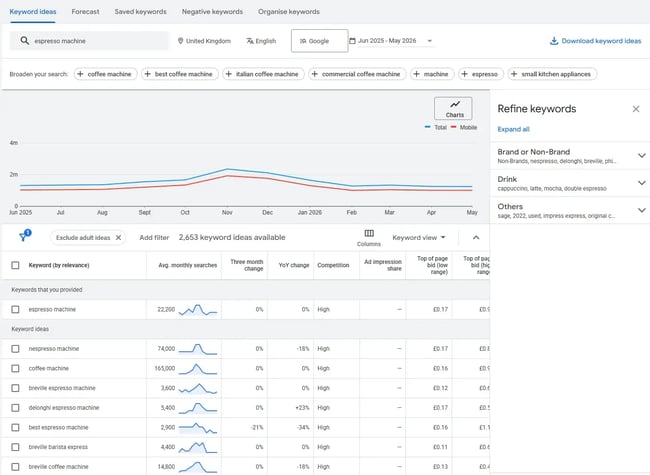
The real value here isn’t just finding more keywords. It’s understanding the shape of a topic, including which subtopics have meaningful search demand, which are too niche to prioritize, and where the gaps in content might be. Use it alongside seed keyword research to build a fuller picture of the territory being written into.
One thing to note: Keyword Planner requires a Google Ads account, but the account doesn’t need to be running active ads to access it. Set up an ad, then pause it before any money is taken.
3. Modern Semantic Analysis Tools
These modern semantic analysis tools aren’t “LSI keyword generators” — they’re content intelligence platforms that analyze top-ranking pages for a target keyword and show what topics, questions, and concepts the best-performing content covers that a page might be missing. Three popular tools include:
- Clearscope analyzes the top search results for a keyword and generates a list of related terms and topics weighted by relevance. As writers work, it scores the draft in real time based on how well it covers the subject. Think of it less as a keyword checklist and more as a topical completeness gauge.
- MarketMuse takes a broader view, mapping an entire content library against a topic area to identify where content has authority and where it has gaps. It’s particularly useful for topic cluster strategy — understanding not just what a single piece needs, but how content as a whole covers a subject domain.
- Surfer SEO sits closest to the writing process, offering real-time guidance on structure, topic coverage, and content length based on what’s currently ranking. It’s useful for writers who want in-context suggestions without switching between tools.
The following screenshot shows what Surfer looks like. In the right-hand menu, there are keywords. The tool makes a recommendation on how many times writers should include the keyword in the piece, based on what competitors have written.
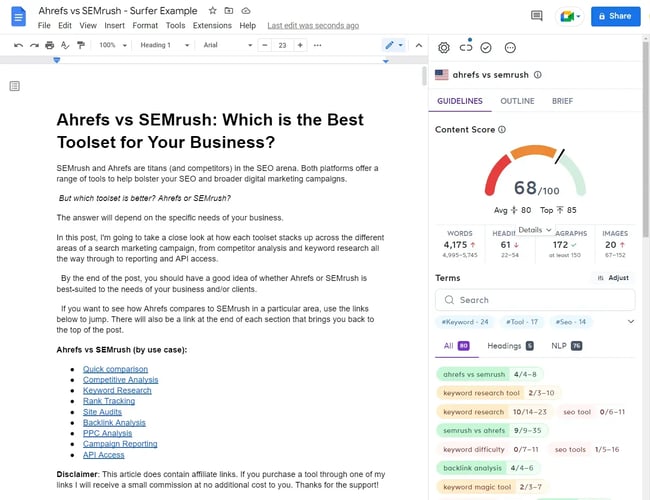
A word of caution using tools to manage keywords: These tools are most valuable as diagnostic and planning aids, not as checklists. Feed them to a competent writer as context and ideas for consideration, not as a list of boxes to tick. As noted earlier, a knowledgeable writer working through a topic thoroughly will hit the relevant concepts naturally — these tools just help verify nothing important got missed. Don’t get too fixated on the Surfer score.
4. AnswerThePublic
takes a different approach to semantic research. Rather than showing keyword volumes and competition data, it maps out the questions, prepositions, and comparisons real people are typing into search engines, AI search, and social media around a topic, providing a window into the why behind a search, not just the what.
Enter a keyword, and it returns a visual web of questions organized by search modifier: who, what, where, when, why, how, which, will, can, and are. Here are the results for a “coffee brewing” search:
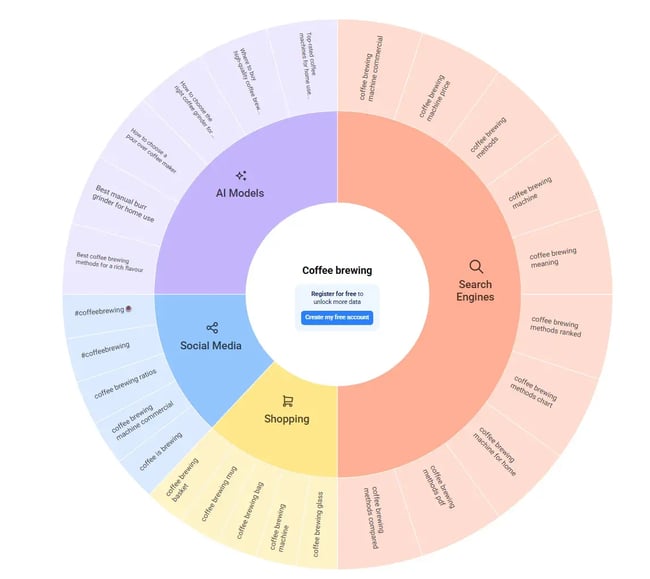
AnswerThePublic earns its place in a semantic research workflow during the early planning stage. Before content strategists outline a piece of content, running a primary keyword through the tool provides a fast, visual read on the full landscape of questions an audience brings to the topic. Those questions become the subheadings, the FAQ sections, the People Also Ask targets — and they help ensure content is built around what people are actually searching for rather than what’s assumed they want to know.
The free version provides a limited number of daily searches. The paid version removes that cap and adds trend data, which is useful when using it regularly across multiple content projects.
5. Google’s Natural Language API
Google’s Natural Language API is a machine learning tool that analyzes text the same way Google’s own systems do. Paste in a piece of content, and it returns a breakdown of the entities, syntax, sentiment, and categories Google identifies in that text. In other words, it shows how Google actually reads a page. The three features most relevant to semantic SEO are:
- Entity analysis. The API identifies the people, places, organizations, concepts, and things in the content. It assigns each one a salience score — essentially a measure of how central that entity is to the overall piece. In an article about keyword mapping, if the API reports the highest-salience entities as “spreadsheet” and “column headers” rather than “SEO” and “search intent,” that’s a signal the content may be drifting off-topic.
- Syntax analysis. The API breaks down sentence structure, parts of speech, and grammatical relationships. This is less about keyword targeting and more about readability and clarity — the kind of signals that correlate with content Google considers well-written and authoritative.
- Content classification. The API automatically categorizes content into topic areas based on Google’s own taxonomy. This is useful for checking whether Google is interpreting a page as intended. If an article about espresso brewing is being classified under “food and drink” rather than “hobbies and leisure,” that context matters for how it gets matched to queries.
; there’s a free demo version that lets anyone test content without setup.
HubSpot AEO Tool
See exactly where your brand shows up in answer engines and take action to close AI visibility gaps.
- Track AI mentions.
- Analyze citations
- Monitor prompts
- Benchmark competitors
Is LSI still relevant?
As a Google ranking factor, no, LSI is not relevant, and it never was. As a historical breakthrough in information retrieval, yes.
LSI is worth understanding because it represents an important moment in the evolution of search. It was one of the first methods to move information retrieval beyond rigid keyword matching toward something more contextual and meaning-based. That was a real breakthrough, and its influence on how the industry thinks about semantic relationships in text is legitimate.
Why LSI Matters Historically
The reason LSI is still in SEO conversations comes down to the right idea being attached to the wrong label. The instinct that context, related language, and topical depth matter for rankings is correct. Marketers saw their content perform better when it was comprehensive and naturally varied in its language, assumed LSI was the mechanism behind it, and the term embedded itself in SEO culture.
Two things kept it alive. Keyword tools built “LSI keyword generator” features into their products, and a steady stream of articles repeated the claim that LSI is part of Google’s algorithm. Together, they gave the myth real staying power.
What Google Actually Uses Instead
Modern semantic search uses machine learning and language models that make LSI look like a pocket calculator by comparison. Here’s what’s actually powering Google’s understanding of language and content today:
- BERT (Bidirectional Encoder Representations from Transformers). Launched by Google in 2019, BERT was a landmark moment in search. Unlike LSI, which analyzes word co-occurrence statistically, BERT reads text bidirectionally, understanding each word in the context of every other word in a sentence. That means it can interpret nuance, handle ambiguous phrasing, and understand natural conversational queries in a way LSI simply cannot.
- RankBrain. Google’s machine learning system for interpreting queries it hasn’t seen before. RankBrain maps unfamiliar queries to concepts it does understand, helping Google return relevant results even for brand-new or unusual search phrases. It’s been part of Google’s core algorithm since 2015.
- Transformers and neural matching. Beyond BERT, Google uses a broader family of transformer-based models to match queries to content based on meaning rather than keyword overlap. These models are trained on vast amounts of text and develop a sophisticated, contextual understanding of language that no statistical method like LSI can replicate.
- Entity-based search and the Knowledge Graph. Google doesn’t just read words — it recognizes entities: people, places, organizations, products, concepts. And it understands the relationships between them. The Knowledge Graph, launched in 2012, structures this entity-relationship data and uses it to enrich search results and understand content at a conceptual level that goes far beyond what LSI was designed to do.
Together, these systems give Google a deep, contextual, intent-aware understanding of both queries and content. LSI, by comparison, is pattern-matching on a spreadsheet.
The Modern Approach to Semantic SEO
Given what Google actually uses, modern semantic SEO comes down to three principles:
- Comprehensive topic coverage. Google rewards pages that cover a subject thoroughly — the primary question, related subtopics, common follow-ups, and adjacent concepts that an audience cares about. Depth beats keyword count.
- Entity optimization. The people, places, products, and concepts central to a topic should be clearly represented, so Google’s entity-based systems can correctly classify what a page is about and match it to the right queries.
- User-intent matching. Content works best when it’s built around what the searcher is actually trying to do. Informational, navigational, and transactional intent each call for different structures and depth — and getting this right matters more than any keyword tactic.
What Actually Works for Semantic SEO
Here’s what that looks like in practice:
- Write for depth, not density. Cover the topic so thoroughly that a reader has no reason to go elsewhere. That’s the content Google wants to rank.
- Use the audience’s language. Write naturally, vary phrasing, and avoid repetitive keyword insertion. Good writers do this instinctively.
- Build around topic clusters. A single page rarely wins in isolation. A pillar page supported by related content builds topical authority across a domain.
- Use semantic research tools diagnostically. Tools like Clearscope, MarketMuse, Surfer, and Google’s Natural Language API are most useful for identifying gaps in existing content, not for briefing writers upfront.
- Match structure to intent. Use format, depth, and calls to action to serve what the searcher needs — not just to include the right phrases.
- Track the right metrics. Rankings and traffic tell part of the story. Engagement signals — time on page, scroll depth, return visits — show whether the content is actually serving its audience. Use ranking metrics to monitor performance across both dimensions.
Frequently Asked Questions About Latent Semantic Indexing
Does related keyword research still matter?
Yes, related keywords still matter — but the framing does too. Researching semantically related terms, subtopics, and audience questions is valuable for building comprehensive content. The catch is that inserting “LSI keywords” doesn’t trigger a ranking boost; the value is in revealing the full shape of a topic, not satisfying an algorithm with synonyms.
Find the keyword research tools that fit the work — like AnswerThePublic and People Also Ask — to map out what an audience actually wants to know, and then write content that answers it thoroughly.
How does LSI differ from semantic search?
LSI is a specific 1980s mathematical technique that identifies relationships between words by analyzing co-occurrence patterns across documents. Semantic search is the broader, modern approach search engines use today, powered by machine learning, transformer models like BERT, entity recognition, and natural language processing. The key difference is that LSI is statistical and pattern-based, while semantic search actually attempts to understand meaning, context, and intent. LSI was a stepping stone toward semantic search, not a version of it.
How can I optimize for semantic SEO?
Focus on three things: depth, intent, and natural language. Write content that covers a topic comprehensively, addresses the real question behind the search query, and speaks in the language the audience naturally uses rather than forcing keywords into unnatural positions. Structurally, think in topic clusters rather than individual pages, use clear headings that reflect genuine subtopics, and make sure the entities central to the subject are clearly named and contextualized.
For a deeper look at the signals that actually move rankings, this guide to modern SEO strategy is a good next step.
From LSI Myths to Semantic SEO Success
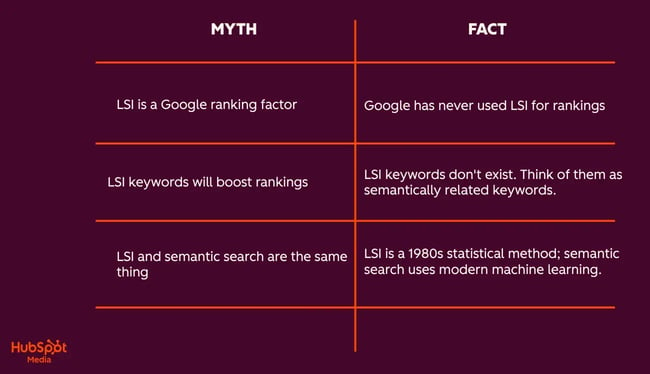
LSI sparked one of SEO’s most persistent myths. But knowing what it actually is — and what it isn’t — makes it far easier to build a content strategy grounded in how search works today. The myths can go: LSI keywords aren’t part of any ranking factor, and Google has never used LSI for rankings.
The modern approach is more sensible than the myths suggest. Cover a topic thoroughly, match the structure to the intent behind the query, build topic clusters rather than isolated pages, and use semantic research tools to audit existing content rather than brief writers up front.
That single shift — from keyword targeting to genuine topical depth — does more for organic visibility than any LSI keyword list ever could. The same thinking extends to answer engines, where more buyers now start their research: HubSpot AEO tracks where a brand appears in AI-generated answers, so websites can grow visibility wherever their audience is searching.
Editor's note: This post was originally published in April 2017 and has been updated for comprehensiveness.
HubSpot AEO Tool
See exactly where your brand shows up in answer engines and take action to close AI visibility gaps.
- Track AI mentions.
- Analyze citations
- Monitor prompts
- Benchmark competitors
Keyword Research