

A discovery call is an early-stage sales conversation used to understand a prospect’s goals, challenges, budget, timeline, and fit. Strong discovery calls help sales reps qualify opportunities before demos or proposals, focus follow-up on the buyer’s needs, and avoid spending time on poor-fit deals.
In this guide, you’ll learn what a discovery call is, how it differs from a cold call, which discovery call questions to ask, how to run a structured sales discovery process, and how to use a discovery call template to keep the conversation focused.
Tools like Sales Hub and HubSpot Smart CRM can also help reps prepare for discovery calls, capture notes, and turn call insights into clear next steps.
Table of Contents
- What is a discovery call?
- Discovery Call Questions
- How to Run a Discovery Call
- Discovery Call Template
- Discovery Call Tips
- Frequently Asked Questions About Discovery Calls
What is a discovery call?
A discovery call is an early-stage sales conversation that happens after a prospect has shown interest in a company’s product or service. Sales reps use discovery calls to understand the prospect’s goals, pain points, decision process, budget, timeline, and overall fit before recommending a solution.
The main goal of a discovery call is to determine whether the seller can help the prospect. A strong call sets expectations, uncovers qualification signals, and gives both sides enough context to agree on next steps.
Why are discovery calls important?
Discovery calls are important because they help buyers and sellers assess fit before either side invests more time. A strong discovery call reveals the prospect’s goals, pain points, urgency, budget, decision process, and next steps.
Discovery calls help sales teams:
- Show buyer-first intent. A great discovery call focuses on solving the prospect’s problem, not pushing a product.
- Qualify or disqualify faster. Discovery calls help reps separate viable opportunities from poor-fit prospects. Qualification frameworks like BANT — budget, authority, need, and timeline — turn assumptions about budget, authority, need, and timeline into clearer sales decisions.
- Answer prospect-specific questions. Buyers often research before speaking with sales, but discovery gives reps a chance to answer questions tied to the prospect’s actual use case, goals, and constraints.
.png)
Free Guide: 101 Sales Qualification Questions
101 Questions to Ask Contacts When Qualifying, Closing, Negotiating, and Upselling.
- Budget Questions
- Business Impact Questions
- Competitor Questions
- And More!
Download Free
All fields are required.
Form not available
You're all set!
Click this link to access this resource at any time.
Discovery Call vs. Cold Call
A cold call is unsolicited outreach to someone who has not yet engaged with the company. A discovery call happens after a prospect has shown interest and focuses on understanding fit, needs, and next steps.
- When the call happens. A cold call happens at the very beginning of outreach, while a discovery call takes place after initial interest or engagement.
- Main goal. A cold call focuses on initiating a conversation and generating interest, whereas a discovery call focuses on understanding the prospect’s needs, challenges, and goals.
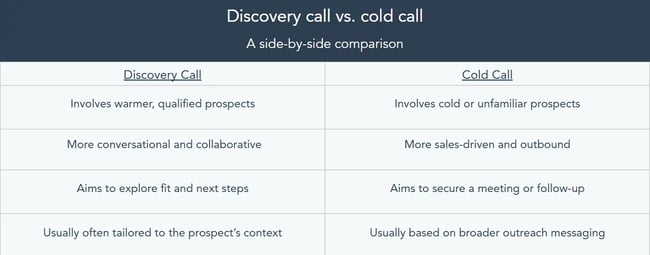
- Conversation style. Cold calls are brief and introductory. Discovery calls are more detailed and consultative.
- Duration. Cold calls usually last 2–10 minutes and focus on establishing initial interest. Discovery calls typically run 20–45 minutes and are designed to uncover customer needs, pain points, and objectives.
Discovery Call Questions
The best discovery call questions are open-ended and designed to uncover goals, pain points, budget, timeline, decision process, and fit. Use the questions below to set the stage, qualify the opportunity, identify poor-fit prospects, and confirm next steps.
Questions That Set the Stage
Here are 20 discovery call questions to help guide the conversation. For more examples, review these sales questions.
1. Mind if I share what I learned about your business before we start talking about mine?
, founder of DemandJen, uses this question to open discovery calls with context instead of assumptions:
Jen explains that she doesn’t want to assume she has all the correct answers simply because she researched the company before the call.
“It looks like COMPANY sells a PRODUCT/SERVICE to STAKEHOLDER ROLES at CUSTOMER VERTICALS/TYPES. It seems like the problem you’re solving for those customers is X, and the company makes money by XYZ. What did I get wrong?”
Here’s why I do it this way:
- Prospects notice when sellers come prepared. The tone changes when they realize you took the time to understand the business, and the reaction Allen-Knuth usually gets is, “Thank you for taking the time to learn about our business. Most sellers don’t.”
- Most discovery calls are 30 minutes. Reps should not spend that time asking buyers to explain information they could have researched beforehand. Strong prep leaves more time for the questions that actually move the conversation forward.
- The “what did I get wrong” close invites correction. Correction = discovery. It sets the tone that we’re not a know-it-all. Know-it-all reps sound naive.
From there, reps can transition into a more specific follow-up, such as: “I don’t work inside your company, but it sounds like your CEO is asking the business to...”
Key takeaway: Opening with prior research establishes context and accelerates a more meaningful discussion. It also gives prospects a chance to introduce themselves on their own terms.
2. Tell me about your role. What do you do day-to-day?
This question helps reps understand the prospect’s role before digging into company-level challenges.
Pro tip: Keep this question low-pressure. Prospects often feel comfortable explaining their day-to-day work before discussing bigger business challenges.
3. What metrics are you responsible for?
This question clarifies how the prospect measures success. If the previous answer focused on tasks, this follow-up connects the role to measurable outcomes.
Pro tip: The language here is also very important — always use the word “metric.” Define success in numbers. Measurable outcomes make business impact easy to demonstrate.
Questions That Qualify
Move beyond surface-level discovery. Use BANT to uncover goals, expose pain points, and identify obstacles to success.
4. What problem are you trying to solve?
Sales reps can use this question to uncover what the buyer wants to change. The question works because it gives the prospect room to answer in their own words instead of steering them toward a specific response.
Pro tip: The best discovery questions are open-ended and reveal a prospect’s goals, challenges, budget, timeline, and decision-making process.
5. What’s the source of that problem?
A prospect may understand the problem but not the root cause. Asking about the source helps reps identify whether the issue is something their product or service can actually solve.
6. “Why do you want it, and who else does it impact?”
, founder of #samsales, explains one of her biggest aha moments from writing the playbook The Perfect Discovery Call.
“Once reps know what buyers want, they often jump to, ‘We can solve that. Let me show you how,” she writes. “Instead, ask, ‘Why do you want it, and who else does it impact?’”
Samantha explains that reps share examples and ask follow-up questions. She writes, a rep may ask, “Can you share a bit about why you need these now, or if you’ve had data in place that just hasn’t served you in the right way?”
The rep can then get a thoughtful answer that can help them understand the product fit. The prospect might say, “Yep, we’ve never invested in data, just looked at competition and our gut. To that end, we tested flavors popular in the Southwest in the Northwest, and they just didn’t hit. It cost us $800k to learn that lesson.”
That’s it! With the help of this technique and by maintaining your enthusiasm, you unlock key data (in this case, the cost of their previous mistake).
7. Why hasn’t it been addressed before?
Previous roadblocks often predict future ones. Challenges that stalled past solutions (such as budget constraints) can become key signals of qualification.
8. What do you think could be a potential solution? Why?
This question shows how the prospect thinks about solving the problem. Their answer can help reps tailor the value proposition to the prospect’s priorities and decision style.
9. What would a successful outcome look like?
This question helps uncover the prospect’s vision of success. Expectations may not always be realistic, but the answer shows whether the solution aligns with the outcome the prospect wants.
Pro tip: Listen without judgment, then record the prospect’s expectations in so the follow-up reflects what they actually said.
10. If you didn’t choose a product, do you have a plan in place to address this problem?
This question uncovers urgency fast. A clear plan signals commitment to solving the problem, while the absence of one often indicates a poor fit or a low-priority initiative.
Questions That Disqualify
Next, ask questions that reveal whether the prospect has the budget, authority, timeline, and internal support to move forward.
11. What are your primary roadblocks to implementing this plan?
A direct question often delivers the most direct answers. It exposes the obstacles prospects believe are holding them back and brings hidden blockers to the surface.
12. What’s your timeline for implementation?
Timelines can make or break a deal. If expectations and execution windows don’t align, qualification becomes straightforward. The “T” in BANT exists for a reason.
13. What’s the approximate budget for solving this problem?
Budget isn’t a conversation for later. It’s a qualification factor from day one. Establishing financial viability early helps determine whether a sales engagement is worth pursuing.
14. Whose budget does the funding come from?
Consider the tone of the conversation before asking this question. It may feel too probing if the prospect does not know you well yet.
If the conversation has enough trust, ask which team or leader owns the budget.
It’s useful to know whether the budget owner is an individual or the entire department.
Questions That Establish Next Steps
Finally, ask questions that clarify the buying process, identify remaining blockers, and confirm the next step.
15. Who else will be involved in choosing a vendor?
This question helps reps understand whether the prospect is a gatekeeper, an influencer, a decision-maker, or a member of a larger buying committee. It also reveals how complex the decision process may be.
16. What’s the process for actually purchasing the product once you decide on it? Are there legal or procurement reviews?
A well-run discovery process earns the trust needed to discuss purchasing decisions openly. At that point, direct questions feel consultative rather than pushy.
17. What are potential curveballs?
This question reveals whether unexpected changes could stall the deal. If the prospect gave a vague answer about roadblocks, this follow-up may uncover more specific risks.
18. How can I help make this easy?
Some prospects will ask for more information; others won’t. Allowing them to voice their needs helps eliminate obstacles and accelerate progress.
19. How will this solution make your life better?
The more tangible the future state feels, the stronger the case becomes. Showing how day-to-day work improves helps prospects champion the solution with stakeholders.
20. Can I follow up with you on mm/dd?
Close the call strongly by suggesting a follow-up date.
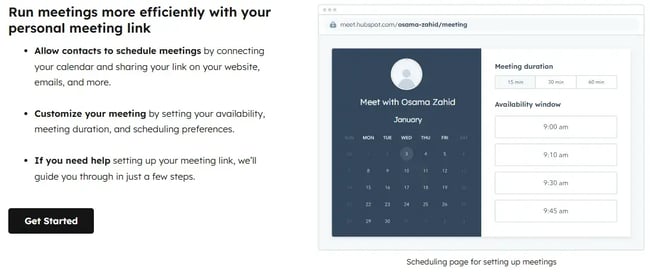
If uncertainty remains after the call, schedule a follow-up to close the gaps and gain clarity. HubSpot’s meeting scheduler lets prospects book time through that sync with connected calendars.
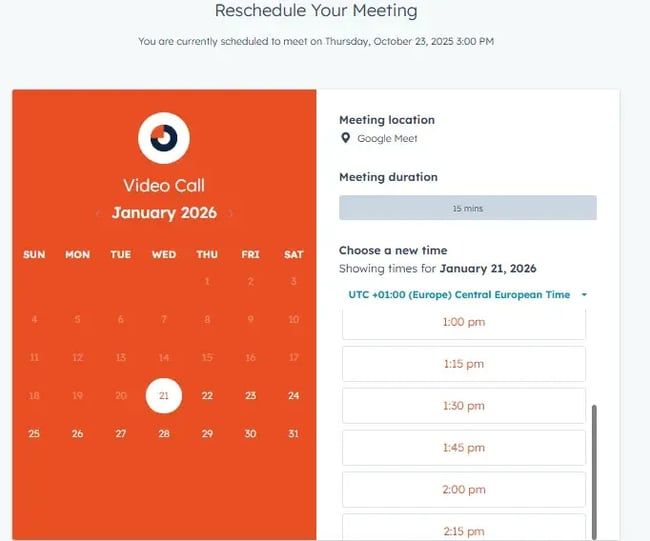
HubSpot also automates meeting changes by sending rescheduling and cancellation links via email.
The outcome of an effective discovery call is a shared sales plan and a clear roadmap of agreed-upon next steps.
How to Run a Discovery Call
To run a discovery call, follow these six steps: , review ICP and persona fit, set the agenda, open the conversation, qualify or disqualify the opportunity, and establish next steps.
1. Research your prospect’s business ahead of time.
A strong discovery call starts with pre-call research into the prospect, the company, and the CRM history. Before the call, review the prospect’s company, role, vertical, likely challenges, goals, and recent engagement with your business.
For example, if the prospect downloaded a guide about SEO best practices, the rep can ask whether the team is struggling to generate enough organic search demand.
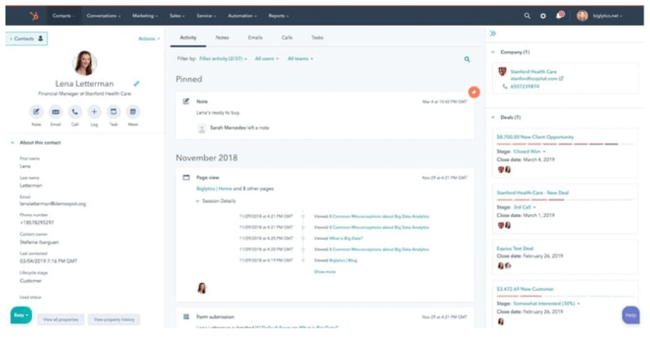
HubSpot Smart CRM help reps see a prospect’s emails, meetings, notes, and deal activity in one place before the call. Breeze prospecting agent can also help reps prepare by researching accounts and surfacing relevant context before outreach.
Pro tip: Treat disqualification as useful information. If the prospect is not a fit, the call can still save the team from spending time on a demo, proposal, or follow-up sequence that will not move forward.
2. Review ICP and persona fit.
Discovery calls aren’t just about winning interest; they’re about validating fit. A clear understanding of the ideal customer profile and buyer personas helps separate high-potential opportunities from poor-fit prospects.
Use tool to capture discovery outcomes and move qualified deals forward without losing the context from the call.
HubSpot can also help reps keep meeting activity and follow-up context connected to the prospect record.
3. Set the agenda.
Discovery calls need structure, direction, and clarity. A strong discovery call starts with a clear agenda and expectations for the conversation.
A clear agenda tells the prospect what the call will cover and what the rep needs to learn. Add the agenda to the meeting invite so both sides know the purpose before the call starts.
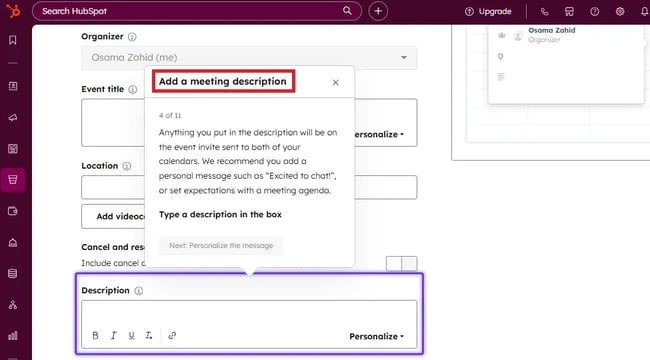
When attendees understand what the discussion will cover, meetings feel more relevant and intentional, which can help reduce no-shows.
When sending the agenda, choose a date and time that work for both parties. HubSpot’s meeting scheduler lets reps share booking links, control availability, and connect calendars so prospects can choose a time without back-and-forth emails.
Pro tip: Don’t schedule more time than the call needs or move into a demo too early. Keep the conversation focused on the prospect’s needs, challenges, and fit before showing product features.
4. Open the call conversationally.
Always keep things light and approachable at the start. Open it up with some easy conversation.
However, don’t make the intros too long or use too much small talk. In a conversational tone, validate (or correct) their point of view and confirm their priorities.
Use the discovery questions above. These questions are a great place to start:
- Tell me about your company.
- Tell me about your role. What do you do day-to-day?
- What metrics are you responsible for?
Skip the last question if they already share their success metrics in their day-to-day work.
5. Ask smart questions to qualify or disqualify the prospect.
According to the 2025 G2 Buyer Behavior Report, prefer to engage with vendor salespeople later in the buying journey, during the evaluation or decision stages. By the time a discovery call happens, most prospects have already done their homework, so reps should ask questions that clarify fit rather than repeat information buyers can find on their own.
To uncover priorities and qualify opportunities, pick the questions that assume a baseline level of familiarity:
- Tell me about your goals (financial, customer-related, operational).
- When do you need to achieve these goals?
- What problem are you trying to solve?
- Are you having problems in [area] related to the product?
- What’s the source of that problem?
- Why is it a priority today?
- Why hasn’t it been addressed before?
- What do you think could be a potential solution? Why?
- What would a successful outcome look like?
- If you didn’t choose a product, do you have a plan in place to address this problem?
Disqualification is a positive outcome when a prospect is not a good fit. To disqualify, ask the following questions:
- What are your primary roadblocks to implementing this plan?
- What’s your timeline for implementation?
- What’s the approximate budget for solving this problem?
- Whose budget does the funding come from?
- Is the budget owner an “executive sponsor”?
Sales Hub playbooks can help reps ask consistent discovery questions, capture structured notes, and keep the conversation moving without switching tools.
captures customer call data in HubSpot Smart CRM, surfaces coaching opportunities, and helps managers identify patterns across calls.
Key takeaway: The discovery call is only the beginning. Real qualification happens when reps analyze the answers, capture clean notes, and use the right context to guide follow-up and next steps.
Free Guide: 101 Sales Qualification Questions
101 Questions to Ask Contacts When Qualifying, Closing, Negotiating, and Upselling.
- Budget Questions
- Business Impact Questions
- Competitor Questions
- And More!
Download Free
All fields are required.
Form not available
You're all set!
Click this link to access this resource at any time.
6. Establish next steps.
Last, set up the next steps. There should be no question about what the prospect (or you) should do to move the deal forward. Be sure to ask:
- Who else will be involved in choosing a vendor?
- Do you have written decision criteria for choosing a vendor? Who compiled these criteria?
- Have you purchased a similar product before?
- Is this a competitive situation?
- What’s the process for actually purchasing the product once you decide on it? Are there legal or procurement reviews?
- What are potential curveballs?
- How can I help make this easy?
- How will this solution make your life better?
- If you implement this solution, how do you hope things are different in one year?
- Can I follow up with you on mm/dd?
Key takeaway: A repeatable discovery process helps reps qualify faster, capture cleaner notes, and leave the call with clear next steps.
Discovery Call Template
A discovery call template gives sales reps a repeatable structure for opening the call, setting expectations, uncovering pain points, handling objections, summarizing the conversation, and confirming next steps.
A B2B sales discovery call framework keeps the conversation focused and helps reps capture the information they need to qualify the opportunity.
Introduce yourself.
- “Hello [prospect’s name], I’m [name] with [company name]. I’ve been doing some research on [your company], and I’m impressed with what I’ve seen so far. I’d like to learn more about [name a specific goal, challenge, or opportunity] to see if there is a way we can work together.”
- “Good [morning/afternoon] [prospect’s name], it’s [name] with [company name]. I was initially referred to you by [referral name]. They mentioned you’re looking to [insert potential pain point]. I’d love to learn more about your situation and see if we can help.”
- “Hey [prospect’s name], it’s [name] from [company name]. I recently noticed [something positive about the company/compliment]. I wanted to connect with you to see if there might be a way we could work together.”
If these starters feel too fast or formal for your prospect, check out this list of conversation starters.
Create a connection.
- “Hi Jill, I noticed from the notes that [context]. I’d love to learn more about that. Could you walk me through [question]?”
The fastest way to frustrate a prospect is to make them repeat themselves. AEs should review SDR notes before the call and use that context to ask smarter questions, build credibility, and move the conversation forward.
Set expectations.
- “Just a heads-up, our call shouldn‘t take more than [specific time you have in mind]. I’m hoping to get a better understanding of your business and the challenges you’re facing. Does that sound good to you?”
- “I’m looking forward to our call today. My goal is to gain a better understanding of your current situation so I can see how we might help. How does this fit with your objectives for the call?”
- “To make the most of our time, I’ve prepared an agenda with a few items I’d like to discuss. We’ll start with [first item] and move on to [subsequent items]. Do you have any questions before we get started?”
- “By the end of our call today, I hope to have a clear understanding of your business and goals and share how we could help. Then, the next step would be to schedule another call to dive deeper. Does that sound like a good plan?”
Find top pain points.
- “I have a few questions I’d like to ask to get a sense of your organization and the challenges you’re dealing with.”
- “I saw on your website that you recently posted a [blog/article] about [topic related to pain point]. Can you tell me more about the situation that led you to publish that post?”
- “I’ve been talking with other companies in your industry, and it seems like [pain point] is a common challenge. Is this something your team is experiencing too?”
- “I know it’s been a tough time for businesses in your industry. What challenges has [your organization] faced over the past few months?”
In addition to the qualifying questions above, creative open-ended questions are a great way to surface pain points.
Figure out how pain points impact your contact.
- “Thank you for telling me about what your organization is dealing with right now. How do you think these challenges are impacting your role?”
- “I’d like to get a better understanding of [pain point] you mentioned. How does [pain point] impact your business and goals?”
- “Just curious, what happens if [pain point] isn’t addressed? What are the potential consequences?”
- “How do those challenges impact other departments or stakeholders? Would it make sense to collaborate to solve [pain point]?”
Empathy statements can help build trust and encourage the prospect to share more openly. Acknowledge concerns with responses such as:
- “That sounds frustrating.”
- “I can see why that would be challenging.”
Find and explain your best solution.
- “Based on what we’ve discussed, it sounds like [product/service] might be a good fit for your organization. Can I give you a quick overview?”
- “I’ve been thinking about how we might be able to help solve {pain point}. Our [product/service] is designed to [brief value proposition]. Would you like to hear more about it?”
- “I’ve been through similar challenges with other clients in the past. We helped them by [brief case study or testimonial]. Does this sound like it would work for you?”
- “It seems we both feel [related topic] is important, and our conclusions on [pain point] align with that. Do you think [product/service] could improve your situation?”
- “Can you walk me through the specific needs of [project], so I can share how we can customize [product/service] to meet those needs?”
Anticipate and handle objections.
- “It sounds like you may not be ready to put this solution in place. Let’s address any concerns so we can find a way to work together.”
- “I’ve found that some clients are hesitant to move forward because of [related objection]. Do you want to share your thoughts on this?”
- “It’s not unusual to have concerns about trying something new. I’m here to listen to any objections you may have so we can fully address them.”
- “Some people may not be ready to use a new resource because of [related objection]. We’ve gotten results for other clients with similar challenges. I’m here to work with you to develop a solution that meets your specific needs.”
For more help preparing for pushback, use this before your next discovery call.
Summarize your conversation.
- “Thank you for taking the time to speak with me today. Based on our conversation, it seems like your top priorities are [insert priorities]. You’re looking for a product that can help you [goals for solution or product]. Is that right?”
- “It sounds like you’re facing [insert challenges] and you want a solution that can help you [insert priorities]. Does that sound right to you?”
- “To recap, you’re looking for a tool that can help you with [insert priorities]. The most important features are [insert features]. Is that a good summary?”
It’s also a good idea to take notes on your summary so that you can include specific details in your .
Confirm the next steps and be gone.
A discovery call works best when reps stop once they have the information they need. A common discovery call mistake is dragging out the meeting with unnecessary product details, which can weaken the trust built earlier in the call.
writes how discovery calls should be “BBG”: Be brief. Be brilliant. Be gone. He elaborates, “I demo a lot of tech as a founder, and one thing that instantly makes me lose confidence in a sales rep is when they drag out meetings unnecessarily. The biggest mistake I see? Reps who feel obligated to fill every minute of the scheduled time slot.”
Chen recalls a phone call with an account executive. He notes that the AE nailed the qualification early on. “They had done their research. I was impressed off the bat. We both knew there was a fit. Clear next steps identified,” Chen shares.
At that point, the prospect was BANT-qualified after about 20 minutes. But then they kept going.
“They started diving into features I didn’t care about. Asking redundant questions. Building ‘rapport’ that felt forced with me. By minute 40, I was checking my phone. By minute 45, I was questioning whether they actually understood my priorities even though they crushed the first half of our disco,” Chen notes.
Remember: If a rep has learned about the prospect, it’s time to close the call with next steps.
Discovery Call Tips
1. Prioritize qualification over process-based questions.
Focus on whether the prospect is ready for your product before figuring out how to implement it. For example, a legal or procurement process isn’t a roadblock to a sale, but a lack of a business plan is.
Establish a pain point or goal, then talk through potential options. Then you can move on to the details of the deal.
To help with that, use the feature in HubSpot Sales Hub. The tool helps you log calls automatically and drop voicemails with one click.
With call tracking, reps can make phone calls directly from HubSpot Smart CRM without switching to another app or device.
Key takeaway: HubSpot automatically ties each call to the associated contact record. This helps keep activity logs complete and up to date.
2. Confirm understanding before moving to the next question.
Clear communication will make the difference between closing a sale or not. It can be tempting to jump to the questions that will bring you closer to closure, but that could lead to missed opportunities.
, a three-time vice president of sales, explains:
“Sometimes, on discovery calls, reps do so much research that they want to prove how much they know about your business, and they end up talking too much.
I have always been impressed with reps who are able to understand the persona of the person they are talking to and ask questions about their challenges to help build that trust and knowledge and uncover the true challenges they are trying to solve.
Especially if you have multiple people on a discovery call, are you taking the time to make sure you understand the individual challenges of each person on the call so they all see value in the solution?
I think the reps that slow down a bit on discovery calls use EQ to connect and understand the personas on the call will win, regardless of how much information you gathered on the company itself.
With the power of AI today, we can get a lot of information quickly, and I think sometimes it ‘overarms’ our reps and they push into a feature dump pitch because they want to seem like an expert.”
Pro tip: HubSpot’s conversation intelligence tool captures customer call data in HubSpot Smart CRM and surfaces coaching insights. After a discovery call, reps and managers can review what the prospect said, where the conversation stalled, and which next steps should happen.
3. Utilize active listening and open-ended questions.
, founder of , recommends pairing active listening with open-ended questions. Instead of working through a rigid list, listen for the prospect’s exact words, ask follow-up questions, and use their answers to shape the next part of the conversation.
“This approach, done right, can skyrocket conversion rates and increase client satisfaction tremendously. It proves that a dash of curiosity and a genuine desire to connect can transform a run-of-the-mill call into a game-changing conversation.”
4. Set a positive tone with transparency.
According to , founder and CEO of , transparency is central to productive discovery calls. According to her, you need to “[be] upfront about your intentions and the purpose behind the discovery call.
“From our experience, being transparent right from the start sets a positive tone and promotes trust with the prospect. This helps align our expectations and ensures that both parties are on the same page, which is crucial for a fruitful discussion.
“I recall a recent discovery call with an e-commerce client. Right from the outset, we transparently mentioned that we wanted to explore how our platform could provide solutions that fit their needs. This immediately created a favorable ambiance for the conversation, as the client appreciated our honesty. It also encouraged them to openly share their challenges and eventually allowed us to be part of achieving their goals.”
5. Highlight consequences to create urgency.
, CEO and sales director of , recommends asking what happens if the prospect does not solve the problem. Reps often discuss the benefits of solving a problem but skip the consequences of inaction. To create urgency without sounding pushy, ask second- and third-layer questions like, “How will this affect your revenue, costs, and risk?”
This week, I was talking with a potential client who was concerned about the efficiency of their cleaning solutions.
“He felt their cleaning was not up to par. Moving beyond the immediate benefits of our steam cleaners, I steered the conversation to discuss what would happen if they did not upgrade. They would incur more maintenance costs, lower customer satisfaction, and risk of shutdown due to noncompliance with health regulations.
“This highlighted the benefits of our products but created a sense of urgency and necessity. People appreciate it more when you come off as a consultant. So, make a real human conversation beyond checking off a list of questions.”
For more ways to create a sense of urgency without pushing, use these sense-of-urgency questions.
6. Approach calls with a learning mindset.
Most prospects are comfortable participating in discovery calls when the conversation feels natural and collaborative rather than overly formal or interrogative.
, founder of , says, “My top tip for conducting effective discovery calls is to go in with a learning mindset, not a selling one. Ask open-ended questions to deeply understand your prospect’s key challenges and priorities. Listen for what’s not being said, read between the lines, and probe further.
“Too often, reps go into calls with a rigid agenda, talking over the prospect. An effective discovery call should be a conversation, not a pitch. Let the prospect’s challenges and needs guide the discussion. The more you listen, the more they’ll open up. And the more they open up, the better equipped you’ll be to provide real value. An insightful discovery call builds trust and sets the foundation for a long, successful partnership.”
Key takeaway: Discovery is not the time to close. Over-selling too early can create resistance and derail the conversation. Check out these sales pitch examples for inspiration.
Frequently Asked Questions About Discovery Calls
What should I expect on a discovery call?
Expect a collaborative conversation about the prospect’s goals, challenges, current process, decision timeline, and possible next steps.
The goal of the discovery call is to understand needs, assess fit, and identify opportunities for alignment. The outcome is a clearer picture of next steps, timelines, and potential paths forward.
Is a discovery call an interview?
No — a discovery call is not an interview. It’s a two-way conversation designed to explore goals, answer questions, and see whether there’s a good fit on both sides.
Think of it as an opportunity to gain clarity, share context, and discuss potential next steps in a relaxed, collaborative setting.
What’s another way to say “discovery call”?
Other names for a discovery call include an exploratory call, a connection call, a qualification call, and a consultation call.
Use “exploratory call” or “connection call” when the conversation focuses on learning about the person or company. Use “qualification call” when the focus is on fit, budget, timeline, and decision process. Use “consultation call” when the conversation focuses on diagnosing customer pain points and offering strategic advice.
Great discovery calls help you close more deals.
Great discovery calls help sales reps qualify fit, uncover urgency, and decide whether to move forward before investing time in a demo or proposal. Use the questions and template above to run a more focused conversation, capture the answers in your CRM, and leave the call with clear next steps.
Editor’s note: This post was originally published in October 2015 and has been updated for comprehensiveness.
Free Guide: 101 Sales Qualification Questions
101 Questions to Ask Contacts When Qualifying, Closing, Negotiating, and Upselling.
- Budget Questions
- Business Impact Questions
- Competitor Questions
- And More!
Download Free
All fields are required.
Form not available
You're all set!
Click this link to access this resource at any time.
Sales Qualification

![How I use BANT to qualify prospects [+ expert tips]](https://53.fs1.hubspotusercontent-na1.net/hubfs/53/bant-questions-6606f7b6c0d9e.webp)

![21 Signs Your Buyer Is a Poor Fit [Sales Process Checklist], According to HubSpot's Former Sales Director](https://53.fs1.hubspotusercontent-na1.net/hubfs/53/Bad%20fit%20checklist.jpg)