The future of sales is entering a new phase as teams adapt to the evolving buyer expectations, rapid advances in AI, and increasingly complex decision-making processes. In 2026, sales will be defined less by individual tools and more by how effectively organizations combine technology, data, and human judgment across the buying journey.
This blog explores in detail the key shifts shaping the future of sales. It spotlights how sales teams will operate, engage buyers, and close deals in 2026 amid emerging buyer behavior patterns and marketing trends. Read along for a forward-looking perspective to remain competitive in the AI era of sales.
Table of Contents
- 9 Sales Predictions for 2026
- How Sales Jobs Could Change in the Next Decade
- Frequently Asked Questions
9 Sales Predictions for 2026
The intersection of technology, buyer autonomy, and rising expectations for relevance will define the future of sales in 2026. As AI adoption accelerates and buying decisions become more complex and distributed, it is time to re-evaluate and evolve long-standing sales playbooks.
The following nine predictions highlight the key shifts that must shape sales strategy and execution. It covers a range of aspects, from how buyers research and evaluate solutions to how sales teams must use data, technology, and human judgment to engage prospects and close deals throughout the year.
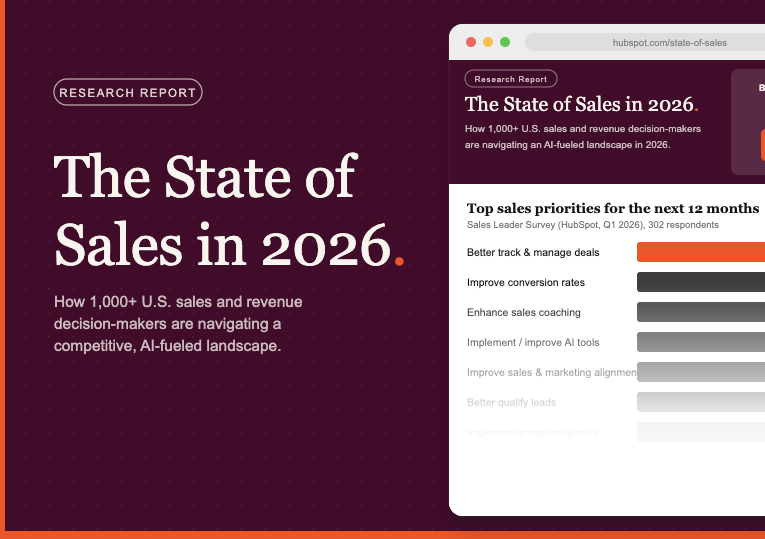
HubSpot's 2026 Sales Trends Report
This in-depth report includes sections, covering:
- How buyers are becoming more self-informed
- How sales teams are using AI and automation
- Adapting to tighter budgets
- And more!
Download Free
All fields are required.
Form not available
You're all set!
Click this link to access this resource at any time.

9
- AI will become table stakes; how well it is used will be the competitive advantage.
- Buyers will increasingly rely on AI to research products before engaging sales.
- A human touch will still seal the deal.
- The invisible buyer will move to the forefront.
- Meaningful interactions and personalization will be vital for long-term success.
- Data will be central to driving engagement.
- AI agents are the next big thing in sales.
- Social selling will play a pivotal role in attracting new leads.
- Localization will triumph.
1. AI will become table stakes; how well it is used will be the competitive advantage
In 2026, AI will cement its position as foundational infrastructure in sales rather than a competitive differentiator. The strategic focus will shift from acquiring AI tools to operationalizing them effectively in everyday tasks such as research, and pipeline management. With that, the advantage for sales teams will increasingly lie in how well they can apply AI insights alongside human judgment, rather than in AI's mere presence.
This is unsurprising, as only 8% of sales reps are not using AI, compared with 92% who are already embracing it. As I was discussing this with , former Head of Sales for the Americas at , she rightly emphasized that “Sellers are going to have to deeply understand AI, the new buying process, and how their product is described by these tools to customize their pitch, cut off objections at the jump, and help prospects to understand your value and offering on a deeper level.”
Kiefer further also rightly stressed the importance of cross-team alignment to ensure AI-driven information accurately reflects the correct positioning. I dug deeper and found data that supports her view: Sales teams aligned with marketing convert % more prospects. This underscores that AI effectiveness depends as much on coordination and strategy as on the technology itself.
2. Buyers will increasingly rely on AI to research products before engaging sales
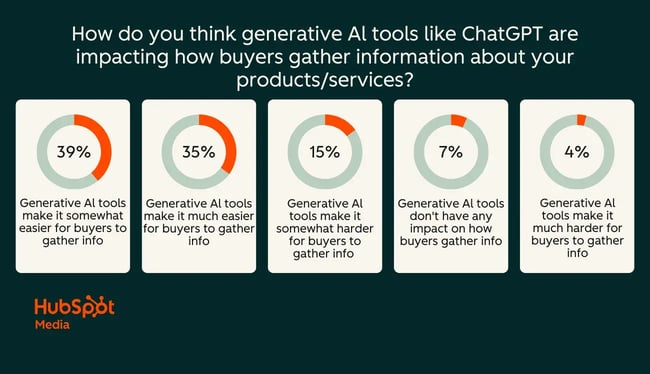
In 2026 and beyond, buyers will depend heavily on AI-powered tools to research, compare, and evaluate solutions before engaging with sales teams. After all, the convenience of AI-generated instant summaries, recommendations, and comparisons is unmatched. Consequently, buyer expectations regarding relevance, context, and preparedness in human interactions will be higher.
Research from 贬耻产厂辫辞迟’蝉 2025 sales trends report confirms that 74% of sellers are seeing that AI tools make it easier for buyers to gather information about their products or services.
further outlines that retail sites saw a 1,300% increase in traffic from AI-powered chatbots, with Cyber Monday seeing 1,950% YoY growth, underscoring the dramatic rise in AI-driven buyer research.
As I discussed this with , Chief Revenue Officer at , she emphasized the importance of aligning sales processes with buyers' increasing use of AI. She explained, “It pays to be AI-optimized. With an overwhelming volume of products and services available digitally, AI-enabled experiences will mean quicker and more accurate decision-making for customers, based on their inputs.”
In this light, Grech advised stepping into the buyer’s shoes to understand their AI adoption during the sales process: In her words, it helps to think: “How are consumers using AI tools going to discover what you’re selling? How will you use AI in your business to help improve efficiency and make the right decisions?”
3. A human touch will still seal the deal.
While AI increasingly supports research and workflow automation, human interaction will continue to remain the decisive factor in closing sales. Empathy, relationship-building, and the ability to read context will be essential capabilities that AI still cannot fully replicate. This will render skilled sales professionals critical to finalizing deals and maintaining strong business relationships in the future of sales.
Data underscores this: % salespeople believe that building buyer confidence is where they can add value, while % believe their value lies in addressing buyers’ emotions. Furthermore, 87% of sales managers report that in-person meetings lead to stronger business relationships, highlighting that buyers continue to value authentic, human engagement alongside technology-enabled interactions.
, chief revenue officer at , summarizes this complementary role of AI and human skill beautifully. Her exact words were, “Sales professionals remain crucial to the customer sales flow. AI’s analysis of the customer journey can help sales professionals do what they do best — to bring a deft human touch to connect with customers and prospects at the right time, with the right information in the right way.”
She adds: “AI [tools] allow salespeople to be human — to really collect on relevant topics, at a relevant time, enabling them to spend their time more effectively.” I echo her thoughts. In fact, I’ve observed that the best salespeople who continuosly hone skills such as relationship-building and closing techniques shine as this helps them provide prospects with the empathy and understanding that AI lacks.
4. The invisible buyer will move to the forefront.
Sales cycles will be increasingly influenced by multiple stakeholders, many of whom will remain “invisible” to the frontline sales rep. Thus, sales success will require identifying all decision-makers and influencers, addressing their unique concerns, and empowering internal champions to advocate for solutions within the organization.
According to , the number of stakeholders in typical deals now ranges from 5 to 11. Furthermore, % of reps report that deals fall through because they cannot secure approval from key decision-makers.
As I discussed the rising complexity of buying committees with , Co-Founder and COO of , he suggested that to counter this problem, sales material and proposals must account for the invisible decision-makers and prepare champions for the internal sell.
In Tanner’s words, “Behind the scenes, sellers need to identify hidden decision-makers, understand whether there is true interest in a deal, and ruthlessly prioritize. In this age, it’s critical that reps spend their time and energy wisely.”
Implementing this is easy with a CRM like which simplifies stakeholder mapping and interaction tracking and ensures the right messages reach every key decision-maker.
5. Meaningful interactions and personalization will be vital for long-term success.
Moving forward, buyers will expect highly personalized engagement at every touchpoint. Generic outreach and one-size-fits-all approaches will become increasingly ineffective, as prospects prioritize relevance, responsiveness, and tailored experiences over volume. Thus, sales teams must focus on discovery, uncover buyer pain points, and tailor demos and pitches to build immediate buy-in and demonstrate ROI.
贬耻产厂辫辞迟’蝉 Sales Trends survey confirms the bar is going higher. It shows that % of sellers lost prospects from deals because the sales process wasn’t personalized enough. Thus, providing prospects and customers with a highly customized experience is what will drive growth for companies.
Kiefer logically explains the why behind this trend. She says, “Because of last year’s slowdown in tech buying, sellers got into the behavior of pushing bundles or one-size-fits-all solutions. Buyers now have pressure fatigue and are desperate for a personalized and custom experience that fits their needs in today's market.”
, Sales Director at , also shared her experience: “As we dive deeper into our customer data, we’ve seen how much people respond to a shopping experience that feels tailored to them. It’s not just about showing them products they might like, it’s about anticipating their needs before they even ask.”
In sync, I’ve read reports from suggesting that people are increasingly willing to share personal data to receive relevant offers, with personalization now valued 20% more by Gen Xers and 18% more by Millennials than in prior years. Therefore, I’m now a big advocate of personalizing sales.
I’ve been using extensively to research prospects and even quickly. In addition, I extensively rely on the features in to combine AI insights with a personal touch to create highly relevant, timely engagement. However, I’d like you to remember that while AI can streamline your research and sequence creation, ultimate success will depend on applying judgment and empathy to guide the conversation.
6. Data will be central to driving engagement.
Moving forward, as buyer behavior becomes more complex, data will remain central to guiding sales engagement, enabling teams to make informed decisions, measure effectiveness, and optimize performance. Well-analyzed data will differentiate high-performing reps from the rest.
I’ve found research demonstrating the impact of data-driven insights. Mintel, for instance, reported a when Gong’s AI algorithms analyzed call recordings and identified areas for improvement.
In my view, to make the most of this future sales trend, a good starting point is to leverage CRM analytics to track every interaction and build cross-team dashboards to understand lead quality, performance metrics, and revenue-driving activities.
I’ve personally used to centralize and synchronize CRM data and found it significantly simplifies generating actionable insights, identifying trends, and measuring sales outcomes. In fact, pairing this and has helped me ensure that analytics directly inform prospect research, outreach personalization, and engagement strategy.
7. AI agents are the next big thing in sales.
AI agents will become a focal point of the sales ecosystem. They will be widely instrumental in automating routine customer interactions and supporting human reps in complex decision-making. These agents will handle tasks ranging from customer inquiries to order management, freeing sales teams to focus on strategic relationship-building and high-value conversations.
Research confirms that the adoption of AI agents is accelerating rapidly. reports that 82% of executives from large enterprises plan to integrate AI agents within the next three years. Among the different types, customer-facing AI agents hold the top priority, according to study.
8. Social selling will play a pivotal role in attracting new leads.
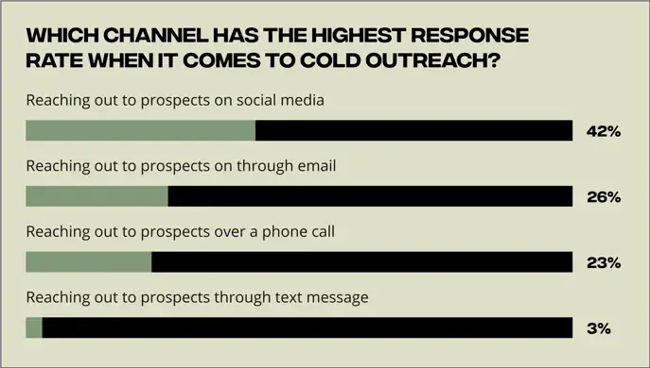
Social selling will become integral to generating and nurturing leads, integrating data-driven insights with real-time digital interactions. After all, shows that social media now delivers 42% response rates — nearly double the 26% response rate of email. Furthermore, 35% of reps say their highest-quality leads come from social channels.
As I was discussing these numbers with former Director of Growth at , he shared that combining social selling with CRM and intent data has driven measurable results for them.
He said, “Sales teams using integrated social selling and CRM platforms are closing deals 45% faster than those using traditional methods. Companies that combine intent data with automated lead scoring experience 3x better conversion rates, suggesting this will become the new normal for B2B sales.”
My two cents are that if your salespeople and stakeholders aren’t on social media like LinkedIn, it’s better to either develop a solid social selling strategy right away or hire an agency to get started. For efficiency, it’s best to use these platforms alongside CRM systems such as to engage prospects in a contextually relevant way, increasing conversion rates and shortening sales cycles.
9. Localization will triumph
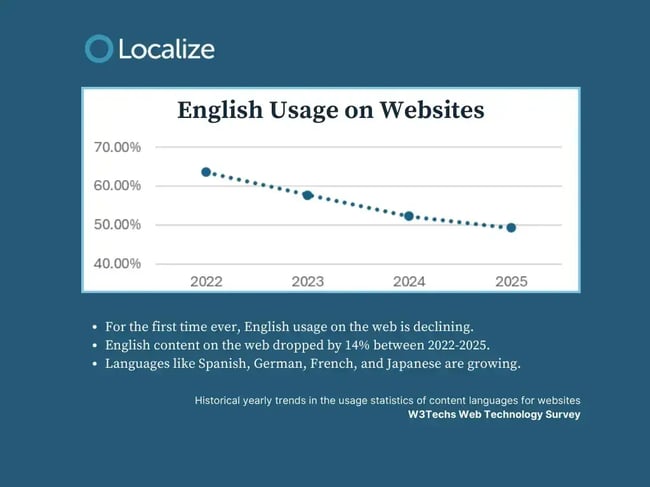
In the future of sales, localization of selling efforts will outweigh globalization in driving revenue growth. After all, today’s buyers increasingly respond to content and experiences tailored to their language and cultural context. Thus, companies that adapt their messaging, pricing, and website experience to local markets will see higher engagement and conversion rates, while cookie-cutter global strategies will underperform.
Research supports this. Between 2022 and 2025, English content on websites declined by %, while Spanish, German, Japanese, and French content increased. Chargebee’s analysis of 6,452 SaaS companies worldwide found that even minor website localization, such as adjusting currency and language, drove nearly % growth. No surprise that use AI to translate sales materials into other languages
In line with this, , CEO of , added: “Europe's B2B markets are exploding, but cookie-cutter strategies backfire. Winners invest in local talent and adapt messaging to cultural nuances. Smith shared from his experience: “When we stopped treating Germany like France or Italy like Spain, our engagement rates jumped. Local insights beat global assumptions every time.”
I’ve observed that HubSpot exemplifies this approach, maintaining localized content in five languages — German, French, Japanese, Spanish, and Portuguese — supported by a 30-person localization team and LLMs to accelerate content adaptation.
How Sales Jobs Could Change in the Next Decade
As sales evolve rapidly, the nature of sales roles will also shift. Moving forward, AI, remote work, evolving buyer expectations, and the need for greater skills will shape sales roles.
The following section expands on how jobs would change, along with examples and practical actions for sales professionals and leaders:
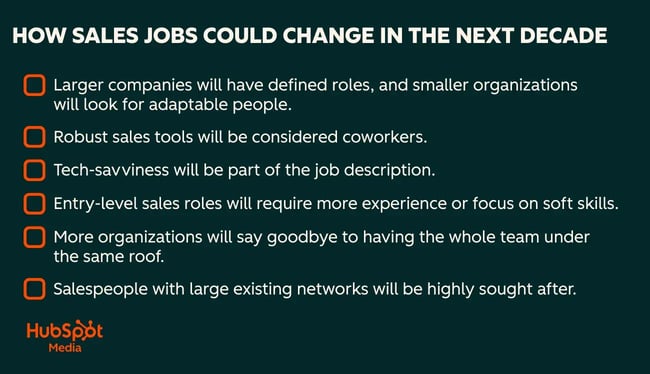
1. Sales roles will be split between specialization and adaptability.
Specialization will continue. However, adaptability will emerge as an increasingly important skill in the sales role. According to the report, adaptability now ranks among the top abilities globally, signaling a structural shift in how sales teams will be built.
In the short to medium term, larger organizations will likely create more specialized sales functions such as solution engineers, AI sales operations specialists, or AI adoption liaisons. At the same time, smaller companies will increasingly seek versatile salespeople who can manage multiple responsibilities across the revenue lifecycle.
Example:A Fortune 500 SaaS company may hire separate specialists for CRM administration, AI tool optimization, sales enablement, and customer onboarding. In contrast, a startup may combine these responsibilities into a single Revenue Operations or Full-Cycle Sales role.
Next steps for sales teams:
- Sales professionals targeting larger organizations should begin cultivating specialized expertise — such as earning CRM certifications, mastering AI-powered lead scoring, or developing product-specific technical skills.
- Reps working in smaller companies should document and communicate their multi-functional experience across sales, customer success, and automation as a strategic advantage.
2. Sales tools will be treated as collaborators, not just software.
As AI adoption accelerates, sales tools will increasingly function as operational partners rather than passive systems of record. AI-driven platforms will guide decision-making across prospect research, outreach, deal prioritization, and forecasting. Salespeople will need to work on adding value as decision facilitators. This change is already visible and will continue.
Example:
A mid-market sales team now relies on AI to automatically score leads, suggest outreach timing, and generate deal insights — while reps focus on relationship-building and negotiation rather than manual data entry.
Next steps for sales teams:
- Sales leaders must first evaluate whether their tools are fully integrated across marketing, sales, and operations. If not, immediately work on the same.
- Reps should invest time in learning to interpret AI-driven insights, not just in using the tools, to maximize impact.
3. Technical fluency will become a baseline requirement.
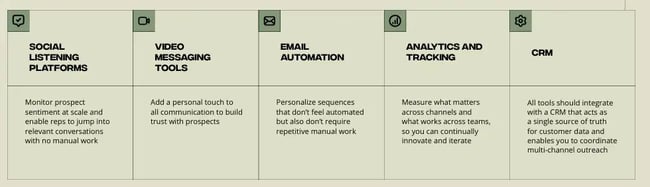
In the short to medium term, technical literacy will no longer be regarded as optional in sales. Proficiency with technologies such as CRM platforms, automation tools, social selling platforms, and generative AI will be considered baseline requirements for most sales roles.
Thus, employers will increasingly expect reps to understand how data flows across these systems and how AI influences prospect engagement and deal outcomes. % of sales directors suggest they hope to increase their investment in team members who can build or implement AI-powered tools.
Example:
A sales rep may be expected to interpret CRM analytics, adjust outreach strategies based on AI recommendations, and collaborate with marketing using shared dashboards rather than relying solely on intuition.
Next steps for sales teams:
- Sales professionals must proactively build technical fluency by gaining hands-on experience with CRMs, automation tools, and AI-powered platforms.
- Organizations should support this shift with ongoing training and clearly defined tech competency benchmarks.
4. Entry-level sales roles will shift toward strategy and soft skills.
As AI automates repetitive tasks such as prospecting, follow-ups, and data enrichment, entry-level sales roles will evolve in the short- to medium-term.
Moving forward, companies will either raise experience requirements or place greater emphasis on soft skills like writing, analytical thinking, and empathy.
Example:
Instead of focusing on cold outreach volume, an entry-level rep may be evaluated on their ability to personalize messaging, analyze buyer pain points, and collaborate with senior sellers during complex deals.
Next steps for sales teams:
- Hiring managers should redefine entry-level criteria to reflect strategic contribution before the next hiring cycle.
- Early-career sales professionals should focus on developing communication, problem-solving, and analytical skills alongside technical proficiency.
5. Distributed and hybrid sales teams will become the default.
Remote and hybrid work models will continue to reshape organizations. With SaaS tools enabling seamless collaboration, companies that are increasingly targeting national and global markets will rely on distributed sales teams.
Example:
A global SaaS company may operate with account executives across regions, supported by centralized sales operations and enablement teams working remotely.
Next steps for sales teams:
- Organizations must invest in robust collaboration tools, standardized processes, and performance metrics that support geographically dispersed teams.
- Sales reps should develop strong written communication and self-management skills to thrive in remote environments.
6. Salespeople with established networks will gain a competitive edge.
As marketing automation and self-serve purchasing continue to mature, the value of sales professionals will increasingly lie in their ability to build trust and navigate complex stakeholder relationships. In the short to medium term, this will make candidates with established professional networks and proven relationship-building capabilities highly sought after.
Example:
A sales rep with an active LinkedIn presence and strong industry connections may generate warmer leads and shorter sales cycles than peers relying solely on inbound demand.
Next steps for salespeople:
- Sales professionals should actively invest in relationship-building through social selling, networking, and long-term account nurturing.
- Organizations should recognize and reward network-driven deal sourcing as a core performance metric.
Frequently Asked Questions
What is the future of sales?
The future of sales is increasingly hybrid and data-driven — combining human relationship skills with powerful automation and AI tools. While AI will continue shaping how buyers research products and how sales teams operate, the human element will remain central to closing deals and building trust. As buyers are becoming more self-informed, sales professionals who harness both technology and empathy will be best positioned to succeed.
Is sales a promising career in 2026?
Yes — sales continues to be a strong career path in 2026, especially for those who embrace modern tools and adapt to industry changes. While technology automates routine tasks, demand for skilled communicators who can interpret insights, build relationships, and drive outcomes remains strong. Furthermore, many companies are still expanding their sales teams even as they adopt AI, indicating that human sales talent remains valued.
What is the future of a sales career?
The future of a sales career will emphasize tech fluency, adaptability, and consultative skills. As AI takes on repetitive or data-heavy tasks, sales professionals will need to focus more on strategic relationship-building, problem-solving, and navigating complex buying cycles.
Thus, job roles may evolve — with hybrid responsibilities or new specializations. However, opportunities will remain, particularly for those who can integrate technology into their workflows and differentiate themselves through emotional intelligence and expertise.
Will AI replace salespeople?
AI will transform aspects of the sales process, but it is not expected to fully replace sales professionals. Research shows that % of sales directors expect to increase their team’s headcount with AI-assisted administrative roles.
AI excels at handling administrative work, lead qualification, and scaling outreach, which increases productivity. However, humans are still essential for building trust, understanding nuanced customer needs, and closing complex deals. Top performers who adopt AI will likely outperform those who don’t, creating a future of AI-augmented rather than AI-replaced sales roles.
Looking ahead
The future of sales is neither purely human nor purely machine — it’s a blend of both. We’re entering a phase in which technology amplifies human capability rather than replaces it.
贬耻产厂辫辞迟’蝉 State of Sales report makes it clear that the highest-performing teams will be those that combine AI-driven insights, cross-functional collaboration, and personalized engagement.
Success will depend on adaptability, technical fluency, and the ability to deliver human value in increasingly complex buying environments.
Are you ready for the future?
Editor's note: This post was originally published in May 2018 and has been updated for clarity and completeness.
HubSpot's 2026 Sales Trends Report
This in-depth report includes sections, covering:
- How buyers are becoming more self-informed
- How sales teams are using AI and automation
- Adapting to tighter budgets
- And more!
Download Free
All fields are required.
Form not available
You're all set!
Click this link to access this resource at any time.
![Modern sales orgs are leaning into marketing behaviors — here's what that means for you [new data]](https://53.fs1.hubspotusercontent-na1.net/hubfs/53/sales-team-marketing-behaviors-1-20251117-5976195.webp)
![Why your sales enablement content needs real-world credibility [new data]](https://53.fs1.hubspotusercontent-na1.net/hubfs/53/sales-enablement-content-credibility-1-20251028-1482008.webp)

.webp)

.png)